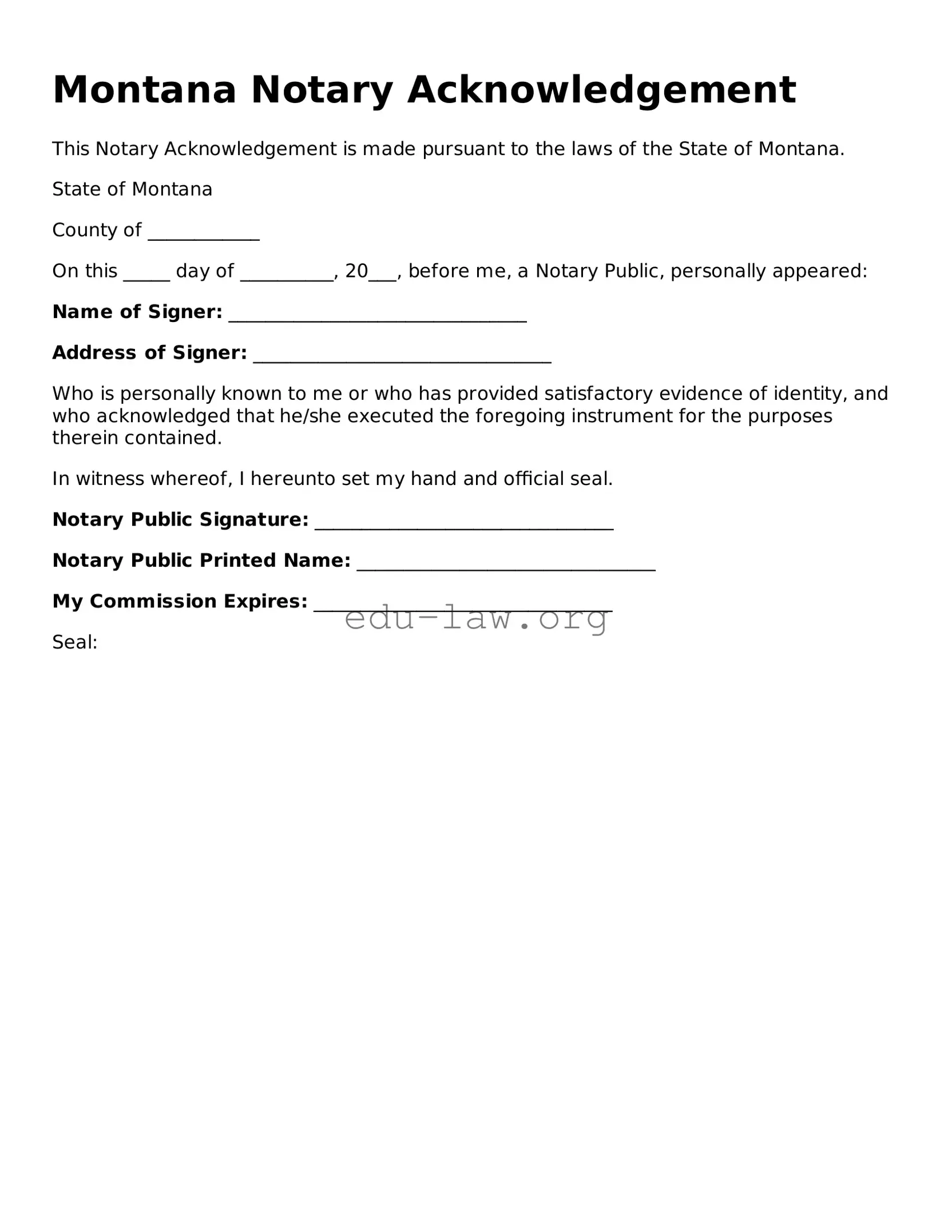
The Montana Notary Acknowledgement form plays a crucial role in the notarization process, ensuring that signatures on important documents are verified and authenticated. This form is used to confirm that the signer appeared before a notary public and acknowledged their signature willingly and without any coercion. It typically includes essential details such as the date of the acknowledgment, the name of the person signing, and the notary's information, including their signature and seal. By utilizing this form, individuals can enhance the credibility of their documents, whether they pertain to real estate transactions, legal agreements, or other formal matters. Understanding the requirements and proper usage of the Montana Notary Acknowledgement form is vital for anyone looking to ensure their documents hold up in legal contexts.
Montana Notary Acknowledgement
This Notary Acknowledgement is made pursuant to the laws of the State of Montana.
State of Montana
County of ____________
On this _____ day of __________, 20___, before me, a Notary Public, personally appeared:
Name of Signer: ________________________________
Address of Signer: ________________________________
Who is personally known to me or who has provided satisfactory evidence of identity, and who acknowledged that he/she executed the foregoing instrument for the purposes therein contained.
In witness whereof, I hereunto set my hand and official seal.
Notary Public Signature: ________________________________
Notary Public Printed Name: ________________________________
My Commission Expires: ________________________________
Seal:
| Fact Name | Description |
|---|---|
| Purpose | The Montana Notary Acknowledgement form is used to verify the identity of a signer and confirm their willingness to sign a document. |
| Governing Law | This form is governed by the Montana Notary Public Act, specifically Title 1, Chapter 5 of the Montana Code Annotated. |
| Signature Requirement | The signer must personally appear before the notary public at the time of the acknowledgment. |
| Notary Seal | A notary public must affix their official seal to the form to validate the acknowledgment. |
| Record Keeping | Notaries are required to maintain a record of all acknowledgments performed, including the details of the signer and the documents involved. |
| Expiration | The acknowledgment does not expire; however, the notary's commission is valid for a specific term, usually four years. |
| Usage | This form is commonly used in real estate transactions, legal documents, and other situations requiring verification of signatures. |
After you have obtained the Montana Notary Acknowledgement form, you are ready to fill it out. Ensure you have the necessary information at hand, as this will streamline the process. Follow these steps carefully to complete the form accurately.
Once you have completed these steps, review the form for accuracy before submitting it or using it as required.
What is a Montana Notary Acknowledgement form?
The Montana Notary Acknowledgement form is a document used to verify that a person has willingly signed a document in the presence of a notary public. This form helps to confirm the identity of the signer and ensures that they understand the contents of the document they are signing.
When do I need to use this form?
You will need to use the Montana Notary Acknowledgement form whenever you are signing important documents that require notarization. This could include contracts, deeds, or any legal documents where proof of signature is necessary. It helps to protect all parties involved by providing a clear record of the signing process.
Who can serve as a notary public in Montana?
In Montana, a notary public must be at least 18 years old, a resident of the state, and must complete the necessary training and application process. Notaries are authorized to perform notarizations, including acknowledging signatures on documents. You can find a notary at banks, law offices, or through online directories.
What information is included in the Notary Acknowledgement form?
The Notary Acknowledgement form typically includes the name of the signer, the date of the acknowledgment, and the signature of the notary public. It may also contain details about the document being signed, ensuring that there is a clear connection between the acknowledgment and the document.
Is there a fee for notarization in Montana?
Yes, notaries in Montana are allowed to charge a fee for their services. The maximum fee varies depending on the type of service provided. It is common for notaries to charge between $5 to $10 for a standard acknowledgment. Be sure to ask about fees before you proceed with the notarization.
How do I find a notary public in Montana?
You can find a notary public in Montana through various means. Check with local banks, law offices, or community centers. Additionally, online search tools and directories can help you locate a notary nearby. It’s important to ensure that the notary is properly commissioned and in good standing.
Failing to include the date of the acknowledgment. It's crucial to record when the document was acknowledged to establish its validity.
Not providing the signer's name clearly. The name must match the one on the identification presented to the notary.
Using an incorrect signature. The signature on the document should match the signer's identification to avoid discrepancies.
Neglecting to check the notary's seal. An illegible or missing seal can render the acknowledgment invalid.
Forgetting to include the notary's name and commission details. This information is essential for the document's authenticity.
Leaving out the jurisdiction where the acknowledgment takes place. This specifies the legal authority under which the notary operates.
Not ensuring the signer is present during the acknowledgment. The notary must witness the signing to validate the process.
Submitting the form without verifying all required information is complete. Double-checking can prevent delays or rejections.
When engaging in legal transactions in Montana, the Notary Acknowledgement form is often accompanied by several other documents. These forms serve various purposes, from establishing identity to facilitating the transfer of property. Below is a list of common documents that may be used alongside the Notary Acknowledgement form.
Each of these documents plays a crucial role in ensuring that legal processes are conducted smoothly and that all parties are protected. Properly executing these forms, including the Notary Acknowledgement, can help mitigate disputes and ensure clarity in legal transactions.
The Montana Notary Acknowledgment form shares similarities with the Affidavit. An affidavit is a written statement confirmed by oath or affirmation, used as evidence in court. Like the acknowledgment form, it requires a notary to verify the identity of the signer and confirm that they are signing willingly. Both documents serve to authenticate the identity of individuals and the legitimacy of their signatures, ensuring that the information provided is accurate and truthful.
Another document similar to the Montana Notary Acknowledgment form is the Power of Attorney. This legal document allows one person to act on behalf of another in legal or financial matters. Just like the acknowledgment form, a Power of Attorney must be notarized to ensure that the principal's identity is confirmed and that they are granting authority willingly. Both documents protect against fraud and provide a clear record of consent.
The Deed is also comparable to the Montana Notary Acknowledgment form. A deed transfers ownership of real property from one party to another. Notarization is essential in this process to verify the identities of the parties involved and confirm that the transfer is conducted voluntarily. Both documents require a notary to ensure that the transaction is legitimate and legally binding.
The Bill of Sale shares characteristics with the Montana Notary Acknowledgment form as well. This document records the sale of personal property, such as vehicles or equipment. Notarization can add an extra layer of authenticity, confirming that both the buyer and seller have agreed to the terms. Similar to the acknowledgment form, it provides a legal record of the transaction, protecting both parties involved.
Another document to consider is the Warranty Deed. This legal instrument guarantees that the seller holds clear title to the property being sold and has the right to transfer it. Like the Montana Notary Acknowledgment form, a Warranty Deed must be notarized to ensure that the identities of the parties are verified and that the transaction is conducted properly. Both documents serve to protect the interests of the parties involved in a property transaction.
The Trust Agreement is another document that resembles the Montana Notary Acknowledgment form. A Trust Agreement outlines the terms under which assets are held for the benefit of another party. Notarization is often required to validate the identities of the parties involved and to confirm that they are entering into the agreement willingly. This helps to prevent disputes and ensures that the terms are enforceable.
Lastly, the Consent Form is similar to the Montana Notary Acknowledgment form. This document is used to obtain permission for various actions, such as medical procedures or participation in research studies. Notarization can be used to verify the identity of the person providing consent, ensuring that they understand what they are agreeing to. Both documents serve to protect individuals by ensuring that their consent is informed and voluntary.
When filling out the Montana Notary Acknowledgment form, it is essential to follow certain guidelines to ensure accuracy and compliance. Here are five important do's and don'ts to consider:
Adhering to these guidelines will help ensure that the notarization process is valid and recognized by the state of Montana.
Understanding the Montana Notary Acknowledgement form is essential for those who engage in notarization. However, several misconceptions can lead to confusion. Here are four common misconceptions:
This is not true. A notary does not need to have personal knowledge of the signer. Instead, the notary must verify the identity of the signer through acceptable forms of identification.
Notaries are not authorized to give legal advice. Their role is to witness the signing of documents and ensure that the signer understands the document they are signing.
While related, these terms are not interchangeable. A notary acknowledgment is a specific type of notarization that confirms a signer’s identity and their intent to sign a document.
In Montana, a notary acknowledgment can be used for a variety of documents, not just specific ones. It is often required for documents that need to be recorded or that require a formal verification of the signer's identity.
When filling out and using the Montana Notary Acknowledgement form, keep the following key points in mind: