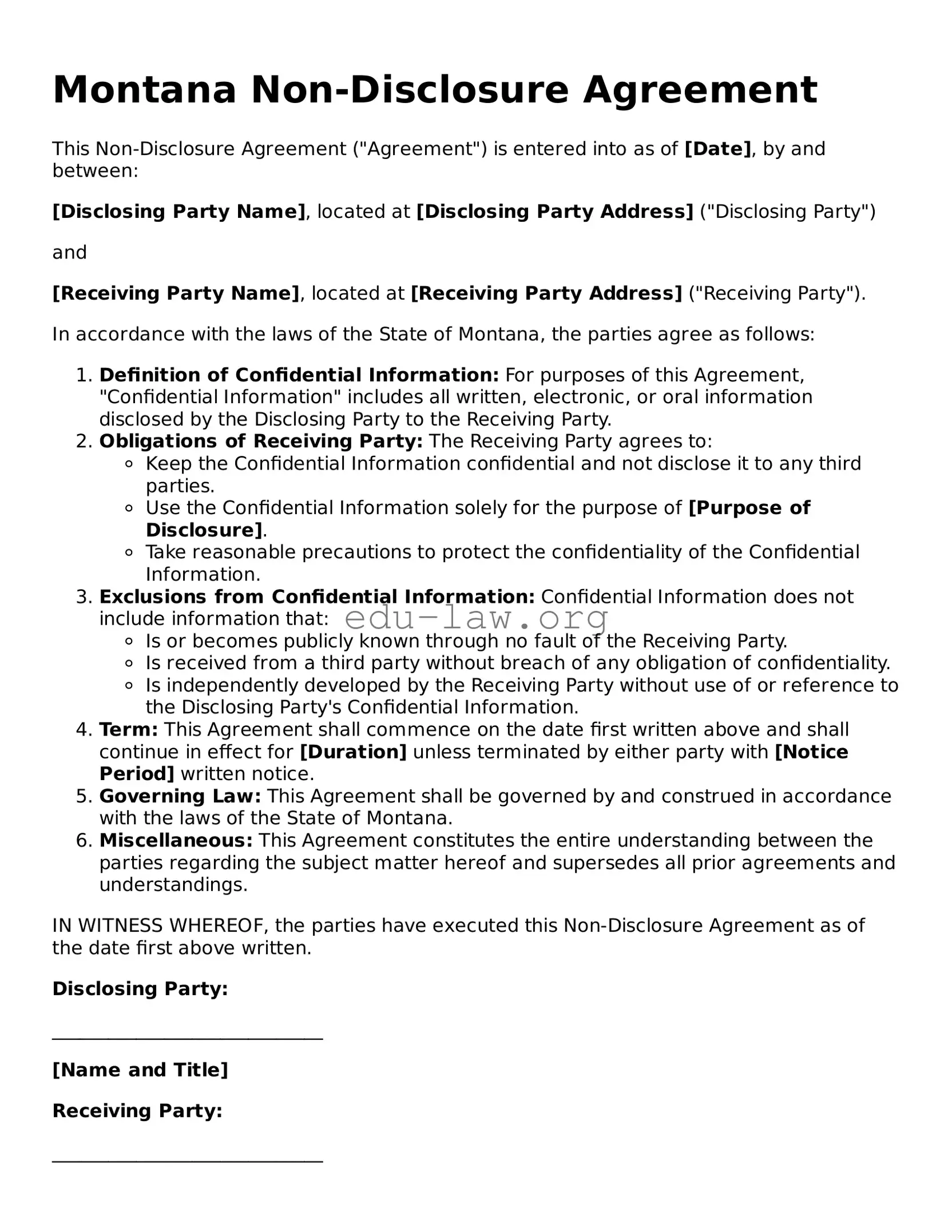
The Montana Non-disclosure Agreement (NDA) form serves as a crucial tool for individuals and businesses seeking to protect sensitive information. This legal document outlines the obligations of parties involved regarding the confidentiality of shared information. It typically includes key elements such as the definition of confidential information, the duration of the confidentiality obligation, and the specific purposes for which the information can be used. Additionally, the NDA may specify any exceptions to confidentiality, such as information that is publicly available or independently developed. Parties must also consider the consequences of breaching the agreement, which can include legal remedies and financial penalties. By clearly defining the terms and expectations, the Montana NDA helps to foster trust and safeguard proprietary information in various business dealings.
Montana Non-Disclosure Agreement
This Non-Disclosure Agreement ("Agreement") is entered into as of [Date], by and between:
[Disclosing Party Name], located at [Disclosing Party Address] ("Disclosing Party")
and
[Receiving Party Name], located at [Receiving Party Address] ("Receiving Party").
In accordance with the laws of the State of Montana, the parties agree as follows:
IN WITNESS WHEREOF, the parties have executed this Non-Disclosure Agreement as of the date first above written.
Disclosing Party:
_____________________________
[Name and Title]
Receiving Party:
_____________________________
[Name and Title]
| Fact Name | Description |
|---|---|
| Purpose | The Montana Non-disclosure Agreement (NDA) is used to protect confidential information shared between parties. |
| Governing Law | The NDA is governed by the laws of the State of Montana. |
| Parties Involved | The agreement typically involves at least two parties: the disclosing party and the receiving party. |
| Definition of Confidential Information | Confidential information may include trade secrets, business plans, customer lists, and proprietary data. |
| Duration | The NDA should specify the duration of confidentiality obligations, often ranging from one to five years. |
| Permitted Disclosures | The NDA may outline circumstances under which confidential information can be disclosed, such as legal requirements. |
| Consequences of Breach | Breaching the NDA can result in legal action, including claims for damages and injunctive relief. |
| Modification and Termination | The NDA should include provisions for modification and termination, detailing how changes can be made. |
| Signatures | Both parties must sign the NDA for it to be legally binding, indicating their agreement to the terms. |
Once you have the Montana Non-disclosure Agreement form in front of you, it’s time to fill it out carefully. Ensure you have all necessary information at hand. This will help you complete the form accurately and efficiently.
After completing the form, review it for accuracy. Make sure all required fields are filled out and that both parties have signed. Once verified, you can distribute copies to all involved parties for their records.
What is a Montana Non-disclosure Agreement (NDA)?
A Montana Non-disclosure Agreement is a legal contract designed to protect confidential information shared between parties. This agreement ensures that sensitive information, such as business secrets or proprietary data, remains confidential. It is commonly used in business relationships, partnerships, or any situation where sensitive information is exchanged. By signing an NDA, parties agree not to disclose the information to unauthorized individuals or entities.
Who should use a Montana NDA?
Any individual or business that plans to share confidential information should consider using a Montana NDA. This includes entrepreneurs discussing business ideas, companies sharing trade secrets, or employers revealing sensitive employee information. Protecting confidential information is crucial in maintaining a competitive edge and ensuring trust in professional relationships.
What are the key components of a Montana NDA?
A Montana NDA typically includes several important elements. First, it defines what constitutes confidential information. Second, it outlines the obligations of the parties involved regarding the use and protection of this information. Third, it specifies the duration of confidentiality, which indicates how long the information must remain protected. Lastly, it may include terms regarding the return or destruction of confidential materials upon termination of the agreement.
What happens if someone breaches the NDA?
If a party breaches the NDA, the injured party may seek legal remedies. This can include monetary damages, injunctive relief, or both. The specific consequences depend on the terms outlined in the agreement and the nature of the breach. It’s important to note that legal action can be costly and time-consuming, so prevention through clear communication and proper agreements is always advisable.
Failing to clearly define confidential information. It's crucial to specify what information is considered confidential to avoid misunderstandings.
Not identifying all parties involved. Ensure that all individuals or entities who will be bound by the agreement are named.
Leaving out the duration of the agreement. Specify how long the confidentiality obligations will last.
Using vague language. Be precise in wording to prevent ambiguity regarding obligations and rights.
Neglecting to include the purpose of sharing the information. Clearly state why the confidential information is being shared.
Not considering exceptions to confidentiality. Include any situations where disclosure is permitted, such as legal requirements.
Failing to outline the consequences of breach. Clearly describe what happens if the agreement is violated.
Not having the agreement reviewed by a legal professional. A legal expert can help ensure the document is enforceable.
Overlooking the need for signatures. Ensure that all parties sign and date the agreement to make it valid.
Using outdated templates. Always use the most current version of the Non-disclosure Agreement to reflect any changes in law or practice.
When entering into a Non-disclosure Agreement (NDA) in Montana, several other forms and documents may be relevant. These documents help clarify the terms of the agreement and protect the interests of all parties involved. Below is a list of commonly used forms that complement an NDA.
These documents serve as essential tools in safeguarding sensitive information and establishing clear expectations among parties. Understanding their purpose can help ensure that your interests are well protected.
The Montana Non-disclosure Agreement (NDA) shares similarities with the Confidentiality Agreement. Both documents are designed to protect sensitive information from being disclosed to unauthorized parties. They establish a legal obligation for the receiving party to keep certain information confidential. While the terms may vary slightly, the core purpose remains the same: to safeguard trade secrets, business strategies, and proprietary information. This agreement is often used in business transactions, ensuring that critical information is not leaked during negotiations or partnerships.
Another document comparable to the Montana NDA is the Non-Compete Agreement. While its primary focus is on restricting an individual's ability to work in competing businesses after leaving a company, it often includes clauses about confidentiality. This means that the individual must not disclose any sensitive information learned during their employment. Both agreements aim to protect a company’s interests, but the Non-Compete Agreement extends beyond confidentiality to limit future employment opportunities in similar fields.
The Mutual Non-disclosure Agreement is also similar to the Montana NDA. This type of agreement is used when both parties share confidential information with one another. Each party agrees to protect the other’s sensitive information, creating a balanced approach to confidentiality. Like the Montana NDA, it outlines what constitutes confidential information and the obligations of each party, fostering trust in collaborative efforts or joint ventures.
In addition, the Proprietary Information Agreement bears resemblance to the Montana NDA. This document focuses specifically on proprietary information, which refers to unique data or processes that give a business a competitive edge. Like the NDA, it sets clear expectations regarding the handling of such information. Both agreements emphasize the importance of confidentiality and the potential consequences of unauthorized disclosure.
The Employment Agreement often includes a confidentiality clause, making it similar to the Montana NDA. This clause requires employees to keep certain information private during and after their employment. While the Employment Agreement encompasses a broader range of terms related to the employment relationship, the confidentiality aspect aligns closely with the objectives of the NDA, ensuring that sensitive company information remains protected.
Lastly, the Licensing Agreement can be likened to the Montana NDA in that it often contains confidentiality provisions. When one party licenses its intellectual property to another, it may involve sharing sensitive information. The confidentiality clauses in a Licensing Agreement serve to protect this information from being disclosed or misused. Both documents aim to maintain the integrity of proprietary information while allowing for collaboration or use of that information under specified conditions.
When filling out a Non-disclosure Agreement (NDA) in Montana, it’s crucial to approach the task with care and attention to detail. Here are some important dos and don'ts to keep in mind.
By following these guidelines, you can help ensure that your Non-disclosure Agreement is effective and legally sound. Remember, protecting sensitive information is vital for both parties involved.
Understanding the Montana Non-disclosure Agreement (NDA) is essential for anyone looking to protect sensitive information. However, several misconceptions often arise regarding this legal document. Here are eight common misunderstandings:
NDAs are only for big businesses. Many people believe that only large corporations need NDAs. In reality, any individual or small business can benefit from using an NDA to protect their proprietary information.
All NDAs are the same. This is far from the truth. NDAs can vary significantly in terms of language, scope, and enforceability. It’s important to tailor the agreement to meet specific needs.
Signing an NDA means you can’t talk to anyone. While NDAs do restrict sharing information, they don’t completely silence individuals. Most agreements allow for certain disclosures, such as to legal representatives or in cases of legal obligation.
NDAs are only useful during negotiations. Some believe that NDAs are only necessary before a deal is struck. In fact, they can also protect information shared after an agreement is made, ensuring ongoing confidentiality.
Verbal agreements are sufficient. Many think that a handshake or a verbal promise is enough to protect sensitive information. However, without a written NDA, it can be challenging to prove what was agreed upon.
NDAs are enforceable in any situation. Not all NDAs are enforceable. Courts may not uphold agreements that are overly broad or vague. Clarity and specificity are key to ensuring enforceability.
Once signed, an NDA lasts forever. Many assume that NDAs are permanent. However, most agreements specify a time frame for how long the information must remain confidential, after which the obligations may no longer apply.
Only one party needs to sign the NDA. Some people think that only the party receiving the information needs to sign the NDA. In many cases, both parties should sign to protect their respective interests.
By addressing these misconceptions, individuals and businesses can better navigate the complexities of NDAs and ensure that their sensitive information remains protected.
When filling out and using the Montana Non-disclosure Agreement (NDA) form, consider the following key takeaways: