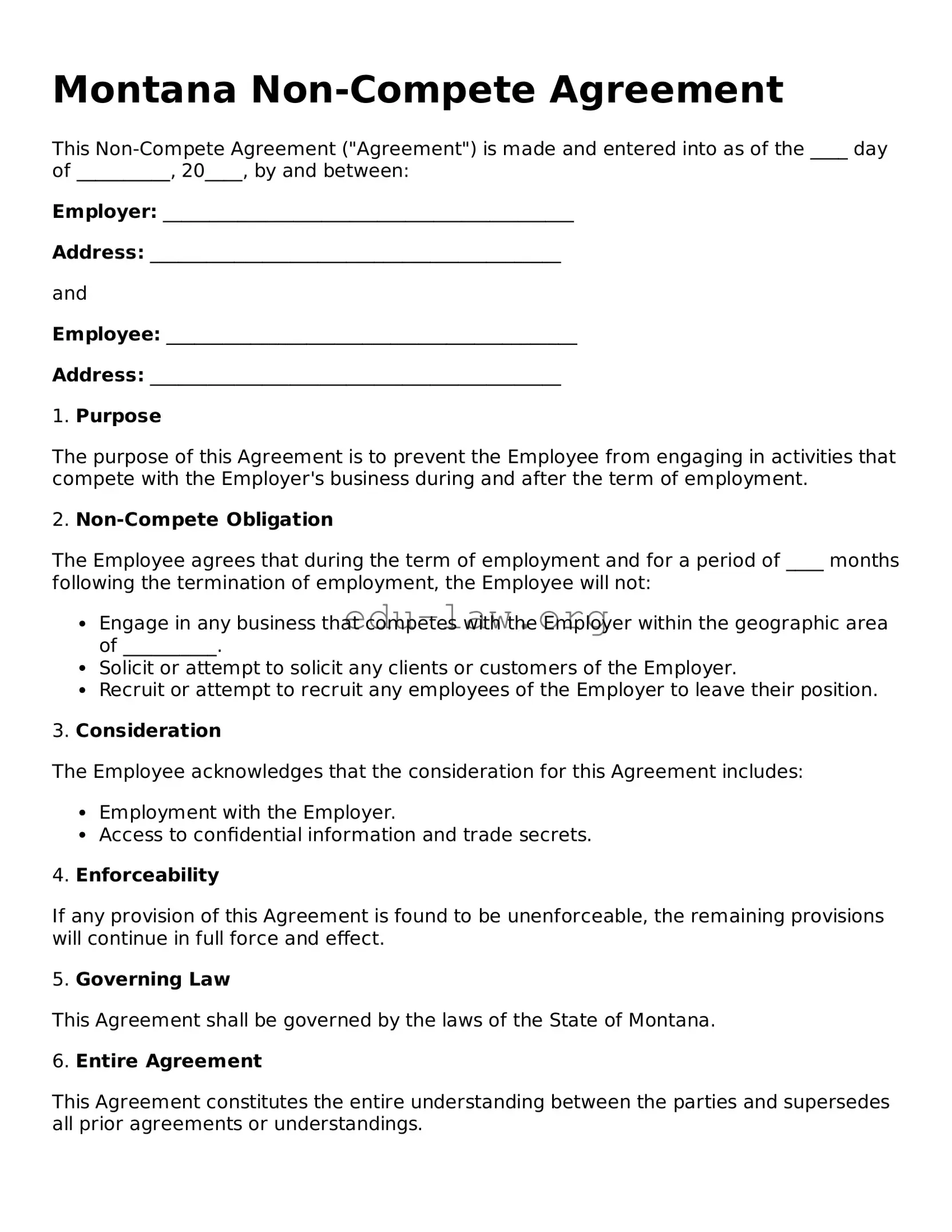
The Montana Non-compete Agreement form serves as a crucial tool for employers and employees navigating the complexities of post-employment restrictions. This form outlines the terms under which an employee agrees not to engage in similar business activities that could compete with their employer after leaving the company. Key aspects of the form include the duration of the non-compete period, the geographical scope of the restriction, and the specific activities that are prohibited. It is essential for both parties to understand that the enforceability of such agreements can hinge on reasonableness in terms of time and space. Moreover, Montana law emphasizes the importance of mutual consideration, meaning that both the employer and employee should receive something of value in exchange for the agreement. As businesses increasingly rely on these agreements to protect their interests, understanding the nuances of the Montana Non-compete Agreement form becomes imperative for anyone entering into an employment relationship in the state.
Montana Non-Compete Agreement
This Non-Compete Agreement ("Agreement") is made and entered into as of the ____ day of __________, 20____, by and between:
Employer: ____________________________________________
Address: ____________________________________________
and
Employee: ____________________________________________
Address: ____________________________________________
1. Purpose
The purpose of this Agreement is to prevent the Employee from engaging in activities that compete with the Employer's business during and after the term of employment.
2. Non-Compete Obligation
The Employee agrees that during the term of employment and for a period of ____ months following the termination of employment, the Employee will not:
3. Consideration
The Employee acknowledges that the consideration for this Agreement includes:
4. Enforceability
If any provision of this Agreement is found to be unenforceable, the remaining provisions will continue in full force and effect.
5. Governing Law
This Agreement shall be governed by the laws of the State of Montana.
6. Entire Agreement
This Agreement constitutes the entire understanding between the parties and supersedes all prior agreements or understandings.
IN WITNESS WHEREOF, the parties have executed this Non-Compete Agreement as of the date first above written.
Employer Signature: _______________________________
Date: ___________________
Employee Signature: _______________________________
Date: ___________________
| Fact Name | Description |
|---|---|
| Governing Law | The Montana Non-compete Agreement is governed by Montana state law, specifically Title 28, Chapter 2 of the Montana Code Annotated. |
| Enforceability | In Montana, non-compete agreements are generally enforceable but must meet specific criteria to be considered valid. |
| Reasonableness | The agreement must be reasonable in terms of time, geographic area, and the scope of activity it restricts. |
| Duration Limit | Montana law does not specify a maximum duration for non-compete agreements, but shorter durations are often favored. |
| Geographic Limit | Non-compete agreements should have a clearly defined geographic scope that is not overly broad. |
| Consideration Requirement | For a non-compete agreement to be enforceable, there must be adequate consideration, such as employment or access to confidential information. |
| Employee Protections | Montana law prohibits non-compete agreements for certain professions, including those in the medical field and certain public employees. |
| Judicial Scrutiny | Montana courts tend to scrutinize non-compete agreements closely, ensuring they protect legitimate business interests without unduly restricting employees. |
| Modification and Severability | If a court finds a portion of the agreement unenforceable, it may modify the terms or sever the invalid part while upholding the rest. |
| Written Requirement | Non-compete agreements must be in writing to be enforceable, ensuring clarity and mutual understanding between parties. |
Completing the Montana Non-compete Agreement form involves several straightforward steps. Once you have filled out the form, it will need to be reviewed and signed by both parties to ensure mutual understanding and agreement. Below are the steps to guide you through the process of filling out the form.
What is a Non-compete Agreement in Montana?
A Non-compete Agreement is a contract between an employer and an employee. It restricts the employee from working for competitors or starting a competing business for a specific period after leaving the company. In Montana, these agreements must be reasonable in scope, duration, and geographic area to be enforceable.
Are Non-compete Agreements enforceable in Montana?
Yes, Non-compete Agreements can be enforceable in Montana, but they are subject to certain limitations. The agreement must protect legitimate business interests and should not impose undue hardship on the employee. Courts will evaluate the reasonableness of the terms before enforcing the agreement.
How long can a Non-compete Agreement last in Montana?
The duration of a Non-compete Agreement in Montana should be reasonable. Typically, agreements lasting one to two years are more likely to be upheld. However, longer durations may be scrutinized, especially if they restrict the employee's ability to find work.
What happens if I violate a Non-compete Agreement?
If you violate a Non-compete Agreement, your former employer may take legal action against you. This could include seeking an injunction to prevent you from working for a competitor or pursuing damages for any losses incurred due to the violation. It is important to review the specific terms of your agreement and consult with a legal professional if you have concerns.
Can I negotiate the terms of a Non-compete Agreement?
Yes, you can negotiate the terms of a Non-compete Agreement before signing it. It is advisable to discuss any concerns with your employer. You may want to adjust the duration, geographic scope, or specific restrictions to ensure they are fair and reasonable. Always consider seeking legal advice during this process to protect your interests.
Incomplete Information: Many individuals fail to fill out all required fields. Leaving sections blank can lead to delays or even invalidation of the agreement.
Incorrect Dates: Entering the wrong dates can create confusion regarding the duration of the non-compete clause. Ensure that all dates are accurate and clearly stated.
Ambiguous Language: Using vague terms or phrases can lead to misinterpretation. It's important to be clear and specific about the terms of the agreement.
Not Understanding the Scope: Some individuals do not fully grasp the geographical area covered by the agreement. It's essential to define the scope clearly to avoid future disputes.
Omitting Consideration: Failing to state what the employee will receive in return for signing the agreement can render it unenforceable. Always include this critical element.
Ignoring State Laws: Each state has its own regulations regarding non-compete agreements. Ignoring Montana's specific laws can lead to unenforceable clauses.
Not Consulting Legal Counsel: Many people skip the step of having a lawyer review the agreement. Legal advice can help ensure that the terms are fair and enforceable.
Forgetting to Sign: It may seem simple, but some individuals forget to sign the agreement. Without a signature, the document is not valid.
When entering into a Non-compete Agreement in Montana, several other documents and forms may be useful or necessary to ensure clarity and legality in the agreement. Below is a list of commonly used documents that can complement the Non-compete Agreement, each serving a unique purpose.
These documents play a crucial role in defining the terms of employment and protecting the interests of both the employer and the employee. It is essential to consider each of these forms in conjunction with the Non-compete Agreement to create a comprehensive legal framework that supports a fair and transparent working relationship.
The Montana Non-compete Agreement form shares similarities with the Non-disclosure Agreement (NDA). Both documents aim to protect sensitive information. An NDA prevents employees from sharing proprietary information, trade secrets, or confidential data with third parties. While the Non-compete Agreement restricts an employee's ability to work in a competing business after leaving, the NDA focuses primarily on safeguarding information during and after employment.
Another similar document is the Employment Contract. An Employment Contract outlines the terms of employment, including duties, compensation, and duration. Like the Non-compete Agreement, it can include clauses that restrict an employee's future employment options. Both documents aim to clarify expectations and protect the interests of the employer, although the Employment Contract is broader in scope.
The Confidentiality Agreement is also akin to the Non-compete Agreement. This document specifically addresses the handling of confidential information, similar to an NDA. However, it may also include non-compete clauses. Both agreements are designed to prevent employees from disclosing sensitive information or engaging in competitive practices that could harm the employer's business.
The Proprietary Information Agreement (PIA) is another document that aligns with the Non-compete Agreement. A PIA ensures that employees do not disclose proprietary information obtained during their employment. While the Non-compete Agreement restricts future employment opportunities, the PIA focuses on the protection of specific information that is vital to the company's success.
The Non-solicitation Agreement is similar in that it restricts an employee's ability to solicit clients or employees after leaving a company. This agreement protects business relationships and prevents former employees from taking clients or talent to a competing business. Both the Non-solicitation Agreement and the Non-compete Agreement serve to safeguard a company's interests in the competitive market.
The Release of Claims form can also be compared to the Non-compete Agreement. This document is often signed when an employee leaves a company, waiving the right to pursue legal claims against the employer. While it does not directly restrict future employment, it can include non-compete clauses, thereby limiting the employee's options after departure.
The Severance Agreement is another related document. This agreement is typically offered to employees who are laid off or terminated. It may include a Non-compete clause as part of the severance package. Like the Non-compete Agreement, it aims to protect the employer's interests while providing some form of compensation to the departing employee.
The Partnership Agreement can also bear similarities to the Non-compete Agreement, especially in the context of business partners. Such agreements often contain clauses that restrict partners from starting competing businesses or soliciting clients after the partnership ends. Both documents are designed to maintain the integrity and competitive edge of the business.
Finally, the Independent Contractor Agreement can resemble the Non-compete Agreement in its use of non-compete clauses. This document outlines the terms of work for independent contractors, including any restrictions on competing activities after the contract ends. Both agreements aim to protect the business's interests while defining the relationship between the employer and the worker.
When filling out the Montana Non-compete Agreement form, it is essential to approach the process with care and attention to detail. Below is a list of things you should and shouldn't do to ensure that the agreement is completed correctly and effectively.
By following these guidelines, you can help ensure that the Non-compete Agreement is filled out correctly and serves its intended purpose.
Non-compete agreements can often be misunderstood. Here are eight common misconceptions about the Montana Non-compete Agreement form, along with clarifications to help you navigate this topic more effectively.
This is not true. In Montana, non-compete agreements are only enforceable under specific conditions. They must be reasonable in duration and geographic scope, and they cannot impose undue hardship on the employee.
Not every employee must sign one. Employers may choose to require non-compete agreements for certain positions, especially those involving sensitive information or trade secrets, but it is not mandatory for all roles.
This is a misconception. Employees can challenge the enforceability of a non-compete agreement in court if they believe it is overly restrictive or unfair.
In Montana, this is incorrect. Non-compete agreements must have a reasonable time limit. Typically, a duration of one to two years is considered acceptable, depending on the circumstances.
These are different legal documents. A non-compete agreement restricts an employee from working for competitors after leaving a job, while a non-disclosure agreement protects confidential information during and after employment.
This is misleading. While a non-compete agreement may limit where you can work for a certain period, it does not completely bar you from working in your industry. It simply restricts you from working with specific competitors.
This is not accurate. Employers must demonstrate that enforcing the agreement is necessary to protect legitimate business interests, such as trade secrets or client relationships.
This is incorrect. Non-compete laws vary significantly from state to state. What is enforceable in one state may not be enforceable in Montana, making it essential to understand local laws.
When dealing with the Montana Non-compete Agreement form, there are several important aspects to consider. Understanding these key points can help ensure that the agreement is both effective and compliant with state laws.
Understanding these key takeaways can facilitate better decision-making regarding the use of non-compete agreements in Montana.