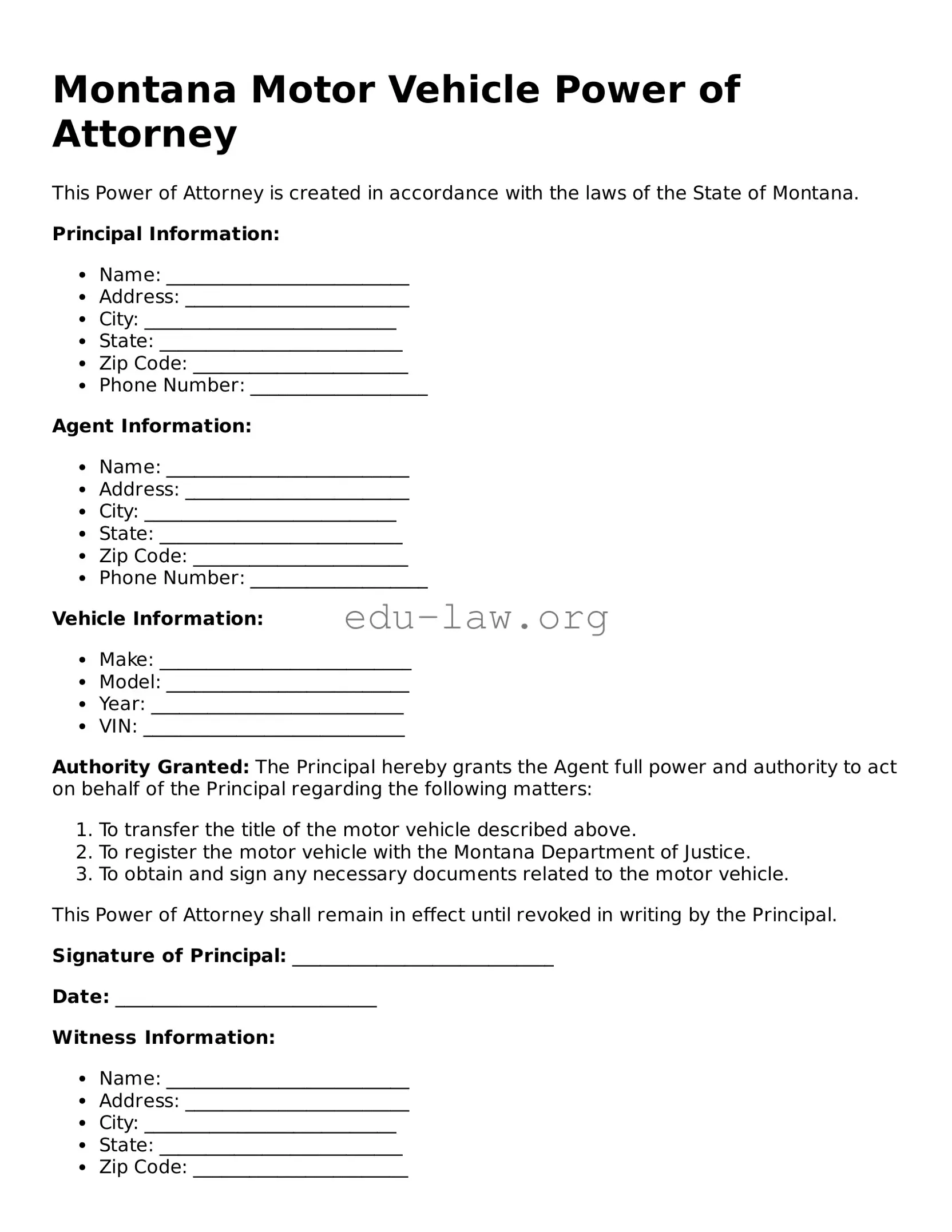
The Montana Motor Vehicle Power of Attorney form serves as a vital legal tool for individuals who wish to delegate authority over their motor vehicle transactions to another person. This form allows the designated agent to perform a range of activities, including registering a vehicle, transferring ownership, and obtaining titles on behalf of the vehicle owner. It is particularly useful in situations where the owner cannot be present to complete these tasks, such as during a relocation or while managing multiple properties. By using this form, the principal can ensure that their interests are protected while granting the agent the necessary power to act. The document requires specific information, such as the names and addresses of both the principal and the agent, as well as details about the vehicle in question. Importantly, it must be signed and dated to be legally binding. Understanding the nuances of this form can simplify the often complex process of vehicle management and ownership transfer in Montana.
Montana Motor Vehicle Power of Attorney
This Power of Attorney is created in accordance with the laws of the State of Montana.
Principal Information:
Agent Information:
Vehicle Information:
Authority Granted: The Principal hereby grants the Agent full power and authority to act on behalf of the Principal regarding the following matters:
This Power of Attorney shall remain in effect until revoked in writing by the Principal.
Signature of Principal: ____________________________
Date: ____________________________
Witness Information:
Signature of Witness: ____________________________
Date: ____________________________
| Fact Name | Description |
|---|---|
| Purpose | The Montana Motor Vehicle Power of Attorney form allows an individual to authorize another person to act on their behalf regarding motor vehicle transactions. |
| Governing Law | This form is governed by Montana Code Annotated, Title 61, Chapter 1, Part 1. |
| Principal | The individual granting authority is referred to as the principal. |
| Agent | The person designated to act on behalf of the principal is known as the agent. |
| Vehicle Transactions | This form can be used for various vehicle-related transactions, including title transfers and registration renewals. |
| Signature Requirement | The principal must sign the form to validate the authority granted to the agent. |
| Notarization | While notarization is not mandatory, it is recommended to enhance the document's credibility. |
| Revocation | The principal can revoke the power of attorney at any time, provided they notify the agent and any relevant parties. |
Filling out the Montana Motor Vehicle Power of Attorney form is a straightforward process. This document allows you to designate someone to act on your behalf regarding vehicle matters. Follow these steps to complete the form accurately.
What is a Montana Motor Vehicle Power of Attorney form?
The Montana Motor Vehicle Power of Attorney form is a legal document that allows an individual, known as the principal, to designate another person, called the agent, to act on their behalf regarding specific matters related to motor vehicles. This can include tasks such as transferring ownership, registering a vehicle, or obtaining a duplicate title. By granting this authority, the principal ensures that their agent can handle these responsibilities without needing to be present in person.
Who can serve as an agent in a Montana Motor Vehicle Power of Attorney?
In Montana, the agent designated in the Power of Attorney form can be any competent adult. This means that the person should be at least 18 years old and capable of making decisions. It is common for individuals to choose trusted family members, friends, or professionals who have experience in handling motor vehicle transactions. The important aspect is that the agent must be reliable and able to act in the best interest of the principal.
How does one complete the Montana Motor Vehicle Power of Attorney form?
Completing the Montana Motor Vehicle Power of Attorney form involves several straightforward steps. First, the principal must fill out their personal information, including name and address. Next, the agent's details must be provided. It’s essential to specify the powers granted to the agent, which can be broad or limited depending on the principal's needs. After filling out the form, the principal must sign it in the presence of a notary public to ensure its validity. This notarization is crucial as it confirms that the principal is signing voluntarily and understands the implications of the document.
Is the Montana Motor Vehicle Power of Attorney form revocable?
Yes, the Montana Motor Vehicle Power of Attorney form can be revoked at any time by the principal. To do this, the principal should create a written notice of revocation and provide it to the agent. It is also advisable to inform any relevant institutions, such as the Department of Motor Vehicles, to prevent the agent from acting on behalf of the principal. Revoking the Power of Attorney ensures that the principal retains control over their motor vehicle matters and can designate a new agent if needed.
Not providing complete information about the principal. It's crucial to include full names, addresses, and contact information.
Forgetting to sign the form. The principal's signature is essential for the document to be valid.
Neglecting to date the form. Without a date, it may be unclear when the authority was granted.
Using outdated forms. Always ensure you are using the latest version of the Montana Motor Vehicle Power of Attorney form.
Failing to specify the powers granted. Clearly outline what the agent can do on behalf of the principal.
Not providing identification for the agent. Including the agent's full name and contact details helps avoid confusion.
Overlooking witness or notary requirements. Some situations may require additional verification for the document.
Leaving blank spaces. Fill in all sections completely to prevent any potential disputes or misunderstandings.
Not reviewing the completed form. Double-checking for errors or omissions can save time and hassle later.
Assuming the form is valid without proper submission. Make sure to submit the completed form to the appropriate authorities.
When dealing with motor vehicle transactions in Montana, the Motor Vehicle Power of Attorney form is just one of several important documents you may encounter. Each document serves a unique purpose and can simplify the process of managing vehicle ownership and related matters. Here’s a look at some other forms and documents that are often used alongside the Motor Vehicle Power of Attorney.
Understanding these documents can significantly ease the process of handling vehicle transactions in Montana. Each form plays a critical role in ensuring that ownership and registration are managed smoothly and legally. Always consider consulting with a professional if you have questions about these forms or the processes involved.
The Montana Motor Vehicle Power of Attorney form shares similarities with the General Power of Attorney. Both documents allow an individual, known as the principal, to designate another person, referred to as the agent, to act on their behalf. This can include making decisions, signing documents, or handling transactions. The key difference lies in the scope; while the General Power of Attorney can cover a wide range of matters, the Motor Vehicle Power of Attorney is specifically focused on matters related to motor vehicles, such as title transfers or registration issues.
Another document similar to the Montana Motor Vehicle Power of Attorney is the Durable Power of Attorney. Like the Motor Vehicle Power of Attorney, the Durable Power of Attorney enables a principal to appoint someone to manage their affairs. The crucial distinction is that a Durable Power of Attorney remains effective even if the principal becomes incapacitated. This means that if a person is unable to make decisions due to health issues, their agent can still act on their behalf, unlike in the case of a standard Power of Attorney, which may become void under such circumstances.
The Vehicle Title Transfer form also bears resemblance to the Montana Motor Vehicle Power of Attorney. This document is used to officially change the ownership of a vehicle from one person to another. While the Vehicle Title Transfer form focuses solely on the transfer of ownership, the Motor Vehicle Power of Attorney allows someone to handle the transfer on behalf of the owner. In essence, the Power of Attorney can facilitate the completion of the Vehicle Title Transfer without the owner needing to be present.
The Bill of Sale is another document that relates closely to the Montana Motor Vehicle Power of Attorney. A Bill of Sale serves as a receipt that indicates the transfer of ownership of a vehicle from the seller to the buyer. When using a Motor Vehicle Power of Attorney, the agent can sign the Bill of Sale on behalf of the seller, ensuring that the transaction can proceed smoothly even if the seller is unavailable to sign it themselves.
The Affidavit of Heirship is similar in that it helps establish ownership but serves a different purpose. This document is often used when a vehicle owner passes away, and their heirs need to prove their right to inherit the vehicle. While the Montana Motor Vehicle Power of Attorney is used to delegate authority during the owner's lifetime, the Affidavit of Heirship comes into play after the owner's death, facilitating the transfer of the vehicle to the rightful heirs.
The Release of Liability form also has a connection to the Montana Motor Vehicle Power of Attorney. This document is used by vehicle owners to notify the Department of Motor Vehicles that they are no longer responsible for a vehicle once it has been sold or transferred. An agent acting under the Motor Vehicle Power of Attorney can sign this form on behalf of the vehicle owner, ensuring that the owner's liability is officially released and that they are protected from future claims related to the vehicle.
The Vehicle Registration form is another document that shares similarities with the Montana Motor Vehicle Power of Attorney. This form is used to register a vehicle with the state, providing necessary information about the vehicle and its owner. When an agent is appointed through the Motor Vehicle Power of Attorney, they can complete and submit the Vehicle Registration form on behalf of the vehicle owner, making the process easier and more efficient for the owner.
Finally, the Consent to Transfer form is akin to the Montana Motor Vehicle Power of Attorney in that it allows for the transfer of vehicle ownership. This form is often required when a vehicle is being sold or transferred to a new owner. By using the Motor Vehicle Power of Attorney, an agent can provide the necessary consent to transfer the vehicle, streamlining the process and ensuring that all legal requirements are met without the owner's direct involvement.
When filling out the Montana Motor Vehicle Power of Attorney form, it is important to follow certain guidelines to ensure the process goes smoothly. Here are some things to do and avoid:
When it comes to the Montana Motor Vehicle Power of Attorney form, several misconceptions can lead to confusion. Understanding these misconceptions can help individuals navigate the process more effectively. Here are seven common misunderstandings:
Many people believe that the Motor Vehicle Power of Attorney form is solely for the purpose of selling a vehicle. In reality, it can be used for various transactions, such as registering a vehicle, transferring ownership, or handling title issues.
Some think that any person can be appointed as an agent to act on behalf of the vehicle owner. However, it’s important to choose someone trustworthy and capable, as they will have significant authority over the vehicle.
While notarization adds an extra layer of validity, it is not always required. The Montana Motor Vehicle Division accepts forms that are signed by the vehicle owner without a notary in certain situations.
Many people think that once they complete the form, the authority granted is permanent. In fact, the vehicle owner can revoke the Power of Attorney at any time, as long as they follow the proper procedures.
While the form is specific to Montana, non-residents can also use it if they are dealing with a vehicle registered in Montana. This flexibility can be beneficial for those who may have recently moved or are handling a vehicle for someone else.
Some individuals avoid using the form because they believe it is too complicated. In reality, the Motor Vehicle Power of Attorney form is designed to be straightforward, with clear instructions for completion.
There is a misconception that this form is only necessary for older or classic vehicles. However, it is applicable to any vehicle, regardless of age, whenever someone needs to delegate authority for vehicle-related tasks.
By addressing these misconceptions, individuals can better understand the Montana Motor Vehicle Power of Attorney form and use it effectively for their vehicle-related needs.
When filling out and using the Montana Motor Vehicle Power of Attorney form, consider the following key takeaways: