The Montana Medical Power of Attorney form is an essential legal document that allows individuals to designate a trusted person to make healthcare decisions on their behalf in the event they become unable to do so themselves. This form empowers the appointed agent to communicate with medical professionals and make choices regarding treatment options, ensuring that the individual's healthcare preferences are honored. It is crucial for anyone, regardless of age or health status, to consider creating this document as it provides peace of mind and clarity during potentially challenging times. The form outlines the scope of authority granted to the agent, which can include decisions about surgeries, medications, and end-of-life care. Additionally, it allows individuals to express their wishes regarding organ donation and other critical health-related matters. By understanding the key components and significance of the Montana Medical Power of Attorney form, individuals can take proactive steps to safeguard their medical choices and ensure their voices are heard, even when they cannot speak for themselves.
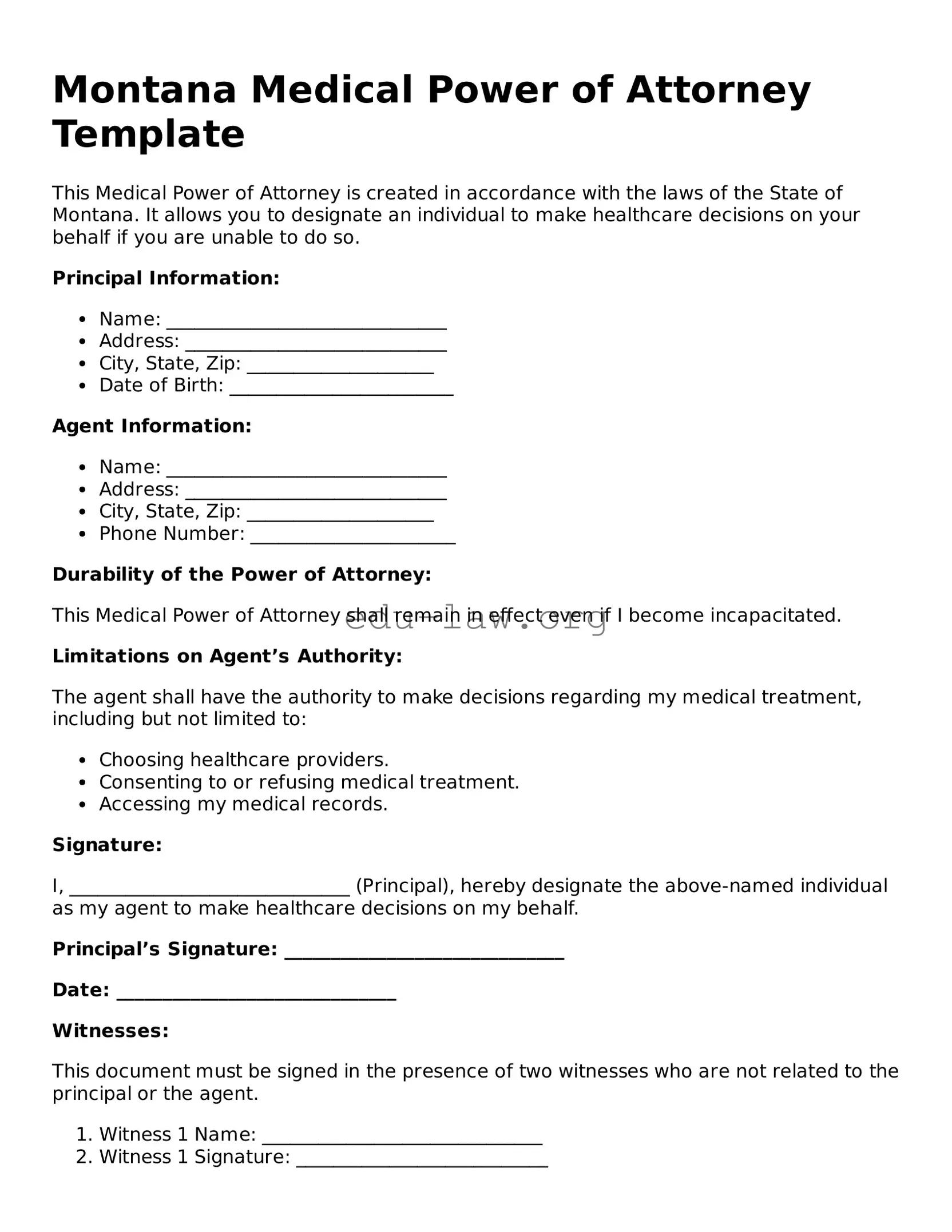
Montana Medical Power of Attorney Template
This Medical Power of Attorney is created in accordance with the laws of the State of Montana. It allows you to designate an individual to make healthcare decisions on your behalf if you are unable to do so.
Principal Information:
Agent Information:
Durability of the Power of Attorney:
This Medical Power of Attorney shall remain in effect even if I become incapacitated.
Limitations on Agent’s Authority:
The agent shall have the authority to make decisions regarding my medical treatment, including but not limited to:
Signature:
I, ______________________________ (Principal), hereby designate the above-named individual as my agent to make healthcare decisions on my behalf.
Principal’s Signature: ______________________________
Date: ______________________________
Witnesses:
This document must be signed in the presence of two witnesses who are not related to the principal or the agent.
Notarization:
State of Montana, County of ______________
Subscribed and sworn before me on this ____ day of ____________, 20__.
Notary Public Signature: ___________________________
My Commission Expires: ___________________________
| Fact Name | Description |
|---|---|
| Purpose | The Montana Medical Power of Attorney form allows individuals to designate a trusted person to make medical decisions on their behalf if they become incapacitated. |
| Governing Law | This form is governed by the Montana Code Annotated, specifically Title 72, Chapter 5, which addresses health care decisions and advance directives. |
| Eligibility | Any competent adult can create a Medical Power of Attorney in Montana, ensuring that their healthcare preferences are respected. |
| Revocation | The principal can revoke the Medical Power of Attorney at any time, provided they are still competent to make decisions. |
After obtaining the Montana Medical Power of Attorney form, you will need to complete it accurately to ensure your medical decisions can be made according to your wishes. Follow these steps carefully.
Once completed, keep a copy for your records and provide copies to your agent and healthcare providers. This ensures that your medical preferences are known and can be acted upon when necessary.
What is a Montana Medical Power of Attorney?
A Montana Medical Power of Attorney is a legal document that allows you to designate someone to make medical decisions on your behalf if you become unable to do so. This person, known as your agent or proxy, will have the authority to make choices regarding your healthcare, ensuring that your wishes are respected even when you cannot communicate them yourself.
Why should I create a Medical Power of Attorney?
Creating a Medical Power of Attorney is important because it ensures that someone you trust will make healthcare decisions that align with your values and preferences. Without this document, healthcare providers may have to rely on family members or the courts to make decisions, which might not reflect your wishes. This can lead to confusion and potential conflicts during a difficult time.
Who can I appoint as my agent?
You can appoint any competent adult as your agent in a Montana Medical Power of Attorney. This could be a family member, a close friend, or a trusted advisor. It’s essential to choose someone who understands your healthcare preferences and is willing to advocate for you. Keep in mind that your agent should be someone you trust implicitly to make decisions in your best interest.
How do I create a Medical Power of Attorney in Montana?
To create a Medical Power of Attorney in Montana, you need to fill out the appropriate form, which can often be found online or obtained from legal offices. After completing the form, you must sign it in front of a notary public or two witnesses who are not related to you or named in the document. Once signed, provide copies to your agent, healthcare providers, and keep one for your records.
Can I change or revoke my Medical Power of Attorney?
Yes, you have the right to change or revoke your Medical Power of Attorney at any time, as long as you are mentally competent. To revoke the document, you can create a new one or simply write a statement indicating your desire to cancel it. Make sure to inform your previous agent and any healthcare providers about the change to avoid confusion.
What happens if I don’t have a Medical Power of Attorney?
If you do not have a Medical Power of Attorney and become unable to make your own medical decisions, the responsibility may fall to family members or legal guardians. This can lead to disagreements among family members and may require court intervention to determine who will make decisions on your behalf. Having a Medical Power of Attorney helps prevent this situation by clearly stating your wishes and designating a trusted person to act for you.
Not selecting a healthcare agent. It's crucial to choose someone you trust to make medical decisions on your behalf.
Failing to specify limitations on the agent's authority. Clearly outline what your agent can and cannot do regarding your medical care.
Overlooking the need for witnesses or notarization. Montana requires the form to be signed in front of a notary public or two witnesses.
Not updating the form when personal circumstances change. If your relationship with your agent changes, it's important to revise the document.
Using vague language. Be specific about your wishes regarding medical treatments and interventions.
Ignoring the state-specific requirements. Each state has its own rules, so ensure you follow Montana's guidelines closely.
Not discussing your wishes with your healthcare agent. It's essential to communicate your preferences and values to the person you choose.
Failing to keep a copy of the signed form in a safe place. Make sure your agent and loved ones know where to find it when needed.
When considering a Montana Medical Power of Attorney, it's essential to understand that this document often works alongside several other forms and documents. Each of these plays a vital role in ensuring your healthcare wishes are honored and that your affairs are managed appropriately if you become unable to communicate them yourself. Here’s a list of commonly used documents that complement the Medical Power of Attorney.
Understanding these documents can empower you to make informed decisions about your healthcare and financial future. Each plays a unique role in ensuring your wishes are respected and your needs are met, providing peace of mind for both you and your loved ones.
The Montana Medical Power of Attorney form is similar to the Durable Power of Attorney. Both documents allow individuals to designate someone to make decisions on their behalf. However, while the Durable Power of Attorney can cover financial and legal matters, the Medical Power of Attorney specifically focuses on healthcare decisions. This ensures that the appointed agent can make informed choices regarding medical treatment when the individual is unable to do so themselves.
Another related document is the Living Will. A Living Will outlines an individual’s preferences for medical treatment in situations where they cannot communicate their wishes. While the Medical Power of Attorney appoints someone to make those decisions, the Living Will provides specific instructions on what types of treatment the individual desires or wishes to avoid. Together, these documents create a comprehensive approach to healthcare planning.
The Advance Healthcare Directive combines elements of both the Medical Power of Attorney and the Living Will. This document allows a person to appoint an agent for medical decisions while also providing specific instructions regarding their healthcare preferences. It serves as a unified document that simplifies the decision-making process for loved ones and healthcare providers.
A Healthcare Proxy is another document that shares similarities with the Medical Power of Attorney. Like the Medical Power of Attorney, it allows individuals to designate someone to make medical decisions on their behalf. The primary difference lies in the terminology and specific legal requirements, which can vary by state. Nonetheless, both serve the same essential purpose of ensuring that an individual’s healthcare wishes are honored.
The Do Not Resuscitate (DNR) order is a specific directive that complements the Medical Power of Attorney. This document communicates a person’s wishes regarding resuscitation efforts in the event of cardiac arrest or respiratory failure. While the Medical Power of Attorney allows for broader healthcare decisions, a DNR focuses solely on the individual’s preferences for life-sustaining measures.
The Physician Orders for Life-Sustaining Treatment (POLST) form is another important document that works alongside the Medical Power of Attorney. POLST translates an individual’s healthcare preferences into actionable medical orders. This form is particularly useful for individuals with serious illnesses, as it provides clear guidance to healthcare providers about the desired level of care in emergencies.
The Declaration for Mental Health Treatment is a specialized document that allows individuals to express their preferences regarding mental health care. Similar to the Medical Power of Attorney, it appoints an agent to make decisions if the individual is unable to do so. However, it specifically addresses mental health treatment options, ensuring that the individual’s wishes in this area are respected.
The Living Will Declaration is another variant that focuses on end-of-life care. While it overlaps with the Living Will mentioned earlier, it is often used in specific legal contexts to emphasize an individual’s wishes regarding life-sustaining treatment. This document can be particularly important in situations where a person’s prognosis is terminal or their quality of life is severely diminished.
Lastly, the Health Information Release Authorization allows individuals to grant permission for others to access their medical records and health information. While this document does not designate someone to make decisions, it complements the Medical Power of Attorney by ensuring that the appointed agent has the necessary information to make informed healthcare choices.
When filling out the Montana Medical Power of Attorney form, it’s important to follow certain guidelines to ensure that your document is valid and effective. Here are ten things to keep in mind:
The Montana Medical Power of Attorney (MPOA) form is an essential legal document that allows individuals to designate someone to make medical decisions on their behalf in the event they become unable to do so. However, several misconceptions surround this important document. Below is a list of ten common misconceptions, along with clarifications for each.
Understanding these misconceptions can help individuals make informed decisions about their healthcare and ensure their wishes are respected in times of need.
When considering the Montana Medical Power of Attorney form, it's essential to understand its purpose and requirements. Here are some key takeaways:
Understanding these key points can help ensure that your healthcare decisions are respected and that your wishes are clearly communicated.