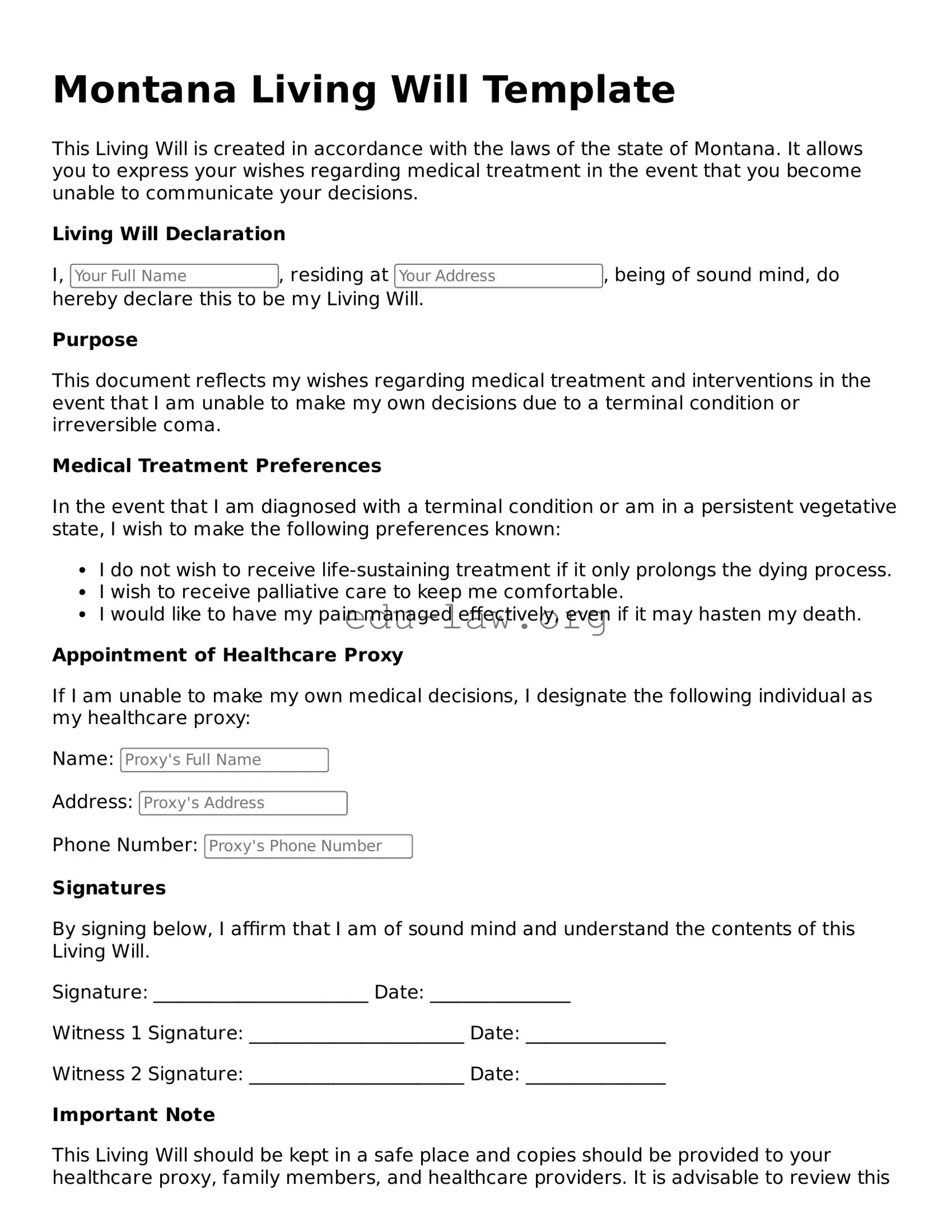
In the state of Montana, the Living Will form serves as a crucial tool for individuals who wish to express their healthcare preferences in advance, particularly in situations where they may be unable to communicate their wishes due to illness or incapacity. This document allows individuals to outline their desires regarding medical treatment, including life-sustaining measures, in a clear and legally recognized manner. By completing a Living Will, a person can specify their choices about interventions such as resuscitation, artificial nutrition, and hydration. This empowers individuals to maintain control over their medical care, ensuring that their values and preferences are respected even when they cannot advocate for themselves. Additionally, the form can help alleviate the burden on family members who may otherwise face difficult decisions during emotionally challenging times. Overall, understanding the Montana Living Will form is an essential step in planning for one's healthcare future and ensuring that personal wishes are honored.
Montana Living Will Template
This Living Will is created in accordance with the laws of the state of Montana. It allows you to express your wishes regarding medical treatment in the event that you become unable to communicate your decisions.
Living Will Declaration
I, , residing at , being of sound mind, do hereby declare this to be my Living Will.
Purpose
This document reflects my wishes regarding medical treatment and interventions in the event that I am unable to make my own decisions due to a terminal condition or irreversible coma.
Medical Treatment Preferences
In the event that I am diagnosed with a terminal condition or am in a persistent vegetative state, I wish to make the following preferences known:
Appointment of Healthcare Proxy
If I am unable to make my own medical decisions, I designate the following individual as my healthcare proxy:
Name:
Address:
Phone Number:
Signatures
By signing below, I affirm that I am of sound mind and understand the contents of this Living Will.
Signature: _______________________ Date: _______________
Witness 1 Signature: _______________________ Date: _______________
Witness 2 Signature: _______________________ Date: _______________
Important Note
This Living Will should be kept in a safe place and copies should be provided to your healthcare proxy, family members, and healthcare providers. It is advisable to review this document periodically and update it as necessary.
| Fact Name | Description |
|---|---|
| Purpose | The Montana Living Will form allows individuals to outline their preferences for medical treatment in case they become unable to communicate their wishes. |
| Governing Law | This form is governed by the Montana Code Annotated, Title 50, Chapter 9, which covers advanced directives and living wills. |
| Eligibility | Any adult who is of sound mind can complete a Living Will in Montana, ensuring their healthcare preferences are respected. |
| Revocation | A Living Will can be revoked at any time by the individual, either verbally or in writing, as long as they are competent to do so. |
Completing the Montana Living Will form is an important step in ensuring your healthcare wishes are known and respected. This document outlines your preferences regarding medical treatment in the event that you become unable to communicate your decisions. Follow the steps below to accurately fill out the form.
Once you have filled out the form, it is advisable to discuss your wishes with your healthcare provider to ensure they are understood and can be honored in a medical setting.
What is a Montana Living Will?
A Montana Living Will is a legal document that allows an individual to express their wishes regarding medical treatment in the event they become unable to communicate their preferences. This document specifically addresses end-of-life care and decisions about life-sustaining treatments, ensuring that a person's desires are respected when they cannot speak for themselves.
Who can create a Living Will in Montana?
Any adult who is at least 18 years old and of sound mind can create a Living Will in Montana. It is important that the individual understands the implications of the decisions they are making regarding their medical care.
What are the requirements for a valid Living Will in Montana?
To be valid, a Living Will must be in writing and signed by the individual creating it. Additionally, the document must be witnessed by at least two individuals who are not related to the individual or beneficiaries of their estate. This ensures that the document reflects the individual's true intentions without undue influence.
Can a Living Will be revoked?
Yes, a Living Will can be revoked at any time by the individual who created it. This can be done verbally or in writing. It is advisable to inform any healthcare providers and family members of the revocation to avoid confusion about the individual's current wishes.
What should be included in a Living Will?
A Living Will should clearly outline the individual's preferences regarding medical treatments, including the use of life-sustaining measures such as resuscitation, mechanical ventilation, and feeding tubes. Specific instructions can help guide healthcare providers and family members in making decisions that align with the individual's values and wishes.
How does a Living Will differ from a Power of Attorney for healthcare?
A Living Will focuses specifically on the individual's wishes regarding medical treatment and end-of-life care. In contrast, a Power of Attorney for healthcare designates another person to make medical decisions on behalf of the individual if they are unable to do so. Both documents serve important roles in healthcare planning but address different aspects of medical decision-making.
Is a Living Will recognized in other states?
While a Montana Living Will is valid within the state, its recognition in other states may vary. Many states have similar laws regarding advance directives, but the specific requirements and forms can differ. It is advisable for individuals who travel or move frequently to consult the laws of other states to ensure their Living Will remains effective.
Where should a Living Will be kept?
A Living Will should be kept in a safe but accessible location. It is important to inform family members and healthcare providers about its location. Additionally, individuals may choose to provide copies to their doctors and anyone designated to make healthcare decisions on their behalf, ensuring that their wishes are known and can be honored when needed.
Not specifying treatment preferences: Many individuals fail to clearly outline their preferences regarding specific medical treatments. This can lead to confusion and may not reflect their true wishes.
Missing signatures: It’s crucial to ensure that the form is signed. An unsigned document is not legally binding and may not be honored by healthcare providers.
Not dating the document: Forgetting to include the date can create ambiguity. A dated document helps clarify when the wishes were expressed.
Using vague language: Ambiguities in language can lead to misinterpretations. Clear and precise wording helps convey intentions without confusion.
Overlooking witness requirements: In Montana, the form typically needs to be witnessed by two individuals. Skipping this step can invalidate the document.
Failing to communicate wishes: Not discussing the contents of the Living Will with family members or healthcare proxies can lead to disputes or misunderstandings later.
Not reviewing regularly: Life circumstances change. Failing to revisit and update the Living Will can result in outdated preferences that no longer reflect current values or wishes.
Assuming all healthcare providers understand: It’s important to ensure that all healthcare providers are aware of the Living Will. Simply having the document does not guarantee that it will be recognized or followed.
Neglecting to store it safely: Keeping the Living Will in a secure yet accessible location is vital. If it’s misplaced or hard to find, it may not be available when needed most.
In addition to the Montana Living Will form, there are several other important documents that individuals may consider when planning for healthcare decisions. These documents help ensure that a person's wishes regarding medical treatment and end-of-life care are respected. Below is a list of commonly used forms and documents that complement the Living Will.
Considering these documents in conjunction with the Montana Living Will can provide a comprehensive approach to healthcare planning. Each document serves a unique purpose, ensuring that individuals' wishes are honored and respected in various situations. It is advisable to consult with legal or healthcare professionals to ensure that all documents are properly completed and reflect one’s intentions accurately.
The Montana Living Will form is similar to the Advance Directive for Health Care. Both documents serve the purpose of outlining an individual's preferences regarding medical treatment in the event they become unable to communicate their wishes. An Advance Directive can include a Living Will, but it may also appoint a healthcare proxy—someone designated to make medical decisions on behalf of the individual. This flexibility allows for a comprehensive approach to healthcare decisions, ensuring that an individual's values and preferences are respected even when they cannot voice them directly.
Another document akin to the Montana Living Will is the Durable Power of Attorney for Health Care. This document specifically allows an individual to appoint someone they trust to make healthcare decisions on their behalf if they are incapacitated. While a Living Will focuses on specific medical treatment preferences, the Durable Power of Attorney provides a broader scope by empowering the designated agent to interpret and make decisions based on the individual's best interests. This distinction is crucial for those who want to ensure that their healthcare decisions are managed by someone who understands their values.
The Do Not Resuscitate (DNR) order is another important document that shares similarities with the Montana Living Will. A DNR specifically instructs medical personnel not to perform CPR or other resuscitation efforts if a person's heart stops or they stop breathing. While a Living Will may include broader directives about end-of-life care, a DNR focuses solely on the immediate response to cardiac or respiratory arrest. Individuals often use both documents together to create a comprehensive plan for their end-of-life care preferences.
Lastly, the Physician Orders for Life-Sustaining Treatment (POLST) form is also comparable to the Montana Living Will. The POLST is a medical order that translates a patient’s preferences regarding life-sustaining treatments into actionable physician orders. Unlike a Living Will, which is typically a more general statement of wishes, a POLST is designed for individuals with serious health conditions and provides specific instructions that healthcare providers must follow. This ensures that patients receive care that aligns closely with their wishes during critical medical situations.
When filling out the Montana Living Will form, it is essential to approach the task with care and attention. Here are some important dos and don'ts to keep in mind.
By following these guidelines, you can help ensure that your Living Will accurately reflects your wishes and provides clear direction for your healthcare decisions.
When it comes to the Montana Living Will form, several misconceptions can lead to confusion. Understanding these misconceptions can help individuals make informed decisions about their end-of-life care. Here is a list of common misunderstandings:
By clearing up these misconceptions, individuals can better navigate the process of creating a Living Will that accurately reflects their wishes regarding medical care.
Filling out and using the Montana Living Will form is an important step in planning for your future healthcare needs. Here are some key takeaways to keep in mind:
By understanding these key points, you can make informed decisions about your healthcare and ensure your wishes are respected.