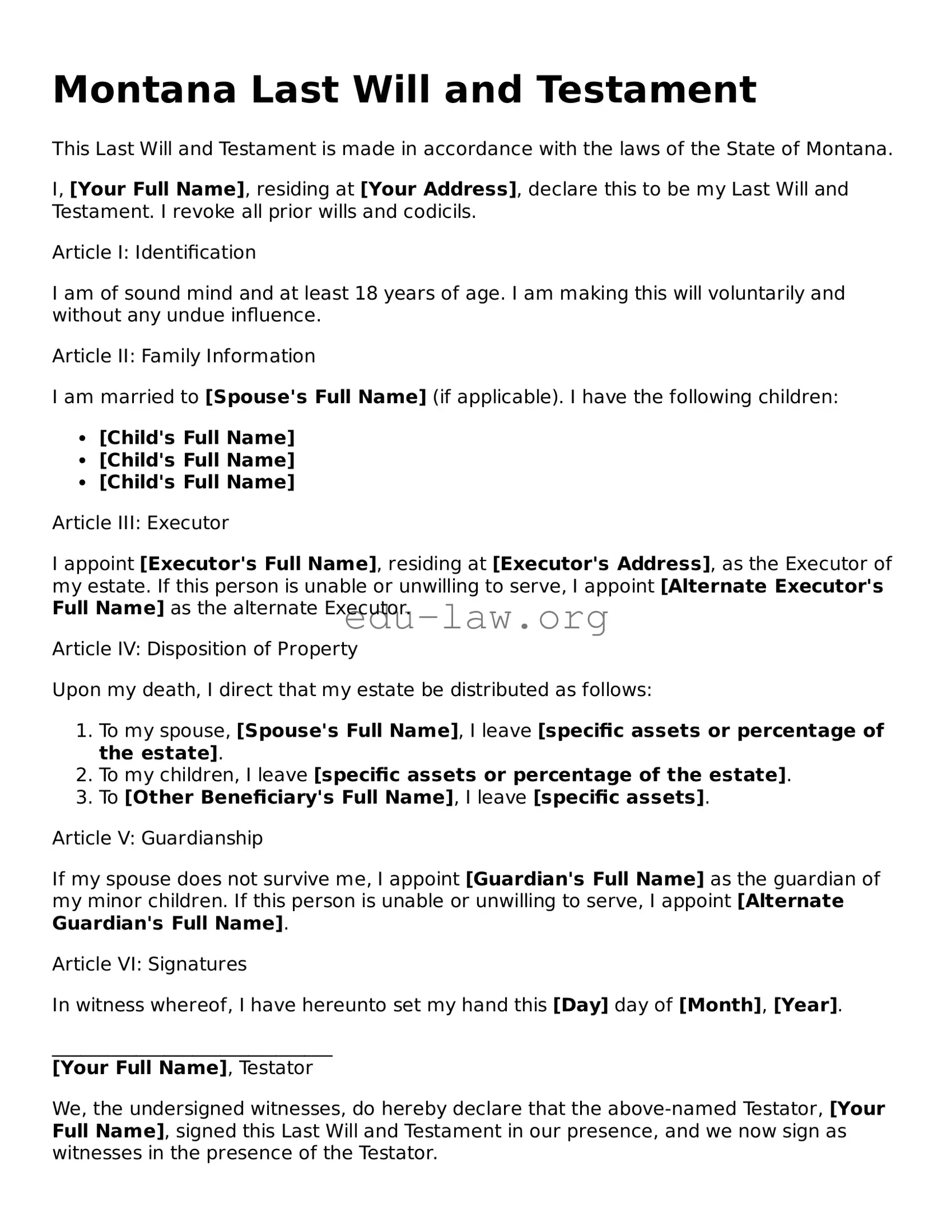
Creating a Last Will and Testament is an essential step in ensuring that an individual's wishes regarding their estate are honored after their passing. In Montana, the Last Will and Testament form serves as a legal document that outlines how a person's assets will be distributed among beneficiaries. This form addresses several key components, including the appointment of an executor, who will be responsible for managing the estate and ensuring that the terms of the will are carried out. It also allows individuals to specify guardianship for minor children, ensuring their care in the event of the parent's death. Additionally, the form includes provisions for revoking any previous wills, thus providing clarity and preventing potential disputes. By utilizing this form, residents of Montana can take control of their legacy, providing peace of mind for themselves and their loved ones. Understanding the nuances of this document is crucial for effective estate planning and can help avoid complications in the future.
Montana Last Will and Testament
This Last Will and Testament is made in accordance with the laws of the State of Montana.
I, [Your Full Name], residing at [Your Address], declare this to be my Last Will and Testament. I revoke all prior wills and codicils.
Article I: Identification
I am of sound mind and at least 18 years of age. I am making this will voluntarily and without any undue influence.
Article II: Family Information
I am married to [Spouse's Full Name] (if applicable). I have the following children:
Article III: Executor
I appoint [Executor's Full Name], residing at [Executor's Address], as the Executor of my estate. If this person is unable or unwilling to serve, I appoint [Alternate Executor's Full Name] as the alternate Executor.
Article IV: Disposition of Property
Upon my death, I direct that my estate be distributed as follows:
Article V: Guardianship
If my spouse does not survive me, I appoint [Guardian's Full Name] as the guardian of my minor children. If this person is unable or unwilling to serve, I appoint [Alternate Guardian's Full Name].
Article VI: Signatures
In witness whereof, I have hereunto set my hand this [Day] day of [Month], [Year].
______________________________
[Your Full Name], Testator
We, the undersigned witnesses, do hereby declare that the above-named Testator, [Your Full Name], signed this Last Will and Testament in our presence, and we now sign as witnesses in the presence of the Testator.
______________________________
[Witness 1 Full Name]
[Witness 1 Address]
______________________________
[Witness 2 Full Name]
[Witness 2 Address]
All provisions of this Will shall be construed in accordance with the laws of the State of Montana.
| Fact Name | Details |
|---|---|
| Governing Law | The Montana Last Will and Testament is governed by the Montana Code Annotated, Title 72, Chapter 2. |
| Age Requirement | Individuals must be at least 18 years old to create a valid will in Montana. |
| Written Form | The will must be in writing. It can be handwritten or typed. |
| Signature Requirement | The testator must sign the will at the end. If unable to sign, another person can sign on their behalf in their presence. |
| Witness Requirement | At least two witnesses must be present when the will is signed. They should also sign the will. |
| Self-Proving Wills | A will can be made self-proving by including a notarized affidavit from the witnesses. |
| Revocation | A will can be revoked by creating a new will or by physically destroying the original document. |
| Holographic Wills | Montana recognizes holographic wills, which are handwritten and signed by the testator without witnesses. |
| Residency Requirement | There is no residency requirement; however, the will must comply with Montana laws if the property is located in Montana. |
| Executor Appointment | The testator can appoint an executor in the will to manage the estate after death. |
Once you have the Montana Last Will and Testament form, you can begin filling it out. This process is straightforward, but it’s important to ensure all information is accurate and complete. After filling out the form, you will need to sign it in the presence of witnesses to make it legally binding.
What is a Last Will and Testament in Montana?
A Last Will and Testament is a legal document that outlines how a person's assets and property will be distributed after their death. In Montana, this document can also specify guardianship for minor children and appoint an executor to manage the estate. It serves as a crucial tool for ensuring that your wishes are honored and can help minimize disputes among family members.
Do I need a lawyer to create a Last Will and Testament in Montana?
While it is not legally required to have a lawyer draft your will in Montana, consulting with one is often beneficial. A legal professional can help ensure that your will complies with state laws and accurately reflects your wishes. If your estate is complex or if you have specific concerns, seeking legal advice is highly recommended.
What are the requirements for a valid Last Will and Testament in Montana?
To be valid in Montana, a Last Will and Testament must be in writing and signed by the testator (the person making the will). Additionally, it must be witnessed by at least two individuals who are not beneficiaries of the will. These witnesses must also sign the document in the presence of the testator. Following these guidelines helps ensure that the will is legally enforceable.
Can I change my Last Will and Testament after it has been created?
Yes, you can change your Last Will and Testament at any time while you are still alive and mentally competent. To make changes, you can either create a new will that revokes the previous one or add a codicil, which is an amendment to the existing will. Be sure to follow the same legal requirements for signing and witnessing to ensure the changes are valid.
What happens if I die without a will in Montana?
If you die without a will, your estate will be distributed according to Montana's intestacy laws. This means that your assets will be allocated to your closest relatives, which may not align with your personal wishes. Dying intestate can lead to complications and potential disputes among family members, making it essential to have a will in place.
Can I include specific gifts in my Last Will and Testament?
Yes, you can include specific gifts in your will. This means you can designate particular items, such as jewelry, vehicles, or real estate, to specific individuals. Clearly outlining these gifts can help prevent confusion and ensure that your belongings are distributed according to your wishes.
How can I ensure my Last Will and Testament is properly executed?
To ensure your will is properly executed, follow the legal requirements for signing and witnessing in Montana. Store the document in a safe place and inform your executor and close family members where it can be found. Additionally, consider discussing your wishes with your loved ones to minimize surprises and potential disputes after your passing.
Is it possible to contest a Last Will and Testament in Montana?
Yes, it is possible to contest a will in Montana. Grounds for contesting may include claims of undue influence, lack of capacity, or improper execution. If you believe that a will does not reflect the true intentions of the deceased, you may file a petition with the court. However, contesting a will can be a lengthy and emotionally challenging process, so it is advisable to seek legal counsel if you are considering this option.
Failing to properly identify the testator. It is crucial to include the full legal name and address of the person making the will. Omitting this information can lead to confusion and potential challenges to the validity of the will.
Not signing the will in the presence of witnesses. In Montana, a will must be signed by the testator and witnessed by at least two individuals. If this step is skipped, the will may not be considered valid.
Using ambiguous language. Clear and specific terms should be used when describing assets and beneficiaries. Vague language can create disputes among heirs and complicate the distribution process.
Neglecting to update the will after major life changes. Changes such as marriage, divorce, or the birth of a child should prompt a review and possible revision of the will to reflect current intentions.
Failing to keep the will in a safe and accessible location. A will should be stored in a place where it can be easily found after the testator's death. If it cannot be located, the will may be deemed lost and not honored.
Not considering tax implications. Individuals often overlook the potential tax consequences of their estate plan. Consulting with a professional can help ensure that the will minimizes tax burdens for beneficiaries.
When preparing a Last Will and Testament in Montana, several other documents may be beneficial to ensure your estate planning is comprehensive. Each of these documents serves a unique purpose and can help clarify your wishes or manage your affairs effectively. Below is a list of commonly used forms and documents that complement a will.
By considering these additional forms and documents, you can create a more thorough estate plan. This proactive approach can help ensure that your wishes are honored and that your loved ones are supported during challenging times.
A Living Will is a document that outlines a person's wishes regarding medical treatment in the event they become incapacitated. Like a Last Will and Testament, it provides clear instructions to ensure that an individual's preferences are honored. However, while a Last Will deals with the distribution of assets after death, a Living Will focuses on healthcare decisions during a person's lifetime, particularly in critical situations where they cannot communicate their wishes.
A Durable Power of Attorney is similar to a Last Will in that it allows an individual to designate someone to make decisions on their behalf. This document is particularly important for financial and legal matters. Unlike a Last Will, which takes effect after death, a Durable Power of Attorney is effective immediately or upon the principal's incapacitation, ensuring that someone can manage their affairs without delay.
A Health Care Proxy is another important document that shares similarities with a Last Will. It allows individuals to appoint someone to make healthcare decisions on their behalf if they are unable to do so. While a Last Will dictates the distribution of assets after death, a Health Care Proxy focuses on medical decisions, ensuring that a person's healthcare preferences are respected during their lifetime.
A Revocable Trust is a legal arrangement that allows individuals to manage their assets during their lifetime and distribute them after death. It is similar to a Last Will in that both documents provide a plan for asset distribution. However, a Revocable Trust can help avoid probate, allowing for a smoother transition of assets to beneficiaries without court involvement, which is often a lengthy process associated with a Last Will.
An Irrevocable Trust is similar to a Revocable Trust but cannot be changed once established. This document is often used for asset protection and tax planning. Like a Last Will, it ensures that assets are distributed according to the grantor's wishes. However, because it is irrevocable, the grantor relinquishes control over the assets, which is a significant difference from a Last Will or a Revocable Trust.
A Codicil is an amendment to an existing Last Will and Testament. It allows individuals to make changes without creating an entirely new document. This is similar to a Last Will in that it still governs the distribution of assets after death. Codicils can be used to add new beneficiaries, change executors, or modify specific bequests, ensuring that the will remains current and reflective of the individual's wishes.
An Estate Plan encompasses various documents, including a Last Will, but also includes trusts, powers of attorney, and healthcare directives. While a Last Will focuses solely on asset distribution, an Estate Plan provides a comprehensive strategy for managing an individual's affairs during their lifetime and after death. This holistic approach ensures that all aspects of a person's wishes are addressed.
A Beneficiary Designation is a document that specifies who will receive certain assets, such as life insurance policies or retirement accounts, upon an individual's death. It is similar to a Last Will in that both documents determine the distribution of assets. However, beneficiary designations typically take precedence over a Last Will, meaning that assets listed in these designations bypass probate and go directly to the named beneficiaries.
A Joint Tenancy Agreement allows two or more people to own property together, with rights of survivorship. This document is similar to a Last Will because it determines how property is transferred upon death. In a Joint Tenancy, when one owner passes away, their share automatically goes to the surviving owner(s), avoiding probate and ensuring a seamless transfer of ownership.
A Letter of Instruction is not a legal document but serves as a companion to a Last Will. It provides additional guidance on personal matters, funeral arrangements, and asset distribution preferences. While a Last Will is a legally binding document, a Letter of Instruction can offer clarity and context, helping loved ones understand the deceased's wishes beyond the legal framework.
When filling out the Montana Last Will and Testament form, it’s important to approach the process with care. Here’s a helpful list of dos and don’ts to guide you.
By following these guidelines, you can help ensure that your Last Will and Testament accurately reflects your intentions and is legally valid in Montana.
There are several misconceptions about the Montana Last Will and Testament form that can lead to confusion. Understanding these can help ensure that your wishes are properly documented and respected.
Clarifying these misconceptions can help you make informed decisions about your estate planning. If you have questions, consider reaching out to a legal professional for guidance.
When filling out and using the Montana Last Will and Testament form, keep these key takeaways in mind: