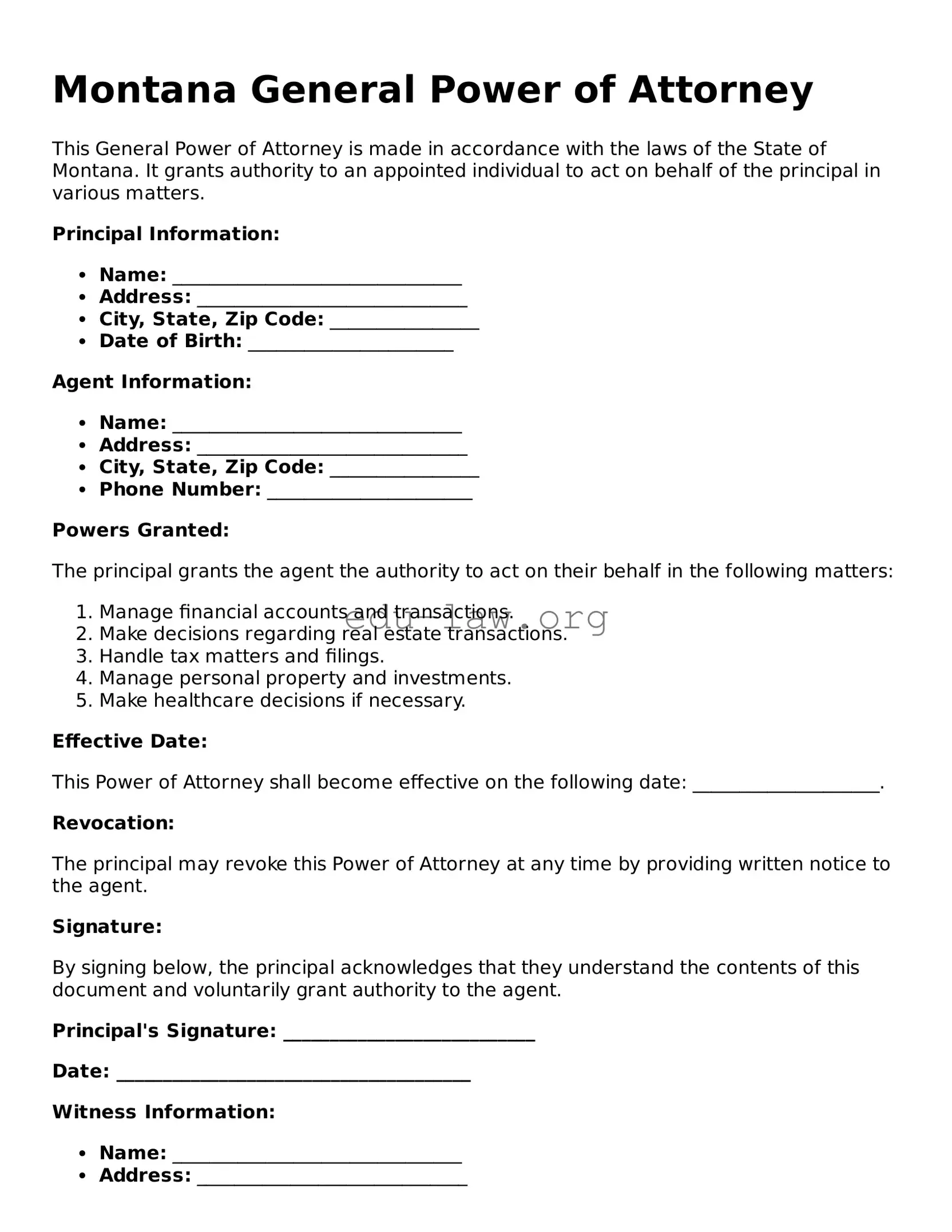
The Montana General Power of Attorney form serves as a vital tool for individuals seeking to delegate authority to another person, known as an agent or attorney-in-fact. This form allows the designated agent to make financial and legal decisions on behalf of the principal, the person granting the authority. It covers a wide range of powers, including managing bank accounts, handling real estate transactions, and making investment decisions. Importantly, the form can be tailored to fit specific needs, allowing the principal to limit or expand the scope of authority granted. It is essential for individuals to understand the implications of this form, as it can remain in effect even if the principal becomes incapacitated, unless explicitly stated otherwise. Additionally, the Montana General Power of Attorney form must be signed in the presence of a notary public to ensure its validity, providing an added layer of security for both parties involved. Understanding these aspects is crucial for anyone considering this legal document, as it can significantly impact personal and financial affairs.
Montana General Power of Attorney
This General Power of Attorney is made in accordance with the laws of the State of Montana. It grants authority to an appointed individual to act on behalf of the principal in various matters.
Principal Information:
Agent Information:
Powers Granted:
The principal grants the agent the authority to act on their behalf in the following matters:
Effective Date:
This Power of Attorney shall become effective on the following date: ____________________.
Revocation:
The principal may revoke this Power of Attorney at any time by providing written notice to the agent.
Signature:
By signing below, the principal acknowledges that they understand the contents of this document and voluntarily grant authority to the agent.
Principal's Signature: ___________________________
Date: ______________________________________
Witness Information:
| Fact Name | Description |
|---|---|
| Definition | A General Power of Attorney in Montana allows an individual (the principal) to appoint someone else (the agent) to handle their financial and legal affairs. |
| Governing Law | The General Power of Attorney in Montana is governed by the Montana Uniform Power of Attorney Act, specifically found in Title 72, Chapter 31 of the Montana Code Annotated. |
| Durability | This type of power of attorney can be made durable, meaning it remains effective even if the principal becomes incapacitated, unless otherwise specified. |
| Agent's Authority | The agent has broad authority to manage the principal’s financial matters, including paying bills, managing investments, and handling real estate transactions. |
| Revocation | The principal can revoke the General Power of Attorney at any time, as long as they are mentally competent to do so. |
Filling out the Montana General Power of Attorney form is a straightforward process. Once you have completed the form, it will be ready for your designated agent to act on your behalf in financial matters. Here’s how to fill it out step by step.
What is a General Power of Attorney in Montana?
A General Power of Attorney (POA) in Montana is a legal document that allows an individual, known as the principal, to appoint another person, referred to as the agent or attorney-in-fact, to make decisions on their behalf. This authority can cover a wide range of matters, including financial transactions, property management, and business dealings. The principal can specify the powers granted to the agent, ensuring that their preferences and wishes are respected.
How do I create a General Power of Attorney in Montana?
To create a General Power of Attorney in Montana, you must be at least 18 years old and mentally competent. You can either draft the document yourself or use a template available online or from a legal professional. It is essential to clearly outline the powers you wish to grant your agent. Once completed, the document must be signed in front of a notary public to ensure its validity. It is advisable to provide copies to your agent and any relevant financial institutions or individuals.
Can I revoke a General Power of Attorney in Montana?
Yes, you can revoke a General Power of Attorney in Montana at any time, as long as you are mentally competent. To do so, you should create a written revocation document that states your intention to cancel the previous POA. This revocation should also be signed and notarized. It is important to notify your agent and any institutions that were relying on the original document to ensure that they are aware of the change.
What happens if the principal becomes incapacitated?
If the principal becomes incapacitated, the General Power of Attorney remains effective unless it includes a specific clause stating otherwise. This means that the agent can continue to make decisions on behalf of the principal. However, if the principal wishes to have a different arrangement in the event of incapacity, they may consider establishing a Durable Power of Attorney, which specifically remains in effect during periods of incapacitation.
Not specifying the powers granted. It’s essential to clearly outline what authority the agent will have. Leaving this vague can lead to confusion.
Failing to date the document. A date is crucial for establishing when the power of attorney takes effect. Without it, the validity may be questioned.
Not signing in front of a notary. In Montana, notarization is often required. Failing to do so can render the document invalid.
Using outdated forms. Laws can change, and using an old version may result in non-compliance. Always check for the latest version.
Overlooking the agent’s qualifications. Choose someone trustworthy and capable. An unqualified agent can lead to poor decisions.
Not discussing the arrangement with the agent. It’s vital to ensure the appointed person is willing and understands their responsibilities.
Ignoring state-specific requirements. Each state has its own rules regarding power of attorney documents. Familiarize yourself with Montana’s specific laws.
Neglecting to include alternate agents. Life is unpredictable; having a backup agent ensures that someone can step in if the primary agent is unavailable.
Failing to keep copies. After completing the form, make sure to retain copies for yourself and provide one to your agent. This ensures everyone is on the same page.
Not reviewing the document regularly. Life circumstances change. Regularly review and update the power of attorney to reflect your current wishes.
A General Power of Attorney (POA) in Montana is a powerful legal document that allows one person to act on behalf of another in a variety of matters, including financial and legal decisions. However, it is often used in conjunction with other important forms and documents to ensure comprehensive management of one's affairs. Below are several key documents that may accompany a General Power of Attorney.
In summary, while a General Power of Attorney serves as a vital tool for managing various aspects of life, it is often beneficial to consider additional documents that address specific needs and situations. By utilizing these forms in conjunction, individuals can create a robust framework for decision-making that reflects their wishes and protects their interests.
The Montana Durable Power of Attorney is similar to the General Power of Attorney in that it grants authority to an agent to make decisions on behalf of the principal. However, the key distinction lies in its durability. A Durable Power of Attorney remains effective even if the principal becomes incapacitated. This means that the agent can continue to act on behalf of the principal without interruption, ensuring that financial and legal matters are managed even during periods of diminished capacity.
The Medical Power of Attorney is another document that shares similarities with the General Power of Attorney. While the General Power of Attorney can cover a wide range of decisions, the Medical Power of Attorney specifically focuses on healthcare decisions. This document allows an agent to make medical choices for the principal when they are unable to do so themselves. It is crucial for ensuring that an individual’s healthcare preferences are respected in critical situations.
The Financial Power of Attorney is closely related to the General Power of Attorney but is explicitly focused on financial matters. This document allows an agent to handle financial transactions, manage bank accounts, and make investment decisions on behalf of the principal. The Financial Power of Attorney can be tailored to grant specific financial powers, making it a versatile tool for managing one’s financial affairs.
The Limited Power of Attorney differs from the General Power of Attorney in its scope and duration. A Limited Power of Attorney grants an agent authority to act on behalf of the principal for specific tasks or a defined period. This can be particularly useful for individuals who need someone to handle a particular transaction or set of decisions without granting broad powers that a General Power of Attorney would entail.
Lastly, the Springing Power of Attorney is another variation that resembles the General Power of Attorney. This document becomes effective only upon the occurrence of a specified event, such as the principal’s incapacitation. Unlike the General Power of Attorney, which is effective immediately upon execution, the Springing Power of Attorney provides a layer of protection for the principal, ensuring that their agent’s authority is activated only when necessary.
When filling out the Montana General Power of Attorney form, it's essential to follow specific guidelines to ensure the document is valid and meets your needs. Here are ten things to keep in mind:
Many people have misunderstandings about the Montana General Power of Attorney form. Here are seven common misconceptions:
Understanding these misconceptions can help you make informed decisions about using a General Power of Attorney in Montana.
When considering the Montana General Power of Attorney form, it's essential to understand its implications and requirements. Here are some key takeaways to keep in mind:
Understanding these points can help you navigate the process of filling out and using the Montana General Power of Attorney form effectively.