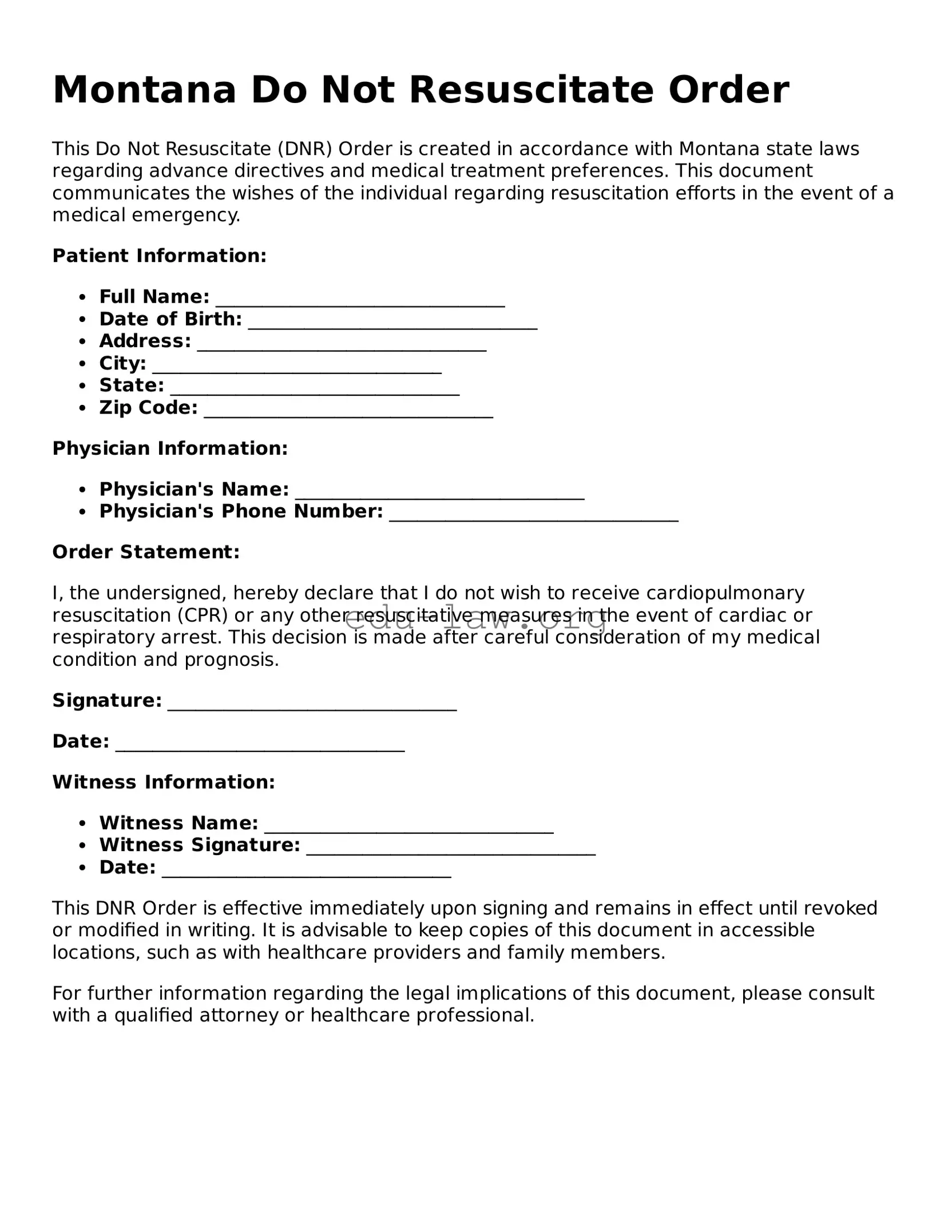
In Montana, the Do Not Resuscitate (DNR) Order form serves as a crucial document for individuals who wish to express their preferences regarding medical interventions in the event of a life-threatening situation. This form allows patients to communicate their desire not to receive cardiopulmonary resuscitation (CPR) or other life-saving measures if their heart stops or they stop breathing. It is essential for patients, families, and healthcare providers to understand that the DNR Order is not a blanket refusal of all medical care; rather, it specifically addresses resuscitation efforts. To be valid, the form must be completed and signed by the patient or their legal representative, and it should be presented to medical personnel in emergencies. Additionally, it is important to note that the DNR Order can be revoked at any time, reflecting the patient's changing wishes. Understanding the implications and processes surrounding the DNR Order is vital for ensuring that individuals receive the care they desire while respecting their autonomy and dignity at the end of life.
Montana Do Not Resuscitate Order
This Do Not Resuscitate (DNR) Order is created in accordance with Montana state laws regarding advance directives and medical treatment preferences. This document communicates the wishes of the individual regarding resuscitation efforts in the event of a medical emergency.
Patient Information:
Physician Information:
Order Statement:
I, the undersigned, hereby declare that I do not wish to receive cardiopulmonary resuscitation (CPR) or any other resuscitative measures in the event of cardiac or respiratory arrest. This decision is made after careful consideration of my medical condition and prognosis.
Signature: _______________________________
Date: _______________________________
Witness Information:
This DNR Order is effective immediately upon signing and remains in effect until revoked or modified in writing. It is advisable to keep copies of this document in accessible locations, such as with healthcare providers and family members.
For further information regarding the legal implications of this document, please consult with a qualified attorney or healthcare professional.
| Fact Name | Details |
|---|---|
| Definition | A Do Not Resuscitate (DNR) Order is a legal document that allows a person to refuse cardiopulmonary resuscitation (CPR) in case of cardiac arrest. |
| Governing Law | The DNR Order in Montana is governed by Montana Code Annotated § 50-9-103. |
| Eligibility | Any adult who is capable of making their own healthcare decisions can complete a DNR Order. |
| Signature Requirement | The DNR Order must be signed by the patient or their legal representative. |
| Healthcare Provider Role | Healthcare providers must comply with a valid DNR Order and cannot perform CPR if it is in place. |
| Revocation | A DNR Order can be revoked at any time by the patient or their representative. |
| Form Accessibility | The DNR Order form is available through healthcare facilities and state health departments. |
| Additional Considerations | Patients should discuss their DNR wishes with family and healthcare providers to ensure understanding and compliance. |
Completing the Montana Do Not Resuscitate Order form is an important step in ensuring your healthcare wishes are respected. This process involves gathering necessary information and filling out the form accurately. Follow these steps to complete the form correctly.
Once you have filled out the form, it is essential to communicate your wishes to your healthcare team and loved ones. This will help ensure that everyone is aware of your decisions regarding medical treatment.
What is a Do Not Resuscitate (DNR) Order in Montana?
A Do Not Resuscitate Order is a legal document that allows a person to refuse resuscitation efforts in the event of a medical emergency. In Montana, this order is specifically designed for individuals who have a terminal condition or are in a state where resuscitation would not improve their quality of life. The DNR order must be signed by a physician and the patient or their legal representative.
Who can request a DNR Order in Montana?
Any adult who is capable of making their own medical decisions can request a DNR order. Additionally, a legal representative, such as a healthcare proxy or power of attorney, can request this order on behalf of an individual who is unable to make decisions due to incapacity.
How do I obtain a DNR Order form in Montana?
You can obtain a DNR Order form from your healthcare provider, hospital, or through the Montana Department of Public Health and Human Services. It is essential to ensure that the form is properly filled out and signed by a physician to be valid.
What information is required on the DNR Order form?
The DNR Order form typically requires the patient's name, date of birth, and a statement indicating the patient's wishes regarding resuscitation. It must also include the physician's signature and the date the order was issued. Additional information, such as the patient's medical condition, may also be included to clarify the context of the order.
Can a DNR Order be revoked?
Yes, a DNR Order can be revoked at any time by the patient or their legal representative. To revoke the order, the individual should inform their healthcare provider and may need to complete a new form indicating their wishes. It is important to ensure that all relevant parties are notified of the revocation to avoid any confusion during emergencies.
Where should I keep my DNR Order?
It is advisable to keep the DNR Order in a location that is easily accessible, such as with other important medical documents or in a designated folder. Additionally, inform family members, caregivers, and healthcare providers about the location of the document to ensure it can be quickly retrieved in an emergency.
What should I do if I change my mind about my DNR Order?
If you change your mind about your DNR Order, you should communicate your new wishes to your healthcare provider. You may need to complete a new DNR Order form that reflects your current preferences. It is crucial to ensure that all relevant parties are aware of the change to avoid any unintended actions during a medical emergency.
Failing to provide accurate personal information. Ensure that your full name, date of birth, and contact details are correct.
Not having the form signed by a physician. A valid Do Not Resuscitate Order requires a doctor’s signature for it to be legally binding.
Overlooking the need for witnesses. Montana law mandates that the form be signed in the presence of two witnesses who are not related to you.
Using outdated forms. Always obtain the latest version of the Do Not Resuscitate Order to ensure compliance with current laws.
Neglecting to discuss your wishes with family members. Clear communication can prevent confusion and ensure everyone understands your intentions.
Not reviewing the form periodically. Life circumstances change, and so may your wishes regarding resuscitation.
Forgetting to provide copies to relevant parties. Distributing copies to healthcare providers and family members is essential for enforcement.
Assuming that verbal instructions are sufficient. Written documentation is necessary for clarity and legal standing.
Ignoring state-specific requirements. Each state has its own laws regarding Do Not Resuscitate Orders; familiarize yourself with Montana’s specific regulations.
Failing to update the form after major life events. Changes such as marriage, divorce, or a new diagnosis may require you to revise your order.
In Montana, the Do Not Resuscitate (DNR) Order form is an important document that allows individuals to express their wishes regarding resuscitation efforts in the event of a medical emergency. Alongside this form, several other documents can provide additional clarity and support for healthcare decisions. Below is a list of commonly used forms that complement the DNR Order.
These documents work together to ensure that an individual's healthcare preferences are respected and followed. It is essential to have these forms completed and accessible to provide clear guidance to healthcare providers and loved ones during critical times.
The Advance Directive is a legal document that allows individuals to outline their healthcare preferences in advance, particularly regarding end-of-life care. Like the Montana Do Not Resuscitate Order (DNR), it provides guidance to healthcare providers about the individual's wishes. Both documents help ensure that a person's choices are respected, especially when they are unable to communicate their desires due to a medical condition.
A Living Will is another document similar to the DNR. It specifically addresses an individual's wishes about medical treatments and life-sustaining measures in situations where they are terminally ill or incapacitated. While the DNR focuses on resuscitation efforts, the Living Will encompasses a broader range of healthcare decisions, ensuring that a person's overall treatment preferences are known and honored.
The Physician Orders for Life-Sustaining Treatment (POLST) form is designed for individuals with serious illnesses. It translates a patient's wishes into actionable medical orders. Like the DNR, it is intended for use in emergency situations and is signed by a physician. Both documents aim to provide clear instructions to medical personnel regarding a patient's preferences for treatment.
The Medical Power of Attorney (MPOA) allows an individual to designate someone to make healthcare decisions on their behalf if they become unable to do so. Similar to the DNR, it ensures that a person's healthcare preferences are respected. While the DNR specifies what should not be done in emergencies, the MPOA empowers a trusted individual to make decisions aligned with the patient's wishes.
The Do Not Intubate (DNI) order is closely related to the DNR. It specifically instructs healthcare providers not to place a patient on a ventilator in the event of respiratory failure. Both documents communicate critical preferences about life-sustaining measures, allowing patients to express their wishes regarding specific interventions.
The Healthcare Proxy is a document that designates a person to make medical decisions for someone else. Like the DNR, it ensures that the appointed individual understands and can advocate for the patient's healthcare preferences. This document complements the DNR by providing a designated advocate who can navigate complex medical situations.
The Comfort Care Order is focused on providing relief from pain and distress rather than prolonging life. Similar to the DNR, it prioritizes the patient's comfort in end-of-life situations. Both documents reflect a commitment to honoring the individual's wishes regarding the type of care they wish to receive as they approach death.
The End-of-Life Care Plan outlines the overall approach to care for individuals nearing the end of life. Like the DNR, it emphasizes the patient's values and preferences. Both documents serve to guide healthcare providers in delivering care that aligns with the patient's desires, ensuring that their final days are spent according to their wishes.
The Hospice Care Plan is tailored for patients who are in the final stages of a terminal illness. It focuses on comfort and quality of life rather than curative treatment. The DNR complements this plan by specifying that resuscitation efforts should not be initiated, further aligning with the goals of hospice care to provide a peaceful end-of-life experience.
Finally, the Do Not Hospitalize (DNH) order is similar to the DNR in that it expresses a patient's wishes regarding specific medical interventions. The DNH indicates that a patient does not wish to be hospitalized for any reason, while the DNR focuses solely on resuscitation efforts. Both documents work together to ensure that a patient's preferences regarding medical care are clearly communicated and respected.
When filling out the Montana Do Not Resuscitate (DNR) Order form, it is essential to approach the process with care and clarity. Here are some important dos and don'ts to keep in mind:
By following these guidelines, you can help ensure that your wishes regarding resuscitation are clearly communicated and respected.
Understanding the Montana Do Not Resuscitate (DNR) Order form is crucial for patients and their families. However, several misconceptions can lead to confusion. Here are five common misconceptions:
This is false. A DNR only indicates that CPR should not be performed in the event of cardiac arrest. Other medical treatments and care will still be provided as needed.
This misconception is misleading. Anyone can have a DNR order, regardless of their health status. It is a personal choice that reflects an individual’s wishes regarding resuscitation.
This is not true. A DNR order can be revoked or modified at any time by the patient or their legal representative. It’s essential to communicate any changes to healthcare providers.
This is a common fear, but it is unfounded. A DNR order does not hasten death. It simply respects a person's wishes regarding resuscitation efforts in a critical situation.
This is often not the case. It is vital to ensure that the DNR order is communicated clearly to all healthcare providers and included in medical records to avoid confusion during emergencies.
By understanding these misconceptions, individuals can make informed decisions about their healthcare preferences.
Filling out the Montana Do Not Resuscitate (DNR) Order form is an important step in ensuring that your healthcare preferences are respected in critical situations. Here are some key takeaways to consider:
Taking these steps can help ensure that your wishes are honored and that you receive the care that aligns with your values during critical moments.