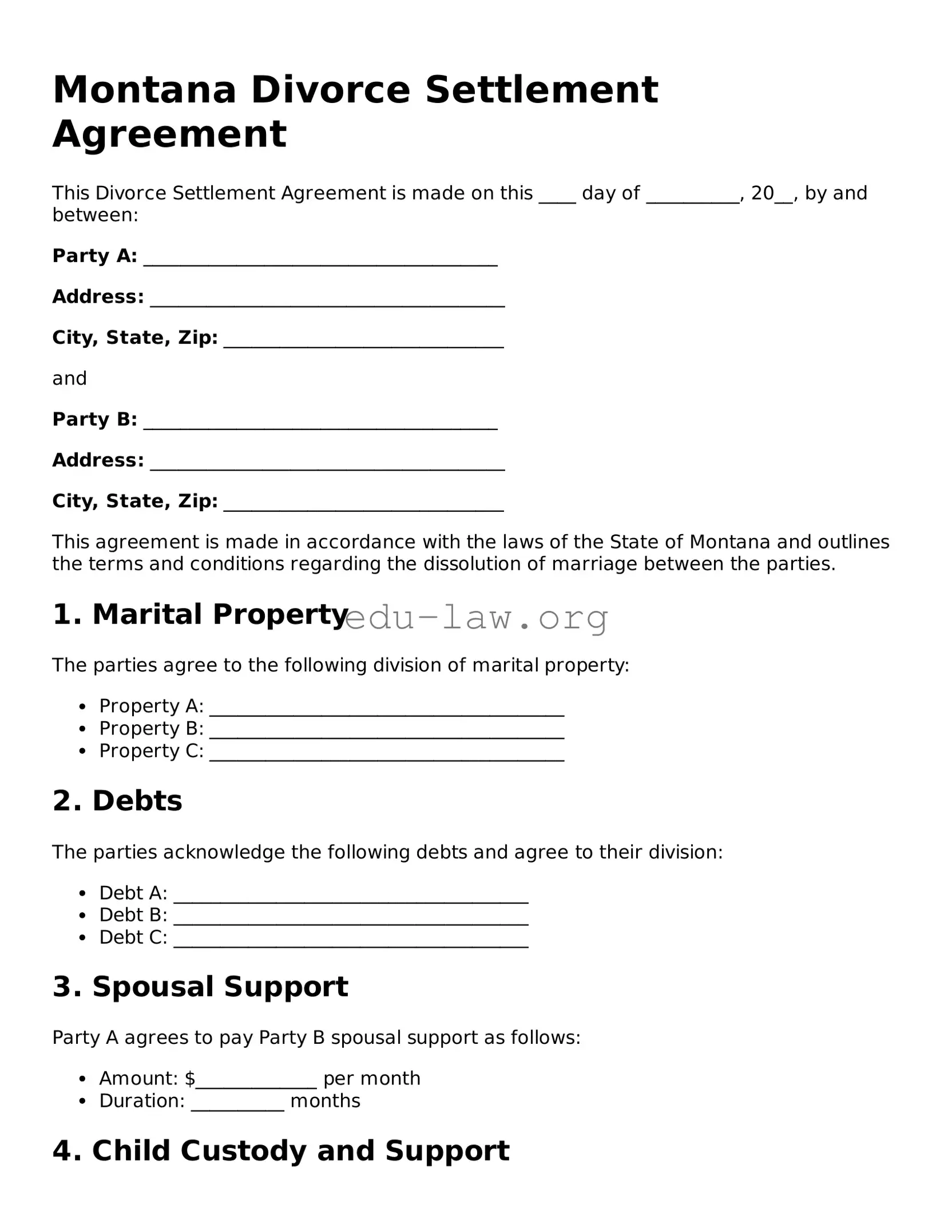
When navigating the complexities of divorce in Montana, understanding the Divorce Settlement Agreement form is crucial. This form serves as a comprehensive document that outlines the terms agreed upon by both parties regarding the division of assets, debts, and responsibilities. It addresses important aspects such as child custody, visitation rights, and child support, ensuring that the welfare of any children involved is prioritized. Additionally, the agreement covers spousal support and property division, providing clarity and structure to what can often be an emotionally charged process. By detailing each party's obligations and rights, the form aims to prevent future disputes and facilitate a smoother transition into post-divorce life. Completing this form accurately is essential for both parties to move forward with confidence and security.
Montana Divorce Settlement Agreement
This Divorce Settlement Agreement is made on this ____ day of __________, 20__, by and between:
Party A: ______________________________________
Address: ______________________________________
City, State, Zip: ______________________________
and
Party B: ______________________________________
Address: ______________________________________
City, State, Zip: ______________________________
This agreement is made in accordance with the laws of the State of Montana and outlines the terms and conditions regarding the dissolution of marriage between the parties.
1. Marital Property
The parties agree to the following division of marital property:
2. Debts
The parties acknowledge the following debts and agree to their division:
3. Spousal Support
Party A agrees to pay Party B spousal support as follows:
4. Child Custody and Support
If applicable, the parties agree to the following terms regarding child custody and support:
5. Miscellaneous Provisions
The parties agree to the following additional terms:
IN WITNESS WHEREOF, the parties have executed this Divorce Settlement Agreement as of the date first above written.
Party A Signature: ___________________________
Date: ___________________________
Party B Signature: ___________________________
Date: ___________________________
| Fact Name | Details |
|---|---|
| Governing Law | The Montana Divorce Settlement Agreement form is governed by the Montana Code Annotated, Title 40, Chapter 4. |
| Purpose | This form is used to outline the terms of a divorce settlement between parties, including asset division, child custody, and support obligations. |
| Filing Requirements | Both parties must sign the agreement, and it must be submitted to the court as part of the divorce proceedings. |
| Modification | The agreement can be modified in the future if both parties consent and the court approves the changes. |
Once you have the Montana Divorce Settlement Agreement form ready, you will need to complete it carefully. This form is essential for finalizing the terms of your divorce, including matters like asset division, child custody, and support. Make sure to have all necessary information at hand before you begin.
After filling out the form, review it thoroughly to ensure all information is accurate. It is crucial to submit the completed form to the appropriate court as part of your divorce proceedings.
What is a Montana Divorce Settlement Agreement form?
The Montana Divorce Settlement Agreement form is a legal document that outlines the terms of a divorce between two parties. It includes details about the division of property, debts, child custody, and support arrangements. This agreement helps both parties reach a mutual understanding and can simplify the divorce process.
Who needs to fill out this form?
How do I complete the form?
Is the Divorce Settlement Agreement legally binding?
What if we cannot agree on the terms?
Not reading the instructions carefully. Many individuals skip the guidelines, leading to incomplete or incorrect submissions.
Failing to include all relevant financial information. Omitting income, assets, or debts can result in an unfair settlement.
Not specifying child custody arrangements clearly. Ambiguity in custody terms can lead to disputes later.
Overlooking the importance of accurate valuations. Misstating the value of property or assets can affect the settlement.
Using vague language. Clear and specific terms are essential to avoid confusion in the future.
Neglecting to consider tax implications. Failing to account for taxes can lead to unexpected financial burdens.
Not addressing spousal support properly. Inadequate or unclear provisions can create issues post-divorce.
Forgetting to include a dispute resolution process. This step is crucial for resolving potential future disagreements.
Submitting the form without proper signatures. All required parties must sign to validate the agreement.
Not keeping copies of the completed form. Retaining a copy is essential for personal records and future reference.
When navigating a divorce in Montana, several key documents accompany the Divorce Settlement Agreement. Each of these forms plays a vital role in ensuring that the divorce process is smooth and that all legal requirements are met. Below is a list of commonly used documents that may be necessary alongside the Divorce Settlement Agreement.
Understanding these documents is crucial for anyone going through a divorce in Montana. Having them prepared and filed correctly can significantly impact the outcome and ensure that both parties are treated fairly throughout the process.
The Marital Settlement Agreement is a document that outlines the terms of a divorce, similar to the Montana Divorce Settlement Agreement. This agreement details the division of property, spousal support, and child custody arrangements. Both documents aim to resolve disputes amicably and provide a clear framework for the parties involved. By reaching a mutual understanding, couples can avoid lengthy court battles and establish their own terms for separation.
The Child Custody Agreement is another document that shares similarities with the Montana Divorce Settlement Agreement. While the latter may encompass broader divorce-related issues, the Child Custody Agreement specifically focuses on the arrangements for children. It addresses custody, visitation rights, and child support, ensuring that the children's best interests are prioritized. Both documents require careful consideration and negotiation to reflect the needs of all parties.
The Property Settlement Agreement is akin to the Montana Divorce Settlement Agreement in its focus on the division of assets and debts. This document delineates how marital property will be divided between spouses, including real estate, bank accounts, and personal belongings. By specifying the distribution of property, it aims to prevent future disputes and provides clarity on each party's financial responsibilities post-divorce.
The Separation Agreement serves a similar purpose as the Montana Divorce Settlement Agreement but is typically used before a divorce is finalized. This document outlines the terms of the couple's separation, including financial obligations and child custody arrangements. It allows couples to live apart while providing a framework for their responsibilities, which can later be incorporated into the divorce settlement.
The Parenting Plan, while often part of a divorce settlement, stands out for its specific focus on child-rearing arrangements. It details how parents will share responsibilities, manage schedules, and communicate regarding their children. Like the Montana Divorce Settlement Agreement, it emphasizes the importance of cooperation and mutual respect in co-parenting, ensuring that children's needs are met effectively.
The Spousal Support Agreement is closely related to the Montana Divorce Settlement Agreement, as it addresses financial support provided by one spouse to another after separation. This document outlines the amount, duration, and conditions of support, ensuring both parties understand their financial obligations. Clarity in this area can prevent future conflicts and provide stability for the receiving spouse.
The Prenuptial Agreement, while created before marriage, shares similarities with the Montana Divorce Settlement Agreement in terms of asset division and financial responsibilities. This document establishes how property and debts will be handled in the event of a divorce. By setting expectations upfront, couples can avoid contentious disputes later, much like the aims of a divorce settlement agreement.
The Mediation Agreement is another document that aligns with the Montana Divorce Settlement Agreement. This document is often the result of mediation sessions, where both parties work with a neutral third party to resolve their differences. The Mediation Agreement outlines the terms agreed upon during these sessions, promoting collaboration and understanding, similar to the goals of a divorce settlement.
Finally, the Final Judgment of Divorce is a court-issued document that finalizes the divorce process. While the Montana Divorce Settlement Agreement is a negotiated document between the parties, the Final Judgment incorporates those terms into a legally binding court order. Both documents serve to formalize the dissolution of marriage, but the Final Judgment provides the legal authority necessary to enforce the agreed-upon terms.
When filling out the Montana Divorce Settlement Agreement form, attention to detail is crucial. Here are some essential dos and don’ts to guide you through the process.
By following these guidelines, you can help ensure a smoother process when completing the Montana Divorce Settlement Agreement form.
Understanding the Montana Divorce Settlement Agreement form is crucial for anyone navigating the divorce process in the state. However, several misconceptions can lead to confusion. Below are seven common misconceptions:
Addressing these misconceptions can help individuals better navigate the divorce process in Montana and ensure that their rights and interests are protected.
Filling out the Montana Divorce Settlement Agreement form requires careful attention to detail. Here are some key takeaways to consider:
By following these key takeaways, you can navigate the process of completing the Montana Divorce Settlement Agreement form more effectively.