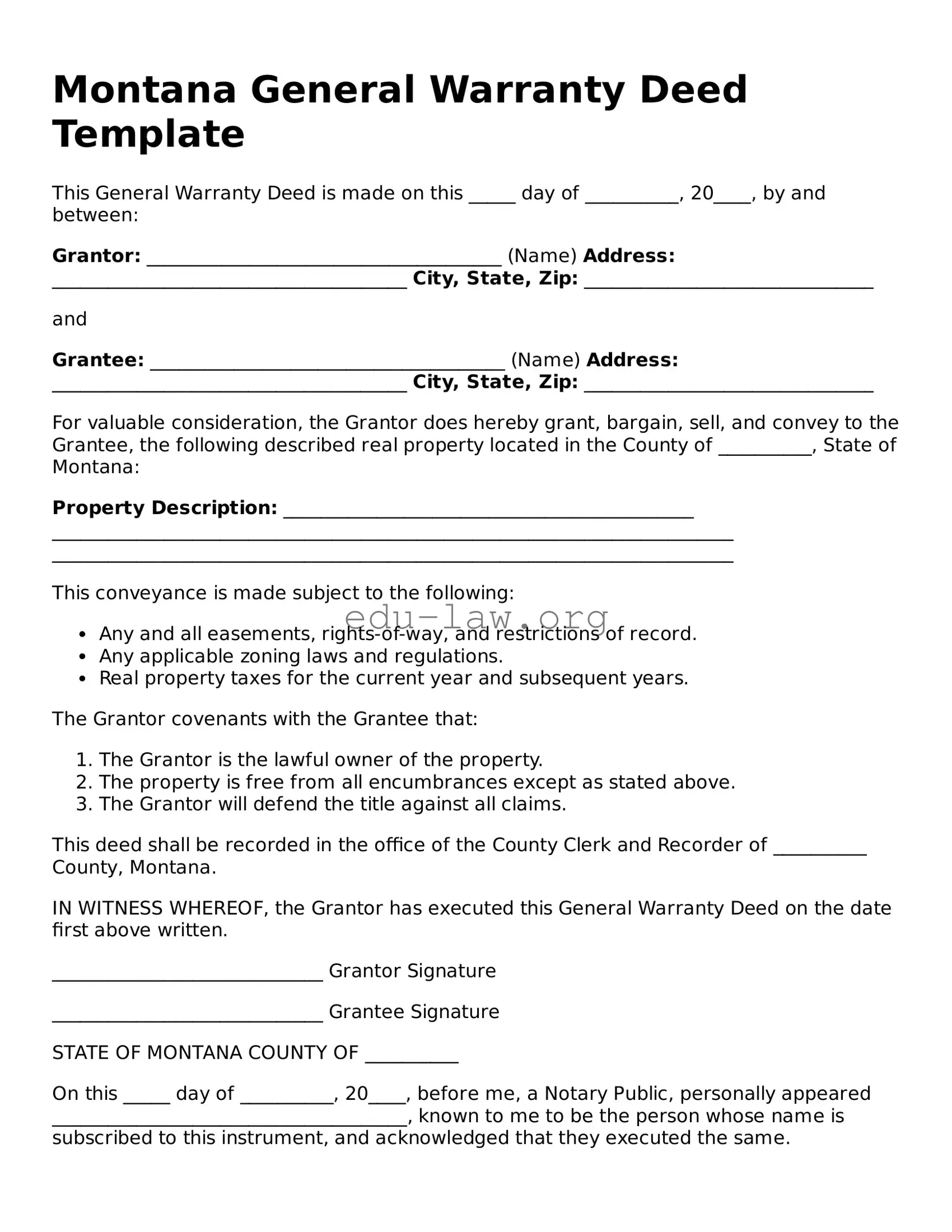
The Montana Deed form plays a crucial role in real estate transactions within the state, serving as a legal document that facilitates the transfer of property ownership. This form outlines essential details such as the names of the parties involved, a clear description of the property being transferred, and the terms of the transfer. It is designed to protect both the buyer and the seller by ensuring that all necessary information is documented. Additionally, the Montana Deed includes provisions for warranties, which can provide assurances regarding the title's legitimacy. Understanding the nuances of this form is vital for anyone involved in property transactions in Montana, as it helps prevent disputes and ensures a smooth transfer process. Whether you are a first-time homebuyer or an experienced investor, being familiar with the Montana Deed form can empower you to navigate the complexities of real estate with confidence.
Montana General Warranty Deed Template
This General Warranty Deed is made on this _____ day of __________, 20____, by and between:
Grantor: ______________________________________ (Name) Address: ______________________________________ City, State, Zip: _______________________________
and
Grantee: ______________________________________ (Name) Address: ______________________________________ City, State, Zip: _______________________________
For valuable consideration, the Grantor does hereby grant, bargain, sell, and convey to the Grantee, the following described real property located in the County of __________, State of Montana:
Property Description: ____________________________________________ _________________________________________________________________________ _________________________________________________________________________
This conveyance is made subject to the following:
The Grantor covenants with the Grantee that:
This deed shall be recorded in the office of the County Clerk and Recorder of __________ County, Montana.
IN WITNESS WHEREOF, the Grantor has executed this General Warranty Deed on the date first above written.
_____________________________ Grantor Signature
_____________________________ Grantee Signature
STATE OF MONTANA COUNTY OF __________
On this _____ day of __________, 20____, before me, a Notary Public, personally appeared ______________________________________, known to me to be the person whose name is subscribed to this instrument, and acknowledged that they executed the same.
Witness my hand and official seal. _____________________________ Notary Public for the State of Montana Residing at: ___________________ My commission expires: ___________
| Fact Name | Description |
|---|---|
| Definition | The Montana Deed form is a legal document used to transfer ownership of real property in Montana. |
| Types of Deeds | Montana recognizes various types of deeds, including warranty deeds, quitclaim deeds, and special warranty deeds. |
| Governing Law | The transfer of property in Montana is governed by the Montana Code Annotated, specifically Title 70, Chapter 21. |
| Signature Requirements | All parties involved in the property transfer must sign the deed for it to be valid. |
| Notarization | A notary public must witness the signatures on the deed to ensure its authenticity. |
| Recording | To protect ownership rights, the completed deed should be recorded with the county clerk and recorder's office. |
After obtaining the Montana Deed form, you will need to fill it out accurately to ensure proper recording. Follow these steps to complete the form correctly.
What is a Montana Deed form?
A Montana Deed form is a legal document used to transfer ownership of real property in the state of Montana. This form serves as a record of the transaction and outlines the details of the property being transferred, including the names of the parties involved and any relevant legal descriptions. It is essential for ensuring that the transfer is recognized by the state and protects the rights of both the buyer and seller.
What types of deeds are available in Montana?
In Montana, several types of deeds can be used depending on the nature of the transaction. The most common types include Warranty Deeds, which guarantee that the seller has clear title to the property; Quitclaim Deeds, which transfer any interest the seller has without guaranteeing clear title; and Special Warranty Deeds, which provide limited guarantees. Each type serves a different purpose and offers varying levels of protection for the buyer.
How do I complete a Montana Deed form?
Completing a Montana Deed form requires careful attention to detail. Start by accurately filling in the names of the grantor (seller) and grantee (buyer), along with their addresses. Include a legal description of the property, which can often be found in previous deeds or property tax records. After filling in the necessary information, the deed must be signed by the grantor in the presence of a notary public to ensure its validity.
Is notarization required for a Montana Deed?
Yes, notarization is required for a Montana Deed. The grantor must sign the deed in front of a notary public, who will then affix their seal. This step is crucial because it verifies the identity of the signer and confirms that the signing was done voluntarily. Without notarization, the deed may not be considered legally binding.
Where do I file the Montana Deed after it is completed?
Once the Montana Deed is completed and notarized, it must be filed with the county clerk and recorder in the county where the property is located. Filing the deed is important as it provides public notice of the ownership transfer. This step protects the rights of the new owner and ensures that the property records are updated accordingly.
Are there any fees associated with filing a Montana Deed?
Yes, there are fees associated with filing a Montana Deed. These fees vary by county, so it is advisable to check with the local county clerk and recorder’s office for the exact amount. In addition to filing fees, there may also be costs related to notarization and any other services required to complete the transaction.
What happens if a Montana Deed is not filed?
If a Montana Deed is not filed, the transfer of ownership may not be recognized legally. This can lead to complications, such as disputes over property rights or difficulties in selling the property in the future. It is critical to file the deed promptly to ensure that the new ownership is officially recorded and protected.
Can I use a Montana Deed form for any type of property?
Generally, a Montana Deed form can be used for most types of real property, including residential, commercial, and agricultural land. However, certain types of properties, such as those held in a trust or properties subject to specific legal restrictions, may require different forms or additional documentation. It is advisable to consult with a legal professional to ensure compliance with all applicable laws and regulations.
Failing to include all necessary parties. It is essential to list all individuals or entities involved in the transaction. Omitting a party can lead to legal complications.
Incorrectly identifying the property. The legal description of the property must be precise. Errors in the description can result in disputes over ownership.
Not signing the deed. All parties must sign the document for it to be valid. A missing signature can invalidate the deed.
Improper notarization. The deed must be notarized correctly. Failure to follow the proper notarization process can lead to issues with acceptance.
Using outdated forms. Always ensure that the most current version of the Montana Deed form is used. Using an outdated form may not comply with current regulations.
Neglecting to record the deed. After completing the form, it is crucial to record it with the appropriate county office. Failing to do so can affect the enforceability of the deed.
When dealing with property transactions in Montana, the Deed form is just one piece of the puzzle. Several other documents often accompany it to ensure a smooth transfer of ownership and to protect the interests of all parties involved. Below is a list of commonly used forms that work in conjunction with the Montana Deed form.
Each of these documents plays a vital role in the property transfer process in Montana. They help clarify responsibilities, protect rights, and ensure that the transaction proceeds smoothly. Understanding these forms can aid in making informed decisions during a property sale or purchase.
The Montana Deed form shares similarities with the Warranty Deed. Both documents serve to transfer property ownership from one party to another. A Warranty Deed guarantees that the seller holds clear title to the property and has the right to sell it. It also assures the buyer that they will not face any future claims against the property. This level of assurance is crucial for buyers who want to ensure their investment is protected against potential disputes.
Another document akin to the Montana Deed is the Quitclaim Deed. Unlike a Warranty Deed, a Quitclaim Deed does not guarantee that the seller has clear title. Instead, it simply transfers whatever interest the seller may have in the property, if any. This type of deed is often used between family members or in situations where the parties know each other well, as it carries more risk for the buyer.
The Special Warranty Deed is another similar document. This deed provides a limited guarantee, stating that the seller has not encumbered the property during their ownership. While it offers some protection to the buyer, it does not extend to any claims that may have arisen before the seller acquired the property. This makes it a middle ground between a Warranty Deed and a Quitclaim Deed.
The Bargain and Sale Deed also resembles the Montana Deed. This document implies that the seller has title to the property and the right to transfer it, but it does not provide the same level of guarantees as a Warranty Deed. Buyers should be cautious, as this type of deed may leave them vulnerable to claims against the property that existed prior to the sale.
A Trustee’s Deed is another related document. This deed is used when a property is transferred by a trustee, often in a foreclosure situation or as part of a trust. The trustee acts on behalf of the beneficiaries, and the deed typically includes a statement that the trustee has the authority to make the transfer. While it serves a specific purpose, it still functions to convey property ownership.
The Executor’s Deed is similar in that it is used to transfer property from a deceased person's estate. This document is executed by the executor named in the will. It conveys the property to the heirs or beneficiaries as specified in the will, ensuring that the deceased's wishes are honored. Like other deeds, it formalizes the transfer of ownership.
The Grant Deed is another document that functions similarly to the Montana Deed. It guarantees that the seller has not sold the property to anyone else and that the property is free from any encumbrances made during the seller's ownership. This provides a level of assurance to the buyer, although it does not offer the same comprehensive protection as a Warranty Deed.
Lastly, the Deed of Trust is related but serves a different purpose. It is used in real estate transactions to secure a loan. The borrower conveys the title of the property to a trustee, who holds it as security for the loan until it is paid off. While it involves the transfer of property, its primary function is to protect the lender’s interest rather than to convey ownership outright.
When filling out the Montana Deed form, it's important to follow certain guidelines. Here are some things you should and shouldn't do:
By following these tips, you can help ensure that your Montana Deed form is filled out correctly and efficiently.
Understanding the Montana Deed form is crucial for anyone involved in real estate transactions in the state. However, several misconceptions can lead to confusion. Here are four common misunderstandings:
This is not entirely accurate. While the primary purpose of the Montana Deed is to transfer ownership, it can also be used to clarify property rights, establish boundaries, or create easements.
This misconception can lead to legal issues. In Montana, a deed must be notarized to be legally binding. Without a notary's signature, the deed may not be recognized by the courts.
While it is possible for individuals to complete the form themselves, it is advisable to seek legal guidance. Mistakes can lead to disputes or complications in property ownership.
This is misleading. Although a deed is a formal document, there are legal processes available to amend or revoke a deed if necessary. Understanding these processes is important for property owners.
When filling out and using the Montana Deed form, there are several important factors to consider. Understanding these key points can help ensure the process goes smoothly and legally.
By following these guidelines, individuals can navigate the complexities of property transactions in Montana more effectively.