When starting a business in Montana, one of the essential steps is to file the Articles of Incorporation form. This document serves as a foundational legal requirement for creating a corporation within the state. It outlines critical information about the corporation, including its name, purpose, and the address of its principal office. Additionally, the form requires details about the registered agent, who will be responsible for receiving legal documents on behalf of the corporation. The Articles of Incorporation also stipulate the number of shares the corporation is authorized to issue, which is vital for understanding ownership structure. By completing this form, business owners not only comply with state regulations but also establish their corporation as a distinct legal entity. This process can provide various benefits, such as limited liability protection for the owners and enhanced credibility with customers and investors. Understanding the requirements and implications of the Articles of Incorporation is crucial for anyone looking to navigate the corporate landscape in Montana.
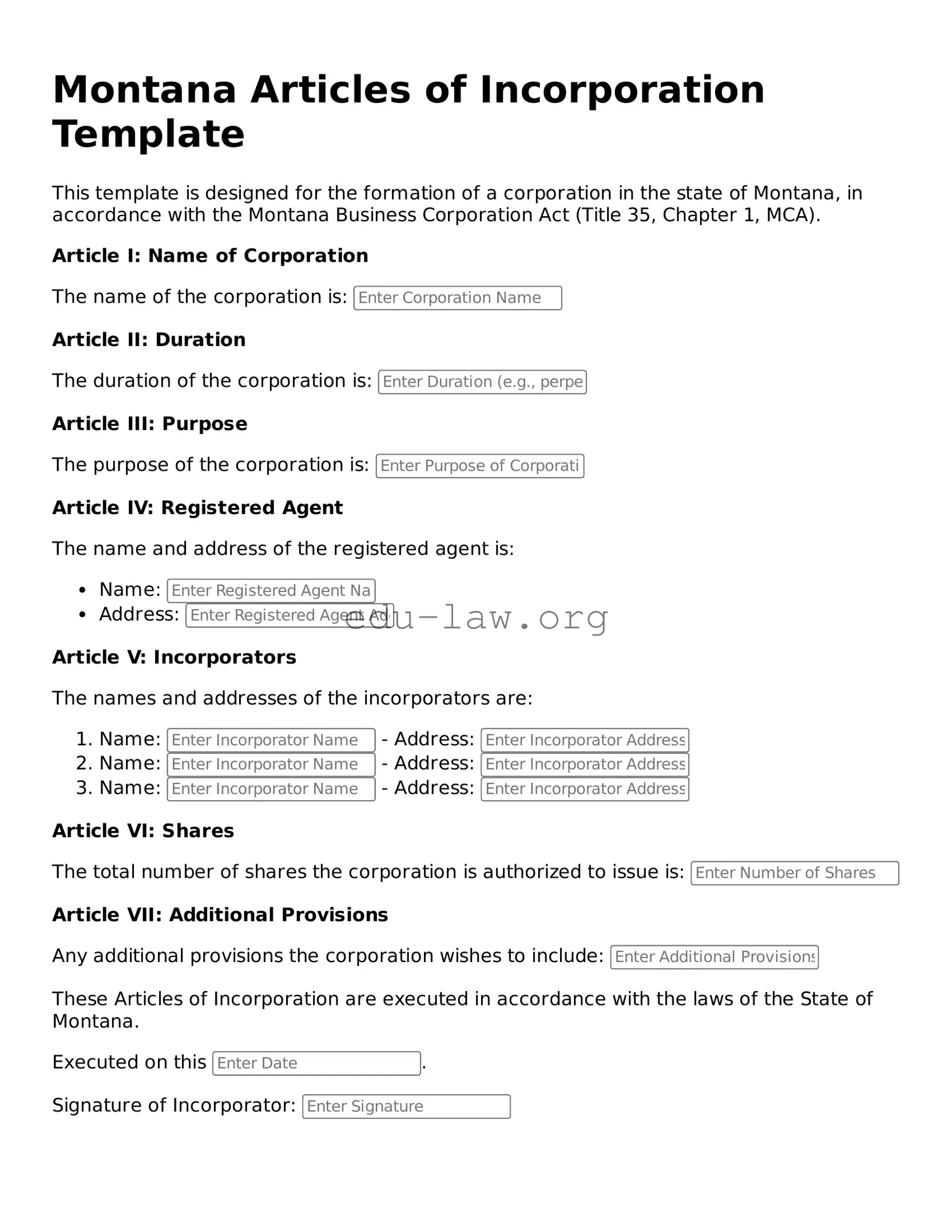
Montana Articles of Incorporation Template
This template is designed for the formation of a corporation in the state of Montana, in accordance with the Montana Business Corporation Act (Title 35, Chapter 1, MCA).
Article I: Name of Corporation
The name of the corporation is:
Article II: Duration
The duration of the corporation is:
Article III: Purpose
The purpose of the corporation is:
Article IV: Registered Agent
The name and address of the registered agent is:
Article V: Incorporators
The names and addresses of the incorporators are:
Article VI: Shares
The total number of shares the corporation is authorized to issue is:
Article VII: Additional Provisions
Any additional provisions the corporation wishes to include:
These Articles of Incorporation are executed in accordance with the laws of the State of Montana.
Executed on this .
Signature of Incorporator:
| Fact Name | Description |
|---|---|
| Governing Law | The Montana Articles of Incorporation are governed by Title 35, Chapter 1 of the Montana Code Annotated. |
| Purpose | This form is used to officially create a corporation in the state of Montana. |
| Required Information | Key details include the corporation's name, duration, and purpose. |
| Registered Agent | A registered agent must be designated to receive legal documents on behalf of the corporation. |
| Incorporator | At least one incorporator is required to sign the Articles of Incorporation. |
| Filing Fee | A filing fee is required when submitting the Articles of Incorporation to the state. |
| Submission Method | Forms can be submitted online, by mail, or in person at the Secretary of State's office. |
| Amendments | Changes to the Articles of Incorporation can be made by filing an amendment form. |
| Public Record | Once filed, the Articles of Incorporation become part of the public record. |
| Compliance | Ongoing compliance with state laws is necessary to maintain the corporation's good standing. |
After you have your Montana Articles of Incorporation form ready, you will need to complete it with the required information. This process is straightforward, and following these steps will help ensure that you fill out the form correctly.
Once you have filled out the form, you can proceed to file it with the appropriate state office along with any required fees. Keep a copy for your records.
What is the purpose of the Montana Articles of Incorporation form?
The Montana Articles of Incorporation form is a legal document that establishes a corporation in the state of Montana. By filing this form, you create a separate legal entity that can own property, enter into contracts, and conduct business. This process also provides liability protection for the owners, meaning their personal assets are generally protected from business debts and legal actions against the corporation.
What information do I need to provide when completing the form?
When filling out the Montana Articles of Incorporation, you will need to provide several key pieces of information. This includes the name of your corporation, which must be unique and not already in use by another entity in Montana. You will also need to include the corporation's purpose, the address of the principal office, and the names and addresses of the initial directors. Additionally, you will need to specify the number of shares the corporation is authorized to issue. Ensuring that all this information is accurate and complete is crucial for a smooth filing process.
How do I file the Montana Articles of Incorporation?
Filing the Montana Articles of Incorporation can be done either online or by mail. If you choose to file online, you will need to visit the Montana Secretary of State’s website, where you can complete the form electronically. If you prefer to file by mail, you can download the form, fill it out, and send it to the appropriate office along with the required filing fee. Be sure to keep a copy of your completed form for your records. Once filed, the Secretary of State will review your application and, if everything is in order, will issue a certificate of incorporation.
What is the filing fee for the Montana Articles of Incorporation?
The filing fee for the Montana Articles of Incorporation varies depending on the type of corporation you are forming. Generally, the fee is around $70 for a standard corporation. However, additional fees may apply if you choose expedited processing or if you are filing for a specific type of corporation, such as a nonprofit. It's important to check the latest fee schedule on the Montana Secretary of State's website to ensure you include the correct amount with your filing.
Incorrect Business Name: Many people fail to ensure that their chosen business name is unique and not already in use. It’s essential to check the Montana Secretary of State’s business name database to avoid conflicts.
Missing Registered Agent Information: A registered agent is required for every corporation in Montana. Omitting this information can lead to delays in processing your application.
Inaccurate Purpose Statement: The purpose of the corporation must be clearly stated. Vague or overly broad statements can cause confusion and may result in rejection of the application.
Improper Filing Fee: Each submission must include the correct filing fee. Failing to include the proper amount can delay the incorporation process.
Omitting Signatures: All necessary signatures must be included on the form. Missing signatures can render the application invalid.
Not Following Submission Guidelines: Each form has specific submission guidelines, including how to file and where to send the documents. Ignoring these instructions can lead to complications.
When forming a corporation in Montana, the Articles of Incorporation is a crucial document. However, several other forms and documents are often necessary to ensure compliance with state regulations and to establish the corporation's operations effectively. Below is a list of commonly used documents alongside the Articles of Incorporation.
These documents work in conjunction with the Articles of Incorporation to establish a legally compliant and operationally sound corporation in Montana. Ensuring that all necessary forms are completed and submitted correctly is vital for the successful formation and management of the business.
The Articles of Incorporation in Montana serves as a foundational document for establishing a corporation. Similar to the Articles of Incorporation, the Certificate of Incorporation is used in other states to formally create a corporation. This document outlines essential details such as the corporation's name, purpose, and the number of shares it can issue. While the terminology may vary by state, both documents fulfill the same purpose of legally recognizing a corporation's existence.
The Bylaws of a corporation are another important document that complements the Articles of Incorporation. Bylaws outline the internal rules and procedures for managing the corporation. They detail the roles of directors and officers, how meetings will be conducted, and other operational guidelines. While the Articles of Incorporation focus on the corporation's formation, the Bylaws govern its day-to-day operations.
A Limited Liability Company (LLC) Operating Agreement serves a similar purpose for LLCs as the Articles of Incorporation do for corporations. This document outlines the management structure and operating procedures of the LLC. It includes information on member responsibilities, profit distribution, and decision-making processes. Both documents are essential for establishing a legal framework, but they cater to different types of business entities.
The Partnership Agreement is another document that shares similarities with the Articles of Incorporation. This agreement is used by partnerships to outline the terms of the partnership, including each partner's contributions, profit-sharing, and responsibilities. While the Articles of Incorporation focus on corporate structure, the Partnership Agreement emphasizes the collaborative nature of partnerships.
The Certificate of Good Standing is a document that verifies a corporation's compliance with state regulations. This certificate is similar to the Articles of Incorporation in that it confirms the legal status of a corporation. While the Articles of Incorporation establish the corporation, the Certificate of Good Standing demonstrates that it is actively maintaining its legal obligations.
The Statement of Information is a document required in many states that provides updated information about a corporation. Similar to the Articles of Incorporation, it contains vital information such as the corporation's address, officers, and registered agent. While the Articles serve as the initial formation document, the Statement of Information ensures that the state has current records about the corporation.
The Foreign Corporation Registration is necessary for a corporation that wishes to operate in a state other than where it was formed. This document is similar to the Articles of Incorporation as it provides essential information about the corporation and its intended operations in a new state. Both documents establish the corporation's legitimacy, but the Foreign Corporation Registration addresses multi-state operations.
The Assumed Name Certificate, also known as a "Doing Business As" (DBA) registration, is another document that shares a purpose with the Articles of Incorporation. This certificate allows a corporation to operate under a name different from its legal name. While the Articles of Incorporation establish the corporation's official name, the Assumed Name Certificate permits flexibility in branding and marketing.
The Stock Certificates issued by a corporation are documents that signify ownership of shares in the company. Similar to the Articles of Incorporation, which authorize the issuance of shares, stock certificates represent the actual ownership stake in the corporation. Both documents are essential for understanding the ownership structure of a corporation.
Finally, the Annual Report is a document that corporations must file to provide updated information to the state. This report is similar to the Articles of Incorporation as it reflects the corporation's ongoing compliance and operational status. While the Articles of Incorporation are filed at the formation stage, the Annual Report is a recurring obligation that keeps the state informed about the corporation's activities.
When filling out the Montana Articles of Incorporation form, attention to detail is essential. Here are ten guidelines to help ensure a smooth process.
When it comes to incorporating a business in Montana, there are several misconceptions that can lead to confusion. Here are six common misunderstandings about the Montana Articles of Incorporation form:
Understanding these misconceptions can help clarify the process of incorporating a business in Montana. Taking the time to learn the facts can lead to a smoother experience and better decision-making.
When filling out and using the Montana Articles of Incorporation form, it’s essential to keep several key points in mind. These takeaways will help ensure a smooth process and compliance with state requirements.
Filing the Articles of Incorporation correctly is vital for your business's legal standing. Ensure all information is accurate and complete to avoid delays or issues down the line.