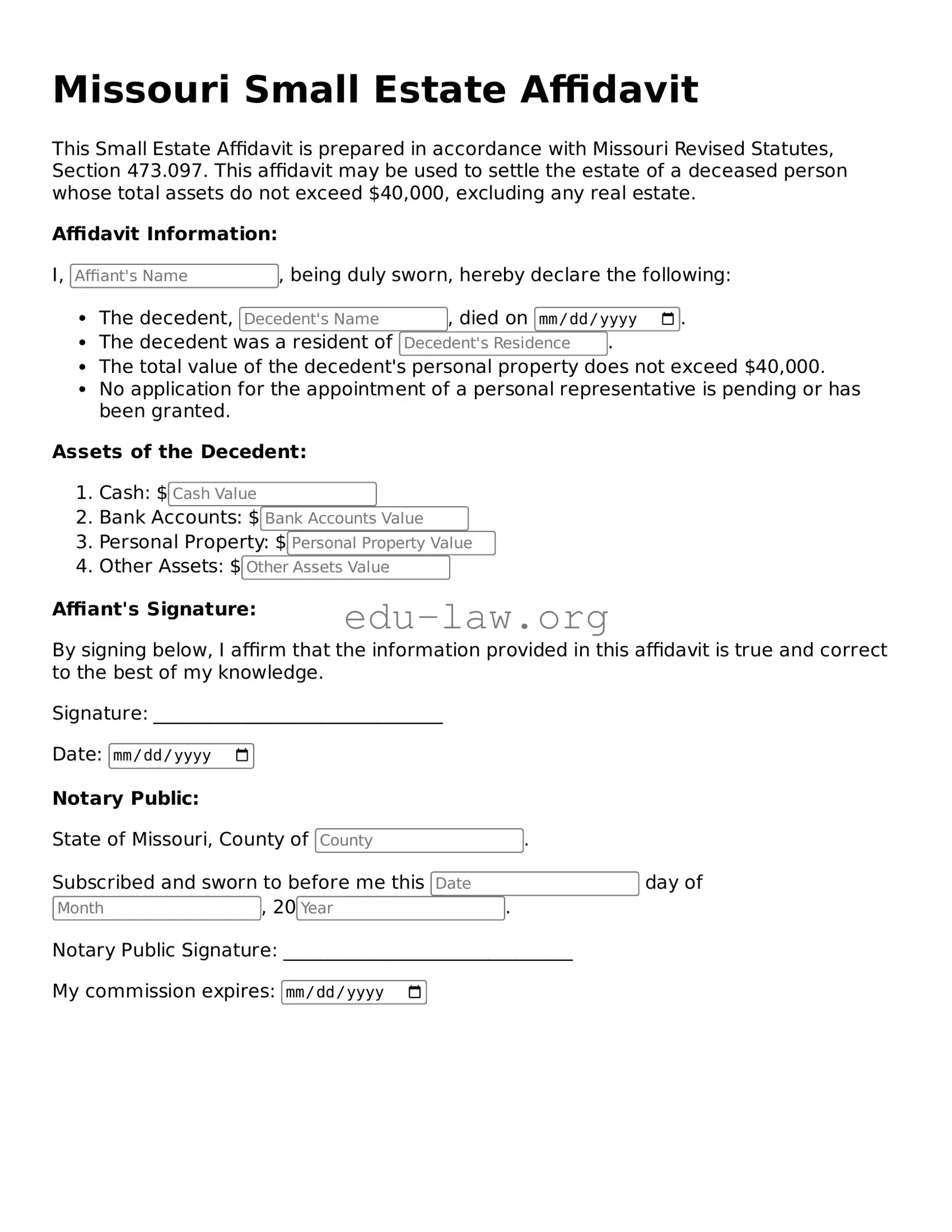
In the state of Missouri, the Small Estate Affidavit serves as a valuable tool for individuals seeking to simplify the process of settling an estate when the total value of the deceased's assets falls below a certain threshold. This form allows heirs or beneficiaries to bypass the lengthy and often costly probate process, enabling them to claim the deceased's assets more efficiently. Typically, the Small Estate Affidavit can be utilized when the estate's value does not exceed $40,000, providing a streamlined alternative for those navigating the complexities of estate administration. To effectively use this affidavit, individuals must meet specific eligibility requirements, including being a qualified heir or beneficiary. Additionally, the form requires the declaration of various details, such as the deceased's information, a list of assets, and the names of all heirs, ensuring transparency and accountability in the transfer of assets. By understanding the nuances of the Small Estate Affidavit, individuals can better manage the responsibilities that come with settling an estate, while also honoring the wishes of their loved ones.
Missouri Small Estate Affidavit
This Small Estate Affidavit is prepared in accordance with Missouri Revised Statutes, Section 473.097. This affidavit may be used to settle the estate of a deceased person whose total assets do not exceed $40,000, excluding any real estate.
Affidavit Information:
I, , being duly sworn, hereby declare the following:
Assets of the Decedent:
Affiant's Signature:
By signing below, I affirm that the information provided in this affidavit is true and correct to the best of my knowledge.
Signature: _______________________________
Date:
Notary Public:
State of Missouri, County of .
Subscribed and sworn to before me this day of , 20.
Notary Public Signature: _______________________________
My commission expires:
| Fact Name | Description |
|---|---|
| Purpose | The Missouri Small Estate Affidavit allows heirs to claim assets without going through formal probate when the estate is below a certain value. |
| Value Limit | As of 2023, the total value of the estate must not exceed $40,000 for individuals or $100,000 for married couples to qualify for the affidavit. |
| Governing Law | The process is governed by Missouri Revised Statutes, Section 473.097. |
| Eligibility | Only certain individuals, such as heirs or beneficiaries, can file the affidavit. They must be able to prove their relationship to the deceased. |
| Required Information | The affidavit must include details about the deceased, the heirs, and a list of the estate's assets. |
| Filing Process | Heirs must complete the affidavit and file it with the appropriate court in the county where the deceased lived. |
| Asset Transfer | Once the affidavit is approved, heirs can transfer assets like bank accounts or real estate without further court intervention. |
After gathering the necessary information, you are ready to fill out the Missouri Small Estate Affidavit form. This process involves carefully entering details about the deceased, their assets, and the individuals entitled to inherit. Accuracy is crucial to ensure a smooth transition of assets.
Once you have filled out the form and completed all the necessary steps, you can proceed to file the affidavit with the appropriate court. This will initiate the process of transferring the assets to the rightful heirs.
What is a Missouri Small Estate Affidavit?
The Missouri Small Estate Affidavit is a legal document that allows individuals to claim assets from a deceased person's estate without going through the lengthy and often costly probate process. This affidavit is typically used when the total value of the estate is below a certain threshold, which is currently set at $40,000 for personal property. By using this affidavit, heirs can simplify the transfer of assets such as bank accounts, vehicles, and other personal belongings directly to the beneficiaries.
Who is eligible to use the Small Estate Affidavit?
Eligibility to use the Small Estate Affidavit generally requires that the estate's total value does not exceed the established limit. Additionally, the individual claiming the assets must be an heir or a designated beneficiary. It is important to note that if there are any outstanding debts or claims against the estate, those must be addressed before the affidavit can be utilized. The person completing the affidavit must also be at least 18 years old and of sound mind.
What assets can be claimed using the Small Estate Affidavit?
With a Missouri Small Estate Affidavit, various types of personal property can be claimed. This includes items like bank accounts, stocks, bonds, vehicles, and tangible personal property. However, real estate cannot be transferred using this affidavit. If the deceased owned real estate, a different legal process may be required to transfer that property to the heirs.
How do I complete the Small Estate Affidavit?
Completing the Small Estate Affidavit involves gathering necessary information about the deceased, including their name, date of death, and a description of the assets being claimed. The form must be filled out accurately, ensuring that all required signatures are included. Once completed, the affidavit needs to be notarized. After notarization, the document can be presented to financial institutions or other entities holding the deceased's assets to facilitate the transfer.
Is there a time limit for filing the Small Estate Affidavit?
While there is no strict deadline for filing a Small Estate Affidavit, it is advisable to complete the process in a timely manner. Delaying the filing may complicate the transfer of assets, especially if there are outstanding debts or claims against the estate. It is prudent to address any potential issues as soon as possible to ensure a smooth transition of assets to the rightful heirs.
What should I do if there are disputes among heirs regarding the Small Estate Affidavit?
In cases where disputes arise among heirs regarding the Small Estate Affidavit, it may be necessary to seek legal advice. Open communication among family members can often resolve misunderstandings. However, if disagreements persist, mediation or legal intervention may be required to address the issues. It is important to handle such disputes carefully to avoid further complications in the estate settlement process.
Failing to verify eligibility: Individuals often overlook the requirement that the estate must not exceed $40,000 in value. This mistake can lead to delays or rejections.
Inaccurate information: Providing incorrect names, addresses, or other personal details can result in complications. Double-checking all entries is crucial.
Missing signatures: Some people forget to sign the affidavit or have the required witnesses sign. All necessary signatures must be present for the form to be valid.
Not including supporting documents: Failing to attach necessary documents, such as death certificates or proof of ownership, can hinder the process. Ensure all required documentation is included.
Ignoring state-specific requirements: Each state has unique rules regarding small estate affidavits. Not adhering to Missouri's specific guidelines can lead to issues.
Submitting the form to the wrong court: Some individuals mistakenly file the affidavit in an incorrect jurisdiction. It is essential to file in the appropriate probate court.
Not understanding the consequences: Many people do not fully grasp the implications of using a small estate affidavit. This can lead to unexpected legal challenges or complications in the future.
When dealing with the Missouri Small Estate Affidavit, it's essential to understand that several other forms and documents may accompany it. These documents help streamline the process of settling an estate and ensure that all legal requirements are met. Here are four commonly used forms that often go hand in hand with the Small Estate Affidavit:
Understanding these accompanying documents is vital for anyone navigating the estate settlement process in Missouri. Each form plays a unique role in ensuring that the estate is handled properly and in accordance with the law.
The Missouri Small Estate Affidavit is similar to the Affidavit of Heirship. Both documents serve to establish the rightful heirs of a deceased person's estate without the need for formal probate proceedings. The Affidavit of Heirship is often used when the estate is relatively small and the heirs are known, allowing them to claim property or assets directly. This document typically requires the signatures of witnesses who can attest to the relationship between the deceased and the heirs, ensuring a clear line of succession.
Another document that resembles the Small Estate Affidavit is the Simplified Probate Petition. This petition is designed for smaller estates, allowing for a more streamlined process than traditional probate. Like the Small Estate Affidavit, it aims to expedite the distribution of assets to heirs. However, the Simplified Probate Petition may involve a court hearing, while the Small Estate Affidavit can often be executed without such proceedings, making it a more straightforward option for eligible estates.
The Declaration of Trust is also comparable to the Small Estate Affidavit in that both documents facilitate the transfer of assets without going through the lengthy probate process. A Declaration of Trust allows individuals to place their assets in a trust during their lifetime, which can then be distributed according to their wishes upon death. This method provides privacy and can minimize estate taxes, similar to how the Small Estate Affidavit simplifies the transfer of small estates.
The Last Will and Testament shares similarities with the Small Estate Affidavit as both documents outline the distribution of a deceased person's assets. While a will typically requires probate, the Small Estate Affidavit allows for a quicker transfer of assets for estates that meet specific criteria. Both documents reflect the individual's intentions regarding their property and ensure that heirs receive their rightful inheritance.
The Transfer on Death (TOD) deed is another document that parallels the Small Estate Affidavit. A TOD deed allows property owners to designate beneficiaries who will automatically inherit the property upon the owner's death, bypassing probate. This document simplifies the transfer process, much like the Small Estate Affidavit, which enables heirs to claim assets without formal court involvement.
The Community Property Agreement is also similar, particularly for married couples in community property states. This agreement allows spouses to agree on the joint ownership of property, which can simplify the transfer of assets upon death. While the Small Estate Affidavit focuses on small estates, both documents aim to streamline the process of asset distribution, reflecting the couple's intentions.
The Affidavit of Support can be compared to the Small Estate Affidavit in that both serve to affirm the intentions and relationships of individuals involved in asset distribution. The Affidavit of Support is commonly used in immigration contexts to prove financial support, while the Small Estate Affidavit confirms the heirs' rights to inherit. Both documents rely on the truthfulness of the affiant's statements to facilitate their respective processes.
Lastly, the Power of Attorney (POA) document has similarities with the Small Estate Affidavit in terms of granting authority to act on someone else's behalf. A POA allows an individual to manage another person's financial or medical affairs, which can include handling estate matters. While the Small Estate Affidavit deals with the distribution of assets after death, both documents empower individuals to make decisions regarding property and finances, ensuring that the wishes of the principal are honored.
When filling out the Missouri Small Estate Affidavit form, it’s important to follow specific guidelines. Here’s a list of things you should and shouldn’t do:
When it comes to the Missouri Small Estate Affidavit form, there are several misconceptions that can lead to confusion. Here are four common misunderstandings:
Understanding these misconceptions can help streamline the process of handling a small estate in Missouri. Always consider consulting with a legal professional for personalized guidance.
Filling out and using the Missouri Small Estate Affidavit form can be a straightforward process if you keep a few key points in mind. Here are some essential takeaways to help you navigate this form effectively:
By following these key takeaways, you can confidently complete the Missouri Small Estate Affidavit form and ensure a smoother process for settling the estate.