In Missouri, the Release of Liability form plays a crucial role in protecting individuals and organizations from potential legal claims arising from activities that carry inherent risks. Whether you’re organizing a sports event, a recreational outing, or any activity where participants might face injury, this form is essential. It outlines the understanding between the parties involved, stating that participants acknowledge the risks and agree not to hold the organizers responsible for any accidents or injuries that may occur. The form typically includes key elements such as a clear description of the activity, the risks involved, and the explicit consent of the participant. By signing this document, individuals confirm their awareness of these risks and waive their right to pursue legal action in the event of an incident. It's important to ensure that the language used is straightforward and that participants fully comprehend what they are signing. This can help prevent misunderstandings and provide a layer of protection for those organizing the event. Understanding the nuances of the Missouri Release of Liability form is vital for anyone planning an event, as it not only safeguards against potential lawsuits but also fosters a culture of safety and responsibility among participants.
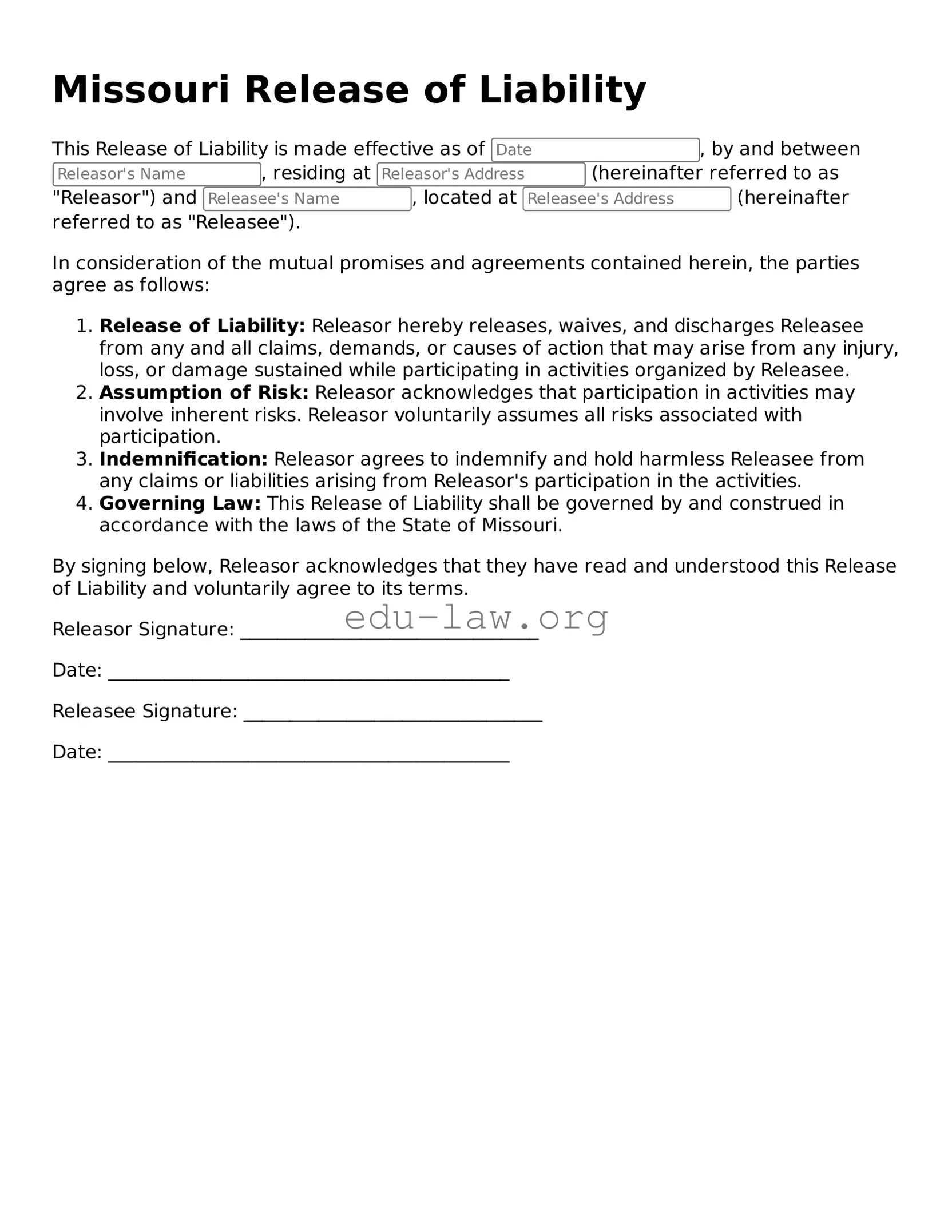
Missouri Release of Liability
This Release of Liability is made effective as of , by and between , residing at (hereinafter referred to as "Releasor") and , located at (hereinafter referred to as "Releasee").
In consideration of the mutual promises and agreements contained herein, the parties agree as follows:
By signing below, Releasor acknowledges that they have read and understood this Release of Liability and voluntarily agree to its terms.
Releasor Signature: ________________________________
Date: ___________________________________________
Releasee Signature: ________________________________
Date: ___________________________________________
| Fact Name | Description |
|---|---|
| Purpose | The Missouri Release of Liability form is used to protect individuals and organizations from legal claims resulting from injuries or damages incurred during an activity. |
| Governing Law | This form is governed by Missouri state law, particularly under the Missouri Revised Statutes. |
| Voluntary Participation | Participants must voluntarily sign the form, indicating their understanding and acceptance of the risks involved. |
| Scope of Release | The form typically releases the organizer from liability for ordinary negligence, but not for gross negligence or willful misconduct. |
| Minors | For participants under 18, a parent or guardian must sign the release on their behalf. |
| Enforceability | The enforceability of the release may be challenged in court if it is deemed unconscionable or unclear. |
Filling out the Missouri Release of Liability form is an important step in ensuring that all parties understand the terms of participation. After completing the form, it is essential to review it carefully before submission to ensure accuracy and completeness.
What is a Missouri Release of Liability form?
A Missouri Release of Liability form is a legal document that protects an individual or organization from being held responsible for injuries or damages that may occur during a specific activity or event. It is often used in recreational activities, sports events, and other situations where there is a risk of injury.
Why should I use a Release of Liability form?
Using a Release of Liability form can help ensure that participants understand the risks involved in an activity. It also provides a layer of protection for organizers or providers by reducing the likelihood of legal claims for injuries that occur during the activity.
Who should sign the Release of Liability form?
Typically, all participants in the activity should sign the form. If a participant is a minor, a parent or legal guardian must sign on their behalf. This ensures that everyone involved acknowledges the risks and agrees to the terms laid out in the document.
What information is included in the form?
The form usually includes details such as the names of the parties involved, a description of the activity, acknowledgment of the risks, and a statement releasing the organizer from liability. It may also include space for signatures and dates to confirm agreement.
Is the Release of Liability form legally binding?
Yes, when properly executed, the form can be legally binding. However, its enforceability may depend on various factors, including how clearly the risks are outlined and whether the form complies with state laws. Courts generally uphold these forms as long as they are reasonable and not overly broad.
Can I modify the Release of Liability form?
Yes, you can modify the form to fit the specific needs of your event or activity. However, it is essential to ensure that any modifications do not compromise the legal protections intended by the document. Consulting with a legal professional can help ensure that the changes are appropriate.
What happens if someone gets injured despite signing the form?
Even with a signed Release of Liability form, there may still be circumstances where a claim can be made. If negligence is involved, such as failing to provide a safe environment, the release may not protect the organizer. Each situation is unique, and legal advice may be necessary in such cases.
How do I ensure that participants understand the form?
To ensure understanding, take the time to explain the form to participants before they sign. Encourage them to ask questions and clarify any points of confusion. Providing a brief overview of the risks associated with the activity can also help participants make informed decisions.
Where can I obtain a Missouri Release of Liability form?
You can find templates for a Missouri Release of Liability form online or through legal document services. Additionally, local legal professionals can provide customized forms that meet your specific needs and comply with state regulations.
Is there a fee associated with using a Release of Liability form?
There is typically no fee for using a Release of Liability form itself, especially if you obtain a template online. However, if you seek legal assistance to draft or review the document, there may be associated costs. It's always best to weigh the benefits of professional guidance against any potential risks.
Failing to read the entire form carefully. Many individuals overlook important sections that clarify their rights and responsibilities.
Not providing accurate personal information. Errors in names, addresses, or contact details can lead to complications later.
Neglecting to specify the activity involved. Omitting this detail can render the release ineffective.
Forgetting to include the date of the activity. This information is essential for establishing the context of the release.
Signing without reading the terms. Individuals often sign the form without fully understanding the implications.
Not having witnesses when required. Some situations necessitate a witness signature, which can invalidate the release if overlooked.
Using a different version of the form. Always ensure you are using the most current version of the Missouri Release of Liability form.
Failing to keep a copy of the signed form. Without a copy, individuals may struggle to prove their acceptance of the terms.
Not understanding the scope of the release. Individuals should be aware of what they are waiving to avoid future disputes.
Assuming the release applies to all risks. The release may not cover every potential risk associated with the activity.
When engaging in activities that may involve risk, individuals often utilize a Missouri Release of Liability form to protect themselves legally. However, this form is just one piece of a larger puzzle. Several other documents can complement it, providing additional layers of protection and clarity. Here are five commonly used forms that often accompany the Release of Liability.
Utilizing these documents alongside the Missouri Release of Liability form can enhance safety and clarity for all parties involved. Each form serves a unique purpose, ensuring that participants are informed and protected while engaging in various activities.
The Waiver of Liability form is similar to the Missouri Release of Liability form in that both documents aim to protect an organization or individual from legal claims arising from injuries or damages. A Waiver of Liability typically requires participants to acknowledge the risks involved in an activity and voluntarily relinquish their right to sue for any injuries sustained. This document is often used in recreational activities, sports events, and other situations where participants may face inherent risks.
The Indemnity Agreement shares similarities with the Missouri Release of Liability form as it also seeks to limit liability. However, while a release of liability generally prevents a participant from suing, an indemnity agreement requires one party to compensate another for any losses or damages incurred. This document is often used in business contracts, construction projects, and events where one party may be exposed to risks due to the actions of another.
The Assumption of Risk form is closely related to the Missouri Release of Liability form. It explicitly outlines the risks associated with a particular activity and requires participants to acknowledge these risks before engaging in the activity. By signing this document, participants accept the potential dangers involved, which can help reduce the liability of the organization hosting the activity.
The Consent to Treat form is often used in medical settings, allowing healthcare providers to treat a patient without fear of legal repercussions. While it is focused on medical treatment, it shares the same principle of informing the participant of potential risks and obtaining their agreement to proceed. Both forms emphasize the importance of informed consent and the acceptance of inherent risks.
The Participant Agreement is another document that aligns with the Missouri Release of Liability form. This agreement typically outlines the terms and conditions of participation in an event or activity, including the responsibilities of both the participant and the organizer. By signing this document, participants acknowledge their understanding of the rules and accept the associated risks, thereby limiting the organizer's liability.
The Liability Release for Minors is particularly relevant when minors are involved in activities that carry risk. This document requires a parent or guardian to sign on behalf of the minor, releasing the organization from liability. Similar to the Missouri Release of Liability form, it aims to protect the organization while ensuring that the risks are clearly communicated to the parent or guardian.
The Hold Harmless Agreement is another document that shares similarities with the Missouri Release of Liability form. It requires one party to agree not to hold another party responsible for any damages or injuries that may occur during an activity. This agreement is commonly used in contracts and events, providing a clear understanding of liability between the involved parties.
The Safety Agreement is often used in workplaces or events where safety protocols are critical. This document outlines the safety measures in place and requires participants to acknowledge their understanding and compliance. While it focuses on safety, it also serves to limit liability for the organization, similar to the Missouri Release of Liability form.
Finally, the Event Liability Waiver is specifically tailored for events, ensuring that participants understand the risks associated with attending. This document requires participants to waive their right to sue in case of injury or damage. Like the Missouri Release of Liability form, it serves to protect the event organizers from potential legal claims arising from participant activities.
When filling out the Missouri Release of Liability form, consider the following guidelines:
Many people have misunderstandings about the Missouri Release of Liability form. Below are ten common misconceptions, along with clarifications to help you better understand this important legal document.
Understanding these misconceptions can help you navigate the use of the Missouri Release of Liability form more effectively. Always consider consulting a legal expert for personalized advice.
The Missouri Release of Liability form is an important document that helps protect individuals and organizations from legal claims. Understanding how to properly fill out and use this form is crucial. Here are key takeaways: