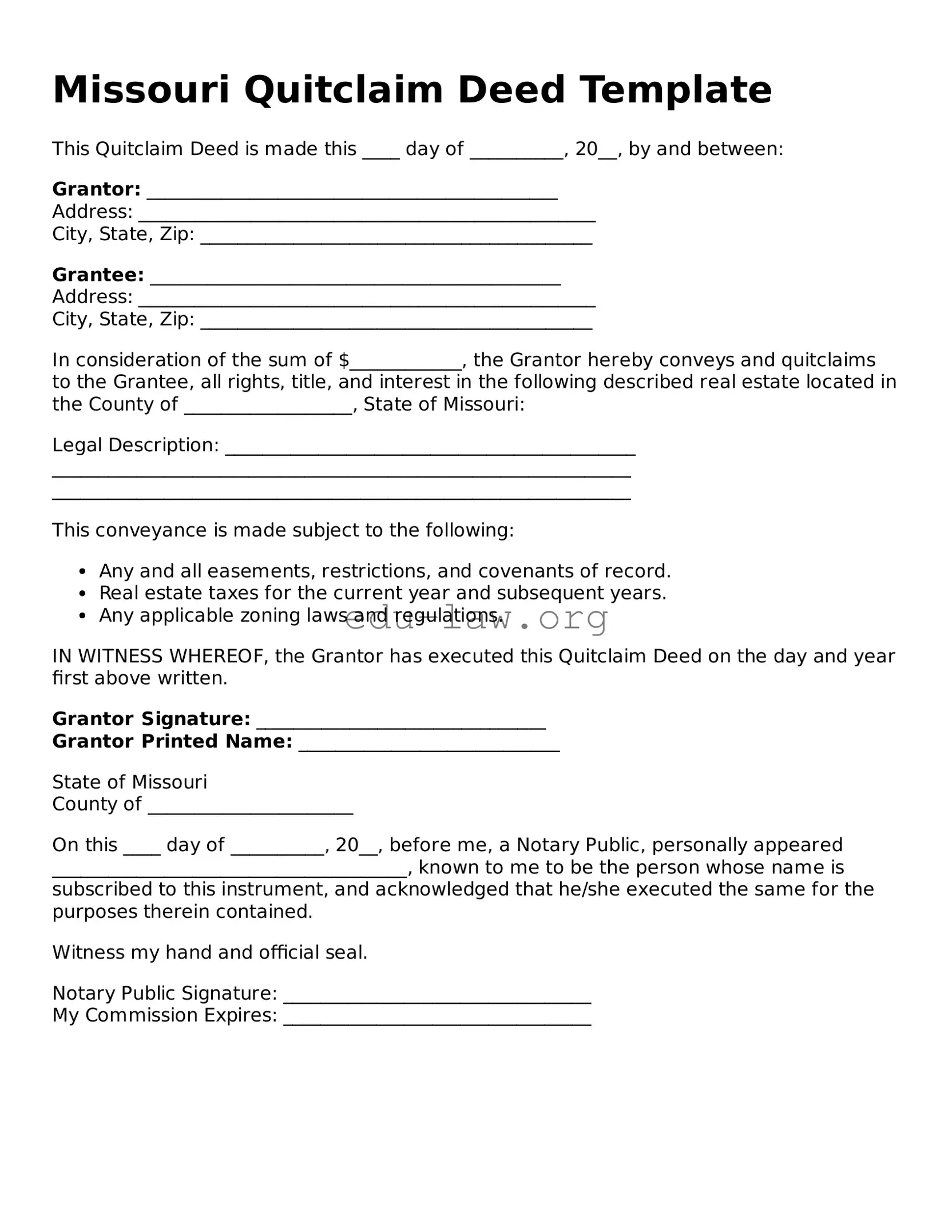
The Missouri Quitclaim Deed form serves as a crucial legal instrument for transferring property rights between parties. This form allows an individual, known as the grantor, to convey any interest they may have in a piece of real estate to another individual, referred to as the grantee. Unlike warranty deeds, which provide guarantees about the title's validity, a quitclaim deed offers no such assurances. Instead, it transfers whatever interest the grantor possesses, if any, without making promises regarding the property's condition or any potential claims against it. This makes the quitclaim deed particularly useful in specific situations, such as during divorce settlements or when transferring property between family members. The form requires essential information, including the names of both parties, a description of the property, and the signatures of the grantor. Additionally, while it does not necessitate notarization to be effective, having the document notarized can enhance its credibility and facilitate the recording process with local authorities. Understanding the nuances of the Missouri Quitclaim Deed form is essential for anyone involved in real estate transactions in the state.
Missouri Quitclaim Deed Template
This Quitclaim Deed is made this ____ day of __________, 20__, by and between:
Grantor: ____________________________________________
Address: _________________________________________________
City, State, Zip: __________________________________________
Grantee: ____________________________________________
Address: _________________________________________________
City, State, Zip: __________________________________________
In consideration of the sum of $____________, the Grantor hereby conveys and quitclaims to the Grantee, all rights, title, and interest in the following described real estate located in the County of __________________, State of Missouri:
Legal Description: ____________________________________________
______________________________________________________________
______________________________________________________________
This conveyance is made subject to the following:
IN WITNESS WHEREOF, the Grantor has executed this Quitclaim Deed on the day and year first above written.
Grantor Signature: _______________________________
Grantor Printed Name: ____________________________
State of Missouri
County of ______________________
On this ____ day of __________, 20__, before me, a Notary Public, personally appeared ______________________________________, known to me to be the person whose name is subscribed to this instrument, and acknowledged that he/she executed the same for the purposes therein contained.
Witness my hand and official seal.
Notary Public Signature: _________________________________
My Commission Expires: _________________________________
| Fact Name | Description |
|---|---|
| Definition | A quitclaim deed is a legal document used to transfer ownership of real estate without guaranteeing the title. |
| Governing Law | The Missouri Quitclaim Deed is governed by Missouri Revised Statutes, Chapter 442. |
| Parties Involved | The document involves two main parties: the grantor (seller) and the grantee (buyer). |
| Consideration | While consideration is often included, it is not required for the deed to be valid in Missouri. |
| Title Transfer | The quitclaim deed transfers whatever interest the grantor has in the property, if any. |
| Use Cases | Commonly used in divorce settlements, property transfers between family members, or clearing title defects. |
| Recording | To ensure the transfer is public, the deed should be recorded with the local county recorder’s office. |
| Limitations | It does not provide any warranties or guarantees about the property’s title or condition. |
Once you have your Missouri Quitclaim Deed form ready, you will need to fill it out carefully. Ensure that all information is accurate to avoid any issues later on. After completing the form, it will need to be signed and notarized before submission.
What is a Missouri Quitclaim Deed?
A Missouri Quitclaim Deed is a legal document used to transfer ownership of real estate from one party to another without any warranties or guarantees. This means that the person transferring the property, known as the grantor, does not guarantee that they have clear title to the property. The recipient, or grantee, receives whatever interest the grantor has, if any. This type of deed is often used among family members or in situations where the parties know each other well and trust one another.
When should I use a Quitclaim Deed in Missouri?
Quitclaim Deeds are commonly used in specific situations. For instance, they are ideal for transferring property between family members, such as when a parent transfers property to a child. They can also be used to clear up title issues, such as when an ex-spouse is removed from the title after a divorce. However, it’s important to note that because a Quitclaim Deed does not provide any guarantees, it may not be suitable for all transactions, especially those involving buyers who require assurance of clear title.
How do I complete a Quitclaim Deed in Missouri?
Completing a Quitclaim Deed in Missouri involves several steps. First, you need to obtain the form, which can typically be found online or through legal stationery stores. Fill in the names of the grantor and grantee, along with a legal description of the property being transferred. Ensure that the document is signed by the grantor in front of a notary public. Once completed, the deed must be filed with the local county recorder’s office to make the transfer official. It’s advisable to check with local regulations, as requirements may vary by county.
Are there any fees associated with filing a Quitclaim Deed in Missouri?
Yes, there are fees associated with filing a Quitclaim Deed in Missouri. Each county sets its own recording fees, which can vary. Typically, these fees are based on the number of pages in the document. Additionally, if the property is being transferred as part of a sale, there may be other costs involved, such as transfer taxes. It’s a good idea to check with the local recorder’s office for the most accurate fee information before filing.
Incorrect Names: People often misspell names or use nicknames instead of legal names. It’s crucial to use the full legal name as it appears on official documents.
Missing Signatures: All parties involved must sign the deed. Forgetting a signature can lead to delays or invalidation of the document.
Improper Notarization: A Quitclaim Deed must be notarized to be valid. Failing to have it notarized or using an unqualified notary can cause issues.
Incorrect Property Description: The property must be described accurately. Omitting details or using vague descriptions can create confusion about what is being transferred.
Not Recording the Deed: After filling out the Quitclaim Deed, it should be recorded with the county clerk. Neglecting this step can lead to disputes over property ownership in the future.
The Missouri Quitclaim Deed is a vital document used to transfer property ownership. However, several other forms and documents may accompany it to ensure a smooth transaction and provide legal clarity. Below is a list of these commonly used documents, each serving a specific purpose in the property transfer process.
Understanding these documents is crucial for anyone involved in a property transaction in Missouri. Each plays a significant role in ensuring that the transfer is legally sound and protects the interests of all parties involved.
The Missouri Quitclaim Deed is similar to the Warranty Deed, which also transfers property ownership. However, unlike the Quitclaim Deed, the Warranty Deed provides a guarantee that the grantor holds clear title to the property and has the right to sell it. This means the grantee is protected against future claims on the property, making the Warranty Deed a more secure option for buyers who want assurance of ownership rights.
Another document that resembles the Quitclaim Deed is the Bargain and Sale Deed. This type of deed implies that the grantor has the right to transfer the property but does not provide any warranties against defects in the title. While both documents transfer ownership, the Bargain and Sale Deed offers slightly more protection than a Quitclaim Deed, as it suggests that the grantor has not encumbered the property.
The Special Warranty Deed is also similar to the Quitclaim Deed, but it offers limited warranties. The grantor guarantees that they have not caused any title issues during their ownership period. This provides a bit more security for the grantee than a Quitclaim Deed, which offers no guarantees. However, it still does not protect against any claims that arose before the grantor's ownership.
In addition, the General Warranty Deed shares similarities with the Quitclaim Deed. However, it provides extensive guarantees against any title defects, covering the entire history of the property. This makes it a more comprehensive option for buyers, as it protects them from any claims that may arise from previous owners, unlike the Quitclaim Deed, which offers no such protection.
The Grant Deed is another document that functions similarly to the Quitclaim Deed. It transfers property ownership but typically includes implied warranties that the property is free from encumbrances created by the grantor. While the Quitclaim Deed transfers ownership without any guarantees, the Grant Deed provides a bit more assurance to the grantee regarding the title's condition.
The Deed of Trust is also worth mentioning, as it is often used in real estate transactions. While it serves a different purpose—acting as a security instrument for a loan—it involves the transfer of property rights. The Quitclaim Deed transfers ownership, while the Deed of Trust secures a loan against the property, highlighting the various ways property rights can be managed.
Lastly, the Affidavit of Title is similar in that it deals with property ownership, but it is not a deed. Instead, it is a sworn statement made by the seller regarding the status of the title. This document can complement a Quitclaim Deed by providing additional information about the property, such as any liens or encumbrances, helping to clarify the ownership situation for the buyer.
When filling out the Missouri Quitclaim Deed form, it’s important to follow certain guidelines to ensure the document is completed accurately. Here’s a list of things you should and shouldn’t do:
By following these guidelines, you can help ensure that your Quitclaim Deed is filled out correctly and is legally binding.
The Missouri Quitclaim Deed is a legal document used to transfer property ownership. However, several misconceptions surround its use and implications. Here are nine common misconceptions:
This is incorrect. A quitclaim deed transfers whatever interest the grantor has in the property without any warranties. It does not guarantee that the title is free from liens or claims.
While often used for family transfers, quitclaim deeds can be used in various situations, including sales between unrelated parties or transferring property into a trust.
This is misleading. A warranty deed provides assurances about the title and protects the buyer from future claims, while a quitclaim deed offers no such protections.
This is partially true. A quitclaim deed can transfer the grantor's interest, but it does not eliminate any obligations or claims against the property.
This is false. A quitclaim deed can be revoked or challenged in certain circumstances, such as fraud or lack of capacity at the time of signing.
In Missouri, while notarization is highly recommended for a quitclaim deed to be enforceable, it is not strictly required for the deed to be valid.
While it is advisable to file a quitclaim deed to provide public notice of the transfer, it is not a legal requirement for the deed to be valid.
This is misleading. While it transfers the grantor's interest, it does not necessarily transfer all responsibilities, especially if there are existing mortgages or liens.
This is not entirely accurate. While primarily used for real estate, quitclaim deeds can also be used for other types of property transfers, such as vehicles or personal property.
When dealing with the Missouri Quitclaim Deed form, it's essential to understand its purpose and the process involved. Here are some key takeaways to keep in mind: