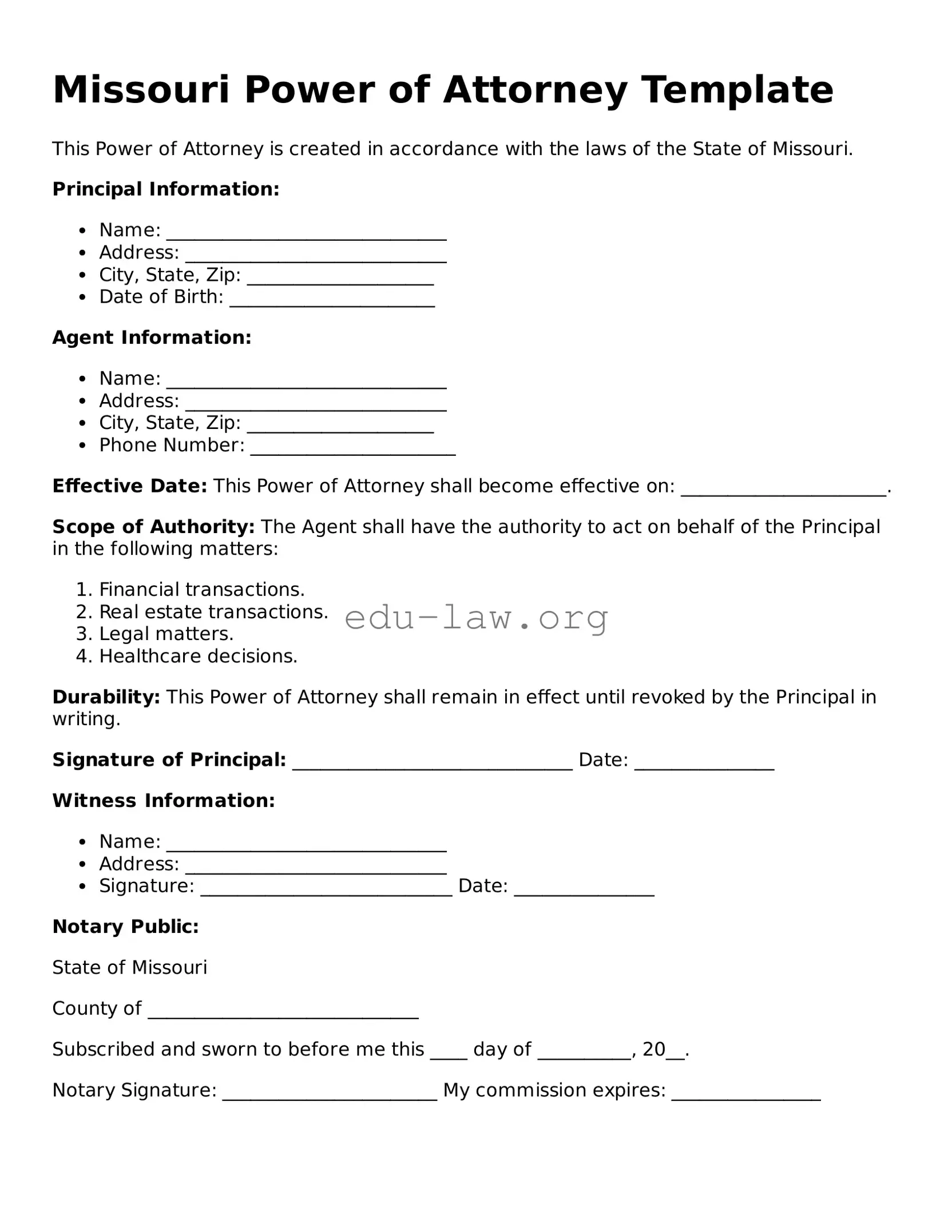
The Missouri Power of Attorney form is a crucial legal document that allows an individual, known as the principal, to designate another person, referred to as the agent or attorney-in-fact, to make decisions on their behalf. This form can cover a wide range of powers, including financial matters, healthcare decisions, and property management. It is essential for ensuring that your wishes are respected when you are unable to communicate or make decisions due to illness or incapacity. The document can be tailored to grant specific powers or can be broad in scope, depending on the principal's needs. Additionally, the form requires the principal's signature and must be notarized to be legally binding. Understanding the implications and responsibilities associated with this form is vital for both the principal and the agent, as it establishes a relationship of trust and authority that can have significant consequences. By preparing this document, individuals can ensure their interests are protected and their preferences are honored during challenging times.
Missouri Power of Attorney Template
This Power of Attorney is created in accordance with the laws of the State of Missouri.
Principal Information:
Agent Information:
Effective Date: This Power of Attorney shall become effective on: ______________________.
Scope of Authority: The Agent shall have the authority to act on behalf of the Principal in the following matters:
Durability: This Power of Attorney shall remain in effect until revoked by the Principal in writing.
Signature of Principal: ______________________________ Date: _______________
Witness Information:
Notary Public:
State of Missouri
County of _____________________________
Subscribed and sworn to before me this ____ day of __________, 20__.
Notary Signature: _______________________ My commission expires: ________________
| Fact Name | Description |
|---|---|
| Definition | A Missouri Power of Attorney form allows an individual to designate another person to act on their behalf in legal and financial matters. |
| Governing Law | The Missouri Power of Attorney is governed by Chapter 404 of the Revised Statutes of Missouri. |
| Types | There are several types of Power of Attorney forms, including durable, medical, and limited Power of Attorney. |
| Durability | A durable Power of Attorney remains effective even if the principal becomes incapacitated. |
| Signing Requirements | The form must be signed by the principal and notarized to be legally valid in Missouri. |
| Revocation | A Power of Attorney can be revoked at any time by the principal, provided they are mentally competent. |
| Agent's Authority | The agent's authority can be broad or limited, depending on the specifications outlined in the form. |
| Healthcare Decisions | A separate medical Power of Attorney is required for healthcare decisions, which must comply with specific state laws. |
Filling out the Missouri Power of Attorney form is a straightforward process that allows you to designate someone to make decisions on your behalf. After completing the form, it will need to be signed and possibly notarized, depending on your specific needs and the requirements of the parties involved.
After completing these steps, ensure that all parties involved understand their roles and responsibilities under the Power of Attorney. This will help prevent misunderstandings and ensure that your wishes are respected.
What is a Power of Attorney in Missouri?
A Power of Attorney (POA) in Missouri is a legal document that allows one person, known as the principal, to designate another person, known as the agent or attorney-in-fact, to act on their behalf in various matters. This can include financial decisions, medical decisions, or other specific tasks outlined in the document. The authority granted can be broad or limited, depending on the principal's wishes.
How do I create a Power of Attorney in Missouri?
To create a Power of Attorney in Missouri, the principal must fill out a form that clearly states the powers being granted. The document should be signed by the principal and witnessed by at least two individuals or notarized. It is important that the principal is of sound mind when executing the document. Specific forms are available for different types of authority, such as financial or medical powers of attorney.
Can I revoke a Power of Attorney in Missouri?
Yes, a Power of Attorney can be revoked at any time by the principal, as long as they are competent. To revoke the document, the principal should create a written notice of revocation and notify the agent and any relevant third parties. It is advisable to destroy any copies of the original Power of Attorney to prevent confusion.
What happens if the principal becomes incapacitated?
If the principal becomes incapacitated, the Power of Attorney remains in effect unless it is a non-durable Power of Attorney, which terminates upon the principal’s incapacity. A durable Power of Attorney continues to be valid even if the principal is unable to make decisions. This distinction is crucial for ensuring that the agent can act on behalf of the principal when needed.
What powers can I grant to my agent?
The powers granted to an agent can vary widely based on the principal's needs. Common powers include managing bank accounts, making investment decisions, handling real estate transactions, and making healthcare decisions. The principal should clearly outline the specific powers in the Power of Attorney document to avoid any ambiguity.
Do I need to have a lawyer to create a Power of Attorney?
While it is not legally required to have a lawyer to create a Power of Attorney in Missouri, consulting with one can be beneficial. A lawyer can provide guidance on the implications of the document, ensure that it complies with state laws, and help tailor the powers to meet the principal’s specific needs.
Is a Power of Attorney valid if executed in another state?
A Power of Attorney executed in another state may be valid in Missouri if it complies with Missouri law. However, it is advisable to have the document reviewed to ensure that it meets all necessary requirements. If the document does not conform, the principal may need to execute a new Power of Attorney that adheres to Missouri statutes.
Can I use a Power of Attorney for healthcare decisions?
Yes, a specific type of Power of Attorney, known as a healthcare Power of Attorney, allows the agent to make medical decisions on behalf of the principal. This document must be executed in accordance with Missouri law and should clearly state the agent's authority regarding healthcare matters. It is important to discuss these wishes with the agent in advance.
What should I do if my agent is not acting in my best interest?
If an agent is not acting in the principal's best interest, the principal can revoke the Power of Attorney, provided they are still competent. If the principal is incapacitated, a court can be petitioned to remove the agent and appoint a guardian or conservator. It is essential to document any concerns regarding the agent's actions for potential legal proceedings.
Failing to specify the powers granted. It is important to clearly outline what authority is being given to the agent. Without this clarity, the agent may not be able to act as intended.
Not naming a successor agent. If the primary agent is unable or unwilling to serve, having a backup ensures that someone can still act on behalf of the principal.
Overlooking the need for notarization. In Missouri, a Power of Attorney must be notarized to be valid. Without this step, the document may not be recognized.
Using outdated forms. Laws can change, and using an old version of the Power of Attorney form may lead to complications. Always ensure the most current form is being used.
Neglecting to date the document. A Power of Attorney should include the date it was signed. This helps establish when the authority begins and can prevent disputes.
Not discussing the decision with the agent. It is crucial to communicate with the chosen agent about their responsibilities and ensure they are willing to accept the role.
Failing to keep copies of the document. After completing the Power of Attorney, it is essential to distribute copies to the agent and keep one for personal records. This ensures all parties have access when needed.
When creating a Power of Attorney (POA) in Missouri, it's essential to consider additional documents that may complement or enhance the effectiveness of your POA. Each of these documents serves a unique purpose and can help ensure that your wishes are respected and carried out according to your preferences.
Incorporating these documents alongside a Power of Attorney can provide clarity and security for both you and your loved ones. By clearly articulating your wishes, you can ensure that your values and preferences are honored during critical moments.
The Missouri Durable Power of Attorney is similar to a standard Power of Attorney but with a key difference. A durable Power of Attorney remains effective even if the principal becomes incapacitated. This ensures that the agent can continue to make decisions on behalf of the principal, providing peace of mind in situations where the principal may not be able to communicate their wishes due to illness or injury.
The Health Care Power of Attorney is another related document. This form specifically allows an individual to designate someone to make medical decisions on their behalf if they are unable to do so. It focuses solely on health care choices, ensuring that the agent can advocate for the principal’s medical preferences in critical situations.
The Financial Power of Attorney is similar in that it empowers an agent to handle financial matters. This document allows the agent to manage bank accounts, pay bills, and make investment decisions. Unlike the general Power of Attorney, this form is often limited to financial affairs, which can help in keeping the principal's finances organized and managed effectively.
The Limited Power of Attorney is another variation. This document grants specific powers to an agent for a limited time or for particular tasks. For example, it may allow someone to sign documents for a real estate transaction while the principal is away. This focused approach can be beneficial when only certain actions need to be delegated.
A Springing Power of Attorney becomes effective only under certain conditions, such as the principal’s incapacity. This document is similar to the Durable Power of Attorney but adds a layer of protection by ensuring that the agent's authority does not start until it is truly needed. This can provide reassurance to the principal that their agent will not have power until necessary.
The Revocation of Power of Attorney is a document that terminates an existing Power of Attorney. If a principal wishes to change their agent or revoke the authority given to someone, this form is essential. It ensures that the previous agent no longer has any legal power to act on behalf of the principal.
The Guardianship document is similar in that it involves appointing someone to make decisions for another person. However, guardianship is typically established through a court process and applies to individuals who cannot make decisions for themselves due to incapacity. Unlike a Power of Attorney, guardianship may involve more oversight and legal requirements.
The Advance Directive combines elements of a Health Care Power of Attorney and a living will. This document outlines a person’s wishes regarding medical treatment and appoints an agent to make health care decisions. It ensures that an individual’s preferences are respected, even when they cannot communicate them.
Finally, the Trust document allows for the management of assets during a person's life and after their death. While a Power of Attorney is about delegating authority for decision-making, a Trust is about managing and distributing assets. Both documents can work together to ensure a person's wishes are honored regarding their property and health care decisions.
When filling out the Missouri Power of Attorney form, it's essential to approach the task with care. Here are ten important dos and don’ts to consider:
By following these guidelines, you can help ensure that your Power of Attorney form is completed correctly and meets your needs.
Understanding the Missouri Power of Attorney form is crucial for effective estate planning. However, several misconceptions can lead to confusion. Here are five common misconceptions:
Many people believe that a Power of Attorney (POA) is solely for managing financial affairs. In reality, a POA can also grant authority for healthcare decisions, allowing someone to make medical choices on your behalf if you are unable to do so.
Some individuals think that once a POA is established, it cannot be changed or revoked. This is not true. As long as you are mentally competent, you can revoke or modify your Power of Attorney at any time.
While legal assistance can be beneficial, it is not mandatory. Individuals can create a valid Power of Attorney using forms available online or through various legal resources, as long as they meet Missouri's requirements.
Some people fear that granting a Power of Attorney means they will lose control over their own affairs. In fact, a POA allows you to designate someone to help you, while you still retain the right to manage your own decisions unless specified otherwise.
Many associate the need for a POA solely with older adults. However, anyone can benefit from having a Power of Attorney, regardless of age. Unexpected situations can arise at any time, making it wise for everyone to consider establishing a POA.
Being informed about these misconceptions can help individuals make better decisions regarding their Power of Attorney needs in Missouri.
Understanding the Missouri Power of Attorney form is crucial for individuals seeking to designate someone to act on their behalf. Here are ten key takeaways regarding its completion and use:
Filling out the Missouri Power of Attorney form correctly can help ensure that an individual’s wishes are honored and that their affairs are managed appropriately in times of need.