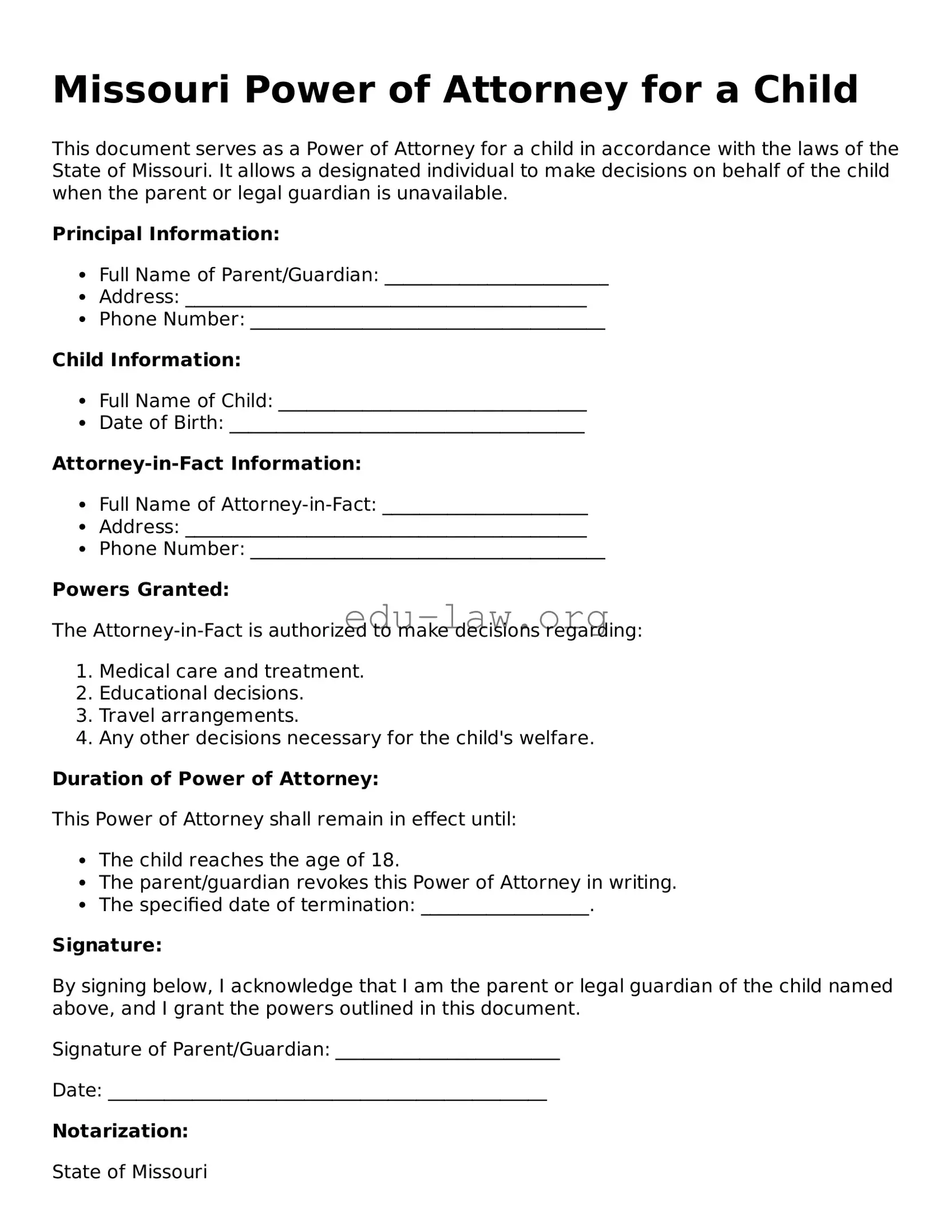
In Missouri, the Power of Attorney for a Child form serves as a crucial legal tool for parents or guardians seeking to delegate authority over their minor children to another trusted adult. This document allows the designated individual, often referred to as the agent, to make important decisions regarding the child's welfare, education, and medical care in the absence of the parent or legal guardian. It is particularly useful in situations such as temporary relocations, extended travel, or when a parent is unable to fulfill their responsibilities due to unforeseen circumstances. The form outlines the specific powers granted, which can include decisions about schooling, health care, and general day-to-day activities. Additionally, it is important to note that this power can be tailored to meet the unique needs of each family, allowing for flexibility in the duration and extent of authority granted. Completing this form accurately is essential to ensure that the designated agent can act in the best interest of the child without legal complications. Understanding the implications and requirements of the Power of Attorney for a Child in Missouri is vital for any parent or guardian looking to safeguard their child's well-being in their absence.
Missouri Power of Attorney for a Child
This document serves as a Power of Attorney for a child in accordance with the laws of the State of Missouri. It allows a designated individual to make decisions on behalf of the child when the parent or legal guardian is unavailable.
Principal Information:
Child Information:
Attorney-in-Fact Information:
Powers Granted:
The Attorney-in-Fact is authorized to make decisions regarding:
Duration of Power of Attorney:
This Power of Attorney shall remain in effect until:
Signature:
By signing below, I acknowledge that I am the parent or legal guardian of the child named above, and I grant the powers outlined in this document.
Signature of Parent/Guardian: ________________________
Date: _______________________________________________
Notarization:
State of Missouri
County of ______________________
On this _____ day of ___________, 20___, before me, a notary public, personally appeared ______________________, known to me to be the person whose name is subscribed to this document, and acknowledged that he/she executed the same for the purposes therein contained.
Notary Public Signature: _____________________________
My Commission Expires: _____________________________
| Fact Name | Description |
|---|---|
| Purpose | The Missouri Power of Attorney for a Child form allows a parent or legal guardian to appoint another adult to make decisions on behalf of their child. |
| Governing Law | This form is governed by Missouri Revised Statutes, specifically Chapter 404. |
| Duration | The power of attorney can be effective for a specific period or until revoked by the parent or guardian. |
| Eligibility | Any adult can be designated as an agent, provided they are willing to accept the responsibility. |
| Notarization | The form must be signed in the presence of a notary public to be valid. |
| Revocation | A parent or guardian can revoke the power of attorney at any time by providing written notice. |
| Limitations | The form does not grant the agent the authority to make decisions about medical treatment unless specified. |
Filling out the Missouri Power of Attorney for a Child form is a straightforward process. This form allows a parent or legal guardian to designate another adult to make decisions on behalf of their child. Follow these steps carefully to ensure the form is completed accurately.
What is a Missouri Power of Attorney for a Child form?
The Missouri Power of Attorney for a Child form is a legal document that allows a parent or legal guardian to designate another adult to make decisions on behalf of their child. This can include decisions related to education, healthcare, and other aspects of the child's welfare. It is particularly useful when parents are temporarily unable to care for their child due to travel, illness, or other circumstances.
Who can be designated as an agent in this form?
Any adult can be designated as an agent in the Missouri Power of Attorney for a Child form. This could be a relative, family friend, or neighbor whom the parent trusts to act in the best interest of the child. It’s important to choose someone who is responsible and understands the needs of the child.
How long is the Power of Attorney valid?
The Power of Attorney for a Child in Missouri is generally valid for up to one year. However, parents can specify a shorter duration if desired. It’s essential to keep in mind that this document can be revoked at any time by the parent or guardian who created it, as long as they are of sound mind.
What decisions can the agent make on behalf of the child?
The agent designated in the Power of Attorney can make a variety of decisions, including those related to education, medical care, and general welfare. This means they can enroll the child in school, make healthcare decisions, and provide consent for medical treatment. However, it’s important to note that the agent cannot make decisions that would permanently alter the child’s legal status, such as adoption.
Do I need to have the Power of Attorney form notarized?
Yes, the Missouri Power of Attorney for a Child form must be notarized to be legally binding. This means that a notary public must witness the signing of the document. Notarization helps to confirm the identities of the parties involved and ensures that the form is executed properly.
Can I revoke the Power of Attorney once it is established?
Absolutely. The parent or legal guardian who created the Power of Attorney can revoke it at any time, as long as they are mentally competent to do so. To revoke the document, it is advisable to provide written notice to the designated agent and, if possible, to have the revocation notarized for clarity.
Where can I obtain the Missouri Power of Attorney for a Child form?
The Missouri Power of Attorney for a Child form can typically be obtained from various sources, including legal websites, local government offices, or family law attorneys. It’s important to ensure that you are using the most current version of the form to comply with state laws.
Not specifying the duration of the power of attorney. It is crucial to clearly state how long the authority is granted. Without this, there may be confusion about when the power ends.
Failing to identify the child properly. Ensure that the child’s full name, date of birth, and any other identifying information are included. Omitting these details can lead to complications.
Overlooking the need for signatures. Both the parent and the agent must sign the form. A missing signature can render the document invalid.
Not including the agent’s contact information. Providing a phone number and address for the agent helps ensure that they can be reached when necessary.
Using vague language when describing the powers granted. Be specific about what decisions the agent can make. Ambiguity can lead to misunderstandings.
Ignoring state-specific requirements. Each state has its own rules regarding power of attorney forms. Make sure to follow Missouri’s specific guidelines to avoid issues.
Not notarizing the document. In Missouri, notarization is often required for the form to be legally binding. Failing to do so can lead to disputes about its validity.
Neglecting to keep copies of the completed form. It is essential to retain copies for all parties involved. This helps in case any disputes arise later.
When establishing a Power of Attorney for a Child in Missouri, it's often beneficial to consider additional documents that can support the arrangement. Each of these forms serves a unique purpose and can provide clarity and protection for both the child and the appointed agent.
Using these additional forms alongside the Missouri Power of Attorney for a Child can create a comprehensive framework for the child's care and well-being. Each document plays a vital role in ensuring that the child's needs are met and that the appointed agent has the necessary authority to act effectively.
The Missouri Power of Attorney for a Child form is similar to the General Power of Attorney. Both documents allow an individual to appoint another person to act on their behalf. However, the General Power of Attorney is broader in scope, covering various matters, including financial and legal decisions. In contrast, the Power of Attorney for a Child specifically focuses on decisions related to the care and custody of a minor, making it more specialized for parental or guardian responsibilities.
Another document that shares similarities is the Medical Power of Attorney. This form grants someone the authority to make medical decisions on behalf of another person. Like the Power of Attorney for a Child, it is designed to ensure that a trusted individual can make critical decisions when the original party is unable to do so. However, the Medical Power of Attorney is specifically tailored for healthcare-related matters, while the Power of Attorney for a Child encompasses broader aspects of a child's upbringing and welfare.
The Child Custody Agreement is also comparable, as it addresses the care and custody of a minor. This legal document outlines the arrangements for a child's living situation, visitation rights, and parental responsibilities. While the Power of Attorney for a Child allows a parent to delegate authority temporarily, a Child Custody Agreement is typically a more permanent solution established during divorce or separation proceedings, detailing the long-term custody plan for the child.
Similar to the Power of Attorney for a Child is the Guardianship Agreement. This document is utilized when a court appoints an individual to care for a minor, often in situations where the parents are unable to fulfill their roles. While both documents provide for the care of a child, a Guardianship Agreement is usually more formal and involves court oversight, whereas the Power of Attorney for a Child can be executed privately without court intervention.
The Temporary Custody Agreement also bears resemblance to the Power of Attorney for a Child. This document allows a parent to grant temporary custody to another individual, often for a specified period. Like the Power of Attorney for a Child, it is intended to address short-term needs for a child's care. However, the Temporary Custody Agreement typically requires the consent of both parents and may involve more formal arrangements compared to the straightforward delegation of authority seen in the Power of Attorney for a Child.
The Standby Guardian Designation is another related document. It allows a parent to designate someone to care for their child in the event of an emergency or incapacitation. This document is particularly useful for parents who want to ensure that their child is cared for without delay. While both the Standby Guardian Designation and the Power of Attorney for a Child focus on the well-being of a child, the former is specifically for emergencies, whereas the latter can cover a wider range of situations.
Finally, the Adoption Agreement is similar in that it involves the legal care of a child. This document formalizes the process of adopting a child, transferring parental rights from biological parents to adoptive parents. Although it is a more permanent arrangement compared to the temporary nature of the Power of Attorney for a Child, both documents emphasize the importance of ensuring that a child is placed in a safe and loving environment, highlighting the legal recognition of parental roles.
When filling out the Missouri Power of Attorney for a Child form, it is essential to approach the task with care. Here are some guidelines to help ensure the process goes smoothly.
Following these dos and don’ts can help prevent complications and ensure that the Power of Attorney for a Child is effective and legally binding.
Understanding the Missouri Power of Attorney for a Child form is crucial for parents and guardians. However, several misconceptions can lead to confusion. Here are five common misunderstandings:
Many believe this form is only necessary in urgent situations. In reality, it can be beneficial for planned events, such as travel or temporary relocations, allowing a trusted adult to make decisions on behalf of the child.
While notarization adds an extra layer of legitimacy, it is not a strict requirement for the Power of Attorney for a Child form to be effective. Signing in front of witnesses can also suffice, depending on the circumstances.
This form does not transfer custody. It simply allows the designated adult to make decisions temporarily. Custody remains with the biological or legal parents unless a court order states otherwise.
While parents often use this form, other guardians or relatives can also establish a Power of Attorney for a Child. Anyone with a vested interest in the child's well-being can initiate this process.
Revoking a Power of Attorney for a Child is straightforward. The parent or guardian can simply provide written notice to the designated adult and any relevant institutions, such as schools or medical facilities.
Clarifying these misconceptions can help ensure that children receive the appropriate care and support when needed.
When filling out and using the Missouri Power of Attorney for a Child form, consider the following key takeaways: