In Missouri, the Operating Agreement form plays a crucial role in the establishment and management of limited liability companies (LLCs). This document outlines the internal structure and operational guidelines of the LLC, ensuring that all members are on the same page regarding their rights and responsibilities. It typically includes essential elements such as the management structure, voting rights, profit distribution, and procedures for adding or removing members. By clearly defining these aspects, the Operating Agreement helps prevent misunderstandings and disputes among members, providing a solid foundation for the business. Additionally, it can address various scenarios, such as the process for resolving conflicts and what happens in the event of a member's departure. Having a well-drafted Operating Agreement is not just a best practice; it can also protect the limited liability status of the company, making it an indispensable tool for any LLC in Missouri.
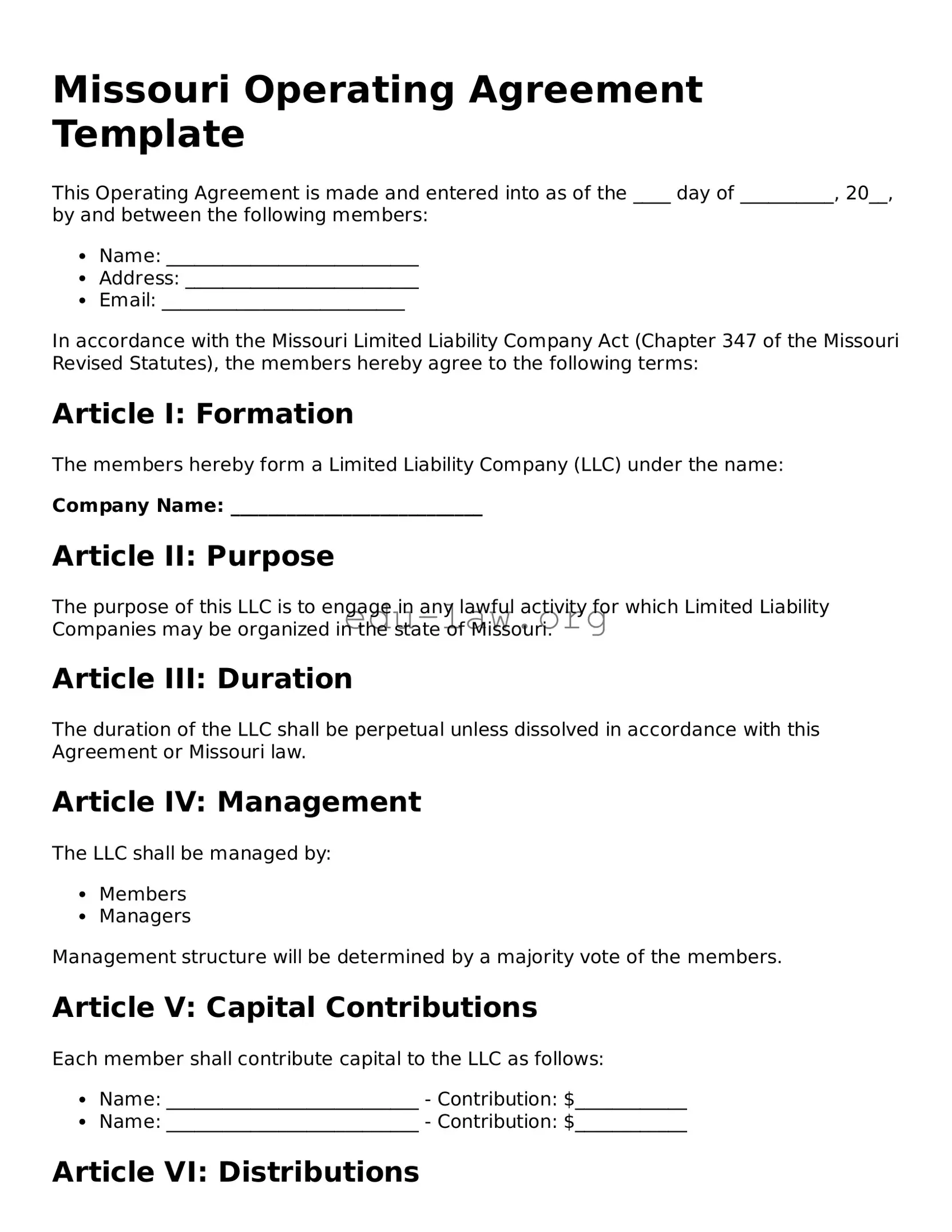
Missouri Operating Agreement Template
This Operating Agreement is made and entered into as of the ____ day of __________, 20__, by and between the following members:
In accordance with the Missouri Limited Liability Company Act (Chapter 347 of the Missouri Revised Statutes), the members hereby agree to the following terms:
Article I: Formation
The members hereby form a Limited Liability Company (LLC) under the name:
Company Name: ___________________________
Article II: Purpose
The purpose of this LLC is to engage in any lawful activity for which Limited Liability Companies may be organized in the state of Missouri.
Article III: Duration
The duration of the LLC shall be perpetual unless dissolved in accordance with this Agreement or Missouri law.
Article IV: Management
The LLC shall be managed by:
Management structure will be determined by a majority vote of the members.
Article V: Capital Contributions
Each member shall contribute capital to the LLC as follows:
Article VI: Distributions
Distributions of profits and losses shall be allocated to members in proportion to their respective capital contributions.
Article VII: Indemnification
The LLC shall indemnify any member or manager against expenses and liabilities incurred in connection with the LLC to the fullest extent permitted by Missouri law.
Article VIII: Amendments
This Operating Agreement may be amended only by a written agreement signed by all members.
Article IX: Governing Law
This Agreement shall be governed by and construed in accordance with the laws of the State of Missouri.
Signatures
By signing below, the members agree to the terms of this Operating Agreement:
This document serves as a foundational agreement for the operations of your LLC in Missouri. It is advisable to consult with a legal professional to ensure compliance with all applicable laws and regulations.
| Fact Name | Description |
|---|---|
| Definition | The Missouri Operating Agreement outlines the management structure and operating procedures for a limited liability company (LLC) in Missouri. |
| Governing Law | This agreement is governed by the Missouri Limited Liability Company Act, specifically Chapter 347 of the Revised Statutes of Missouri. |
| Mandatory Requirement | While not legally required, it is highly recommended for LLCs to have an Operating Agreement to clarify roles and responsibilities. |
| Members' Rights | The agreement specifies the rights and duties of the members, including voting rights and profit distribution. |
| Amendments | Members can amend the Operating Agreement by following the procedures outlined within the document itself. |
| Dispute Resolution | The agreement may include provisions for resolving disputes among members, which can help avoid costly litigation. |
| Duration | It can specify the duration of the LLC, whether it is perpetual or for a limited time. |
| Filing Requirement | The Operating Agreement is not filed with the state but should be kept on record with the LLC’s other important documents. |
| Initial Contributions | It details the initial contributions of each member, which can be cash, property, or services. |
| Tax Treatment | The agreement can outline how the LLC will be taxed, whether as a partnership or corporation, affecting members' tax liabilities. |
After obtaining the Missouri Operating Agreement form, you will need to fill it out carefully. This document is crucial for outlining the management structure and operational guidelines for your business. Follow the steps below to complete the form accurately.
What is a Missouri Operating Agreement?
A Missouri Operating Agreement is a legal document that outlines the management structure and operational procedures of a limited liability company (LLC) in Missouri. It serves as a foundational document, detailing the rights and responsibilities of the members and managers, as well as the procedures for decision-making and profit distribution.
Is an Operating Agreement required in Missouri?
No, Missouri does not legally require LLCs to have an Operating Agreement. However, having one is highly recommended. It helps clarify the internal processes of the company and can prevent disputes among members. Additionally, an Operating Agreement can provide legal protection for the members’ personal assets.
Who should draft the Operating Agreement?
What key elements should be included in the Operating Agreement?
The Operating Agreement should include several essential components, such as the LLC’s name and address, the purpose of the business, details about member contributions, profit and loss distribution, management structure, and procedures for adding or removing members. It may also address dispute resolution and what happens if the LLC dissolves.
Can the Operating Agreement be changed after it is created?
Yes, the Operating Agreement can be amended. Members must follow the procedures outlined in the document for making changes. Typically, this requires a majority or unanimous vote, depending on what the original agreement stipulates.
What happens if there is no Operating Agreement?
If an LLC does not have an Operating Agreement, Missouri's default LLC laws will apply. This may not align with the members’ intentions and could lead to conflicts. Without a clear agreement, issues related to management and profit distribution may become complicated and lead to disputes.
How does the Operating Agreement affect liability protection?
The Operating Agreement plays a crucial role in maintaining the limited liability status of the LLC. By clearly outlining the separation between personal and business assets, it helps protect members from personal liability for the company's debts and obligations, as long as the LLC is properly managed and maintained.
Can an Operating Agreement be used in court?
Yes, an Operating Agreement can be used in court as evidence of the members' intentions and the agreed-upon management structure. If disputes arise, a well-drafted Operating Agreement can help resolve issues more effectively by providing a clear reference point for the terms agreed upon by the members.
Where can I find a template for a Missouri Operating Agreement?
Templates for a Missouri Operating Agreement can be found online through various legal websites, or you can consult with a legal professional who can provide a customized document tailored to your LLC’s specific needs. It is important to ensure that any template complies with Missouri law and accurately reflects your business's structure.
Omitting Essential Information: One common mistake is failing to provide complete information about the members of the LLC. Every member's name, address, and ownership percentage should be clearly stated. Missing this information can lead to confusion and disputes later on.
Neglecting to Specify Management Structure: Many individuals overlook the importance of detailing how the LLC will be managed. It is crucial to indicate whether the LLC will be member-managed or manager-managed. This decision impacts how the business operates and who makes key decisions.
Inadequate Provisions for Profit Distribution: Some people fail to clearly outline how profits and losses will be distributed among members. This lack of clarity can create significant conflicts, especially if the business becomes profitable.
Ignoring Amendment Procedures: Another frequent error is not including procedures for amending the Operating Agreement. As circumstances change, having a clear process for making adjustments is vital for maintaining the integrity and functionality of the LLC.
When forming a limited liability company (LLC) in Missouri, the Operating Agreement is a crucial document. However, several other forms and documents often accompany it to ensure compliance and smooth operation of the business. Below are some key documents that may be needed alongside the Missouri Operating Agreement.
Each of these documents plays a vital role in the establishment and operation of an LLC in Missouri. Properly preparing and filing these forms helps ensure that the business runs smoothly and remains compliant with state regulations.
The Missouri Operating Agreement form is similar to the Limited Liability Company (LLC) Operating Agreement used in various states. Like the Missouri version, this document outlines the management structure, member responsibilities, and operational procedures for the LLC. It serves to protect the members’ personal assets from business liabilities while clarifying each member's role and contributions. This foundational document is essential for establishing clear expectations among members and ensuring compliance with state laws.
Another comparable document is the Partnership Agreement. This agreement governs the relationship between partners in a business venture. It details each partner's contributions, profit-sharing ratios, and decision-making processes. Similar to the Operating Agreement, the Partnership Agreement aims to prevent disputes by setting clear guidelines and expectations for all parties involved, ensuring smooth operations within the partnership.
The Bylaws of a corporation also share similarities with the Missouri Operating Agreement. Bylaws outline the rules for governance and management of a corporation, including the roles of officers and directors. Both documents serve to establish a framework for operation, but while the Operating Agreement is specific to LLCs, Bylaws are tailored for corporate entities. Each document aims to provide clarity and structure to the organization, minimizing potential conflicts.
The Joint Venture Agreement is another document that parallels the Missouri Operating Agreement. This agreement is used when two or more parties collaborate on a specific business project. It outlines each party's contributions, responsibilities, and profit-sharing arrangements. Like the Operating Agreement, it seeks to clarify roles and expectations, ensuring all parties are aligned on the project's goals and operations.
The Shareholders’ Agreement is similar in purpose to the Missouri Operating Agreement but is specific to corporations. It governs the relationship among shareholders, detailing their rights, obligations, and the management of the corporation. Both documents aim to protect the interests of the parties involved and provide a clear framework for decision-making, thereby reducing the likelihood of disputes.
The Non-Disclosure Agreement (NDA) also bears similarities in its function of protecting sensitive information. While the Missouri Operating Agreement focuses on the operational aspects of a business, an NDA establishes confidentiality between parties. Both documents are crucial in safeguarding the interests of the involved parties, ensuring that proprietary information and business strategies remain secure.
The Employment Agreement can be compared to the Missouri Operating Agreement in that both outline specific roles and expectations. While the Operating Agreement details the structure and management of the LLC, an Employment Agreement defines the terms of employment for individuals within the organization. Each document plays a critical role in clarifying responsibilities and protecting the interests of the parties involved.
The Franchise Agreement is another document that shares similarities with the Missouri Operating Agreement. This agreement outlines the terms under which a franchisee can operate a franchise. It includes details about fees, operational guidelines, and the responsibilities of both the franchisor and franchisee. Like the Operating Agreement, it establishes a framework for the relationship and ensures that both parties understand their roles and obligations.
Finally, the Articles of Organization, which are required to form an LLC, are similar to the Missouri Operating Agreement in that both are essential for establishing the business entity. The Articles of Organization provide basic information about the LLC, such as its name and registered agent, while the Operating Agreement delves into the operational and management aspects. Together, they form the foundation for the legal structure of the LLC, ensuring compliance with state regulations.
When filling out the Missouri Operating Agreement form, it's important to keep in mind some best practices and common pitfalls. Here are four things you should do and four things you should avoid.
Things You Should Do:
Things You Shouldn't Do:
Many people have misunderstandings about the Missouri Operating Agreement form. Here are ten common misconceptions and clarifications regarding this important document.
This is not true. Any business entity, regardless of size, can benefit from having an Operating Agreement. It helps establish clear guidelines for operations.
While it is not legally required to have an Operating Agreement in Missouri, it is highly recommended. This document can help prevent disputes among members.
While it is best practice for all members to sign, it is not a legal requirement. However, having all signatures can help avoid future disagreements.
This is a misconception. Operating Agreements can be amended as needed. It’s important to keep the document up to date to reflect the current operations of the business.
This is incorrect. Operating Agreements address various aspects of the business, including management structure, member responsibilities, and decision-making processes.
These are different documents. Articles of Organization are filed with the state to create the business, while the Operating Agreement outlines the internal workings.
While templates can be helpful, they may not address specific needs of your business. Customizing the agreement is often necessary to ensure it fits your unique situation.
This depends on how the agreement is structured. Members can have different levels of authority and decision-making power, which should be clearly outlined in the document.
This is misleading. An Operating Agreement should be revisited and possibly revised as the business evolves, even after it has been established.
While it can help minimize conflicts, it cannot eliminate them entirely. Clear communication and adherence to the agreement are key to resolving issues.
When filling out and using the Missouri Operating Agreement form, it is essential to keep several key points in mind to ensure clarity and compliance.
By focusing on these key takeaways, you can create a robust Operating Agreement that supports the growth and stability of your business in Missouri.