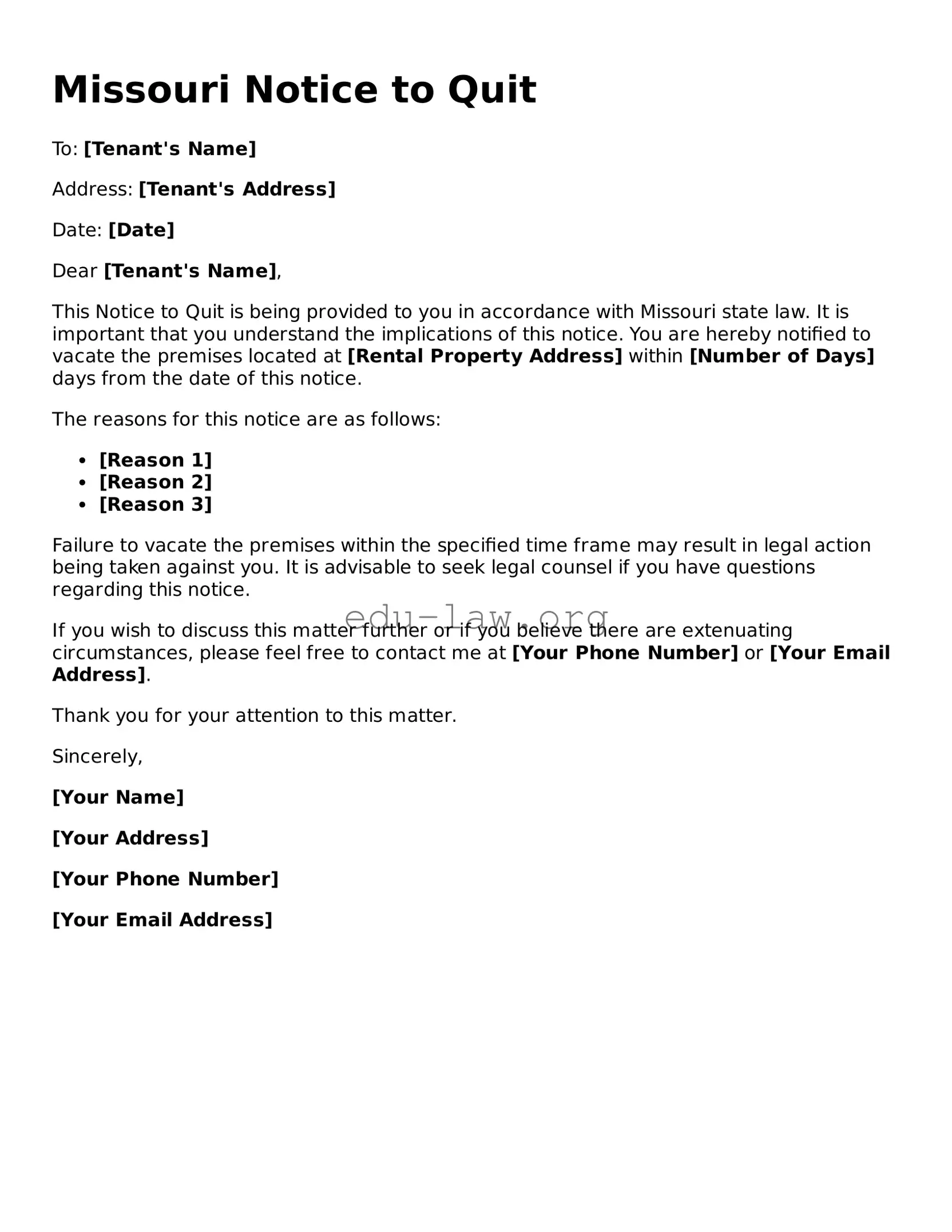
The Missouri Notice to Quit form is a crucial document in the landlord-tenant relationship, serving as a formal notification to tenants regarding the termination of their lease. This form is typically issued when a tenant has violated the terms of their rental agreement or has failed to pay rent. It outlines the specific reasons for the termination and provides a timeline within which the tenant must vacate the premises. Understanding the requirements and implications of this notice is essential for both landlords and tenants. The form must be completed accurately, including the tenant's name, address, and the nature of the lease violation. Furthermore, it is important to deliver the notice in accordance with Missouri law to ensure its enforceability. By following the proper procedures, landlords can protect their rights while tenants can better understand their obligations and options moving forward.
Missouri Notice to Quit
To: [Tenant's Name]
Address: [Tenant's Address]
Date: [Date]
Dear [Tenant's Name],
This Notice to Quit is being provided to you in accordance with Missouri state law. It is important that you understand the implications of this notice. You are hereby notified to vacate the premises located at [Rental Property Address] within [Number of Days] days from the date of this notice.
The reasons for this notice are as follows:
Failure to vacate the premises within the specified time frame may result in legal action being taken against you. It is advisable to seek legal counsel if you have questions regarding this notice.
If you wish to discuss this matter further or if you believe there are extenuating circumstances, please feel free to contact me at [Your Phone Number] or [Your Email Address].
Thank you for your attention to this matter.
Sincerely,
[Your Name]
[Your Address]
[Your Phone Number]
[Your Email Address]
| Fact Name | Details |
|---|---|
| Purpose | The Missouri Notice to Quit form is used by landlords to inform tenants of their intention to terminate a lease agreement. |
| Governing Law | This form is governed by Missouri Revised Statutes, specifically Section 534.020. |
| Delivery Method | The notice can be delivered in person, by mail, or by posting on the premises. |
| Notice Period | Typically, a 30-day notice is required, but this may vary based on the lease terms or specific circumstances. |
| Tenant's Rights | Tenants have the right to contest the notice if they believe it was issued improperly or if they have a valid defense. |
| Form Requirements | The notice must include specific information, such as the reason for termination and the date by which the tenant must vacate. |
| Consequences of Non-Compliance | If a tenant fails to vacate by the specified date, the landlord may proceed with eviction proceedings. |
| Exceptions | Certain situations, such as domestic violence, may provide tenants with additional protections against eviction. |
| Record Keeping | Landlords should keep a copy of the notice and proof of delivery for their records in case of future disputes. |
| Legal Assistance | Both landlords and tenants may benefit from legal advice when dealing with eviction notices to ensure compliance with the law. |
Once you have the Missouri Notice to Quit form, you are ready to complete it. This form is essential for notifying a tenant of their need to vacate the premises. After filling it out, ensure that it is delivered to the tenant according to state regulations.
What is a Missouri Notice to Quit form?
The Missouri Notice to Quit form is a legal document that a landlord uses to inform a tenant that they must vacate the rental property. This form is typically used when a tenant has violated the lease agreement or has not paid rent. It serves as a formal notice to the tenant, providing them with a specified time frame to leave the premises before further legal action is taken.
How much notice must be given in a Notice to Quit?
The amount of notice required in a Missouri Notice to Quit varies based on the reason for the eviction. Generally, for non-payment of rent, a landlord must provide a tenant with a 10-day notice. For lease violations, the notice period can be 30 days. It's essential to check the specific circumstances to determine the appropriate notice period.
What happens if the tenant does not comply with the Notice to Quit?
If the tenant does not vacate the property by the deadline stated in the Notice to Quit, the landlord may proceed with eviction proceedings. This often involves filing a lawsuit in the local court to obtain an eviction order. The tenant may have an opportunity to respond to the lawsuit, but failure to act can result in a judgment against them.
Can a tenant contest a Notice to Quit?
Yes, a tenant has the right to contest a Notice to Quit. If a tenant believes the notice is unjust or that they have not violated the lease terms, they can respond to the notice and present their case in court. It’s important for tenants to gather evidence and seek legal advice if they plan to contest the eviction.
Failing to include the correct tenant's name. Always ensure that the name matches the one on the lease agreement.
Not specifying the address of the rental property. This is crucial for identifying the location in question.
Using the wrong notice period. Missouri law requires specific notice periods based on the reason for eviction, such as non-payment of rent.
Omitting the reason for eviction. Clearly state the grounds for the notice to ensure legal compliance.
Not signing the form. A signature is required to validate the notice and show that it was issued by the landlord.
Neglecting to provide a date. The notice must include the date it was issued to establish a timeline.
Failing to keep a copy for personal records. Always retain a copy of the notice for your own documentation.
Not delivering the notice properly. Ensure that the notice is delivered in accordance with Missouri law, whether by mail or in person.
Using vague language. Be specific and clear in your wording to avoid confusion or disputes.
Ignoring local laws or regulations. Always check for any additional requirements specific to your city or county.
When dealing with tenancy issues in Missouri, the Notice to Quit form is often accompanied by several other important documents. Each of these forms serves a specific purpose and can help clarify the situation for both landlords and tenants. Below is a list of commonly used documents that may be relevant in the eviction process or landlord-tenant disputes.
Understanding these documents can help both landlords and tenants navigate the complexities of rental agreements and eviction processes. Each form plays a crucial role in ensuring that rights are upheld and that both parties are informed of their responsibilities and options.
The Missouri Notice to Quit form is similar to the Eviction Notice, often used in many states. This document serves as a formal notification to tenants that they must vacate the premises. Like the Notice to Quit, the Eviction Notice specifies a timeframe within which the tenant must leave. It outlines the reasons for the eviction, such as non-payment of rent or lease violations. Both documents aim to initiate the process of removing a tenant from a rental property, making them essential tools for landlords.
Another document that shares similarities with the Missouri Notice to Quit is the Lease Termination Letter. This letter is typically used when a landlord or tenant wishes to end a lease agreement. It clearly states the intention to terminate the lease and provides a deadline for the tenant to vacate. Like the Notice to Quit, the Lease Termination Letter must comply with state laws regarding notice periods, ensuring both parties have adequate time to prepare for the transition.
The Pay or Quit Notice is also comparable to the Missouri Notice to Quit. This document is issued when a tenant has failed to pay rent on time. It informs the tenant that they must either pay the overdue rent or vacate the property within a specified timeframe. Both notices serve as a warning and a call to action, urging tenants to address their obligations or face the consequences of eviction.
The Cure or Quit Notice is another document that resembles the Missouri Notice to Quit. This notice is used when a tenant violates the terms of their lease, such as causing damage to the property. The landlord provides a chance for the tenant to correct the issue within a certain period. If the tenant fails to remedy the situation, they must vacate the premises. Both documents emphasize the importance of compliance with lease terms and provide a clear path for resolution.
The Notice of Default is also similar to the Missouri Notice to Quit. This document is typically used in mortgage situations but can apply to rental agreements as well. It informs the tenant of their failure to meet specific obligations, such as payment. The Notice of Default outlines the necessary steps the tenant must take to rectify the situation, similar to the Notice to Quit's purpose of prompting action from the tenant.
Lastly, the Demand for Possession is akin to the Missouri Notice to Quit. This document is often used in the eviction process and demands that the tenant vacate the property. It serves as a formal request for possession, indicating that legal action may follow if the tenant does not comply. Both documents are critical in the eviction process, providing a clear message about the need to vacate the rental unit.
When filling out the Missouri Notice to Quit form, it is important to follow certain guidelines to ensure clarity and compliance with legal requirements. Below is a list of things you should and shouldn't do.
Following these guidelines will help ensure that the process is handled correctly and efficiently.
Here are six common misconceptions about the Missouri Notice to Quit form:
This is not true. While it is a common practice, not all landlords are legally required to use this specific form. Some may choose to use other methods to terminate a lease.
A Notice to Quit does not guarantee that eviction will occur. It is merely a step in the process. The landlord must still follow legal procedures to obtain an eviction order.
This is a misconception. The Notice to Quit must be delivered according to state law. Proper delivery methods typically include personal service, certified mail, or posting on the property.
This is incorrect. Tenants retain certain rights even after receiving a Notice to Quit. They can contest the notice and seek legal advice to understand their options.
This is false. The content and requirements of a Notice to Quit can vary based on the reason for termination and local laws. It is important to ensure the form meets specific legal criteria.
This is a misunderstanding. The Notice to Quit is typically not filed with the court. It is a notice to the tenant and serves as a preliminary step before any legal action is taken.
The Missouri Notice to Quit form is a formal document used by landlords to notify tenants of their intent to terminate a lease agreement.
Before filling out the form, ensure that you understand the specific reasons for eviction, as this will guide the language you use.
It's essential to include the tenant's full name and the address of the rental property to avoid any confusion.
Clearly state the reason for the eviction, whether it’s for non-payment of rent, lease violations, or other valid grounds.
Be sure to specify the time frame in which the tenant must vacate the property. In Missouri, this is typically 30 days for most situations.
After completing the form, deliver it to the tenant personally or send it via certified mail to ensure there is proof of receipt.
Keep a copy of the Notice to Quit for your records. This is important for any potential legal proceedings.
Filing the Notice to Quit does not automatically mean you can evict the tenant. You may need to go through the court process if they do not leave.
Be aware of local laws and regulations, as they may impose additional requirements or alter the standard notice period.
If the tenant responds or disputes the notice, it may be beneficial to seek legal advice to navigate the situation effectively.