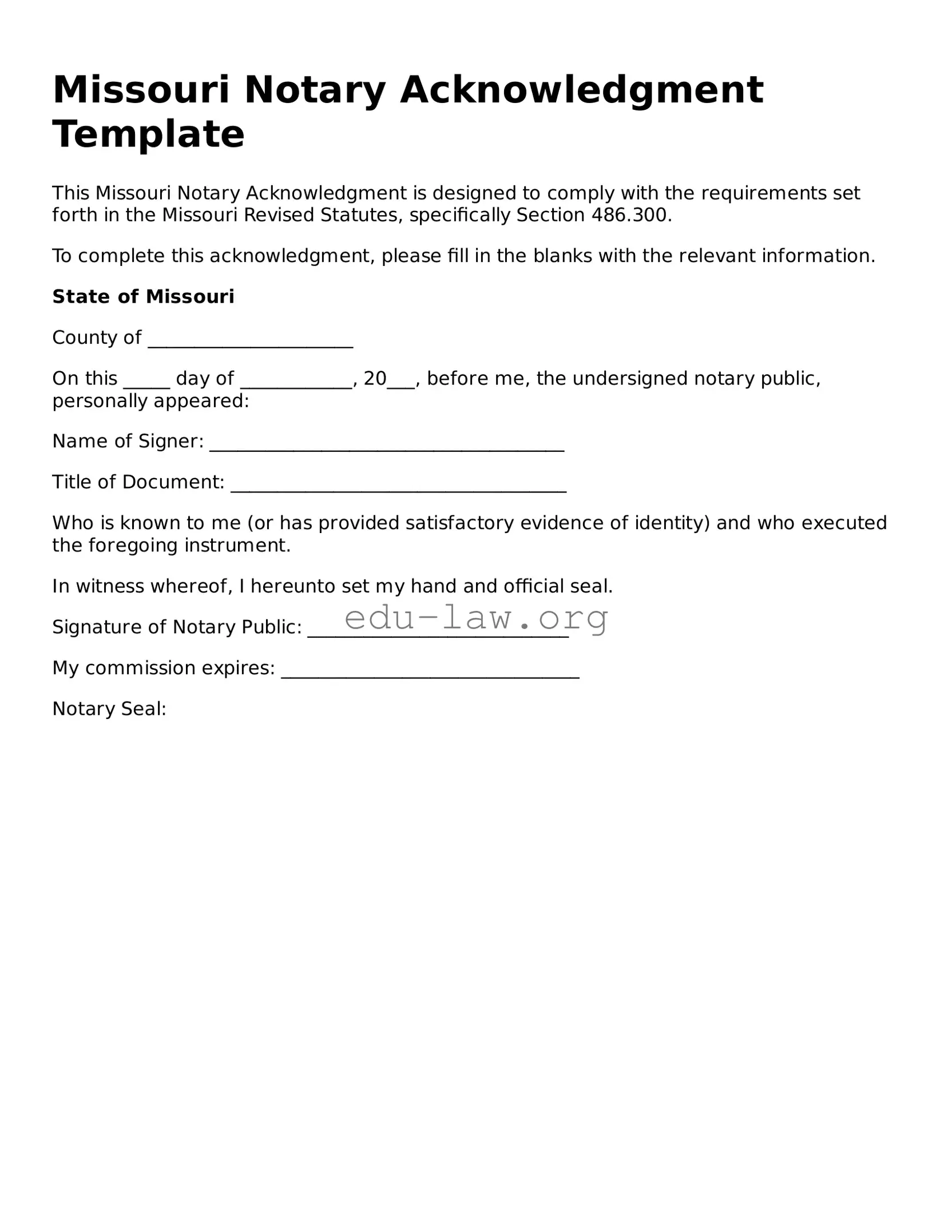
The Missouri Notary Acknowledgment form plays a crucial role in the notarization process, ensuring that signatures on important documents are verified and authenticated. This form serves as a formal declaration by a notary public, confirming that the individual who signed a document did so willingly and in their own capacity. It is essential for various legal and financial transactions, such as real estate deals, loan agreements, and other contracts requiring notarization. The form includes key details such as the signer's name, the date of the acknowledgment, and the notary's signature and seal, all of which contribute to the document's legitimacy. By utilizing this form, individuals can enhance the credibility of their documents and protect themselves against potential disputes or fraud. Understanding the components and purpose of the Missouri Notary Acknowledgment form is vital for anyone engaged in legal or financial matters in the state.
Missouri Notary Acknowledgment Template
This Missouri Notary Acknowledgment is designed to comply with the requirements set forth in the Missouri Revised Statutes, specifically Section 486.300.
To complete this acknowledgment, please fill in the blanks with the relevant information.
State of Missouri
County of ______________________
On this _____ day of ____________, 20___, before me, the undersigned notary public, personally appeared:
Name of Signer: ______________________________________
Title of Document: ____________________________________
Who is known to me (or has provided satisfactory evidence of identity) and who executed the foregoing instrument.
In witness whereof, I hereunto set my hand and official seal.
Signature of Notary Public: ____________________________
My commission expires: ________________________________
Notary Seal:
| Fact Name | Details |
|---|---|
| Definition | A Missouri Notary Acknowledgment form is used to verify the identity of the person signing a document. |
| Governing Law | The form is governed by Missouri Revised Statutes, Chapter 486. |
| Signature Requirement | The signer must personally appear before the notary at the time of signing. |
| Identification | The notary must confirm the identity of the signer through a valid form of ID. |
| Purpose | This form helps prevent fraud by ensuring that the signer is who they claim to be. |
| Notary Seal | A notary seal must be affixed to the acknowledgment for it to be valid. |
| Record Keeping | Notaries are required to keep a record of all acknowledgments performed. |
After obtaining the Missouri Notary Acknowledgement form, it is essential to fill it out accurately to ensure it meets legal standards. Follow these steps carefully to complete the form correctly.
Once the form is filled out completely, it is ready for submission or filing as required. Ensure all information is accurate to avoid any issues in the future.
What is a Missouri Notary Acknowledgement form?
The Missouri Notary Acknowledgement form is a document used to verify that a person has signed a specific document in the presence of a notary public. This form serves as proof that the signature is authentic and that the signer acted willingly and was of sound mind at the time of signing.
Who can act as a notary in Missouri?
In Missouri, a notary public must be at least 18 years old, a resident of the state, and possess the ability to read and write in English. Additionally, they must complete an application process and receive a commission from the state. After obtaining their commission, notaries are authorized to perform various duties, including witnessing signatures and administering oaths.
When is a Notary Acknowledgement required?
A Notary Acknowledgement is often required when documents need to be recorded with a government entity, such as property deeds, mortgages, or powers of attorney. It provides assurance to the receiving party that the document is legitimate and that the signer is who they claim to be.
How do I complete a Notary Acknowledgement form?
To complete a Notary Acknowledgement form, the signer must appear before the notary public and provide valid identification. The notary will then fill out the form, including details such as the date, the signer's name, and the type of document being acknowledged. The signer must then sign the document in the presence of the notary, who will affix their seal and signature to complete the process.
Is there a fee for notarization in Missouri?
Yes, notaries in Missouri are allowed to charge a fee for their services. The maximum fee for most notarial acts is $5. However, some notaries may charge additional fees for travel or other services. It’s important to confirm the fee structure with the notary before proceeding.
Can a Notary Acknowledgement be done remotely?
As of recent changes in law, Missouri allows remote online notarization under specific conditions. This means that a notary can perform an acknowledgment using video conferencing technology. Both the signer and the notary must comply with the state's regulations regarding remote notarization, including using approved platforms and maintaining proper records.
How long is a Notary Acknowledgement valid?
A Notary Acknowledgement does not have an expiration date. However, the underlying document may have its own validity period depending on the nature of the document and the laws governing it. It is advisable to check the specific requirements related to the document in question to ensure compliance.
Incomplete Information: One of the most common mistakes is failing to fill out all required fields. Every section of the form must be completed to ensure that the acknowledgment is valid.
Incorrect Signer Information: Providing incorrect names or details about the person signing can invalidate the acknowledgment. Always double-check the spelling of names and ensure that the information matches official identification.
Not Using the Correct Date: The date on which the acknowledgment is signed must be accurate. Using the wrong date can lead to confusion and potential legal issues.
Failure to Identify the Document: It's important to clearly indicate the document being acknowledged. Omitting this information can make it difficult to verify the purpose of the acknowledgment later.
Not Including the Notary's Signature: A notary acknowledgment is not complete without the notary's signature. Ensure that the notary signs the form in the appropriate section.
Ignoring the Notary Seal: The notary must also affix their official seal on the acknowledgment. Failing to include the seal can render the document unenforceable.
When engaging in legal transactions in Missouri, various forms and documents may accompany the Notary Acknowledgment form. Each document serves a specific purpose, ensuring that the transaction is valid and legally binding. Below is a list of commonly used documents alongside the Missouri Notary Acknowledgment form.
Each of these documents plays a crucial role in various legal processes. Properly notarizing them can help avoid future disputes and ensure that all parties are protected under the law.
The Affidavit is a sworn statement made under oath. Like the Missouri Notary Acknowledgment form, it requires a notary public's signature and seal to confirm the identity of the signer. Both documents serve to verify that the individual signing the document is who they claim to be, ensuring the authenticity of the statement made. An affidavit often includes details about the circumstances surrounding the statement, while the acknowledgment primarily confirms the act of signing itself.
The Power of Attorney (POA) form allows one person to grant another the authority to act on their behalf. Similar to the Missouri Notary Acknowledgment, a POA must be notarized to be valid. This notarization process helps ensure that the person granting authority understands the implications of their decision and that they are signing voluntarily. Both documents require the presence of a notary to authenticate the signatures, adding a layer of protection against fraud.
The Deed is a legal document that transfers ownership of real property. Like the Missouri Notary Acknowledgment form, a deed must be notarized to be effective. The notary’s role is to confirm the identity of the parties involved in the transaction. This helps prevent disputes over ownership and ensures that the transfer is executed properly. Both documents require clear identification and a signature to validate the intent of the parties.
The Bill of Sale is a document that records the sale of personal property. It shares similarities with the Missouri Notary Acknowledgment form in that it can be notarized to provide additional legal protection. Notarization helps verify that both the buyer and seller are in agreement and have willingly signed the document. This process adds credibility to the transaction, making it easier to resolve any future disputes regarding the sale.
The Lease Agreement is a contract between a landlord and tenant outlining the terms of renting property. Notarization is not always required for a lease, but it can be beneficial. When a lease is notarized, it functions similarly to the Missouri Notary Acknowledgment form by confirming the identities of the parties and the authenticity of their signatures. This can provide additional security for both parties in case of disputes regarding the lease terms.
The Contract is a legally binding agreement between two or more parties. Similar to the Missouri Notary Acknowledgment form, a contract can be notarized to enhance its enforceability. Notarization confirms that all parties involved have signed the document willingly and understand its terms. This process helps prevent misunderstandings and provides a clear record of the agreement, much like the acknowledgment form does for signatures.
The Will is a legal document that outlines a person's wishes regarding the distribution of their assets after death. While not all wills require notarization, having a notary acknowledge the signatures can add an extra layer of validity. This is similar to the Missouri Notary Acknowledgment form, as both serve to confirm the identities of the signers and their intent. A notarized will can be more easily accepted in probate court, much like an acknowledged document is accepted as valid.
The Certification of Trust is a document that verifies the existence of a trust and the authority of the trustee. Like the Missouri Notary Acknowledgment form, it often requires notarization to confirm the identities of the individuals involved. This process helps ensure that the trust is legitimate and that the trustee has the authority to act on behalf of the trust. Both documents serve to protect the interests of all parties involved, providing a clear record of authority and intent.
When filling out the Missouri Notary Acknowledgement form, it's essential to follow certain guidelines to ensure accuracy and compliance. Here’s a list of things you should and shouldn't do:
Following these guidelines will help ensure that your Notary Acknowledgement form is completed correctly and is legally valid.
Many people have misunderstandings about the Missouri Notary Acknowledgement form. Clearing up these misconceptions can help ensure proper use and compliance. Here are four common misconceptions:
Understanding these points can help avoid pitfalls when using the Missouri Notary Acknowledgement form. Always ensure that you follow the correct procedures to uphold the integrity of your documents.
When filling out and using the Missouri Notary Acknowledgement form, keep these key points in mind: