In the realm of business and professional relationships, the Missouri Non-disclosure Agreement (NDA) form serves as a crucial tool for safeguarding sensitive information. This legal document establishes a framework for confidentiality, ensuring that parties involved in a transaction or partnership do not disclose proprietary information to outside entities. Typically, an NDA outlines the specific types of information considered confidential, such as trade secrets, client lists, or financial data. It also delineates the obligations of each party regarding the handling of this information, including the duration of confidentiality and the consequences of any breaches. By clearly defining the terms of confidentiality, the Missouri NDA not only protects intellectual property but also fosters trust between parties, encouraging open communication and collaboration. Whether utilized in the context of a startup seeking investment or a seasoned business negotiating a merger, this form plays an essential role in maintaining the integrity of sensitive information in an increasingly competitive landscape.
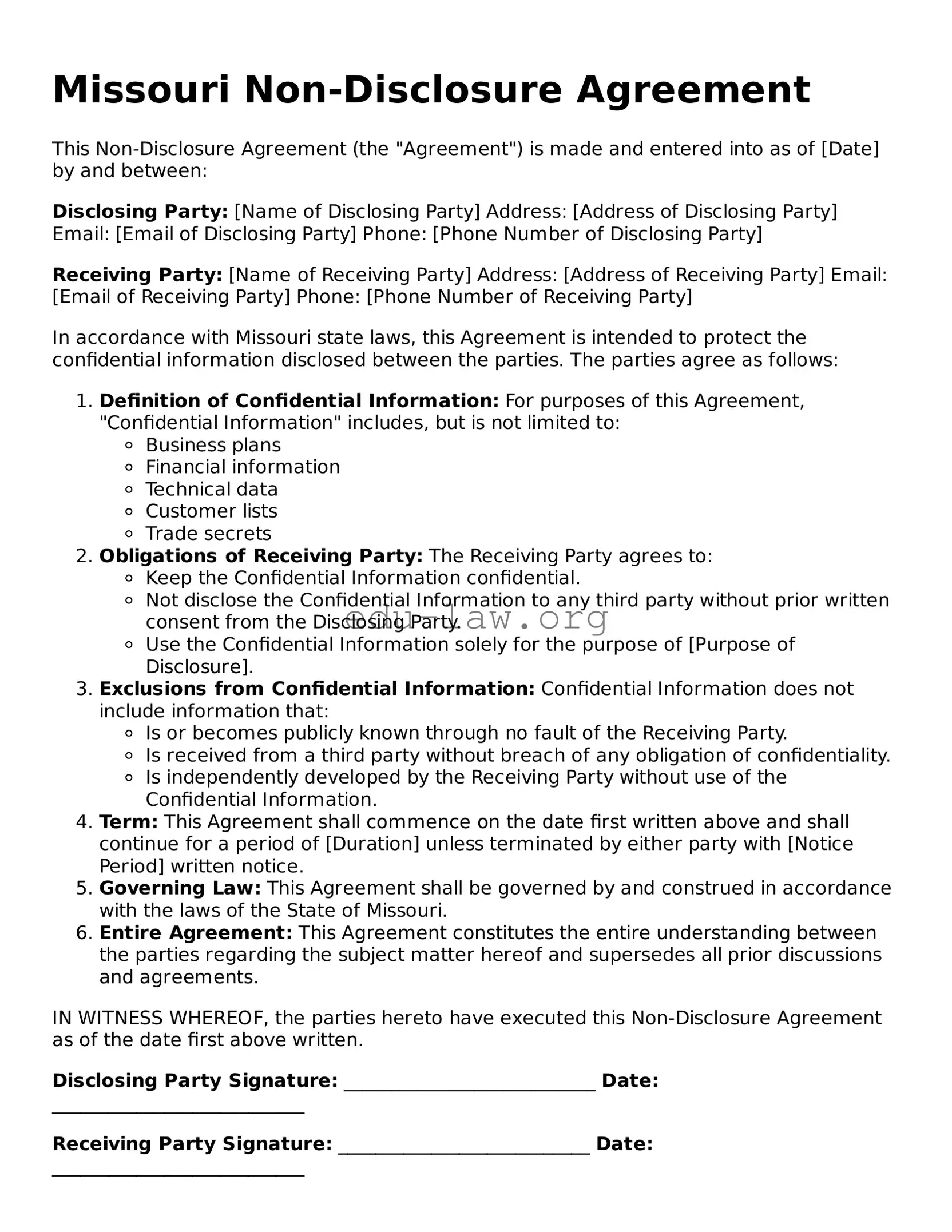
Missouri Non-Disclosure Agreement
This Non-Disclosure Agreement (the "Agreement") is made and entered into as of [Date] by and between:
Disclosing Party: [Name of Disclosing Party] Address: [Address of Disclosing Party] Email: [Email of Disclosing Party] Phone: [Phone Number of Disclosing Party]
Receiving Party: [Name of Receiving Party] Address: [Address of Receiving Party] Email: [Email of Receiving Party] Phone: [Phone Number of Receiving Party]
In accordance with Missouri state laws, this Agreement is intended to protect the confidential information disclosed between the parties. The parties agree as follows:
IN WITNESS WHEREOF, the parties hereto have executed this Non-Disclosure Agreement as of the date first above written.
Disclosing Party Signature: ___________________________ Date: ___________________________
Receiving Party Signature: ___________________________ Date: ___________________________
| Fact Name | Description |
|---|---|
| Definition | A Missouri Non-disclosure Agreement (NDA) is a legal contract that protects confidential information shared between parties. |
| Purpose | The main purpose is to prevent the unauthorized disclosure of sensitive information. |
| Governing Law | The NDA is governed by Missouri state law. |
| Parties Involved | The agreement typically involves a disclosing party and a receiving party. |
| Duration | The duration of confidentiality can vary but is often specified in the agreement. |
| Enforceability | Missouri courts generally enforce NDAs as long as they are reasonable and not overly broad. |
| Exclusions | Information that is public knowledge or independently developed is usually excluded from the NDA. |
| Signature Requirement | Both parties must sign the NDA for it to be legally binding. |
| Remedies for Breach | If breached, the disclosing party may seek damages or injunctive relief. |
| Common Uses | NDAs are commonly used in business partnerships, employment relationships, and during negotiations. |
After obtaining the Missouri Non-disclosure Agreement form, you will need to fill it out carefully to ensure all required information is provided accurately. This will help facilitate the protection of confidential information between the parties involved.
What is a Missouri Non-disclosure Agreement?
A Missouri Non-disclosure Agreement (NDA) is a legal contract designed to protect confidential information shared between parties. This agreement ensures that sensitive information, such as trade secrets or proprietary data, is not disclosed to unauthorized individuals or entities. It is commonly used in business settings when discussing potential collaborations or partnerships.
Who should use a Non-disclosure Agreement in Missouri?
Any individual or business that plans to share confidential information with another party can benefit from using an NDA. This includes entrepreneurs, startups, established businesses, and freelancers. It is especially important in situations where sensitive information is shared, such as during negotiations, product development, or business planning.
What types of information can be protected by an NDA?
An NDA can protect various types of information, including but not limited to trade secrets, business plans, customer lists, financial data, marketing strategies, and technical specifications. The key is that the information must be confidential and not publicly available. The NDA should clearly define what constitutes confidential information to avoid any ambiguity.
How long does a Non-disclosure Agreement last in Missouri?
The duration of an NDA can vary based on the agreement between the parties involved. Typically, NDAs specify a time frame during which the information must remain confidential. This period can range from a few years to indefinitely, depending on the nature of the information and the needs of the parties. It's important to establish a clear timeline in the agreement.
What happens if someone breaches the Non-disclosure Agreement?
If a party breaches the NDA, the affected party may seek legal remedies. This can include monetary damages, injunctive relief, or specific performance. The exact consequences depend on the terms outlined in the agreement and the severity of the breach. Legal action can be costly and time-consuming, so it is essential to adhere to the terms of the NDA.
Can an NDA be enforced in Missouri?
Yes, NDAs can be enforced in Missouri as long as they meet legal requirements. The agreement must be clear, specific, and signed by all parties involved. Courts generally uphold NDAs that are reasonable in scope and duration. However, if the terms are overly broad or restrict a party's ability to work, a court may not enforce the agreement.
Is it necessary to have a lawyer review the Non-disclosure Agreement?
While it is not legally required to have a lawyer review an NDA, it is highly advisable. A legal professional can help ensure that the agreement is comprehensive and tailored to the specific needs of the parties. They can also identify any potential issues or ambiguities that may arise in the future, providing peace of mind for all involved.
How can I create a Non-disclosure Agreement in Missouri?
Creating an NDA in Missouri can be done using templates available online or by drafting a custom agreement. It is crucial to include essential elements such as the definition of confidential information, obligations of the parties, duration of confidentiality, and any exclusions. Consulting with a legal professional can help ensure that the NDA complies with Missouri law and adequately protects the parties' interests.
Incomplete Information: Many individuals fail to provide all required details. This can include missing names, addresses, or dates. Ensure every section is filled out completely to avoid complications.
Incorrect Signatures: Some people neglect to sign the document. Others may sign in the wrong place or fail to include a witness signature if required. Always double-check the signature requirements.
Failure to Define Confidential Information: A common mistake is not clearly outlining what constitutes confidential information. Be specific to prevent misunderstandings later.
Ignoring Duration Terms: Some individuals overlook the duration of the agreement. It’s essential to specify how long the confidentiality obligations will last to avoid future disputes.
Not Reviewing Legal Obligations: Many people do not fully understand the legal obligations they are agreeing to. It’s crucial to read the entire document and understand its implications before signing.
Using Outdated Forms: Some individuals may use an old version of the Non-disclosure Agreement. Always ensure you are using the most current form to comply with legal standards.
When entering into a Non-disclosure Agreement (NDA) in Missouri, several other forms and documents may also be necessary to ensure all parties understand their rights and obligations. These documents help clarify the terms of the agreement and provide a framework for collaboration while protecting sensitive information.
These forms and documents complement the Missouri Non-disclosure Agreement by addressing various aspects of confidentiality and collaboration. Ensuring that all necessary paperwork is in place can help protect sensitive information and establish clear expectations among all parties involved.
A Non-Disclosure Agreement (NDA) is often compared to a Confidentiality Agreement. Both documents serve the same fundamental purpose: to protect sensitive information from being disclosed to unauthorized parties. A Confidentiality Agreement may be broader in scope, covering not only trade secrets but also any proprietary information shared between parties. Like an NDA, it requires the receiving party to maintain confidentiality, but it may also specify the duration of the confidentiality obligation and outline the consequences of breaching the agreement.
Another document similar to an NDA is the Non-Circumvention Agreement. This type of agreement is designed to prevent one party from bypassing another to engage directly with a third party, especially in business dealings. While an NDA focuses on keeping information private, a Non-Circumvention Agreement emphasizes protecting business relationships. Both documents can be used in conjunction to ensure that sensitive information is not only kept confidential but that parties do not exploit each other's connections for personal gain.
A Memorandum of Understanding (MOU) can also resemble an NDA in certain contexts. While an MOU is typically used to outline the intentions and agreements between parties before a formal contract is established, it may include clauses that protect confidential information. An MOU can serve as a preliminary step where parties agree to keep discussions private while they negotiate more detailed terms. This helps build trust and ensures that sensitive ideas or plans are not disclosed prematurely.
Lastly, a Partnership Agreement shares similarities with an NDA, particularly when it comes to protecting proprietary information among partners. This type of agreement outlines the roles, responsibilities, and expectations of each partner, and it often includes confidentiality clauses. In a partnership, sharing sensitive information is common, and having an agreement in place helps safeguard that information from being disclosed to outsiders. Thus, while a Partnership Agreement has a broader focus, it often incorporates elements of confidentiality similar to those found in an NDA.
When filling out the Missouri Non-disclosure Agreement form, it is essential to approach the task carefully. Here are five important things to consider doing and avoiding:
Misconceptions about the Missouri Non-disclosure Agreement (NDA) can lead to misunderstandings regarding its purpose and effectiveness. Here are ten common misconceptions:
Understanding these misconceptions can help individuals and businesses make informed decisions about using non-disclosure agreements in Missouri.
Filling out and using the Missouri Non-disclosure Agreement (NDA) form requires careful attention to detail and an understanding of its purpose. Here are some key takeaways to consider: