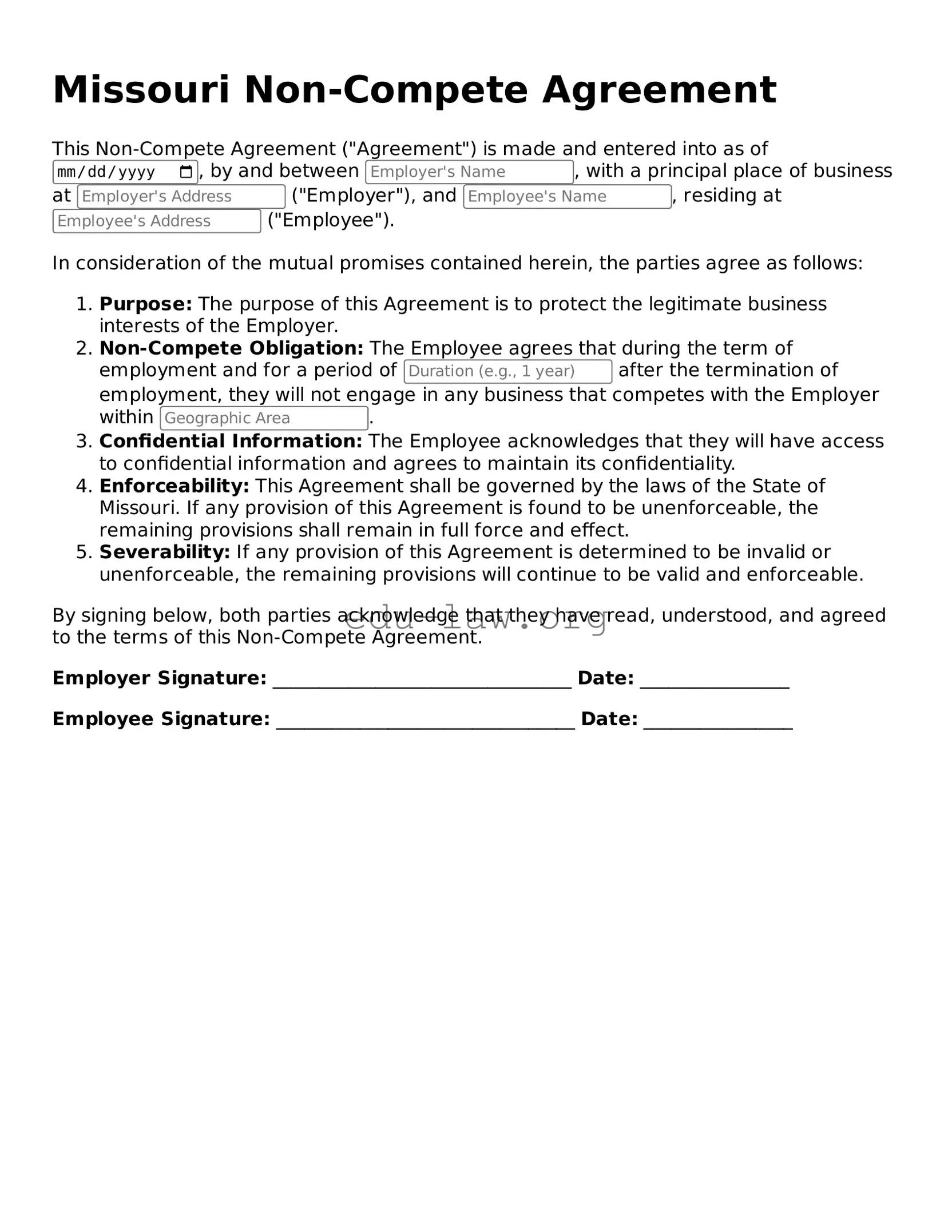
In Missouri, the Non-compete Agreement form serves as an important tool for employers seeking to protect their business interests while ensuring fair competition. This form outlines the terms under which an employee agrees not to engage in certain activities that could harm the employer's business after leaving their position. Key aspects of the agreement include the duration of the restriction, the geographical area it covers, and the specific activities that are prohibited. Employers often use this form to prevent former employees from sharing sensitive information or taking clients to a competing business. However, it is essential for both parties to understand the implications of signing such an agreement, as it can significantly impact future employment opportunities. The balance between protecting business interests and allowing individuals the freedom to work is a crucial consideration in these agreements. A well-drafted Non-compete Agreement can provide clarity and peace of mind for both employers and employees.
Missouri Non-Compete Agreement
This Non-Compete Agreement ("Agreement") is made and entered into as of , by and between , with a principal place of business at ("Employer"), and , residing at ("Employee").
In consideration of the mutual promises contained herein, the parties agree as follows:
By signing below, both parties acknowledge that they have read, understood, and agreed to the terms of this Non-Compete Agreement.
Employer Signature: ________________________________ Date: ________________
Employee Signature: ________________________________ Date: ________________
| Fact Name | Description |
|---|---|
| Definition | A non-compete agreement is a contract that restricts an employee from working for competitors or starting a competing business for a specified period after leaving a job. |
| Governing Law | The Missouri Non-compete Agreement is governed by Missouri state law, specifically Section 431.202 of the Revised Statutes of Missouri. |
| Enforceability | In Missouri, non-compete agreements must be reasonable in duration, geographic scope, and the type of employment restricted to be enforceable. |
| Duration | Typically, a duration of six months to two years is considered reasonable, but this can vary based on the specific circumstances of the employment. |
| Geographic Scope | The geographic area covered by the agreement should be limited to where the employer conducts business or where the employee worked. |
| Consideration | For a non-compete agreement to be valid, there must be consideration, such as a job offer, training, or other benefits provided to the employee. |
| Exceptions | Missouri law may not enforce non-compete agreements against employees who are terminated without cause or laid off. |
| Modification | Courts may modify overly broad non-compete agreements to make them enforceable, but this is at the discretion of the court. |
| Legal Advice | It is advisable for both employers and employees to seek legal advice before entering into a non-compete agreement to understand their rights and obligations. |
After obtaining the Missouri Non-compete Agreement form, the next steps involve carefully filling out the required sections to ensure compliance with state regulations. This process will help clarify the terms of the agreement between the parties involved.
Once the form is completed and signed, it is advisable to keep a copy for your records. Both parties should retain a copy of the agreement for future reference, as it may be necessary to revisit the terms outlined in the document.
What is a Missouri Non-compete Agreement?
A Missouri Non-compete Agreement is a legal contract that restricts an employee from working for competitors or starting a competing business for a specified period after leaving their job. This agreement aims to protect the employer's business interests, trade secrets, and client relationships.
Are Non-compete Agreements enforceable in Missouri?
Yes, Non-compete Agreements can be enforceable in Missouri, but they must meet certain criteria. The agreement must be reasonable in scope, duration, and geographic area. Courts will assess whether the restrictions are necessary to protect legitimate business interests.
How long can a Non-compete Agreement last in Missouri?
The duration of a Non-compete Agreement in Missouri can vary. Typically, a period of one to two years is considered reasonable. However, longer durations may be acceptable depending on the specific circumstances of the employment and the nature of the business.
What are legitimate business interests that a Non-compete Agreement can protect?
Legitimate business interests include trade secrets, proprietary information, customer relationships, and specialized training. The agreement should clearly define what interests are being protected to ensure its enforceability.
Can I negotiate the terms of a Non-compete Agreement?
Yes, you can negotiate the terms of a Non-compete Agreement. Before signing, discuss any concerns or modifications you may have with your employer. It’s important to ensure that the terms are fair and reasonable for both parties.
What happens if I violate a Non-compete Agreement?
If you violate a Non-compete Agreement, your former employer may take legal action against you. This could include seeking an injunction to prevent you from working for a competitor or pursuing damages for any losses incurred due to the violation.
Can I still work in my field if I sign a Non-compete Agreement?
Signing a Non-compete Agreement may limit your ability to work in your field, but it doesn't completely eliminate your options. You can often find employment in different roles or industries that do not conflict with the terms of the agreement.
How can I determine if a Non-compete Agreement is enforceable?
To determine if a Non-compete Agreement is enforceable, consider its reasonableness in terms of duration, geographic scope, and the specific business interests it aims to protect. Consulting with a legal professional can provide clarity on your specific situation.
Do I need a lawyer to review my Non-compete Agreement?
While it’s not mandatory to have a lawyer review your Non-compete Agreement, it is highly recommended. A legal professional can help you understand the implications of the agreement and advise you on your rights and options.
What should I do if I believe my Non-compete Agreement is unfair?
If you believe your Non-compete Agreement is unfair, consider discussing your concerns with your employer. If that doesn’t resolve the issue, seeking advice from a legal professional can help you explore your options and determine the best course of action.
Not clearly defining the scope of the non-compete. It's important to specify what activities or industries the agreement covers.
Failing to state the duration of the non-compete. Without a specific time frame, the agreement can be seen as overly broad.
Neglecting to include a geographic area. The agreement should outline where the restrictions apply to avoid confusion.
Using vague language. Clear and precise wording helps prevent misinterpretation of the terms.
Not considering state laws. Each state has different rules regarding non-compete agreements, and Missouri has its own specific requirements.
Forgetting to have the agreement signed by both parties. A non-compete is only enforceable if both parties agree to the terms.
Overlooking the importance of consideration. There must be something of value exchanged for the agreement to be valid.
Not seeking legal advice. Consulting with a lawyer can help ensure the agreement is enforceable and meets legal standards.
Assuming the agreement will be enforced as written. Courts may modify or reject overly restrictive agreements, so it's crucial to make them reasonable.
When entering into a Non-compete Agreement in Missouri, several other forms and documents may be necessary to ensure clarity and legal compliance. Each of these documents serves a specific purpose and can help define the relationship between the parties involved.
Understanding these documents can help both employers and employees navigate the complexities of employment relationships. Each serves to protect interests and clarify expectations, contributing to a smoother professional interaction.
The Missouri Non-compete Agreement is similar to the Non-disclosure Agreement (NDA). Both documents aim to protect sensitive information and trade secrets. While the Non-compete Agreement restricts an individual from working with competitors for a certain period, the NDA focuses on preventing the sharing of confidential information. Companies often use both agreements to safeguard their business interests when hiring employees or engaging in partnerships.
Another document comparable to the Missouri Non-compete Agreement is the Employment Agreement. This document outlines the terms of employment, including duties, compensation, and duration of employment. While the Employment Agreement may include a non-compete clause, it serves a broader purpose by detailing the overall relationship between the employer and employee. The two documents work together to ensure both parties understand their rights and obligations.
The Missouri Non-compete Agreement also shares similarities with the Confidentiality Agreement. Like the NDA, this document seeks to protect proprietary information. However, the Confidentiality Agreement can exist independently of a non-compete clause. It focuses solely on ensuring that sensitive information remains private, regardless of whether the employee continues to work in the same industry after leaving the company.
A Partnership Agreement is another document that aligns with the principles of the Missouri Non-compete Agreement. This agreement defines the roles and responsibilities of partners in a business venture. It may include non-compete provisions to prevent partners from pursuing competing interests during and after the partnership. Both agreements emphasize the importance of loyalty and commitment to the business.
The Franchise Agreement is also similar to the Missouri Non-compete Agreement. In this case, the franchisor often requires franchisees to sign a non-compete clause to protect the brand's integrity. This ensures that franchisees do not engage in competing businesses that could harm the franchise's reputation. Both documents are essential for maintaining a cohesive brand identity.
The Independent Contractor Agreement bears resemblance to the Missouri Non-compete Agreement as well. When hiring independent contractors, businesses may include non-compete clauses to protect their interests. This ensures that contractors do not take their skills and knowledge to direct competitors after the contract ends. Both agreements help clarify the expectations and limitations placed on the contractor.
The Non-solicitation Agreement is another document that is closely related to the Missouri Non-compete Agreement. This agreement prevents individuals from soliciting clients or employees of a business after leaving. While the non-compete restricts employment with competitors, the non-solicitation agreement specifically targets the relationships that could harm the business. Together, they create a comprehensive strategy to protect business interests.
In addition, the Licensing Agreement can be compared to the Missouri Non-compete Agreement. This document allows one party to use another's intellectual property under specific conditions. Often, licensing agreements include non-compete clauses to prevent licensees from using the licensed material to compete directly with the licensor. Both agreements help define the boundaries of use and protect proprietary information.
Lastly, the Shareholder Agreement shares similarities with the Missouri Non-compete Agreement. This document outlines the rights and obligations of shareholders within a corporation. It may include non-compete provisions to prevent shareholders from engaging in competing businesses that could affect the company’s performance. Both agreements focus on the protection and sustainability of the business as a whole.
When filling out the Missouri Non-compete Agreement form, it is important to approach the task with care. Here are some guidelines to follow:
By following these guidelines, you can help ensure that the process of filling out the Missouri Non-compete Agreement form goes smoothly and effectively.
Misconceptions about the Missouri Non-compete Agreement form can lead to confusion for both employers and employees. Understanding these misconceptions can help clarify the purpose and enforceability of these agreements.
Clarifying these misconceptions can help individuals navigate the complexities of non-compete agreements in Missouri more effectively.
When considering a Non-compete Agreement in Missouri, understanding its nuances is crucial. Here are some key takeaways to keep in mind:
Understanding these elements can help both employers and employees navigate the complexities of Non-compete Agreements in Missouri effectively.