In Missouri, the Medical Power of Attorney form plays a crucial role in healthcare decision-making for individuals who may become incapacitated. This legal document allows a person, known as the principal, to designate a trusted individual, referred to as the agent, to make medical decisions on their behalf when they are unable to do so. The form outlines the specific powers granted to the agent, which can include decisions about medical treatments, surgeries, and end-of-life care. It is essential for the principal to discuss their wishes with the chosen agent to ensure that their healthcare preferences are understood and respected. Additionally, the form must be signed and witnessed to be valid, and it is advisable to keep copies accessible to healthcare providers and family members. By having a Medical Power of Attorney in place, individuals can gain peace of mind, knowing that their healthcare decisions will align with their values and desires, even when they cannot voice them directly.
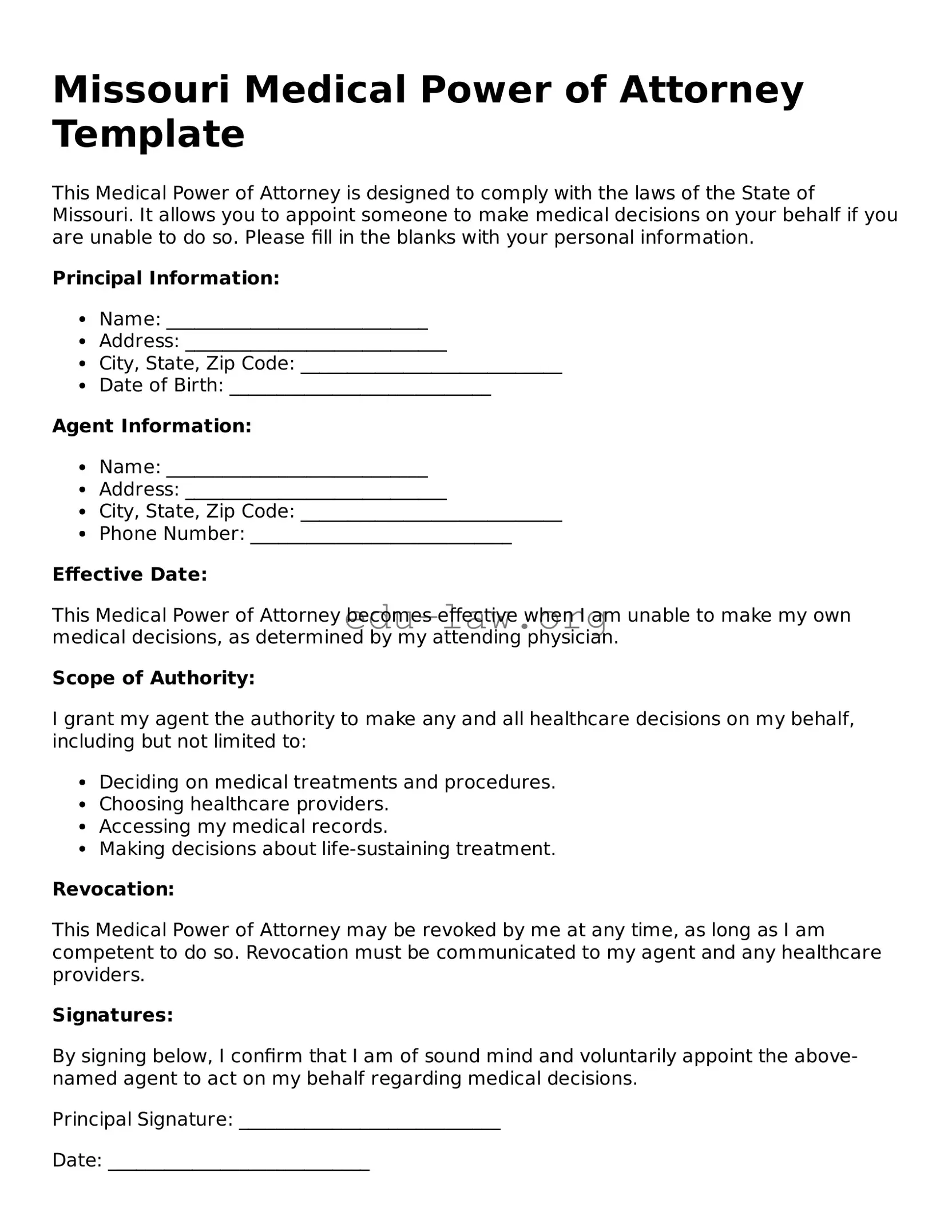
Missouri Medical Power of Attorney Template
This Medical Power of Attorney is designed to comply with the laws of the State of Missouri. It allows you to appoint someone to make medical decisions on your behalf if you are unable to do so. Please fill in the blanks with your personal information.
Principal Information:
Agent Information:
Effective Date:
This Medical Power of Attorney becomes effective when I am unable to make my own medical decisions, as determined by my attending physician.
Scope of Authority:
I grant my agent the authority to make any and all healthcare decisions on my behalf, including but not limited to:
Revocation:
This Medical Power of Attorney may be revoked by me at any time, as long as I am competent to do so. Revocation must be communicated to my agent and any healthcare providers.
Signatures:
By signing below, I confirm that I am of sound mind and voluntarily appoint the above-named agent to act on my behalf regarding medical decisions.
Principal Signature: ____________________________
Date: ____________________________
Agent Signature (optional): ____________________________
Date: ____________________________
Witnesses:
This document must be signed in the presence of two witnesses who are not related to the principal or the agent.
Witness 1 Signature: ____________________________
Date: ____________________________
Witness 2 Signature: ____________________________
Date: ____________________________
Notary Public:
This document may also be notarized to enhance its validity.
Notary Signature: ____________________________
Date: ____________________________
My commission expires: ____________________________
| Fact Name | Description |
|---|---|
| Definition | The Missouri Medical Power of Attorney form allows individuals to designate someone to make healthcare decisions on their behalf if they are unable to do so. |
| Governing Law | This form is governed by the Missouri Revised Statutes, Chapter 404, specifically sections 404.005 to 404.097. |
| Eligibility | Any adult resident of Missouri can create a Medical Power of Attorney. |
| Agent Selection | The individual creating the form (the principal) can choose any competent adult as their agent. |
| Durability | The authority granted to the agent remains effective even if the principal becomes incapacitated. |
| Signature Requirement | The form must be signed by the principal and witnessed by two individuals or notarized. |
| Revocation | The principal can revoke the Medical Power of Attorney at any time, as long as they are competent. |
| Healthcare Decisions | The agent can make decisions regarding medical treatments, procedures, and end-of-life care. |
| Limitations | Some limitations can be specified in the form, such as refusing certain types of medical treatment. |
| Importance | This form is crucial for ensuring that an individual's healthcare preferences are honored when they cannot express them. |
Filling out the Missouri Medical Power of Attorney form is an important step in ensuring your healthcare preferences are honored. Once completed, this document will allow you to designate someone to make medical decisions on your behalf if you are unable to do so.
What is a Missouri Medical Power of Attorney?
A Missouri Medical Power of Attorney is a legal document that allows you to appoint someone to make healthcare decisions on your behalf if you become unable to do so. This person, known as your agent or proxy, will have the authority to make medical decisions based on your preferences and best interests when you are incapacitated.
Who can be appointed as my agent?
You can choose any competent adult to be your agent, such as a family member, friend, or trusted advisor. It is important to select someone who understands your values and wishes regarding medical treatment. However, certain individuals, like your healthcare provider or an employee of your healthcare facility, may not be eligible to serve as your agent.
How do I create a Medical Power of Attorney in Missouri?
To create a Medical Power of Attorney in Missouri, you need to fill out the appropriate form, which can often be found online or through legal resources. The document should clearly state your wishes and identify your chosen agent. After completing the form, you must sign it in the presence of a notary public or two witnesses to make it legally valid.
Can I change or revoke my Medical Power of Attorney?
Yes, you have the right to change or revoke your Medical Power of Attorney at any time, as long as you are mentally competent. To revoke the document, you can create a new one that explicitly states your intent to cancel the previous version or simply notify your agent and any relevant healthcare providers in writing.
What happens if I don’t have a Medical Power of Attorney?
If you do not have a Medical Power of Attorney and become unable to make your own healthcare decisions, your family members may need to go through a legal process to obtain guardianship or conservatorship. This can be time-consuming and may not align with your wishes, making it essential to have a Medical Power of Attorney in place.
Is a Medical Power of Attorney the same as a living will?
No, a Medical Power of Attorney and a living will serve different purposes. A Medical Power of Attorney designates someone to make healthcare decisions for you, while a living will outlines your preferences for medical treatment in specific situations, such as end-of-life care. It is advisable to have both documents to ensure comprehensive healthcare planning.
Do I need a lawyer to create a Medical Power of Attorney?
While it is not legally required to have a lawyer to create a Medical Power of Attorney, consulting with one can be beneficial. A lawyer can help ensure that the document accurately reflects your wishes and complies with Missouri laws. This can provide peace of mind that your healthcare decisions will be honored when needed.
Failing to clearly identify the agent. It’s crucial to name someone who understands your wishes and can make decisions on your behalf. Without a clear designation, your intentions may be misunderstood.
Not discussing your wishes with the chosen agent. Communication is key. If your agent is unaware of your preferences regarding medical treatments, they may struggle to make the right choices in critical situations.
Leaving the form unsigned or undated. A signed and dated form is necessary for it to be valid. Without these, the document may not hold up when needed most.
Using outdated forms. Always ensure you are using the most current version of the Missouri Medical Power of Attorney form. Laws can change, and using an old form could lead to complications.
Not including alternate agents. If your primary agent is unavailable, it’s wise to name one or more alternatives. This ensures that someone can step in to make decisions when necessary.
Overlooking the importance of witnesses. Missouri requires that your Medical Power of Attorney form be signed in the presence of two witnesses. Failing to do so can invalidate the document.
When preparing a Missouri Medical Power of Attorney, it is important to consider other related documents that can complement this form. Each document serves a specific purpose and can help ensure that your healthcare wishes are respected.
Having these documents in place can provide peace of mind and clarity for both you and your loved ones. It is advisable to review and update them regularly to reflect your current wishes.
The Missouri Medical Power of Attorney form is similar to a Living Will. Both documents address healthcare decisions, but they serve different purposes. A Living Will specifies an individual's wishes regarding end-of-life care and medical treatment in situations where they cannot communicate their preferences. In contrast, the Medical Power of Attorney allows someone to appoint a trusted person to make healthcare decisions on their behalf, ensuring that their preferences are honored even when they cannot express them directly.
An Advance Directive is another document akin to the Missouri Medical Power of Attorney. This term often encompasses both the Medical Power of Attorney and the Living Will. Essentially, an Advance Directive is a broader category that includes any written instructions about medical care. It can guide healthcare providers and family members in making decisions that align with the individual's values and wishes, whether through appointed agents or specific treatment instructions.
The Durable Power of Attorney for Healthcare is another related document. While the Medical Power of Attorney focuses solely on healthcare decisions, the Durable Power of Attorney can cover a broader range of decisions, including financial matters. However, when it comes to healthcare, both documents grant authority to an agent to make choices based on the principal's best interests, ensuring that medical needs are met even when the individual cannot advocate for themselves.
A Do Not Resuscitate (DNR) order shares some similarities with the Medical Power of Attorney, particularly regarding end-of-life decisions. A DNR specifically instructs healthcare providers not to perform cardiopulmonary resuscitation (CPR) if a person's heart stops or they stop breathing. While the Medical Power of Attorney allows for broader decision-making about medical treatment, a DNR focuses on one specific aspect of care, reflecting the patient's wishes about resuscitation efforts.
Lastly, the Physician Orders for Life-Sustaining Treatment (POLST) form is comparable to the Medical Power of Attorney. The POLST is a medical order that outlines a patient's preferences for life-sustaining treatment and is intended for individuals with serious health conditions. Like the Medical Power of Attorney, it ensures that healthcare providers are aware of and respect the patient's wishes, but it does so in a more detailed and directive manner, often used in emergency situations.
When filling out the Missouri Medical Power of Attorney form, it is important to approach the process with care and attention. Here are some guidelines to help ensure that the form is completed correctly.
Understanding the Missouri Medical Power of Attorney form is essential for making informed decisions about healthcare. However, there are several misconceptions that can lead to confusion. Here are six common misunderstandings:
Many people think that a Medical Power of Attorney is only useful when they are unable to make decisions for themselves. However, this document can also be used if you want someone else to make decisions on your behalf, even if you are still capable of doing so.
While spouses often have a say in medical decisions, they do not automatically have legal authority unless designated through a Medical Power of Attorney. Without this document, healthcare providers may not recognize their authority.
Some believe that a Medical Power of Attorney is a permanent decision. In reality, you can revoke or update this document at any time, as long as you are mentally competent.
Using a generic form may not meet Missouri’s specific legal requirements. It’s essential to use the correct state-specific form to ensure that your wishes are honored.
A Medical Power of Attorney allows someone to make healthcare decisions on your behalf, but it does not cover financial matters. You may need a separate document for financial powers of attorney.
While healthcare providers strive to respect patient wishes, they must also comply with laws and regulations. Having a Medical Power of Attorney helps clarify your preferences but does not guarantee that all wishes will be followed.
Filling out and using the Missouri Medical Power of Attorney form is an important step in ensuring your healthcare wishes are respected. Here are some key takeaways to keep in mind:
By following these guidelines, you can ensure that your Medical Power of Attorney is effective and aligns with your healthcare preferences.