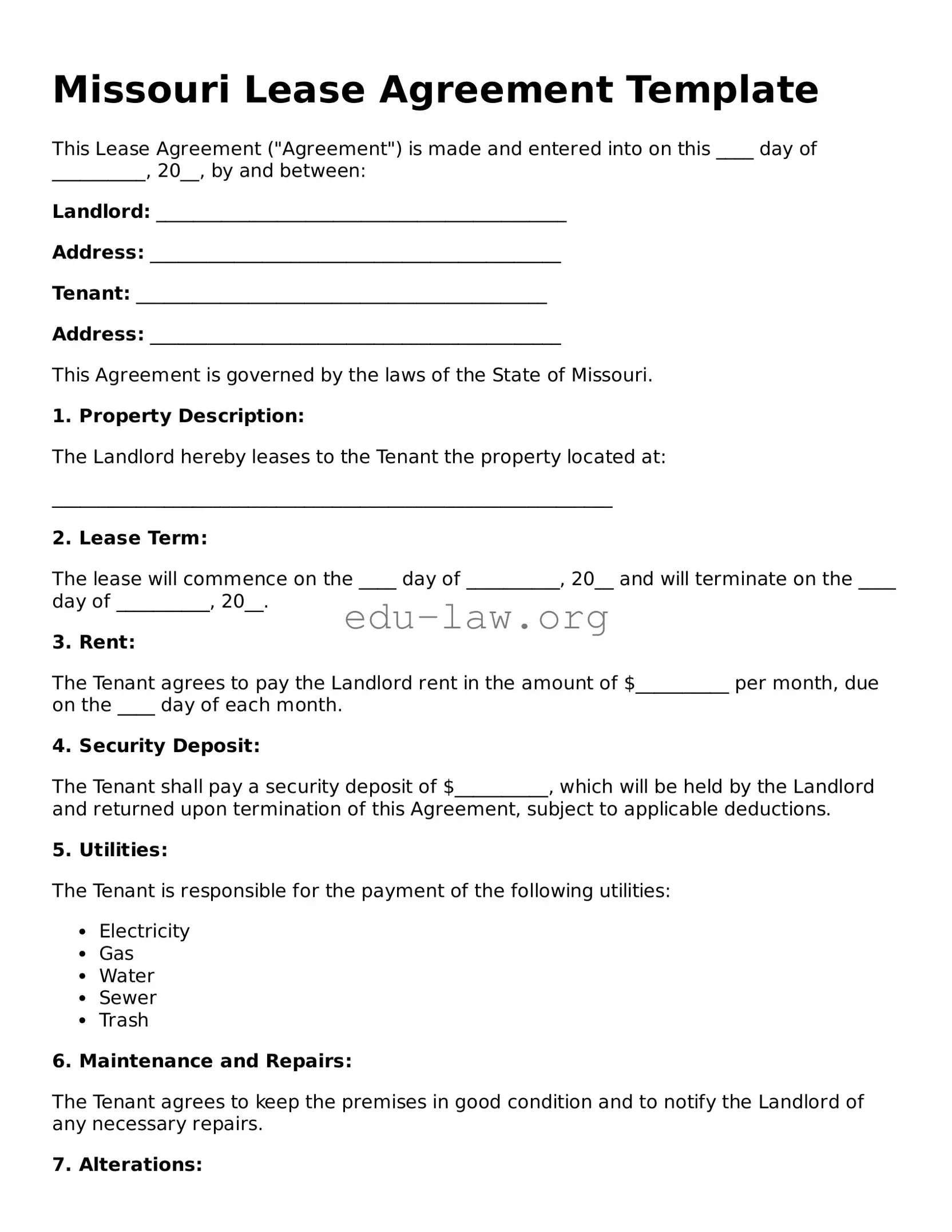
The Missouri Lease Agreement form serves as a crucial document in the rental process, outlining the rights and responsibilities of both landlords and tenants. This legally binding contract typically includes essential details such as the duration of the lease, the amount of rent due, and the method of payment. It also addresses the security deposit requirements, maintenance responsibilities, and rules regarding pets, ensuring that both parties have a clear understanding of their obligations. Additionally, the form may outline procedures for terminating the lease and the consequences of breaking the agreement. By providing a structured framework, the Missouri Lease Agreement helps to foster a transparent relationship between landlords and tenants, minimizing potential disputes and misunderstandings. Understanding the key components of this form is vital for anyone involved in a rental situation in Missouri.
Missouri Lease Agreement Template
This Lease Agreement ("Agreement") is made and entered into on this ____ day of __________, 20__, by and between:
Landlord: ____________________________________________
Address: ____________________________________________
Tenant: ____________________________________________
Address: ____________________________________________
This Agreement is governed by the laws of the State of Missouri.
1. Property Description:
The Landlord hereby leases to the Tenant the property located at:
____________________________________________________________
2. Lease Term:
The lease will commence on the ____ day of __________, 20__ and will terminate on the ____ day of __________, 20__.
3. Rent:
The Tenant agrees to pay the Landlord rent in the amount of $__________ per month, due on the ____ day of each month.
4. Security Deposit:
The Tenant shall pay a security deposit of $__________, which will be held by the Landlord and returned upon termination of this Agreement, subject to applicable deductions.
5. Utilities:
The Tenant is responsible for the payment of the following utilities:
6. Maintenance and Repairs:
The Tenant agrees to keep the premises in good condition and to notify the Landlord of any necessary repairs.
7. Alterations:
The Tenant shall not make any alterations to the premises without the prior written consent of the Landlord.
8. Governing Law:
This Agreement shall be governed by and construed in accordance with the laws of the State of Missouri.
9. Signatures:
In witness whereof, the parties hereto have executed this Lease Agreement as of the date first above written.
Landlord Signature: _______________________________
Date: _________________________________________
Tenant Signature: _______________________________
Date: _________________________________________
| Fact Name | Details |
|---|---|
| Governing Law | The Missouri Lease Agreement is governed by Missouri state law, specifically Chapter 535 of the Revised Statutes of Missouri. |
| Types of Leases | This form can be used for residential, commercial, and agricultural leases in Missouri. |
| Required Information | The lease agreement must include the names of the landlord and tenant, property address, lease term, and rental amount. |
| Security Deposit | Missouri law allows landlords to collect a security deposit, typically not exceeding two months' rent for residential leases. |
| Termination Notice | For month-to-month leases, either party must provide a written notice of at least 30 days before terminating the agreement. |
Filling out the Missouri Lease Agreement form requires careful attention to detail. Each section of the form must be completed accurately to ensure that both parties understand their rights and responsibilities. Below are the steps to guide you through the process.
What is a Missouri Lease Agreement?
A Missouri Lease Agreement is a legally binding contract between a landlord and a tenant. It outlines the terms and conditions under which a tenant may occupy a rental property. This document typically includes details such as the rental amount, duration of the lease, responsibilities for maintenance, and rules regarding the use of the property. Having a written agreement helps protect both parties and ensures clarity about their rights and obligations.
What are the key components of a Missouri Lease Agreement?
Key components of a Missouri Lease Agreement include the names of the landlord and tenant, property address, lease term (fixed or month-to-month), rent amount and payment due date, security deposit details, maintenance responsibilities, and any specific rules or restrictions regarding the property. It’s also important to include clauses about termination and renewal of the lease, as well as procedures for handling disputes.
Can a Missouri Lease Agreement be modified after it has been signed?
Yes, a Missouri Lease Agreement can be modified after it has been signed, but both parties must agree to the changes. Modifications should be documented in writing and signed by both the landlord and tenant. This ensures that any changes are legally recognized and helps avoid misunderstandings in the future. Oral agreements or informal changes are not enforceable, so it’s crucial to keep everything in writing.
What happens if a tenant violates the lease agreement?
If a tenant violates the lease agreement, the landlord has several options. Common violations include late rent payments, unauthorized pets, or damage to the property. The landlord may issue a notice to the tenant, outlining the violation and providing a timeframe for resolution. If the issue is not resolved, the landlord may initiate eviction proceedings. It’s important for both parties to understand their rights and responsibilities to avoid conflicts.
Failing to include all required personal information. Both landlords and tenants must provide accurate names and contact details.
Not specifying the lease term clearly. Indicating the start and end dates is crucial to avoid misunderstandings.
Overlooking the rental amount. Ensure that the monthly rent is clearly stated, along with any late fees or additional charges.
Neglecting to outline security deposit details. The amount, due date, and conditions for its return should be explicitly mentioned.
Failing to describe maintenance responsibilities. Clearly define who is responsible for repairs and maintenance tasks.
Not including pet policies. If pets are allowed, specify any restrictions or additional fees related to pet ownership.
Leaving out terms regarding lease termination. Outline the notice period required for both parties when ending the lease.
Ignoring local laws and regulations. Ensure compliance with Missouri's specific rental laws to avoid legal issues.
Not signing the document. Both parties must sign the lease for it to be legally binding.
Failing to keep copies of the signed lease. Each party should retain a copy for their records to reference in the future.
When entering into a lease agreement in Missouri, several other documents may accompany the primary lease to ensure clarity and protect the rights of both landlords and tenants. Each of these documents serves a unique purpose, contributing to a comprehensive rental experience.
Understanding these documents can empower both landlords and tenants to navigate their rental agreements with confidence. Each form plays a crucial role in maintaining a positive and transparent rental relationship.
The Missouri Lease Agreement form shares similarities with the Residential Lease Agreement, a commonly used document in many states. Both agreements outline the terms and conditions under which a landlord rents property to a tenant. They specify the duration of the lease, the amount of rent due, and the responsibilities of both parties. Just like the Missouri form, a Residential Lease Agreement can include clauses related to security deposits, maintenance responsibilities, and rules regarding pets, making it a comprehensive tool for managing rental relationships.
Another document that resembles the Missouri Lease Agreement is the Commercial Lease Agreement. While the latter is tailored for business properties, both agreements serve the same fundamental purpose: to establish the rights and obligations of the landlord and tenant. They detail the rental terms, including payment schedules and lease duration. However, a Commercial Lease Agreement often includes additional provisions specific to business operations, such as zoning regulations and permitted use of the property, which may not be as relevant in a residential context.
The Month-to-Month Rental Agreement is another document that shares key elements with the Missouri Lease Agreement. This type of agreement allows for a flexible rental arrangement, where either party can terminate the lease with proper notice. Like the Missouri form, it outlines rent payments and responsibilities. However, the Month-to-Month Rental Agreement typically lacks the long-term commitment found in standard lease agreements, making it suitable for tenants seeking short-term housing solutions.
The Sublease Agreement is similar in nature to the Missouri Lease Agreement, as it governs the rental relationship between a tenant and a subtenant. This document allows a tenant to rent out their leased space to another party, while still retaining their obligations to the original landlord. Both agreements require clarity on rental terms, duration, and responsibilities, ensuring that all parties understand their rights. The Sublease Agreement may also include specific terms that address the relationship between the original tenant and the subtenant.
Another comparable document is the Lease Option Agreement. This agreement not only outlines the rental terms but also provides the tenant with the option to purchase the property at a later date. Similar to the Missouri Lease Agreement, it details the rent amount and duration, but it also incorporates conditions related to the purchase option. This can be an attractive option for tenants who are considering homeownership but want to test the property first.
The Rent-to-Own Agreement is akin to the Missouri Lease Agreement, as it combines leasing and purchasing elements. This document allows tenants to rent a property with the intention of buying it after a specified period. Like the Missouri form, it defines rental terms, but it also includes provisions for how a portion of the rent may apply toward the purchase price. This creates a pathway for tenants to transition into homeowners while living in the property.
The Room Rental Agreement is another document that mirrors the Missouri Lease Agreement, particularly in situations where multiple tenants share a living space. This agreement outlines the rental terms for an individual room within a larger property. It specifies rent amounts, shared responsibilities, and rules for common areas, similar to how the Missouri Lease Agreement details expectations for both landlords and tenants in a full rental property.
The Fixed-Term Lease Agreement also shares many characteristics with the Missouri Lease Agreement. This type of lease establishes a specific duration for the rental period, often lasting a year or more. Both agreements detail terms such as rent payment, security deposits, and maintenance responsibilities. The Fixed-Term Lease Agreement provides a sense of stability for tenants and landlords alike, ensuring that both parties are clear about their commitments for the duration of the lease.
Lastly, the Landlord-Tenant Agreement is a foundational document that aligns closely with the Missouri Lease Agreement. This agreement encompasses the essential rights and responsibilities of both parties in a rental arrangement. It typically includes terms related to rent, maintenance, and eviction procedures. While it may not always have the same level of detail as a lease agreement, it serves as a crucial reference point for understanding the legal relationship between landlords and tenants.
Filling out a Missouri Lease Agreement form can be straightforward if you keep a few key points in mind. Here’s a list of things to do and avoid to ensure a smooth process.
By following these guidelines, you can help ensure that your lease agreement is filled out correctly and that your rights as a tenant are protected.
Understanding the Missouri Lease Agreement form is crucial for both landlords and tenants. However, several misconceptions can lead to confusion. Here are six common misconceptions:
While it is highly recommended to have a written lease, oral agreements can also be legally binding in Missouri. However, proving the terms of an oral lease can be challenging.
This is false. Landlords must provide reasonable notice, typically 24 hours, before entering the rental property, except in emergencies.
Missouri law does not specify a strict 30-day rule. Instead, landlords must return security deposits within a "reasonable" time frame, which may vary based on circumstances.
While many terms can be negotiated, certain legal requirements must be met. For example, rent must be paid, and laws regarding habitability must be followed.
This is misleading. Tenants may only withhold rent under specific circumstances, such as significant repairs that the landlord has failed to address.
Not all leases automatically renew. Some leases have a fixed term, while others may have a month-to-month arrangement. It's essential to check the specific terms outlined in the lease.
When filling out and using the Missouri Lease Agreement form, there are several important points to keep in mind. Understanding these can help ensure a smoother rental experience for both landlords and tenants.
By keeping these key takeaways in mind, both landlords and tenants can navigate the leasing process with greater confidence and understanding.