Creating a Last Will and Testament is an essential step in ensuring that your wishes are honored after your passing. In Missouri, this legal document serves as a formal declaration of how you wish your assets to be distributed, who will take care of your minor children, and who will manage your estate. The Missouri Last Will and Testament form is designed to simplify the process of outlining these important decisions. It includes essential components such as the appointment of an executor, who will be responsible for carrying out the terms of your will, and provisions for guardianship if you have dependents. Additionally, it addresses the distribution of personal property and financial assets, allowing you to specify beneficiaries clearly. Understanding the structure and requirements of this form is crucial, as it ensures that your intentions are documented accurately and legally, providing peace of mind for both you and your loved ones.
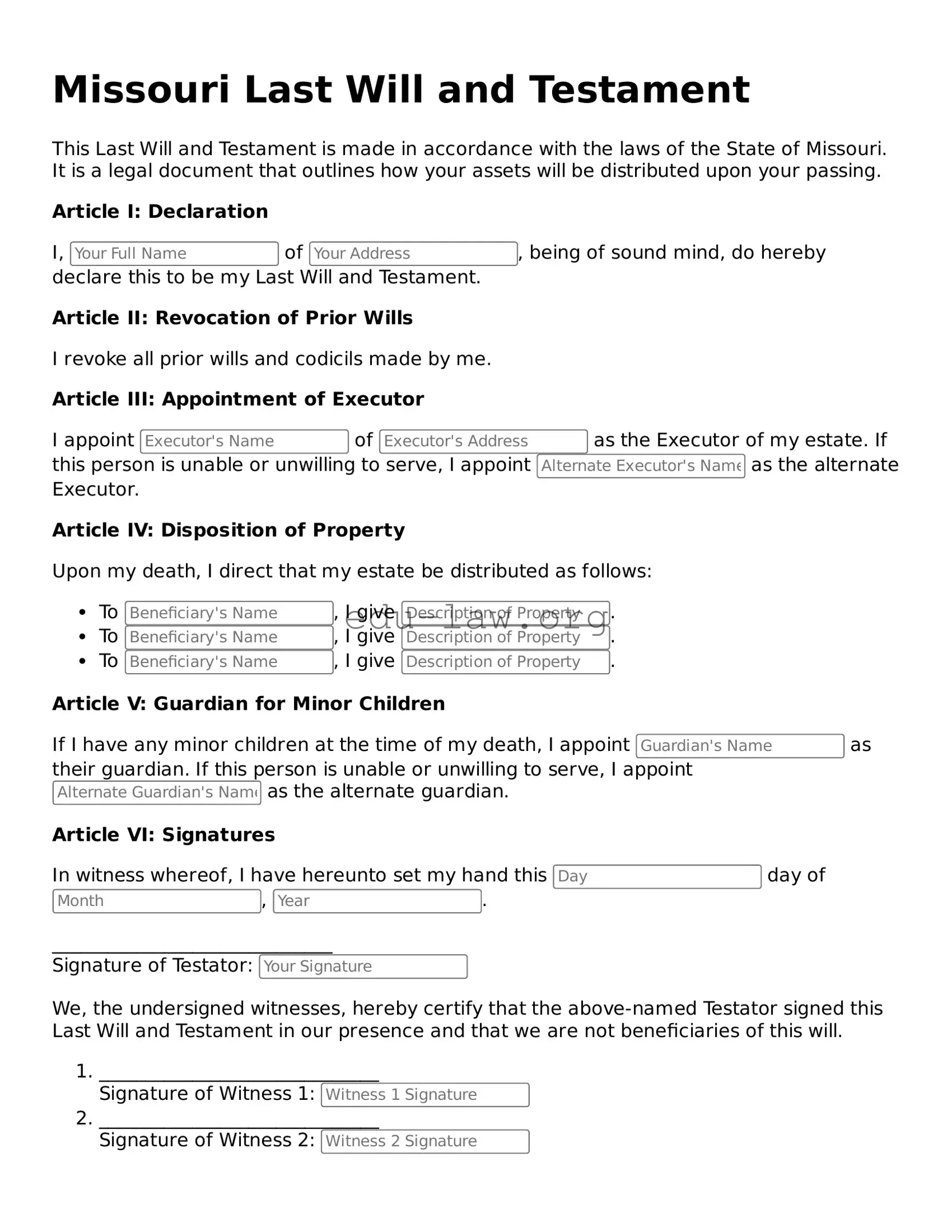
Missouri Last Will and Testament
This Last Will and Testament is made in accordance with the laws of the State of Missouri. It is a legal document that outlines how your assets will be distributed upon your passing.
Article I: Declaration
I, of , being of sound mind, do hereby declare this to be my Last Will and Testament.
Article II: Revocation of Prior Wills
I revoke all prior wills and codicils made by me.
Article III: Appointment of Executor
I appoint of as the Executor of my estate. If this person is unable or unwilling to serve, I appoint as the alternate Executor.
Article IV: Disposition of Property
Upon my death, I direct that my estate be distributed as follows:
Article V: Guardian for Minor Children
If I have any minor children at the time of my death, I appoint as their guardian. If this person is unable or unwilling to serve, I appoint as the alternate guardian.
Article VI: Signatures
In witness whereof, I have hereunto set my hand this day of , .
______________________________
Signature of Testator:
We, the undersigned witnesses, hereby certify that the above-named Testator signed this Last Will and Testament in our presence and that we are not beneficiaries of this will.
Witnesses' Addresses:
This document is intended to serve as a template for a Last Will and Testament in Missouri. It is advisable to consult with a legal professional to ensure compliance with all applicable laws.
| Fact Name | Description |
|---|---|
| Legal Requirement | In Missouri, a Last Will and Testament must be in writing to be considered valid. |
| Signature Requirement | The will must be signed by the testator (the person making the will) or by another person at the testator's direction and in their presence. |
| Witnesses | Missouri law requires at least two witnesses to sign the will, confirming that they witnessed the testator's signature. |
| Revocation | A Last Will and Testament can be revoked by the testator at any time, typically through a new will or by destroying the original document. |
| Governing Law | The Missouri Last Will and Testament is governed by Chapter 474 of the Revised Statutes of Missouri. |
| Self-Proving Will | Missouri allows for a self-proving will, which includes a notarized affidavit from the witnesses, simplifying the probate process. |
After obtaining the Missouri Last Will and Testament form, you will need to complete it carefully to ensure it reflects your wishes regarding your estate. Once filled out, the form will need to be signed and witnessed according to state requirements.
What is a Last Will and Testament in Missouri?
A Last Will and Testament is a legal document that outlines how a person's assets and affairs should be handled after their death. In Missouri, this document allows you to specify who will inherit your property, name guardians for your minor children, and appoint an executor to manage your estate. It serves as a crucial tool for ensuring that your wishes are honored and can help prevent disputes among family members during a difficult time.
Who can create a Last Will and Testament in Missouri?
In Missouri, any individual who is at least 18 years old and of sound mind can create a Last Will and Testament. This means you should be capable of understanding the implications of your decisions and the nature of your assets. If you are a minor or deemed mentally incapacitated, you may not be able to create a valid will without assistance.
What are the requirements for a valid will in Missouri?
To ensure your will is valid in Missouri, it must be written, signed by you, and witnessed by at least two individuals who are present at the same time. These witnesses should not be beneficiaries of the will to avoid potential conflicts of interest. Additionally, while it is not required, having your will notarized can add an extra layer of authenticity and help streamline the probate process.
Can I change or revoke my will in Missouri?
Yes, you can change or revoke your will in Missouri at any time as long as you are of sound mind. To make changes, you can create a new will that explicitly revokes the previous one or add a codicil, which is an amendment to your existing will. It’s important to ensure that any changes comply with the legal requirements to avoid confusion or disputes later on.
What happens if I die without a will in Missouri?
If you pass away without a will, your estate will be distributed according to Missouri's intestacy laws. This means the state will determine how your assets are divided, which may not align with your wishes. Typically, your property will go to your closest relatives, such as a spouse, children, or parents. Dying without a will can lead to complications and may result in a longer probate process.
Can I write my own will in Missouri?
Yes, you can write your own will in Missouri, often referred to as a "holographic will." However, it is essential to ensure that it meets all legal requirements. While DIY wills can be cost-effective, they may lack the necessary legal language or structure, which could lead to challenges during the probate process. Consulting with a legal professional can provide peace of mind and ensure that your will is valid.
How is a will probated in Missouri?
Probate is the legal process of administering a deceased person's estate. In Missouri, the probate process begins by filing the will with the probate court in the county where the deceased lived. The court will then validate the will, appoint an executor, and oversee the distribution of assets according to the will's terms. The process can take several months to complete, depending on the complexity of the estate and any potential disputes.
What is the role of an executor in Missouri?
The executor is the person named in your will to manage your estate after your death. This individual is responsible for gathering assets, paying debts and taxes, and distributing the remaining property to beneficiaries. In Missouri, the executor must also file the will with the probate court and ensure that all legal requirements are met throughout the probate process. Choosing a trustworthy and organized executor is vital for a smooth transition.
Can I include specific bequests in my will?
Absolutely! In your Missouri will, you can include specific bequests, which are gifts of particular items or amounts of money to named individuals or organizations. For example, you might specify that your jewelry goes to your daughter or that a certain sum is donated to a charity. Including these details can help ensure that your personal belongings are distributed according to your wishes and can provide clarity to your loved ones.
Failing to sign the will. A will must be signed by the testator to be valid. Without a signature, the document holds no legal weight.
Not having witnesses present. In Missouri, a will typically requires at least two witnesses who must sign the document in the presence of the testator. Missing witnesses can lead to disputes.
Using outdated forms. Laws change, and using an old version of the will form may not comply with current legal requirements.
Overlooking the inclusion of all assets. It's crucial to list all significant assets clearly. Failing to do so can result in confusion or unintended distribution.
Neglecting to name an executor. The executor is responsible for carrying out the terms of the will. Omitting this vital role can complicate the probate process.
Not specifying guardians for minor children. If applicable, naming guardians is essential to ensure that children are cared for according to your wishes.
Using ambiguous language. Clear and precise language is necessary to avoid misinterpretations. Vague terms can lead to legal disputes among heirs.
Failing to update the will. Life changes, such as marriage, divorce, or the birth of children, may necessitate updates to your will. An outdated will may not reflect your current wishes.
When preparing a Last Will and Testament in Missouri, it's often helpful to consider additional documents that can complement your estate planning. These forms can help ensure your wishes are clearly communicated and legally recognized. Here are five commonly used documents that you might find beneficial.
By considering these documents alongside your Last Will and Testament, you can create a comprehensive estate plan that addresses various aspects of your wishes. It's always a good idea to consult with a professional to ensure everything is in order and meets your needs.
The Missouri Last Will and Testament form shares similarities with a Living Will. While a Last Will outlines how a person’s assets should be distributed after their death, a Living Will focuses on medical decisions when someone is unable to communicate their wishes. Both documents reflect personal choices about one’s future, emphasizing the importance of planning ahead for both financial and health-related matters.
Another document akin to the Last Will is the Durable Power of Attorney. This legal form grants someone the authority to make financial or medical decisions on behalf of another person if they become incapacitated. Like a Last Will, it requires careful consideration of whom to trust with such significant responsibilities, ensuring that one's wishes are honored during difficult times.
The Revocable Trust is also similar to the Last Will. This document allows individuals to place their assets into a trust during their lifetime, which can then be distributed to beneficiaries upon their death. While both documents serve to manage the distribution of assets, a Revocable Trust can help avoid probate, making the transfer of assets more efficient and private.
A Living Trust, closely related to the Revocable Trust, allows individuals to retain control over their assets while they are alive. Upon their passing, the assets are transferred to beneficiaries without going through probate. This document, like the Last Will, requires careful planning and consideration of how one’s assets will be managed and distributed, but it offers added benefits of flexibility and privacy.
The Codicil is another important document that complements a Last Will. It serves as an amendment to an existing will, allowing individuals to make changes without drafting an entirely new document. This is particularly useful for updating beneficiaries or altering specific provisions, ensuring that the will remains current and reflective of one's wishes.
Similar to a Last Will, the Estate Plan encompasses a broader range of documents, including wills, trusts, and powers of attorney. It is a comprehensive strategy for managing one’s affairs, both during life and after death. An Estate Plan provides a roadmap for asset distribution and decision-making, ensuring that all aspects of an individual’s wishes are addressed.
The Advance Directive is another document that aligns with the Last Will in its focus on personal choices regarding health care. This document outlines a person’s preferences for medical treatment in case they become unable to express their wishes. Like a Last Will, it empowers individuals to make decisions about their future, emphasizing the importance of having a say in one’s own care.
A Healthcare Proxy is similar to an Advance Directive but specifically designates someone to make medical decisions on behalf of another person if they are unable to do so. This document complements a Last Will by ensuring that healthcare preferences are respected, providing peace of mind that one's wishes will be honored in critical situations.
Finally, the Financial Power of Attorney is comparable to the Durable Power of Attorney but focuses solely on financial matters. This document allows someone to manage financial affairs on behalf of another individual, ensuring that bills are paid and assets are managed if the person becomes incapacitated. Like the Last Will, it requires careful consideration of whom to trust, emphasizing the importance of planning for the future.
When filling out the Missouri Last Will and Testament form, it is essential to approach the task with care. Here are ten important things to consider:
Understanding the Missouri Last Will and Testament form is essential for anyone looking to create a valid will. However, several misconceptions can lead to confusion. Here are six common misunderstandings:
Many people believe that a will must be drafted by an attorney to be valid. In Missouri, individuals can create their own will, as long as it meets specific legal requirements.
Some think that a verbal will is sufficient. In Missouri, a will must be in writing to be enforceable, ensuring clarity and reducing disputes.
While notarization can help, it is not a requirement for a will in Missouri. A will can be valid as long as it is signed by the testator and witnessed appropriately.
It is a common belief that every asset must be listed in the will. However, some assets, like those held in joint tenancy or certain trusts, do not need to be included.
Many assume that a will is permanent. In reality, individuals can amend or revoke their wills at any time, as long as they follow the proper legal procedures.
Some people think wills only distribute physical assets. However, wills can also address guardianship for minor children and other important decisions.
Being aware of these misconceptions can help individuals navigate the process of creating a will in Missouri more effectively.
When filling out and using the Missouri Last Will and Testament form, keep the following key takeaways in mind: