The Missouri General Power of Attorney form serves as a crucial legal document that empowers an individual, known as the principal, to designate another person, referred to as the agent or attorney-in-fact, to act on their behalf in various matters. This form encompasses a wide range of responsibilities, allowing the agent to handle financial transactions, manage real estate, and make decisions regarding personal property. Importantly, the authority granted can be tailored to the principal's needs, either being broad or limited to specific tasks. The document remains effective until it is revoked by the principal or upon the principal's incapacitation, unless a durable power of attorney is specified. It is essential for individuals to understand the implications of granting such powers, as the agent will have significant control over the principal's financial and legal affairs. Completing this form correctly is vital to ensure that the principal's intentions are honored and that their interests are protected.
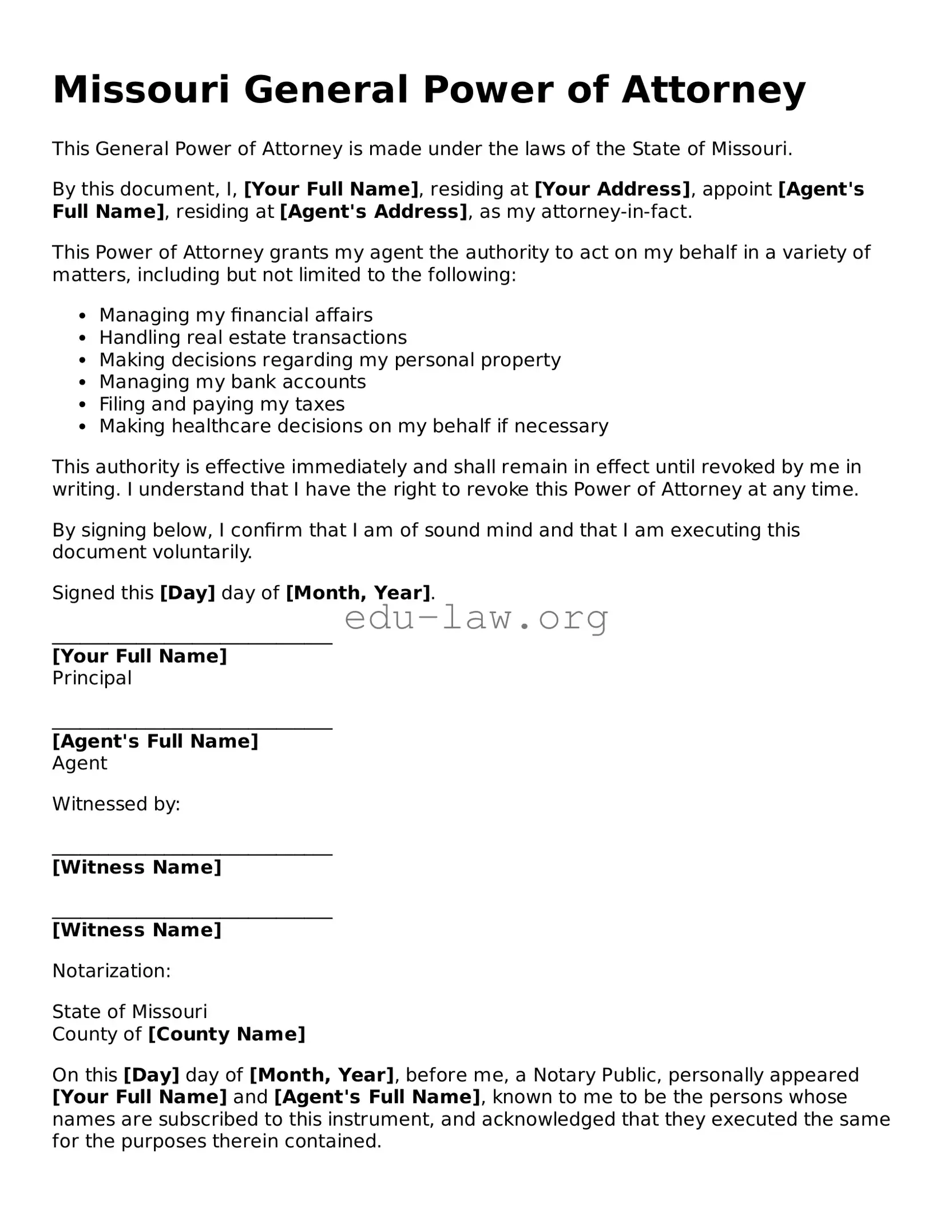
Missouri General Power of Attorney
This General Power of Attorney is made under the laws of the State of Missouri.
By this document, I, [Your Full Name], residing at [Your Address], appoint [Agent's Full Name], residing at [Agent's Address], as my attorney-in-fact.
This Power of Attorney grants my agent the authority to act on my behalf in a variety of matters, including but not limited to the following:
This authority is effective immediately and shall remain in effect until revoked by me in writing. I understand that I have the right to revoke this Power of Attorney at any time.
By signing below, I confirm that I am of sound mind and that I am executing this document voluntarily.
Signed this [Day] day of [Month, Year].
______________________________
[Your Full Name]
Principal
______________________________
[Agent's Full Name]
Agent
Witnessed by:
______________________________
[Witness Name]
______________________________
[Witness Name]
Notarization:
State of Missouri
County of [County Name]
On this [Day] day of [Month, Year], before me, a Notary Public, personally appeared [Your Full Name] and [Agent's Full Name], known to me to be the persons whose names are subscribed to this instrument, and acknowledged that they executed the same for the purposes therein contained.
______________________________
Notary Public
My commission expires: [Expiration Date]
| Fact Name | Description |
|---|---|
| Definition | A Missouri General Power of Attorney form allows an individual (the principal) to designate another person (the agent) to manage their financial and legal affairs. |
| Governing Law | This form is governed by the Missouri Revised Statutes, specifically Chapter 404. |
| Durability | The General Power of Attorney can be made durable, meaning it remains effective even if the principal becomes incapacitated. |
| Agent Authority | The agent can perform a wide range of tasks, including handling bank transactions, managing real estate, and making legal decisions on behalf of the principal. |
| Revocation | The principal can revoke the power of attorney at any time, as long as they are mentally competent to do so. |
| Witness and Notarization | For the form to be valid, it must be signed by the principal in the presence of a notary public and may also require witnesses. |
Filling out the Missouri General Power of Attorney form is an important step in designating someone to manage your financial and legal matters. Once completed, the form needs to be signed and may require notarization, depending on your specific situation. Below are the steps to guide you through the process of filling out the form.
What is a General Power of Attorney in Missouri?
A General Power of Attorney is a legal document that allows one person, known as the principal, to appoint another person, called the agent or attorney-in-fact, to act on their behalf. This document grants the agent broad powers to make decisions regarding financial and legal matters, such as managing bank accounts, signing contracts, and handling real estate transactions. It is essential for individuals who want to ensure their affairs are managed according to their wishes, especially in cases of incapacity.
How do I create a General Power of Attorney in Missouri?
To create a General Power of Attorney in Missouri, you must fill out the appropriate form, which can typically be obtained online or through legal offices. The form must include specific details, such as the names of the principal and agent, the powers being granted, and any limitations. Once completed, the document should be signed by the principal in the presence of a notary public. It is advisable to keep multiple copies and inform relevant parties of the arrangement.
Can I revoke a General Power of Attorney in Missouri?
Yes, you can revoke a General Power of Attorney in Missouri at any time, as long as you are mentally competent. To do so, you should create a written revocation document, clearly stating your intention to revoke the previous power of attorney. This document should also be signed and dated. It's important to notify your agent and any institutions that were relying on the original document to avoid any confusion.
What happens if the principal becomes incapacitated?
If the principal becomes incapacitated, the General Power of Attorney remains in effect unless it is explicitly stated to terminate upon incapacity. This means the agent can continue to act on behalf of the principal, making decisions as outlined in the document. However, if the principal wishes to have a different arrangement in such circumstances, a Durable Power of Attorney should be considered instead, as it specifically addresses incapacity.
Are there any limitations to the powers granted in a General Power of Attorney?
Yes, the powers granted in a General Power of Attorney can be limited based on the principal’s preferences. The principal can specify which powers the agent has, such as restricting financial transactions or limiting actions related to real estate. It is crucial for the principal to clearly outline these limitations in the document to ensure that the agent acts within the desired boundaries. Additionally, certain actions, like making medical decisions, may require a separate document, such as a Healthcare Power of Attorney.
Not Specifying Powers Clearly: One common mistake is failing to clearly define the powers granted to the agent. Vague language can lead to confusion about what the agent can and cannot do.
Choosing the Wrong Agent: Selecting an agent who is not trustworthy or lacks the necessary skills can lead to problems. It’s essential to choose someone reliable and capable of handling the responsibilities.
Ignoring State-Specific Requirements: Each state has its own rules regarding power of attorney forms. Failing to adhere to Missouri’s specific requirements can render the document invalid.
Not Signing in Front of a Notary: In Missouri, the General Power of Attorney form must be signed in front of a notary public. Skipping this step can lead to complications when the document is needed.
Overlooking Revocation Procedures: People often forget to include instructions for revoking the power of attorney. It’s important to state how and when the document can be revoked to avoid future misunderstandings.
Failing to Discuss the Document with the Agent: Not having a conversation with the chosen agent about the responsibilities and expectations can lead to issues. Open communication is key to ensuring everyone is on the same page.
When establishing a General Power of Attorney in Missouri, there are several other forms and documents that may be useful. Each of these documents serves a specific purpose and can help ensure that your wishes are clearly communicated and legally recognized. Here’s a list of some commonly used forms alongside the General Power of Attorney.
Understanding these documents can help you make informed decisions about your legal and financial future. Each serves a distinct purpose and can work together to ensure that your wishes are respected and followed. Always consider consulting with a legal expert to tailor these documents to your specific needs.
The Durable Power of Attorney is a document that allows an individual to designate someone to manage their financial affairs even if they become incapacitated. Similar to the General Power of Attorney, it grants authority to the agent to make decisions on behalf of the principal. However, the key difference lies in its durability; the Durable Power of Attorney remains effective even if the principal is unable to make decisions due to illness or disability.
The Medical Power of Attorney specifically addresses healthcare decisions. This document permits an agent to make medical choices for the principal if they are unable to do so. While the General Power of Attorney can cover financial and legal matters, the Medical Power of Attorney focuses solely on health-related issues, ensuring that the principal's medical preferences are respected.
A Living Will is another important document that outlines an individual’s wishes regarding medical treatment in end-of-life situations. Unlike the General Power of Attorney, which delegates authority to an agent, a Living Will directly communicates the principal's healthcare preferences to medical professionals. This document becomes particularly relevant when the principal is unable to express their wishes due to incapacitation.
The Limited Power of Attorney allows the principal to grant specific powers to an agent for a defined period or purpose. This document is similar to the General Power of Attorney but is narrower in scope. It may be used for particular transactions, such as selling a property or managing a business, without granting broad authority over all financial matters.
The Financial Power of Attorney is focused on financial matters, allowing the agent to handle banking, investments, and real estate transactions. While it shares similarities with the General Power of Attorney, the Financial Power of Attorney is specifically tailored for financial decisions, ensuring that the agent can manage the principal's financial affairs effectively.
The Springing Power of Attorney becomes effective only under specific conditions, such as the principal's incapacitation. This contrasts with the General Power of Attorney, which is effective immediately upon signing. The Springing Power of Attorney offers a layer of protection, ensuring that the agent's authority is activated only when necessary.
The Healthcare Proxy allows an individual to appoint someone to make healthcare decisions on their behalf. Similar to the Medical Power of Attorney, this document focuses on health-related decisions but may also include specific instructions about treatments and procedures. It ensures that the appointed proxy understands the principal's healthcare preferences.
The Revocable Living Trust serves as a legal entity that holds an individual's assets during their lifetime and specifies how those assets should be managed and distributed after death. While it is not a power of attorney, it serves a similar purpose by allowing an individual to control their assets and appoint a trustee to manage them, ensuring that their wishes are followed.
The Guardianship document is used when a court appoints an individual to make decisions for someone who is unable to care for themselves. This is different from the General Power of Attorney, which is created voluntarily by the principal. Guardianship is typically pursued when there is a need for legal intervention due to incapacity, providing a formal structure for decision-making.
The Conservatorship document is similar to Guardianship but specifically pertains to managing an individual's financial affairs. A court appoints a conservator to oversee the financial matters of someone deemed unable to manage their own finances. This process is more formal than a General Power of Attorney, which allows individuals to choose their own agents without court involvement.
When filling out the Missouri General Power of Attorney form, it is essential to follow certain guidelines to ensure the document is valid and effective. Below is a list of actions to take and avoid during this process.
Understanding the Missouri General Power of Attorney form is essential for anyone considering this legal document. However, several misconceptions can lead to confusion. Here are seven common misconceptions:
Many believe that a General Power of Attorney is limited to financial decisions. In reality, it can also grant authority over medical decisions, property management, and more, depending on how it is drafted.
Some think that a General Power of Attorney continues to be valid if the principal becomes incapacitated. However, unless it is specified as a durable power of attorney, it typically becomes invalid in such situations.
While it is true that you can choose an agent, not everyone is eligible. For example, the agent must be of legal age and mentally competent to act on your behalf.
Some believe that an agent can make decisions that contradict the principal's wishes. However, the agent is legally obligated to act in the best interest of the principal and follow their instructions.
Many assume that a General Power of Attorney can be executed without formalities. In Missouri, it is recommended to have the document notarized and, in some cases, witnessed to ensure its validity.
While it is true that a principal can revoke a General Power of Attorney, doing so often requires a formal written notice to the agent and any institutions relying on the document.
Lastly, many people think that a General Power of Attorney is universally applicable. In fact, the powers granted can be customized based on the principal’s specific needs and circumstances.
Awareness of these misconceptions can help individuals make informed decisions regarding the use of a General Power of Attorney in Missouri.
Filling out and using the Missouri General Power of Attorney form is an important step in planning for your future. Here are some key takeaways to consider: