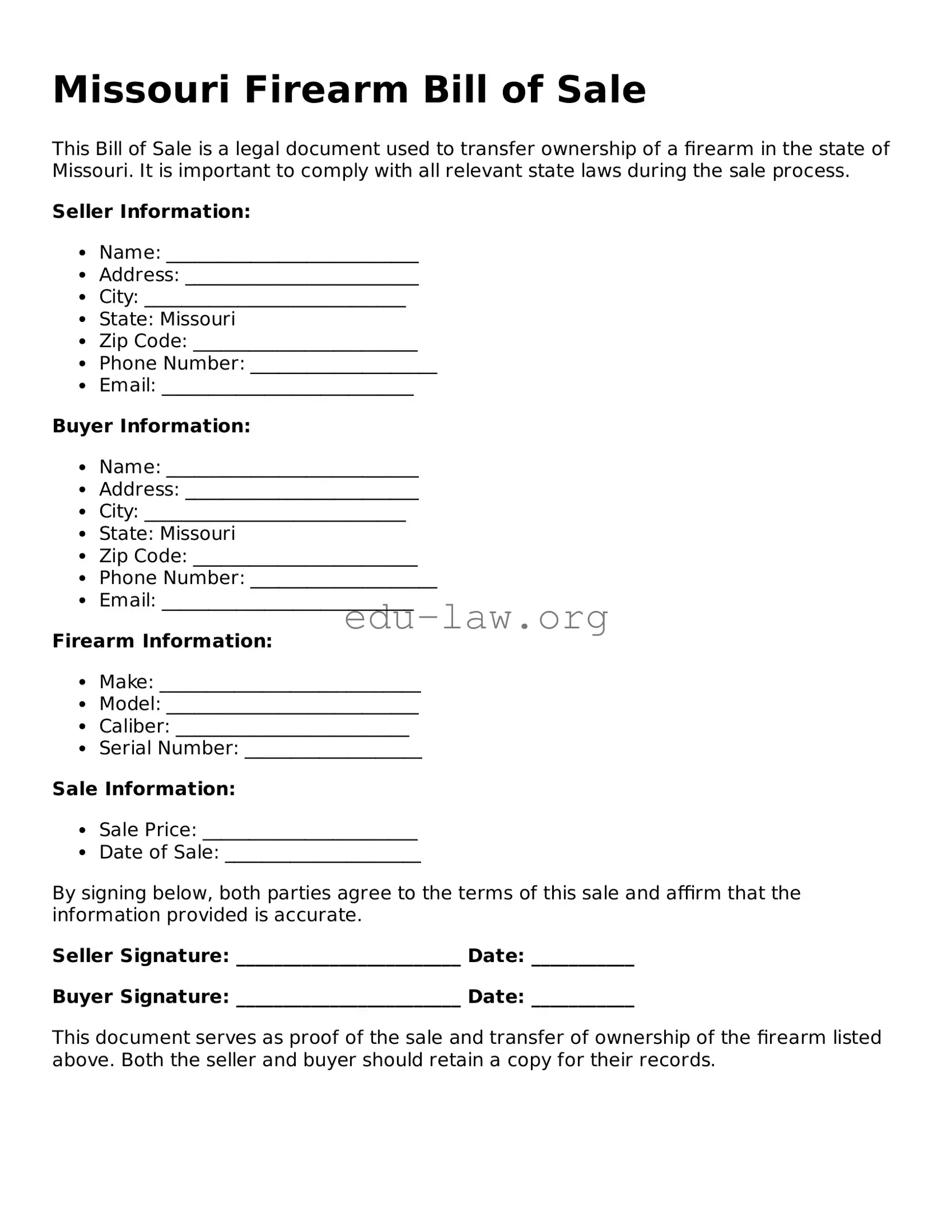
The Missouri Firearm Bill of Sale form serves as an important document in the process of transferring ownership of firearms between individuals. This form not only provides a written record of the transaction but also establishes a clear understanding of the terms agreed upon by both the buyer and the seller. Essential details such as the names and addresses of both parties, the date of the transaction, and a description of the firearm—including its make, model, and serial number—are typically included. This documentation can help protect both parties by ensuring that the sale is conducted legally and transparently. Furthermore, while Missouri does not require a background check for private sales, having a Bill of Sale can provide evidence of the transaction should any legal questions arise in the future. By utilizing this form, individuals can contribute to responsible gun ownership and promote safety in their communities.
Missouri Firearm Bill of Sale
This Bill of Sale is a legal document used to transfer ownership of a firearm in the state of Missouri. It is important to comply with all relevant state laws during the sale process.
Seller Information:
Buyer Information:
Firearm Information:
Sale Information:
By signing below, both parties agree to the terms of this sale and affirm that the information provided is accurate.
Seller Signature: ________________________ Date: ___________
Buyer Signature: ________________________ Date: ___________
This document serves as proof of the sale and transfer of ownership of the firearm listed above. Both the seller and buyer should retain a copy for their records.
| Fact Name | Description |
|---|---|
| Purpose | The Missouri Firearm Bill of Sale form is used to document the sale or transfer of a firearm between private parties. |
| Governing Law | The transfer of firearms in Missouri is governed by Missouri Revised Statutes, Chapter 571. |
| Parties Involved | The form typically includes the names and contact information of both the seller and the buyer. |
| Firearm Description | A detailed description of the firearm being sold, including make, model, and serial number, must be included. |
| Signatures | Both parties must sign the form to validate the transaction. |
| Record Keeping | It is advisable for both parties to keep a copy of the completed bill of sale for their records. |
| Age Requirement | Buyers must be at least 18 years old to legally purchase a firearm in Missouri. |
Once you have the Missouri Firearm Bill of Sale form ready, it's time to fill it out accurately. This document serves as a record of the transaction between the buyer and seller, ensuring that both parties have a clear understanding of the sale. Follow the steps below to complete the form correctly.
What is a Missouri Firearm Bill of Sale?
A Missouri Firearm Bill of Sale is a legal document that records the sale or transfer of a firearm between two parties. It serves as proof of the transaction, detailing the specifics of the firearm, the buyer, and the seller. This document can help protect both parties in case of future disputes or legal issues regarding ownership.
Is a Bill of Sale required for firearm transfers in Missouri?
While a Bill of Sale is not legally required for firearm transfers in Missouri, it is highly recommended. Having a written record can provide important documentation in case of any future legal inquiries or disputes. It helps establish clear ownership and can serve as evidence that the transfer was conducted legally.
What information should be included in the Bill of Sale?
The Bill of Sale should include essential details such as the names and addresses of both the buyer and the seller, the date of the transaction, a description of the firearm (including make, model, and serial number), and the sale price. Both parties should sign the document to confirm the transaction.
Can I create my own Bill of Sale?
Yes, you can create your own Bill of Sale. There are many templates available online that can guide you in drafting a document that meets your needs. Ensure that it includes all necessary information and is signed by both parties. Alternatively, you may choose to use a standard form provided by a local gun shop or legal resource.
Do I need to have the Bill of Sale notarized?
No, notarization is not required for a Bill of Sale in Missouri. However, having the document notarized can add an extra layer of security and authenticity to the transaction. It may also be beneficial if the document needs to be presented in a legal context later on.
What should I do if I lose my Bill of Sale?
If you lose your Bill of Sale, it can be challenging, but not impossible. It is advisable to keep a copy of the document in a safe place. If you cannot recover the original, you may consider drafting a new Bill of Sale, including all the original details, and have both parties sign it again. This can help in maintaining a record of ownership.
Are there any age restrictions for purchasing a firearm in Missouri?
Yes, in Missouri, you must be at least 18 years old to purchase a firearm from a private seller. However, federal law requires individuals to be 21 years old to buy a handgun from a licensed dealer. Always ensure that both parties are aware of and comply with these age restrictions during the transaction.
What happens if the firearm is used in a crime after the sale?
If a firearm sold is later used in a crime, the seller may face legal implications if they cannot prove the transfer of ownership. This is one reason why having a Bill of Sale is crucial. It can demonstrate that the seller no longer owns the firearm and can help protect them from liability.
Where can I find a Missouri Firearm Bill of Sale form?
You can find a Missouri Firearm Bill of Sale form online through various legal websites, gun advocacy organizations, or local gun shops. Ensure that the form you choose is up-to-date and complies with Missouri laws. It’s also a good idea to consult with a legal expert if you have any questions about the process.
Incomplete Information: One of the most common mistakes is failing to fill out all required fields. Make sure to provide complete details, including names, addresses, and firearm specifics.
Incorrect Dates: Writing the wrong date can lead to confusion later on. Always double-check that the date of the transaction is accurate.
Missing Signatures: Both the seller and buyer must sign the form. Forgetting a signature could invalidate the transaction.
Not Providing Identification: It's essential to include a valid form of identification for both parties. This helps establish legitimacy and traceability.
Overlooking Local Laws: Each state may have specific requirements regarding firearm sales. Ignoring local laws can lead to legal issues down the line.
Failure to Keep Copies: After filling out the form, both parties should retain a copy for their records. This is crucial for future reference and potential disputes.
Assuming All Firearms Are the Same: Different types of firearms may have different requirements. Be sure to understand what information is needed for the specific type of firearm being sold.
The Missouri Firearm Bill of Sale form is an important document for anyone involved in the sale or transfer of a firearm in the state. However, it is often used in conjunction with other forms and documents that help ensure the transaction is legally sound and properly documented. Here are some additional forms that may be relevant in this context.
By utilizing these forms in conjunction with the Missouri Firearm Bill of Sale, both buyers and sellers can engage in a more secure and transparent transaction. Proper documentation is essential to safeguard the interests of all parties involved and to comply with legal requirements.
The Missouri Firearm Bill of Sale is similar to a Vehicle Bill of Sale, which is used when transferring ownership of a motor vehicle. Both documents serve as proof of the transaction and include essential details such as the buyer's and seller's names, addresses, and signatures. Just like the firearm bill of sale, the vehicle bill of sale often requires information about the item being sold, including its identification number and condition. This ensures that both parties have a clear understanding of the transaction and protects their interests.
Another document that shares similarities with the Missouri Firearm Bill of Sale is the Boat Bill of Sale. This document is used when a boat is sold and includes pertinent information such as the buyer's and seller's information, the boat's identification number, and details about the sale. Both bills of sale serve as legal proof of ownership transfer, providing a record for future reference, which is crucial for both parties involved in the transaction.
A Personal Property Bill of Sale is also comparable to the Missouri Firearm Bill of Sale. This document is used for the sale of various personal items, such as furniture or electronics. Like the firearm bill of sale, it captures the buyer's and seller's information, a description of the item, and the sale price. This helps to ensure that the transaction is documented and legally binding, giving both parties peace of mind.
The Real Estate Purchase Agreement shares some features with the Missouri Firearm Bill of Sale, though it is typically more complex. Both documents outline the terms of a sale, including the parties involved and the item being sold. While the real estate agreement covers property, the firearm bill of sale focuses on the transfer of a firearm. Each document serves to protect the rights of both the buyer and seller by clearly defining the terms of the transaction.
In addition, a Lease Agreement can be likened to the Missouri Firearm Bill of Sale in that both involve the transfer of rights. A lease agreement outlines the terms under which one party can use another party's property, while the firearm bill of sale details the transfer of ownership. Both documents require clear identification of the parties involved and the item in question, ensuring that all terms are understood and agreed upon.
The Equipment Bill of Sale is another document that functions similarly to the Missouri Firearm Bill of Sale. This form is used when selling equipment, such as machinery or tools. Both documents provide a record of the transaction, capturing the buyer's and seller's details, a description of the item, and the sale price. This documentation is vital for establishing ownership and can be referred to in case of disputes or questions about the sale.
In a similar vein, the Business Asset Bill of Sale is used when transferring ownership of business assets. This document outlines the details of the sale, including the names of the buyer and seller, a description of the assets, and the purchase price. Like the firearm bill of sale, it serves as proof of the transaction and helps to protect both parties by clearly stating the terms of the sale.
The Motorcycle Bill of Sale also bears resemblance to the Missouri Firearm Bill of Sale. When transferring ownership of a motorcycle, this document is essential. It includes the buyer's and seller's information, the motorcycle's identification number, and the sale price. Both documents help establish a legal record of ownership, providing reassurance to both parties involved in the transaction.
Lastly, the Livestock Bill of Sale is another document that shares characteristics with the Missouri Firearm Bill of Sale. This form is used for the sale of livestock and contains similar information, such as the buyer's and seller's details, a description of the livestock, and the sale price. Both bills of sale serve to document the transfer of ownership, ensuring that both parties have a clear understanding of the transaction.
When completing the Missouri Firearm Bill of Sale form, it is important to follow certain guidelines to ensure accuracy and compliance. Below is a list of things you should and shouldn't do.
Following these guidelines can help ensure a smooth transaction and protect both parties involved in the sale.
Misconceptions about the Missouri Firearm Bill of Sale form can lead to confusion for both buyers and sellers. Here are seven common misunderstandings:
It’s a legal requirement for all firearm sales. While a bill of sale is a good practice, it is not legally required for private sales in Missouri. However, having one can provide protection for both parties.
Only licensed dealers can use a bill of sale. This is not true. Any individual can create and use a bill of sale for a firearm transaction, regardless of whether they are a dealer.
All firearm transactions must be recorded. There is no requirement to record private sales with the state. However, keeping a record can be beneficial for personal documentation.
The bill of sale protects against future liability. While it helps document the transaction, it does not completely shield sellers from liability if the firearm is misused after the sale.
There is a standard format that must be followed. There is no official format mandated by law. However, including specific information can make the bill of sale more effective.
Only firearms need a bill of sale. This form can also be used for accessories and ammunition, providing clarity in the transaction.
Once signed, the bill of sale is unchangeable. While it is a binding document, both parties can agree to modifications before finalizing the sale.
Understanding these misconceptions can help ensure smoother transactions and better compliance with local laws.
When filling out and using the Missouri Firearm Bill of Sale form, it is essential to understand the key points to ensure a smooth transaction. Here are some important takeaways:
By following these guidelines, individuals can ensure that their firearm transactions are conducted legally and responsibly.