When it comes to planning for the future, understanding the Missouri Durable Power of Attorney form is essential. This legal document empowers an individual, known as the principal, to designate someone else, referred to as the agent or attorney-in-fact, to make decisions on their behalf in the event they become incapacitated. The authority granted can cover a wide range of matters, including financial transactions, medical decisions, and property management. Importantly, this form remains effective even if the principal loses the ability to make decisions, ensuring that their wishes are respected and upheld. It is crucial to choose a trustworthy agent, as they will have significant control over important aspects of the principal's life. Additionally, the form must be signed in accordance with Missouri state laws to be legally binding. Understanding the nuances of this document can help individuals safeguard their interests and ensure that their preferences are honored when they can no longer advocate for themselves.
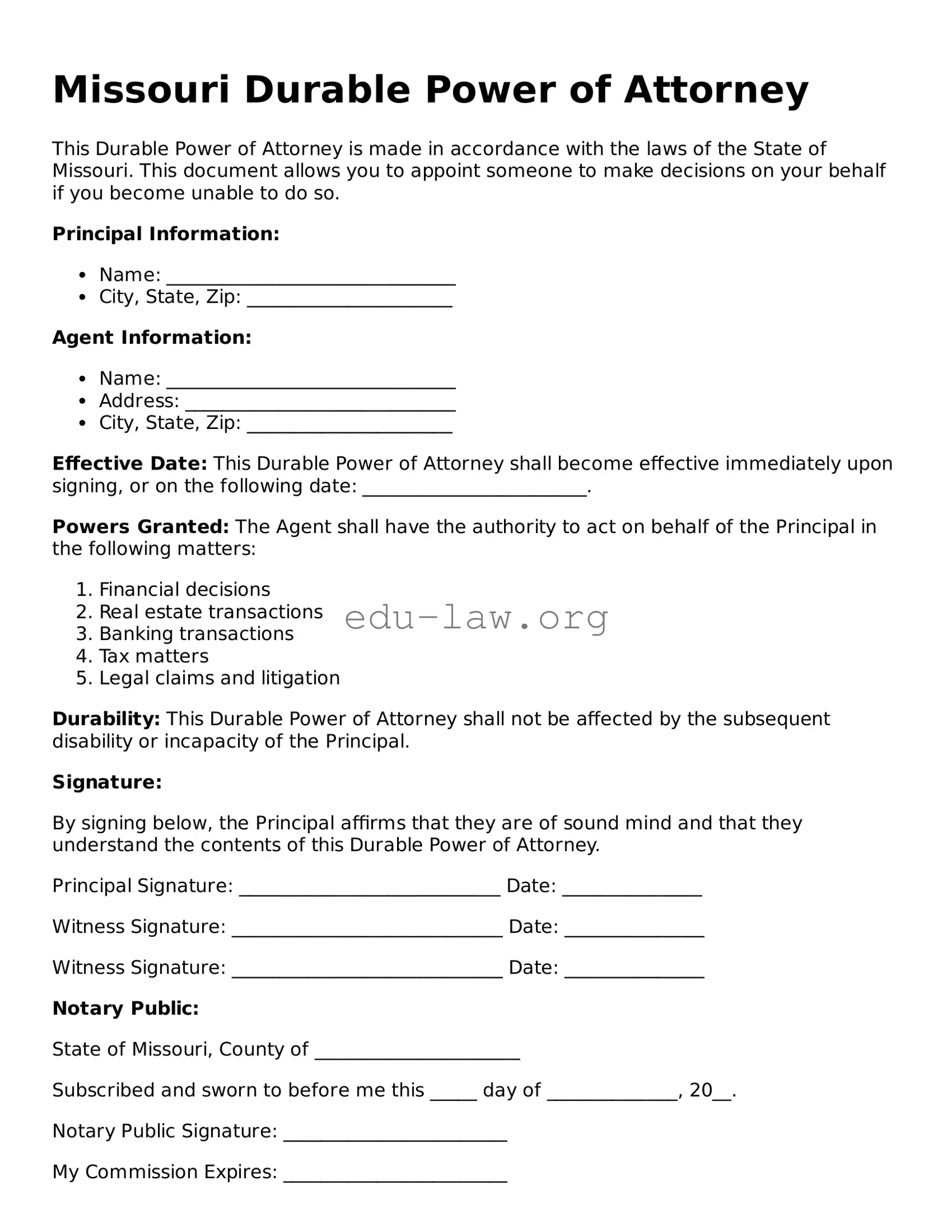
Missouri Durable Power of Attorney
This Durable Power of Attorney is made in accordance with the laws of the State of Missouri. This document allows you to appoint someone to make decisions on your behalf if you become unable to do so.
Principal Information:
Agent Information:
Effective Date: This Durable Power of Attorney shall become effective immediately upon signing, or on the following date: ________________________.
Powers Granted: The Agent shall have the authority to act on behalf of the Principal in the following matters:
Durability: This Durable Power of Attorney shall not be affected by the subsequent disability or incapacity of the Principal.
Signature:
By signing below, the Principal affirms that they are of sound mind and that they understand the contents of this Durable Power of Attorney.
Principal Signature: ____________________________ Date: _______________
Witness Signature: _____________________________ Date: _______________
Witness Signature: _____________________________ Date: _______________
Notary Public:
State of Missouri, County of ______________________
Subscribed and sworn to before me this _____ day of ______________, 20__.
Notary Public Signature: ________________________
My Commission Expires: ________________________
| Fact Name | Details |
|---|---|
| Definition | A Missouri Durable Power of Attorney is a legal document that allows an individual to appoint someone else to make decisions on their behalf, even if they become incapacitated. |
| Governing Law | The Missouri Durable Power of Attorney is governed by Missouri Revised Statutes, Chapter 404. |
| Durability | This type of power of attorney remains effective even if the principal becomes incapacitated, distinguishing it from a regular power of attorney. |
| Principal and Agent | The person granting authority is called the principal, while the person receiving authority is known as the agent or attorney-in-fact. |
| Scope of Authority | The document can grant broad or limited powers, allowing the agent to handle financial matters, make healthcare decisions, or manage property. |
| Execution Requirements | The form must be signed by the principal and notarized or witnessed by two individuals who are not related to the principal. |
| Revocation | The principal can revoke the power of attorney at any time, as long as they are competent to do so. |
| Agent's Duties | The agent must act in the best interest of the principal, following their wishes and maintaining accurate records of all transactions. |
| Healthcare Decisions | While a durable power of attorney can include healthcare decisions, it is often advisable to have a separate healthcare power of attorney for clarity. |
Filling out the Missouri Durable Power of Attorney form requires careful attention to detail. This document allows you to appoint someone to make decisions on your behalf in the event that you become unable to do so yourself. Follow these steps to ensure the form is completed correctly.
After completing the form, keep it in a safe place where it can be easily accessed. It is advisable to review the document periodically to ensure it still reflects your wishes.
What is a Durable Power of Attorney in Missouri?
A Durable Power of Attorney is a legal document that allows you to appoint someone to make decisions on your behalf if you become unable to do so. This document remains effective even if you become incapacitated. It can cover financial matters, healthcare decisions, or both, depending on your needs.
Who can be a Durable Power of Attorney in Missouri?
In Missouri, you can choose any competent adult to serve as your Durable Power of Attorney. This person is often referred to as your agent or attorney-in-fact. It’s important to select someone you trust, as they will have significant authority over your affairs.
How do I create a Durable Power of Attorney in Missouri?
To create a Durable Power of Attorney, you need to fill out a specific form that outlines your wishes. You can find templates online or consult with a legal professional for guidance. After completing the form, you must sign it in front of a notary public to make it legally binding.
Can I change or revoke my Durable Power of Attorney?
Yes, you can change or revoke your Durable Power of Attorney at any time as long as you are still competent. To revoke it, you should notify your agent and any institutions that may have a copy of the document. It’s wise to create a new document if you are appointing someone else.
What powers does my agent have under the Durable Power of Attorney?
The powers granted to your agent can vary based on what you include in the document. They can manage your finances, pay bills, make investments, and handle real estate transactions. If you want to limit their powers, make sure to specify those limitations in the document.
Is a Durable Power of Attorney the same as a Healthcare Power of Attorney?
No, they are not the same. A Durable Power of Attorney typically deals with financial and legal matters, while a Healthcare Power of Attorney specifically allows someone to make medical decisions on your behalf. You may choose to create both documents to cover different aspects of your life.
What happens if I don’t have a Durable Power of Attorney?
If you do not have a Durable Power of Attorney and become incapacitated, a court may appoint a guardian to make decisions for you. This process can be lengthy and costly. Having a Durable Power of Attorney in place can help ensure that your preferences are respected and that someone you trust is in charge of your affairs.
Not specifying powers clearly: Individuals often fail to detail the specific powers granted to the agent. This can lead to confusion about what the agent can and cannot do.
Neglecting to date the form: A common oversight is not dating the Durable Power of Attorney form. A date is crucial for determining the validity of the document.
Forgetting to sign: Some people overlook the importance of their own signature. Without it, the document is not legally binding.
Not having witnesses or notarization: Depending on the situation, failing to have the form witnessed or notarized can invalidate it. Always check the requirements.
Choosing the wrong agent: Selecting someone who may not act in your best interest can lead to issues. It’s essential to choose a trustworthy and responsible individual.
Ignoring state-specific requirements: Each state has its own rules regarding Durable Power of Attorney forms. Ignoring these can lead to complications.
Not reviewing the document regularly: Life circumstances change. Failing to review and update the form can result in outdated information or decisions.
A Missouri Durable Power of Attorney (DPOA) allows an individual to appoint someone to make decisions on their behalf if they become incapacitated. While the DPOA is a crucial document, it is often accompanied by other forms that can help clarify or expand on the powers granted. Here are four important documents commonly used alongside a DPOA:
Using these documents in conjunction with a Missouri Durable Power of Attorney can help ensure that a person's wishes are respected and that their affairs are managed according to their preferences. It's essential to consider each document's purpose and how they work together to create a comprehensive plan for future decision-making.
The Missouri Durable Power of Attorney (DPOA) form is a vital legal document that allows an individual, known as the principal, to designate another person, the agent, to make decisions on their behalf. This document is particularly important when it comes to financial and healthcare decisions, especially if the principal becomes incapacitated. However, several other documents share similarities with the DPOA, serving various purposes in the realm of legal authority and decision-making.
One such document is the General Power of Attorney (GPOA). Like the DPOA, the GPOA grants authority to an agent to act on behalf of the principal. However, the key difference lies in the durability of the power granted. The GPOA typically becomes invalid if the principal becomes incapacitated, whereas the DPOA remains effective under such circumstances. This distinction makes the DPOA a more suitable option for long-term planning.
The Healthcare Power of Attorney (HPOA) is another closely related document. This specific form allows an individual to appoint an agent to make healthcare decisions if they are unable to communicate their wishes. While the DPOA can include healthcare decisions, the HPOA is more focused on medical matters, ensuring that the principal's health care preferences are honored even when they cannot express them directly.
A Living Will is also similar in that it addresses healthcare decisions, but it serves a different purpose. A Living Will outlines the principal's wishes regarding medical treatment and end-of-life care. While the DPOA appoints someone to make decisions, the Living Will provides specific instructions about what those decisions should be, offering clarity and guidance to the appointed agent.
The Revocable Trust, or Living Trust, shares some similarities with the DPOA as it allows for the management of assets. This document enables the principal to place their assets into a trust, managed by a trustee for their benefit during their lifetime and distributed according to their wishes after death. While the DPOA focuses on decision-making authority, the Revocable Trust deals more with asset management and distribution.
A Financial Power of Attorney (FPOA) specifically addresses financial matters, granting an agent the authority to handle the principal's financial affairs. Like the DPOA, the FPOA can be durable, meaning it remains effective during the principal's incapacity. This document is particularly useful for managing bills, investments, and other financial responsibilities when the principal is unable to do so.
The Advance Directive is another document that complements the DPOA. While it encompasses both the Healthcare Power of Attorney and the Living Will, it serves as a comprehensive guide for healthcare decisions. An Advance Directive outlines the principal's preferences regarding medical treatment and appoints an agent, ensuring that their wishes are respected in various healthcare scenarios.
The Guardianship document differs from the DPOA in that it is often court-appointed. If an individual becomes incapacitated without a DPOA in place, a court may appoint a guardian to make decisions on their behalf. This process can be lengthy and complex, highlighting the importance of having a DPOA to avoid such situations and ensure that one's wishes are honored without court intervention.
Lastly, the Minor’s Power of Attorney allows a parent or guardian to delegate authority over a minor child’s care and decisions. While this document is tailored to the needs of children, it shares similarities with the DPOA in that it grants decision-making authority to another person. This can be particularly useful in situations where a parent is temporarily unavailable and needs someone else to step in for the child's well-being.
When filling out the Missouri Durable Power of Attorney form, it's important to be careful and thorough. Here are some dos and don'ts to keep in mind:
Understanding the Missouri Durable Power of Attorney (DPOA) is crucial for effective estate planning. However, several misconceptions can lead to confusion. Here are four common misunderstandings:
This is not entirely accurate. While a DPOA often grants authority over financial decisions, it can also cover health care decisions if specified. It’s important to clarify the scope of authority when drafting the document.
This statement is misleading. A DPOA remains effective even if the principal becomes incapacitated, which is one of its key features. However, it does terminate upon the principal's death.
This is not correct. While the principal can choose anyone they trust, the agent must be at least 18 years old and capable of making decisions. It’s essential to select someone responsible and trustworthy.
This is a common misunderstanding. A DPOA does not have the power to alter a will or distribute assets after death. It is designed to handle affairs during the principal's lifetime, not to dictate posthumous wishes.
When considering the Missouri Durable Power of Attorney form, it is essential to understand its purpose and implications. Below are key takeaways to keep in mind: