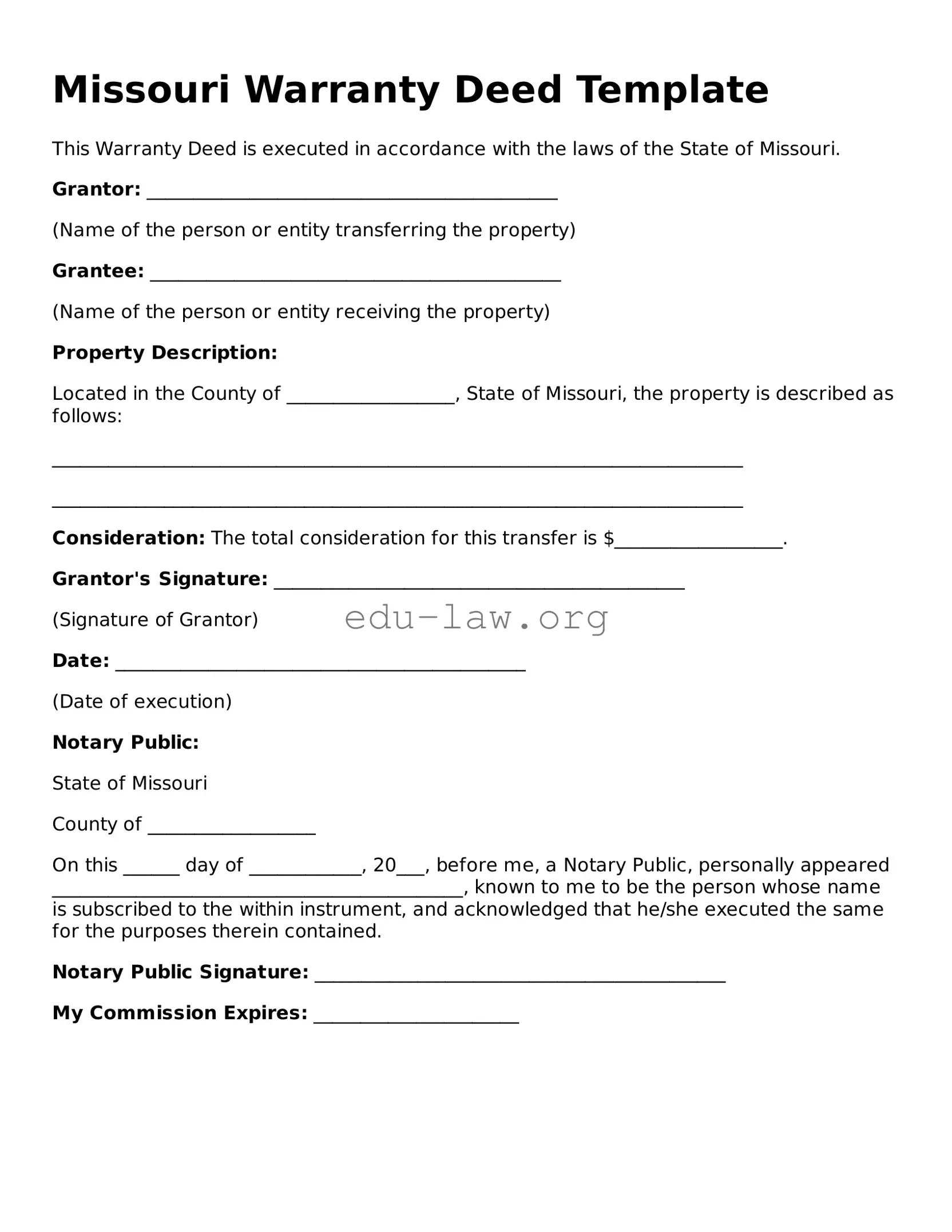
When engaging in real estate transactions in Missouri, understanding the Missouri Deed form is essential for both buyers and sellers. This document serves as a legal instrument that facilitates the transfer of property ownership, ensuring that all parties involved are protected under state law. The form outlines crucial information, including the names of the grantor and grantee, a detailed description of the property, and the terms of the transfer. Additionally, it may specify any conditions or restrictions related to the property, providing clarity and security for the new owner. Proper execution of the deed, which includes signatures and notarization, is vital to validate the transfer. Familiarity with this form can help prevent disputes and ensure a smooth transaction process, making it a cornerstone of real estate dealings in Missouri.
Missouri Warranty Deed Template
This Warranty Deed is executed in accordance with the laws of the State of Missouri.
Grantor: ____________________________________________
(Name of the person or entity transferring the property)
Grantee: ____________________________________________
(Name of the person or entity receiving the property)
Property Description:
Located in the County of __________________, State of Missouri, the property is described as follows:
__________________________________________________________________________
__________________________________________________________________________
Consideration: The total consideration for this transfer is $__________________.
Grantor's Signature: ____________________________________________
(Signature of Grantor)
Date: ____________________________________________
(Date of execution)
Notary Public:
State of Missouri
County of __________________
On this ______ day of ____________, 20___, before me, a Notary Public, personally appeared ____________________________________________, known to me to be the person whose name is subscribed to the within instrument, and acknowledged that he/she executed the same for the purposes therein contained.
Notary Public Signature: ____________________________________________
My Commission Expires: ______________________
| Fact Name | Description |
|---|---|
| Governing Law | The Missouri Deed form is governed by Missouri state law, specifically Chapter 442 of the Revised Statutes of Missouri. |
| Types of Deeds | Common types of deeds in Missouri include warranty deeds, quitclaim deeds, and special warranty deeds. |
| Signature Requirements | All parties involved in the deed must sign the document for it to be valid. |
| Notarization | A Missouri Deed must be notarized to be recorded in the county where the property is located. |
| Recording | To provide public notice of ownership, the deed must be filed with the appropriate county recorder's office. |
| Transfer Tax | Missouri imposes a transfer tax on real estate transactions, which may be applicable when filing the deed. |
Once you have the Missouri Deed form, you will need to complete it accurately to ensure proper transfer of property ownership. After filling out the form, it should be signed and notarized before submission to the appropriate county office.
What is a Missouri Deed form?
A Missouri Deed form is a legal document used to transfer ownership of real property from one party to another within the state of Missouri. This form serves as a written record of the transaction, detailing the parties involved, the property being transferred, and any conditions or restrictions associated with the transfer. It is important to ensure that the deed is properly executed and recorded with the local county recorder's office to establish legal ownership and protect the rights of the new owner.
What types of Deed forms are available in Missouri?
In Missouri, several types of Deed forms are commonly used, each serving different purposes. The most common include the Warranty Deed, which guarantees that the seller holds clear title to the property and has the right to sell it. The Special Warranty Deed offers limited guarantees, only covering the period during which the seller owned the property. A Quitclaim Deed transfers whatever interest the seller has in the property without any warranties, making it a less secure option for the buyer. Understanding the differences between these types of deeds is essential for making informed decisions during a property transaction.
How do I complete a Missouri Deed form?
Completing a Missouri Deed form involves several steps. First, gather all necessary information, including the names and addresses of the grantor (seller) and grantee (buyer), a legal description of the property, and any specific terms of the transfer. Next, fill out the form accurately, ensuring that all details are correct. Both parties must sign the deed in the presence of a notary public to make it legally binding. Finally, submit the completed deed to the local county recorder's office for recording, which provides public notice of the property transfer.
Are there any fees associated with filing a Missouri Deed form?
Yes, there are typically fees associated with filing a Missouri Deed form. These fees can vary by county and may include recording fees, which are charged by the county recorder's office for processing the deed. Additionally, there may be other costs, such as notary fees or taxes related to the property transfer. It is advisable to check with the local recorder's office for the specific fee schedule and any other potential costs involved in the process of filing a deed.
Failing to include all necessary parties. It's crucial to ensure that all individuals or entities involved in the transaction are listed correctly. Missing a party can lead to complications down the line.
Incorrectly identifying the property. The legal description of the property must be accurate. Errors here can result in disputes about ownership or even legal challenges.
Not signing the deed. A deed must be signed by the grantor, the person transferring the property. Without a signature, the deed is invalid.
Using the wrong type of deed. Different deeds serve different purposes. For instance, a quitclaim deed transfers whatever interest the grantor has, while a warranty deed provides guarantees about the title.
Forgetting to notarize the deed. In Missouri, a deed must be notarized to be legally binding. This step is often overlooked but is essential for validity.
Not providing a date. The date of execution is important. It establishes when the transfer of ownership occurs and can impact the rights of parties involved.
Neglecting to record the deed. After filling out the deed, it should be filed with the appropriate county office. Failing to do so can lead to issues with proving ownership in the future.
When transferring property in Missouri, several forms and documents complement the Missouri Deed form. These documents help ensure that the transaction is legally sound and properly recorded. Below are five commonly used documents in conjunction with the Missouri Deed form.
These documents play a crucial role in the property transfer process in Missouri. They provide clarity, protect the interests of both parties, and ensure compliance with state regulations. Familiarity with these forms can streamline the transaction and help avoid potential legal issues.
The Missouri Deed form shares similarities with a Warranty Deed. Both documents serve the purpose of transferring property ownership from one party to another. A Warranty Deed guarantees that the seller has clear title to the property and has the right to sell it. This assurance provides the buyer with confidence, as it protects them against any future claims on the property. In contrast, a Quitclaim Deed, while also transferring ownership, does not offer such guarantees, making the Warranty Deed a more secure option for buyers.
Another document that resembles the Missouri Deed form is the Quitclaim Deed. This type of deed transfers ownership without any warranties or guarantees. It is often used in situations where the parties know each other well, such as family transfers or divorce settlements. While the Quitclaim Deed is simpler and quicker to execute, it does not provide the same level of protection to the buyer as a Warranty Deed does, which can lead to potential issues down the line.
A Special Purpose Deed is also similar to the Missouri Deed form. This type of deed is used for specific situations, such as transferring property into a trust or when a property is being sold as part of a foreclosure. Like the Missouri Deed, it facilitates the transfer of ownership, but it is tailored to meet the unique requirements of certain transactions. The Special Purpose Deed can streamline processes that might otherwise be complicated by standard deed forms.
The Bargain and Sale Deed is another document akin to the Missouri Deed form. This deed implies that the seller has the right to sell the property but does not guarantee that the title is free of encumbrances. While it transfers ownership, it does not provide the same level of protection as a Warranty Deed. Buyers should be aware that they may assume some risks when using a Bargain and Sale Deed, as they may be liable for any claims against the property.
Lastly, the Grant Deed is similar in that it also conveys ownership of real estate. This type of deed typically includes assurances that the property has not been sold to anyone else and that it is free from any undisclosed encumbrances. While the Grant Deed offers some protection to the buyer, it does not provide the same comprehensive guarantees as a Warranty Deed. Thus, buyers should carefully consider their options when deciding which type of deed to use for their property transaction.
When filling out the Missouri Deed form, it's essential to follow specific guidelines to ensure accuracy and compliance. Here are some important dos and don'ts to keep in mind:
When it comes to the Missouri Deed form, several misconceptions often arise. Understanding these can help property owners and buyers navigate the process more effectively. Here are four common misconceptions:
Being informed about these misconceptions can empower individuals to make better decisions regarding property transactions in Missouri.
When filling out and using the Missouri Deed form, keep the following key takeaways in mind: