The Missouri Affidavit of Gift form serves as a crucial document for individuals wishing to transfer ownership of personal property without the exchange of money. This form is particularly useful for gifts such as vehicles, boats, or other significant assets, ensuring that the transfer is documented properly and recognized by the state. By completing this affidavit, the donor can assert their intent to give the property as a gift, while the recipient acknowledges their acceptance. This process not only provides clarity and legal standing but also helps prevent potential disputes in the future. Understanding the requirements and implications of the Missouri Affidavit of Gift is essential for both parties involved, as it outlines the necessary information, including the details of the property, the identities of the donor and recipient, and any relevant signatures. Ultimately, this form simplifies the gift-giving process, making it more straightforward and secure for everyone involved.
Missouri Affidavit of Gift Template
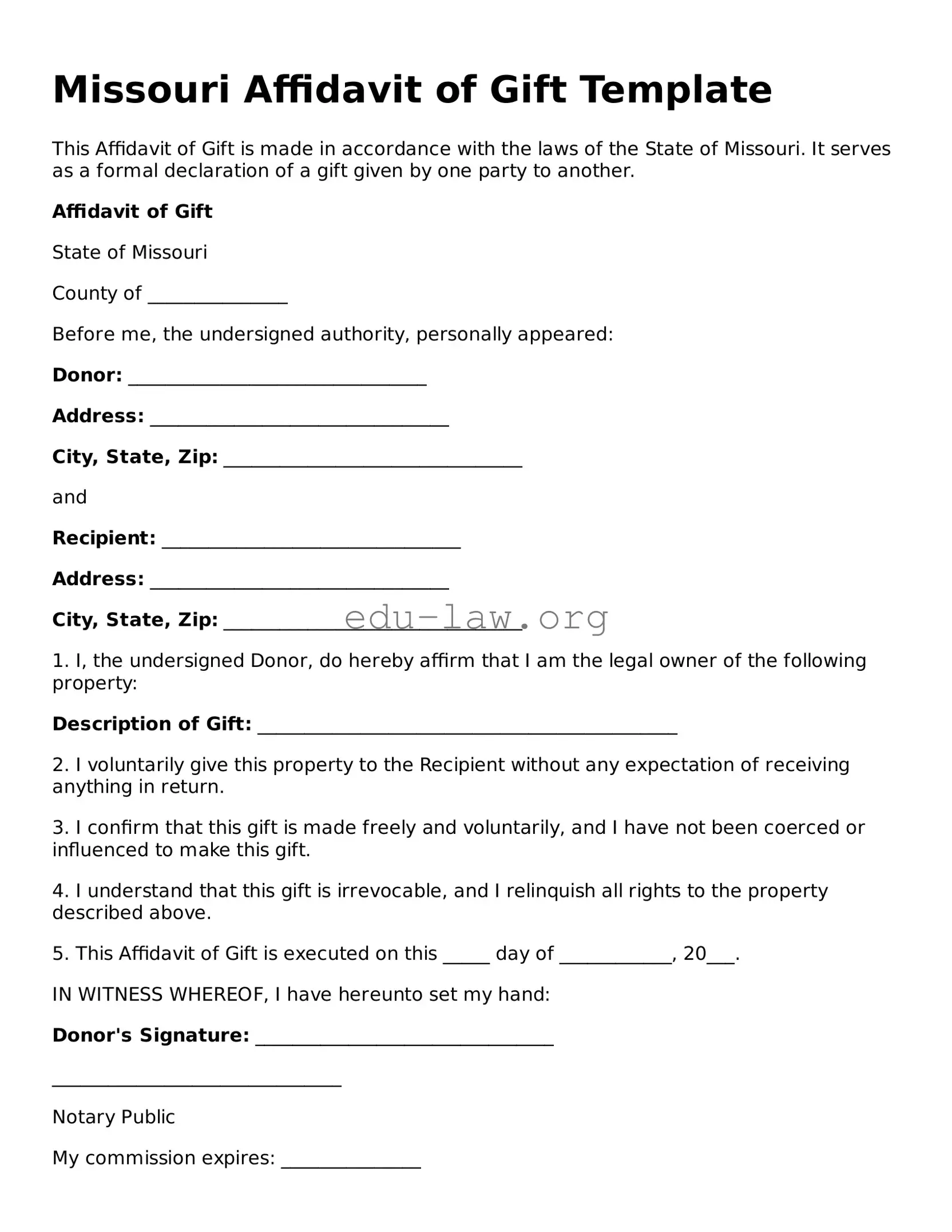
This Affidavit of Gift is made in accordance with the laws of the State of Missouri. It serves as a formal declaration of a gift given by one party to another.
Affidavit of Gift
State of Missouri
County of _______________
Before me, the undersigned authority, personally appeared:
Donor: ________________________________
Address: ________________________________
City, State, Zip: ________________________________
and
Recipient: ________________________________
Address: ________________________________
City, State, Zip: ________________________________
1. I, the undersigned Donor, do hereby affirm that I am the legal owner of the following property:
Description of Gift: _____________________________________________
2. I voluntarily give this property to the Recipient without any expectation of receiving anything in return.
3. I confirm that this gift is made freely and voluntarily, and I have not been coerced or influenced to make this gift.
4. I understand that this gift is irrevocable, and I relinquish all rights to the property described above.
5. This Affidavit of Gift is executed on this _____ day of ____________, 20___.
IN WITNESS WHEREOF, I have hereunto set my hand:
Donor's Signature: ________________________________
_______________________________
Notary Public
My commission expires: _______________
Witnesses:
| Fact Name | Description |
|---|---|
| Purpose | The Missouri Affidavit of Gift form is used to document the transfer of property or assets as a gift, ensuring clarity and legality in the transaction. |
| Governing Law | This form is governed by the Missouri Revised Statutes, specifically Chapter 404, which outlines the laws regarding gifts and property transfers. |
| Eligibility | Any individual or entity wishing to give or receive a gift can utilize this form, provided the gift complies with state laws. |
| Notarization Requirement | The form must be notarized to validate the transfer, ensuring that all parties involved have acknowledged the transaction willingly. |
| Property Types | The affidavit can be used for various types of property, including real estate, vehicles, and personal belongings. |
| Tax Implications | Gifts may have tax consequences for both the giver and the receiver, and it is advisable to consult a tax professional when completing the form. |
| Revocation | Once the affidavit is executed, it generally cannot be revoked unless specific conditions are met, which should be clearly outlined in the documentation. |
| Record Keeping | It is essential for both parties to keep a copy of the signed affidavit for their records, as it serves as proof of the gift transaction. |
| Filing | While the form does not need to be filed with a government agency, it is recommended to keep it in a safe place for future reference. |
Completing the Missouri Affidavit of Gift form is an essential step in documenting the transfer of property or assets. After filling out the form, you will need to submit it to the appropriate authorities to ensure that the gift is officially recognized. Follow these steps carefully to ensure accuracy and completeness.
What is the Missouri Affidavit of Gift form?
The Missouri Affidavit of Gift form is a legal document used to transfer ownership of property or assets from one individual to another as a gift. This form serves as proof of the gift and helps clarify the intent of the giver, ensuring that the transfer is recognized by the state and any relevant authorities.
Who needs to use the Affidavit of Gift form?
This form is typically used by individuals who wish to give property, such as real estate, vehicles, or other assets, to someone else without expecting anything in return. It is particularly useful in situations where the recipient needs to establish ownership for registration or tax purposes.
What information is required on the form?
The Affidavit of Gift form generally requires details about both the donor (the person giving the gift) and the recipient (the person receiving the gift). This includes names, addresses, and a description of the property being gifted. The form may also ask for the date of the gift and any conditions attached to it.
Is the Affidavit of Gift form legally binding?
Yes, once properly completed and signed, the Affidavit of Gift form is legally binding. It demonstrates the donor's intent to give the gift and the recipient's acceptance of it. However, it is important to ensure that all required information is accurately filled out to avoid any potential disputes in the future.
Do I need to have the form notarized?
While notarization is not always required for the Affidavit of Gift form, having it notarized can add an extra layer of authenticity. Notarization helps verify the identities of the parties involved and confirms that the signatures were made voluntarily. It is often recommended, especially for significant gifts or when transferring real estate.
Are there any tax implications associated with gifting property?
Yes, gifting property can have tax implications. In the United States, the IRS allows individuals to gift a certain amount each year without incurring gift tax. However, if the value of the gift exceeds this annual exclusion limit, the donor may need to file a gift tax return. It is advisable to consult with a tax professional to understand the specific tax consequences related to your situation.
Where can I obtain the Missouri Affidavit of Gift form?
The Missouri Affidavit of Gift form can typically be obtained from various sources, including the Missouri Department of Revenue, local county offices, or online legal resources. Ensure that you are using the most current version of the form to comply with state requirements.
Incomplete Information: Many individuals fail to provide all necessary details, such as the full names of both the donor and the recipient. Omitting this information can lead to delays or rejection of the affidavit.
Incorrect Dates: Errors in entering dates, especially the date of the gift, can create confusion. Ensure that the dates are accurate and formatted correctly.
Not Notarizing the Document: The Affidavit of Gift must be notarized to be valid. Forgetting this crucial step can render the document ineffective.
Failing to Sign: Both the donor and recipient must sign the affidavit. Neglecting to do so will invalidate the document.
Providing Inaccurate Descriptions: The description of the gifted item should be clear and specific. Vague or misleading descriptions can lead to disputes later on.
Not Including a Fair Market Value: It is important to state the fair market value of the gift. Failing to do so can raise questions about the legitimacy of the transaction.
Ignoring State Requirements: Each state may have specific requirements for the Affidavit of Gift. Ignoring these can lead to complications, so it's essential to be aware of Missouri's regulations.
Using Outdated Forms: Using an old version of the form can lead to issues. Always ensure that you have the most current version of the Affidavit of Gift.
Not Keeping Copies: After submitting the affidavit, individuals often forget to keep copies for their records. This can be problematic if disputes arise later.
Overlooking Additional Documentation: Sometimes, additional documentation may be required to support the affidavit. Failing to include these can delay the process.
The Missouri Affidavit of Gift form is an important document for transferring ownership of property without a sale. However, it often accompanies several other forms and documents to ensure a smooth and legal transfer. Below is a list of common documents that may be used alongside the Affidavit of Gift.
Using these documents in conjunction with the Missouri Affidavit of Gift can help clarify the intentions of the parties involved and ensure compliance with legal requirements. Proper documentation is essential to avoid future disputes and to facilitate a smooth transfer process.
The Missouri Affidavit of Gift form is similar to the IRS Form 709, which is used for reporting gifts for tax purposes. Both documents serve to establish the transfer of property or assets from one individual to another without compensation. While the Affidavit of Gift may not involve tax implications directly, it provides a formal declaration that can be useful when determining the value of gifts for tax reporting. This ensures that both parties have a clear understanding of the transaction, which can be beneficial in the event of future disputes.
Another document that shares similarities is the Bill of Sale. This document is often used to transfer ownership of personal property, such as vehicles or equipment. Like the Affidavit of Gift, a Bill of Sale provides proof of the transaction and details about the item being transferred. However, a Bill of Sale typically involves a monetary exchange, while the Affidavit of Gift does not. Both documents help clarify the terms of the transfer and protect the interests of both parties involved.
The Warranty Deed is also comparable to the Affidavit of Gift. A Warranty Deed is used to transfer real estate and guarantees that the seller holds clear title to the property. In both cases, the documents serve to affirm the legitimacy of the transfer. However, while a Warranty Deed includes warranties about the property’s condition and title, the Affidavit of Gift focuses solely on the intent to give without any conditions attached. Both documents provide legal protection and clarity regarding ownership.
The Quitclaim Deed is another document that is similar to the Affidavit of Gift. A Quitclaim Deed transfers interest in real estate without guaranteeing that the title is clear. Like the Affidavit of Gift, it can be used to transfer property without payment. However, the Quitclaim Deed does not provide the same level of assurance regarding the title as a Warranty Deed does. Both documents are often used in informal transfers between family members or friends.
The Power of Attorney (POA) document can also be seen as related to the Affidavit of Gift. A POA allows one person to act on behalf of another in legal matters, including the transfer of assets. While the Affidavit of Gift is a declaration of intent to give, a POA can enable someone to execute that intent on behalf of the giver. Both documents are important in ensuring that the giver’s wishes are honored, especially in situations where the giver may not be able to complete the transaction themselves.
The Trust Agreement is another document that bears similarity to the Affidavit of Gift. A Trust Agreement outlines how assets are to be managed and distributed, often for the benefit of another party. Both documents can facilitate the transfer of assets without immediate tax implications. However, a Trust Agreement is generally more complex and involves ongoing management of the assets, while the Affidavit of Gift is a straightforward declaration of a one-time gift.
The Deed of Gift is directly related to the Affidavit of Gift. This document is specifically designed for the transfer of personal property as a gift. Both documents serve to formalize the intention to give without expecting anything in return. However, a Deed of Gift may include more specific details about the property being transferred, while the Affidavit of Gift focuses on the declaration itself. Both serve to protect the interests of the giver and the recipient.
The Release of Liability form can also be compared to the Affidavit of Gift. A Release of Liability is often used when one party wants to relinquish any future claims against another party. In the context of a gift, a Release of Liability can accompany the Affidavit of Gift to clarify that the recipient accepts the gift without any obligations or warranties from the giver. Both documents aim to protect the giver from potential future disputes regarding the gift.
Lastly, the Donation Receipt is similar to the Affidavit of Gift in that it provides documentation for the transfer of property or assets, particularly for charitable contributions. Both documents serve to acknowledge the transfer and can be useful for tax purposes. However, a Donation Receipt is specifically used for donations to nonprofit organizations, while the Affidavit of Gift can be used for personal gifts. Both reinforce the intent behind the transfer and provide a record for both parties.
When filling out the Missouri Affidavit of Gift form, it’s important to be careful and thorough. Here’s a list of things to keep in mind:
Following these guidelines will help ensure that your affidavit is processed smoothly and without unnecessary delays.
The Missouri Affidavit of Gift form is an important legal document, yet several misconceptions surround it. Understanding these misconceptions can help individuals navigate the process more effectively. Below are some common misunderstandings about this form.
By addressing these misconceptions, individuals can approach the Missouri Affidavit of Gift form with greater confidence and understanding. This clarity can lead to smoother transactions and fewer complications down the line.
Filling out and using the Missouri Affidavit of Gift form is straightforward, but there are important details to keep in mind. Here are some key takeaways: