Navigating the complexities of estate management can be daunting, especially during a time of loss. In Minnesota, the Small Estate Affidavit offers a streamlined process for settling the affairs of a deceased individual when the total value of their estate falls below a certain threshold. This form allows heirs to claim the deceased's assets without the lengthy and often costly process of probate. It is particularly beneficial for families dealing with modest estates, as it simplifies the transfer of property, bank accounts, and personal belongings. To utilize this affidavit, specific criteria must be met, including the value of the estate and the identity of the heirs. Additionally, the form requires careful completion to ensure that all necessary information is included, which helps to prevent delays or complications. Understanding the Small Estate Affidavit can empower families to efficiently manage their loved one's estate, easing the burden during an already challenging time.
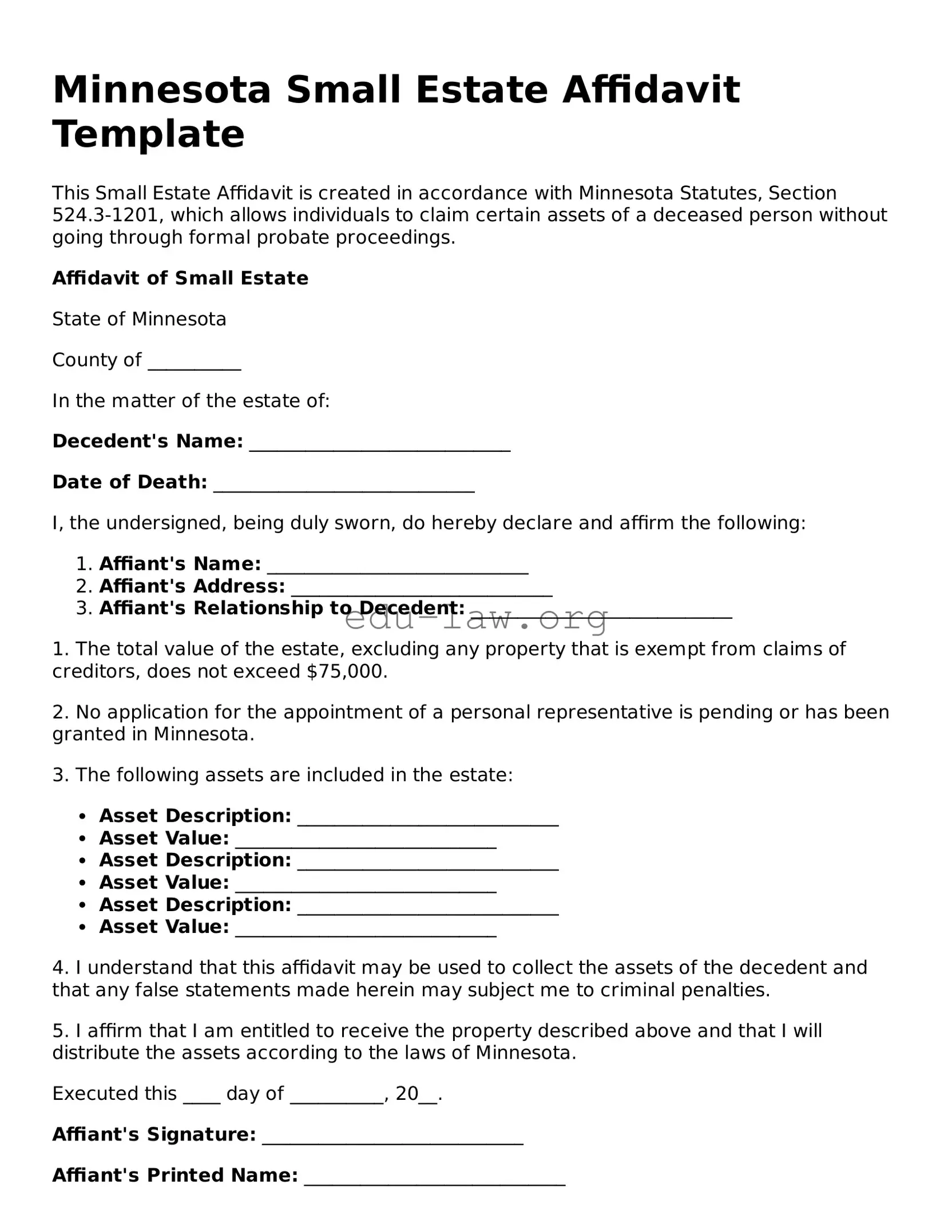
Minnesota Small Estate Affidavit Template
This Small Estate Affidavit is created in accordance with Minnesota Statutes, Section 524.3-1201, which allows individuals to claim certain assets of a deceased person without going through formal probate proceedings.
Affidavit of Small Estate
State of Minnesota
County of __________
In the matter of the estate of:
Decedent's Name: ____________________________
Date of Death: ____________________________
I, the undersigned, being duly sworn, do hereby declare and affirm the following:
1. The total value of the estate, excluding any property that is exempt from claims of creditors, does not exceed $75,000.
2. No application for the appointment of a personal representative is pending or has been granted in Minnesota.
3. The following assets are included in the estate:
4. I understand that this affidavit may be used to collect the assets of the decedent and that any false statements made herein may subject me to criminal penalties.
5. I affirm that I am entitled to receive the property described above and that I will distribute the assets according to the laws of Minnesota.
Executed this ____ day of __________, 20__.
Affiant's Signature: ____________________________
Affiant's Printed Name: ____________________________
Subscribed and sworn to before me this ____ day of __________, 20__.
Notary Public: ____________________________
My Commission Expires: ____________________________
| Fact Name | Description |
|---|---|
| Definition | The Minnesota Small Estate Affidavit is a legal document that allows individuals to claim property of a deceased person without going through formal probate, provided the estate qualifies. |
| Governing Law | This affidavit is governed by Minnesota Statutes, Section 524.3-1201. |
| Eligibility | To use this affidavit, the total value of the estate must be $75,000 or less, excluding certain assets like real estate. |
| Timeframe | The affidavit can be filed as soon as 30 days after the death of the individual whose estate is being claimed. |
| Required Information | The form requires details such as the deceased's name, date of death, and a description of the assets being claimed. |
| Signature Requirement | The affidavit must be signed by the claimant and notarized to ensure its validity. |
| Distribution of Assets | Once the affidavit is approved, the claimant can collect the deceased's assets and distribute them according to the law or the deceased's wishes. |
After completing the Minnesota Small Estate Affidavit form, you will need to submit it to the appropriate court or financial institution to access the decedent's assets. Ensure all necessary documentation is attached to avoid delays.
What is a Minnesota Small Estate Affidavit?
The Minnesota Small Estate Affidavit is a legal document that allows individuals to claim property from a deceased person's estate without going through the formal probate process. This option is available when the total value of the estate is below a certain threshold, making it a simpler and faster way to transfer assets to heirs or beneficiaries.
Who is eligible to use the Small Estate Affidavit?
To use the Small Estate Affidavit in Minnesota, the total value of the deceased person's estate must be less than $75,000, excluding certain assets like real estate. Typically, the person filing the affidavit must be a spouse, child, or another close relative of the deceased. It’s essential to ensure that you meet these eligibility requirements before proceeding.
How do I complete the Small Estate Affidavit?
Completing the Small Estate Affidavit involves gathering necessary information about the deceased, including their name, date of death, and details about their assets. You will need to fill out the affidavit form, which requires a declaration that you are entitled to the property. After completing the form, it must be signed in front of a notary public.
What assets can be claimed using the Small Estate Affidavit?
The Small Estate Affidavit can be used to claim various types of assets, such as bank accounts, personal property, and vehicles. However, it cannot be used for real estate unless the estate qualifies under specific conditions. Always verify that the assets you wish to claim fall within the guidelines set by Minnesota law.
Is there a fee associated with filing the Small Estate Affidavit?
While there is no fee for filing the Small Estate Affidavit itself, you may incur costs for notarization or other related services. Additionally, if you need to record the affidavit with a county office, there may be recording fees. It's wise to check with local authorities for any specific fees that may apply.
What happens after I file the Small Estate Affidavit?
Once the Small Estate Affidavit is filed and accepted, you can present it to financial institutions or other entities holding the deceased's assets. They will then release the property to you. Keep in mind that the affidavit serves as proof of your right to claim the assets, so it is crucial to retain copies for your records.
When filling out the Minnesota Small Estate Affidavit form, it's easy to overlook important details. Here are six common mistakes that people often make:
Many individuals forget to provide essential details about the deceased, such as their full name, date of death, and last known address. Omitting this information can lead to delays or rejections.
Some people underestimate or overestimate the total value of the estate. It’s crucial to accurately assess the value of all assets to ensure compliance with state laws.
All heirs must be identified on the affidavit. Neglecting to include someone can create complications and may result in legal disputes later on.
It may seem simple, but forgetting to sign the affidavit is a common oversight. The document is not valid without a signature, so double-checking this step is essential.
Forms can change over time, and using an outdated version may lead to problems. Always ensure you have the most current form from an official source.
Some individuals fail to attach necessary documents, such as a death certificate or proof of asset ownership. These documents support the claims made in the affidavit and are often required.
By being aware of these common mistakes, individuals can navigate the Small Estate Affidavit process more smoothly and avoid unnecessary complications. Taking the time to review each section carefully can make a significant difference.
When dealing with small estates in Minnesota, several forms and documents may accompany the Small Estate Affidavit. These documents help streamline the process of settling the estate and ensure that all legal requirements are met. Below is a list of commonly used forms and documents.
Using these forms in conjunction with the Minnesota Small Estate Affidavit can simplify the process of estate settlement. Each document plays a vital role in ensuring that the estate is handled correctly and efficiently.
The Minnesota Small Estate Affidavit is similar to the Affidavit of Heirship, which is often used in situations where a deceased person did not leave a will. This document helps establish the heirs of an estate, allowing them to claim property without going through a lengthy probate process. Both documents streamline the transfer of assets, ensuring that heirs can access what they are entitled to without unnecessary delays.
Another comparable document is the Will. While a Will outlines how a person's assets should be distributed after their death, it may require probate to be effective. In contrast, the Small Estate Affidavit provides a quicker route for transferring assets, particularly when the estate is below a certain value. Both documents serve to express the deceased's wishes, but the Small Estate Affidavit offers a simpler alternative when the estate is modest.
The Personal Representative’s Affidavit is also similar, as it is used by an appointed individual to manage the estate of someone who has passed away. This document gives authority to the representative to handle the deceased's affairs, including settling debts and distributing assets. Like the Small Estate Affidavit, it can simplify the process of transferring property, although it may still involve some level of probate depending on the circumstances.
The Petition for Probate shares similarities with the Small Estate Affidavit in that both are used to address the distribution of a deceased person's assets. However, the Petition for Probate is typically necessary when there is a will, and the estate exceeds a certain value. While the Small Estate Affidavit bypasses the probate process for smaller estates, the Petition for Probate formally initiates it, making it a more complex and time-consuming option.
The Transfer on Death Deed (TODD) is another document that can simplify the transfer of property upon death. Like the Small Estate Affidavit, a TODD allows individuals to pass on real estate directly to beneficiaries without going through probate. The key difference lies in the fact that a TODD must be executed during the property owner's lifetime and explicitly names beneficiaries, while the Small Estate Affidavit is utilized after death to claim the estate's assets.
The Affidavit for Collection of Personal Property is similar in purpose, as it allows individuals to claim personal property of a deceased person without going through probate. This document is typically used for personal belongings, bank accounts, or other non-real estate assets. Both the Affidavit for Collection and the Small Estate Affidavit serve to expedite the transfer of assets, but the former is limited to specific types of personal property.
The Small Estate Affidavit can also be compared to the Declaration of Trust, which is used to manage assets placed in a trust. While the Declaration of Trust outlines how assets should be managed during the grantor's lifetime and after their death, the Small Estate Affidavit provides a way for heirs to access assets without a trust. Both documents aim to facilitate the transfer of assets, but they operate under different legal frameworks.
The Assignment of Interest document is another similar form, often used to transfer ownership rights in an estate or property. Like the Small Estate Affidavit, it allows for a smoother transition of ownership without extensive legal proceedings. However, the Assignment of Interest typically requires the consent of all parties involved, whereas the Small Estate Affidavit can be used by a single heir to claim their share.
Lastly, the Release of Claim document can be seen as akin to the Small Estate Affidavit. This form is used when a beneficiary agrees to relinquish their rights to a portion of an estate, often in exchange for a settlement. Both documents facilitate the distribution of an estate, but the Release of Claim specifically addresses the relinquishment of rights, while the Small Estate Affidavit focuses on the transfer of assets to heirs.
Filling out the Minnesota Small Estate Affidavit form can be a straightforward process if approached with care. Here are some essential dos and don'ts to keep in mind:
By following these guidelines, individuals can navigate the process more smoothly and ensure that the estate is handled appropriately.
Misconceptions about the Minnesota Small Estate Affidavit can lead to confusion and potential legal issues. Below are ten common misconceptions, along with clarifications for each.
While many believe the limit is strictly $50,000, the threshold actually varies based on whether the estate includes real property. For estates without real property, the limit is indeed $50,000, but for those with real property, the limit is $75,000.
The affidavit serves as an alternative to probate, but it does not eliminate the need for probate in all circumstances. If the estate includes complex assets or debts, probate may still be necessary.
While consensus among heirs can be helpful, it is not a legal requirement. The affidavit can be filed by one heir without the consent of others, provided they meet the legal criteria.
The Small Estate Affidavit is specifically designed for certain types of assets, primarily bank accounts and personal property. It cannot be used for all asset types, such as vehicles or real estate without additional documentation.
In most cases, completing and filing the Small Estate Affidavit can be done relatively quickly. Once the form is filled out correctly, it can be presented to the relevant institutions without extensive delays.
While the Small Estate Affidavit simplifies the transfer of assets, it does not absolve the estate from its debts. Creditors must still be notified, and debts should be settled before distributing assets.
Only individuals who are legally entitled to the assets can file the affidavit. This typically includes heirs or individuals designated in the will.
The Small Estate Affidavit is not a substitute for a will. A will outlines how an individual wishes to distribute their assets upon death, while the affidavit is a tool for accessing and transferring assets after death.
While the Small Estate Affidavit can streamline the process of asset transfer, it does not exempt the estate from tax obligations. Estate taxes may still apply based on the total value of the estate.
Filing the Small Estate Affidavit does not prevent heirs or interested parties from contesting the validity of the estate or the affidavit itself. Legal challenges can still arise.
Understanding these misconceptions can help individuals navigate the process of handling small estates more effectively.
When filling out and using the Minnesota Small Estate Affidavit form, consider the following key takeaways: