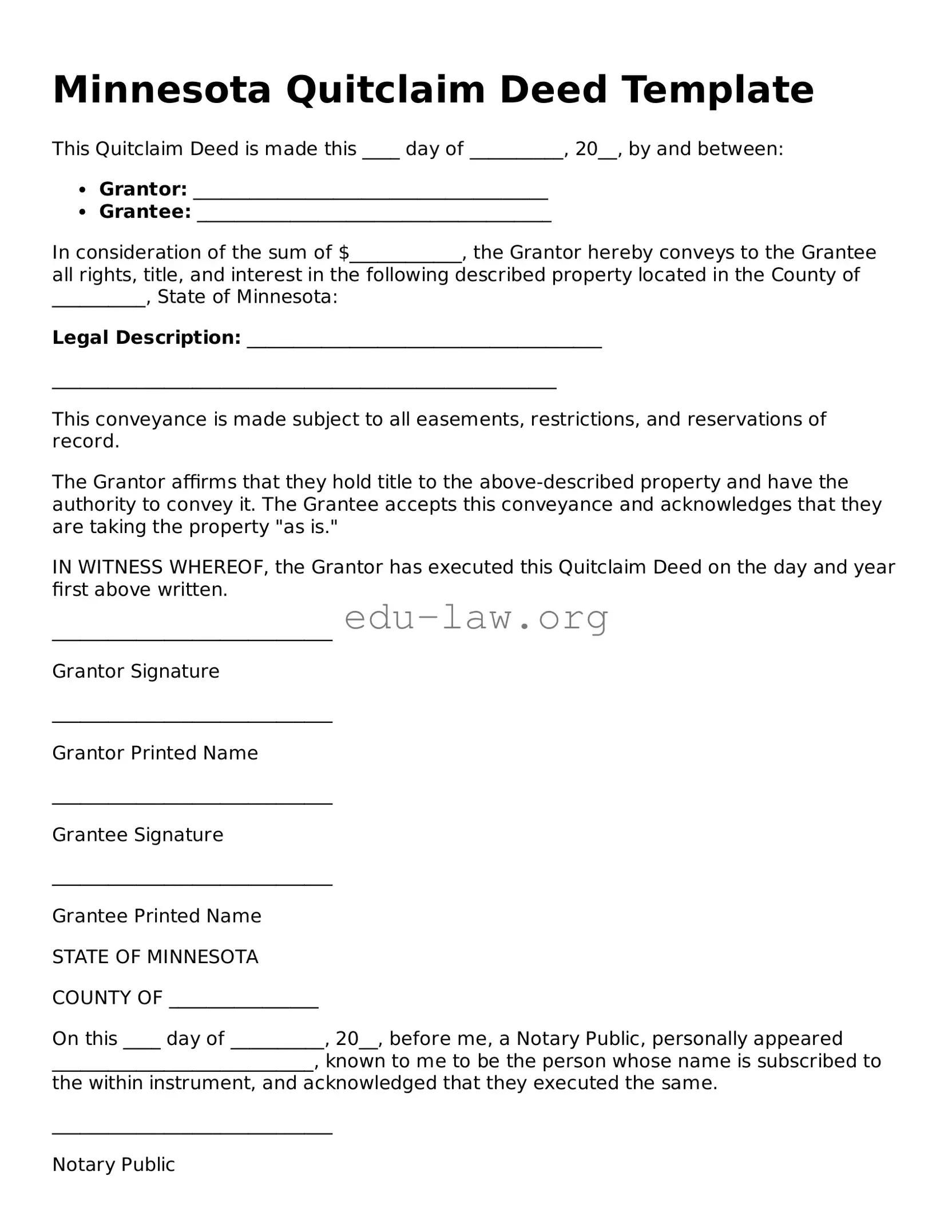
The Minnesota Quitclaim Deed form serves as a vital tool for property owners looking to transfer their interest in real estate without the complexities often associated with other types of deeds. This straightforward document allows one party, known as the grantor, to convey their ownership rights to another party, referred to as the grantee. Unlike warranty deeds, quitclaim deeds do not guarantee that the grantor holds clear title to the property, making them particularly useful in situations such as transferring property between family members or resolving disputes. The form typically requires essential information, including the names of the grantor and grantee, a legal description of the property, and the date of the transfer. Additionally, it must be signed in the presence of a notary public to ensure its validity. Understanding the nuances of this form can help individuals navigate property transfers smoothly and avoid potential legal complications down the line.
Minnesota Quitclaim Deed Template
This Quitclaim Deed is made this ____ day of __________, 20__, by and between:
In consideration of the sum of $____________, the Grantor hereby conveys to the Grantee all rights, title, and interest in the following described property located in the County of __________, State of Minnesota:
Legal Description: ______________________________________
______________________________________________________
This conveyance is made subject to all easements, restrictions, and reservations of record.
The Grantor affirms that they hold title to the above-described property and have the authority to convey it. The Grantee accepts this conveyance and acknowledges that they are taking the property "as is."
IN WITNESS WHEREOF, the Grantor has executed this Quitclaim Deed on the day and year first above written.
______________________________
Grantor Signature
______________________________
Grantor Printed Name
______________________________
Grantee Signature
______________________________
Grantee Printed Name
STATE OF MINNESOTA
COUNTY OF ________________
On this ____ day of __________, 20__, before me, a Notary Public, personally appeared ____________________________, known to me to be the person whose name is subscribed to the within instrument, and acknowledged that they executed the same.
______________________________
Notary Public
My Commission Expires: ________________
| Fact Name | Description |
|---|---|
| Definition | A Quitclaim Deed is a legal document used to transfer ownership of real estate without any warranties regarding the title. |
| Governing Law | In Minnesota, Quitclaim Deeds are governed by Minnesota Statutes Chapter 507. |
| Purpose | This form is often used between family members or in situations where the parties know each other well. |
| No Title Guarantee | The grantor does not guarantee that the title is clear of issues, which is a key characteristic of a Quitclaim Deed. |
| Requirements | The form must be signed by the grantor and should include the names of both the grantor and grantee. |
| Recording | To be legally effective against third parties, the Quitclaim Deed should be recorded with the county recorder’s office. |
| Consideration | While a monetary consideration is not required, stating a nominal amount can be beneficial for legal purposes. |
| Tax Implications | Transfers using a Quitclaim Deed may be subject to Minnesota’s transfer tax, depending on the situation. |
| Use Cases | Commonly used for transferring property between spouses during a divorce or between family members. |
| Legal Advice | It is advisable to seek legal counsel before executing a Quitclaim Deed to understand the implications fully. |
After completing the Minnesota Quitclaim Deed form, the next step is to ensure it is signed and notarized. Once this is done, the deed should be filed with the appropriate county office to make the transfer official.
What is a Minnesota Quitclaim Deed?
A Minnesota Quitclaim Deed is a legal document used to transfer ownership of real estate from one party to another. This type of deed does not guarantee that the property is free from liens or other claims, making it essential for the buyer to conduct thorough due diligence before accepting the transfer.
When should I use a Quitclaim Deed?
A Quitclaim Deed is often used in situations where the parties know each other well, such as transferring property between family members, during divorce settlements, or when adding a spouse to a property title. It is a straightforward way to transfer interest without extensive legal complications.
What information is required to complete a Quitclaim Deed?
To complete a Quitclaim Deed, you will need the names and addresses of both the grantor (the person transferring the property) and the grantee (the person receiving the property). Additionally, a legal description of the property and the date of the transfer are necessary. It's important to ensure all information is accurate to avoid future disputes.
Do I need to have the Quitclaim Deed notarized?
Yes, in Minnesota, a Quitclaim Deed must be signed in the presence of a notary public. This step helps to validate the document and ensures that the signatures are legitimate, which is crucial for the deed to be recorded properly.
How do I record a Quitclaim Deed in Minnesota?
To record a Quitclaim Deed, you must submit the signed and notarized document to the county recorder's office where the property is located. There may be a recording fee, and it is advisable to check with the specific county for their requirements and procedures.
What are the tax implications of using a Quitclaim Deed?
While a Quitclaim Deed itself does not trigger a tax event, the transfer of property may have tax implications, such as potential gift tax if the property is transferred without consideration. It is wise to consult a tax professional to understand any potential liabilities that may arise from the transfer.
Can I revoke a Quitclaim Deed after it has been executed?
Once a Quitclaim Deed has been executed and recorded, it cannot be revoked unilaterally. If you wish to reverse the transfer, both parties must agree to execute a new deed, typically a Quitclaim Deed back to the original owner. Legal advice may be necessary to navigate this process.
Is a Quitclaim Deed the same as a Warranty Deed?
No, a Quitclaim Deed and a Warranty Deed are different. A Warranty Deed provides a guarantee that the property is free from liens and encumbrances, while a Quitclaim Deed offers no such assurances. This distinction is critical when deciding which type of deed to use for a property transfer.
Can I use a Quitclaim Deed to transfer property to a trust?
Yes, you can use a Quitclaim Deed to transfer property into a trust. This is often done for estate planning purposes. However, it is advisable to consult with a legal professional to ensure that the transfer complies with all applicable laws and that the trust is properly established.
What happens if the Quitclaim Deed is not recorded?
If a Quitclaim Deed is not recorded, the transfer of ownership may not be recognized by third parties, including lenders and potential buyers. Recording the deed protects the new owner's interest in the property and provides public notice of the ownership change. It is crucial to complete this step promptly after execution.
Incorrect Names: Failing to use the full legal names of the grantor and grantee can lead to confusion. Ensure that all names are spelled correctly and match the names on official documents.
Missing Signatures: Both the grantor and grantee must sign the form. Omitting a signature can invalidate the deed.
Improper Notarization: The deed must be notarized to be legally binding. Ensure that a notary public is present and that all signatures are acknowledged.
Incorrect Property Description: The property description should be precise. Vague or incomplete descriptions can create issues in property transfer.
Failure to Include Consideration: Even if the transfer is a gift, the form should state the consideration (the value exchanged) to avoid ambiguity.
Ignoring Local Requirements: Some counties may have specific requirements for the Quitclaim Deed. Always check local regulations before submission.
Not Keeping Copies: Failing to retain copies of the completed form can lead to complications later. Always keep a copy for your records.
Neglecting to Record the Deed: After signing and notarizing, the deed must be recorded with the county recorder’s office. Neglecting this step can affect the legal status of the property transfer.
Using Outdated Forms: Always use the most current version of the Quitclaim Deed form. Using outdated forms can result in legal complications.
Not Seeking Legal Advice: While it’s possible to fill out the form independently, consulting with a legal professional can help avoid common pitfalls and ensure the deed is properly executed.
When executing a Minnesota Quitclaim Deed, several other forms and documents may be necessary to ensure a smooth transfer of property. Each of these documents serves a specific purpose in the process of transferring ownership and securing the interests of the parties involved.
Understanding these additional documents can help streamline the property transfer process. Each plays a crucial role in protecting the rights of both the buyer and seller, ensuring a clear and legal transaction.
The Warranty Deed is a document that, like the Quitclaim Deed, transfers ownership of real property. However, it offers a higher level of protection to the buyer. With a Warranty Deed, the seller guarantees that they hold clear title to the property and that there are no undisclosed encumbrances. This contrasts with the Quitclaim Deed, which transfers whatever interest the seller has without any guarantees. Buyers often prefer Warranty Deeds when they want assurance against potential claims on the property.
The Bargain and Sale Deed resembles the Quitclaim Deed in that it conveys property without warranties. However, it implies that the seller has some interest in the property being sold. This type of deed does not guarantee a clear title but suggests that the seller has the right to sell the property. Buyers should exercise caution, as they may still face risks regarding any existing liens or claims against the property.
A Special Purpose Deed, which includes documents like the Executor's Deed or Administrator's Deed, is similar to the Quitclaim Deed in that it transfers property. However, these deeds are typically used in specific situations, such as when property is transferred after a death or through a court order. While they may not provide warranties, they serve a specific purpose and often include information about the authority under which the transfer is made.
The Deed of Trust is another document that can be compared to the Quitclaim Deed. While the Quitclaim Deed transfers ownership, a Deed of Trust secures a loan with the property as collateral. In this case, the borrower conveys the property to a trustee, who holds it until the loan is repaid. This document does not transfer ownership in the same way but is essential in real estate transactions involving financing.
The Grant Deed is often used in property transactions and shares similarities with the Quitclaim Deed. Like the Quitclaim, it transfers ownership of property. However, a Grant Deed includes implied warranties that the seller has not sold the property to anyone else and that the property is free from undisclosed encumbrances. This added layer of protection makes it a more secure option for buyers compared to a Quitclaim Deed.
The Leasehold Deed, while primarily a lease agreement, shares some characteristics with the Quitclaim Deed. It allows a property owner to transfer rights to use the property for a specified period. Unlike the Quitclaim, which transfers ownership, the Leasehold Deed grants temporary rights. However, both documents involve an interest in real property and may require careful consideration before signing.
Finally, the Mineral Deed is a specialized document that transfers ownership of mineral rights, similar to how a Quitclaim Deed transfers property rights. This deed allows the seller to convey their interest in minerals beneath the surface of the land. While the Quitclaim Deed transfers real estate ownership without warranties, the Mineral Deed specifically focuses on the rights to extract minerals, making it a unique but related document in real estate transactions.
When filling out the Minnesota Quitclaim Deed form, it is essential to approach the task with care. The following list outlines important dos and don’ts to ensure a smooth process.
By following these guidelines, individuals can help ensure that their Quitclaim Deed is filled out correctly and meets all necessary legal requirements.
When dealing with the Minnesota Quitclaim Deed form, several misconceptions can lead to confusion. Here are nine common misunderstandings:
Understanding these misconceptions can help you navigate property transfers more effectively in Minnesota.
When it comes to transferring property in Minnesota, a Quitclaim Deed can be a straightforward option. Here are some key takeaways to keep in mind:
Using a Quitclaim Deed can simplify property transfers, but understanding the process is essential to avoid potential pitfalls.