When engaging in financial transactions, clarity and security are paramount. The Minnesota Promissory Note form serves as a crucial tool for individuals and businesses alike, facilitating the borrowing and lending of money while establishing clear terms and conditions. This legally binding document outlines the borrower's promise to repay a specified amount of money to the lender, along with details such as the interest rate, payment schedule, and consequences of default. By clearly defining these elements, the promissory note not only protects the lender's interests but also provides the borrower with a structured repayment plan. Additionally, the form can be customized to suit various lending situations, whether for personal loans, business financing, or real estate transactions. Understanding the key components and implications of the Minnesota Promissory Note is essential for anyone looking to navigate the complexities of lending and borrowing in a transparent and legally sound manner.
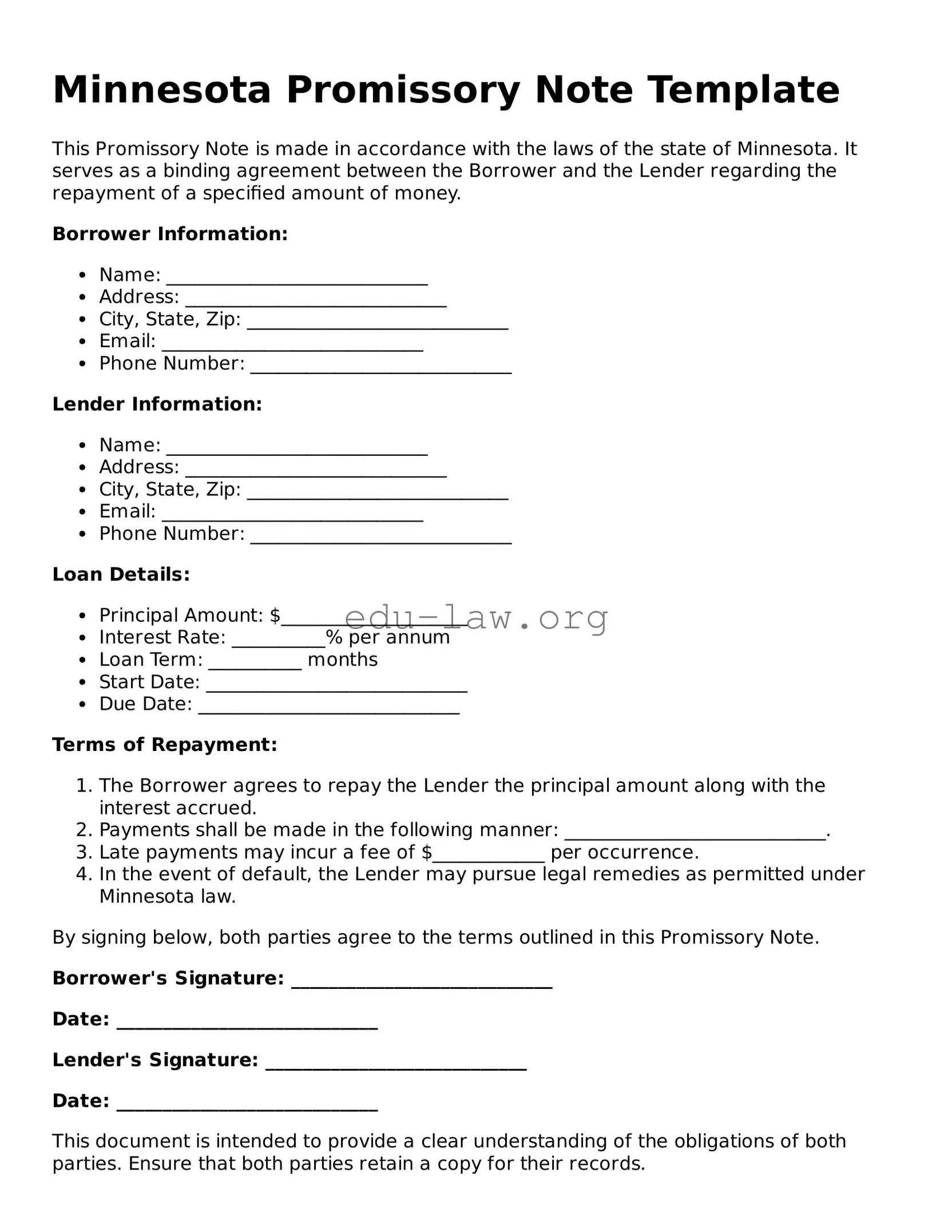
Minnesota Promissory Note Template
This Promissory Note is made in accordance with the laws of the state of Minnesota. It serves as a binding agreement between the Borrower and the Lender regarding the repayment of a specified amount of money.
Borrower Information:
Lender Information:
Loan Details:
Terms of Repayment:
By signing below, both parties agree to the terms outlined in this Promissory Note.
Borrower's Signature: ____________________________
Date: ____________________________
Lender's Signature: ____________________________
Date: ____________________________
This document is intended to provide a clear understanding of the obligations of both parties. Ensure that both parties retain a copy for their records.
| Fact Name | Description |
|---|---|
| Definition | A Minnesota Promissory Note is a written promise to pay a specific amount of money to a designated person or entity at a specified time or on demand. |
| Governing Law | The Minnesota Uniform Commercial Code (UCC) governs promissory notes in Minnesota. |
| Parties Involved | Typically, there are two parties: the borrower (maker) who promises to pay and the lender (payee) who will receive the payment. |
| Interest Rates | The note can specify an interest rate, which must comply with Minnesota usury laws to avoid excessive charges. |
| Payment Terms | Payment terms can vary, including options for installment payments or a lump sum at maturity. |
| Signatures Required | For the note to be enforceable, it must be signed by the maker, and often, a witness or notary is recommended. |
| Default Clauses | The note can include clauses outlining what happens in the event of a default, such as late fees or acceleration of the debt. |
After obtaining the Minnesota Promissory Note form, you will need to complete it with the necessary information. This process involves providing details about the borrower, lender, loan amount, and repayment terms. Make sure to have all relevant information ready before starting.
What is a Minnesota Promissory Note?
A Minnesota Promissory Note is a written agreement between a borrower and a lender. It outlines the terms of a loan, including the amount borrowed, the interest rate, and the repayment schedule. This document serves as a legal record of the debt and can be enforced in court if necessary.
Who needs a Promissory Note?
Anyone who is lending money or borrowing money can benefit from a Promissory Note. Whether you are a friend lending money to another friend, a business providing a loan to a client, or a family member helping out, having a Promissory Note ensures that both parties understand the terms and conditions of the loan.
What information should be included in the Promissory Note?
Key details to include are the names and addresses of both the borrower and lender, the principal amount of the loan, the interest rate, the repayment schedule, and any late fees or penalties for missed payments. It’s also a good idea to include a clause about what happens in case of default.
Is a Promissory Note legally binding?
Yes, a properly executed Promissory Note is legally binding. This means that if the borrower fails to repay the loan as agreed, the lender can take legal action to recover the owed amount. It’s important that both parties fully understand the terms before signing.
Do I need a lawyer to create a Promissory Note?
While it’s not necessary to hire a lawyer, it can be beneficial, especially for larger loans or complex agreements. Many people choose to use templates or online services to create a Promissory Note. Just ensure that the document complies with Minnesota laws and includes all necessary information.
Can a Promissory Note be modified after it’s signed?
Yes, a Promissory Note can be modified, but both parties must agree to the changes. It’s best to document any modifications in writing and have both parties sign the updated agreement. This helps to avoid confusion and ensures that everyone is on the same page.
Incomplete Borrower Information: Many individuals forget to provide all necessary details about the borrower. This includes the full name, address, and contact information. Omitting any of this information can lead to confusion or disputes later.
Missing Lender Details: Just as with the borrower, the lender's information must be complete. Failing to include the lender's name and address can create issues in enforcing the note.
Incorrect Loan Amount: Some people miscalculate the loan amount or fail to write it correctly in both numerical and written forms. This inconsistency can lead to misunderstandings about the actual debt.
Omitting Interest Rate: The interest rate is a crucial part of a promissory note. Not specifying the interest rate or leaving it blank can cause legal complications and affect the repayment terms.
Neglecting Payment Terms: It's essential to clearly outline how and when payments will be made. Some individuals do not specify the payment schedule or the method of payment, which can lead to disputes.
Failure to Sign and Date: A common mistake is not signing or dating the document. Without signatures, the note may not be legally binding, and the parties involved may not be able to enforce the agreement.
When engaging in a lending arrangement, the Minnesota Promissory Note serves as a crucial document outlining the terms of the loan. However, several other forms and documents often accompany it to ensure clarity and legal compliance. Below is a list of these essential documents, each playing a vital role in the lending process.
These documents, alongside the Minnesota Promissory Note, create a comprehensive framework that supports both lenders and borrowers. By clearly defining the terms and expectations, they help foster trust and transparency in the lending process.
The Minnesota Promissory Note is similar to a loan agreement, which outlines the terms and conditions under which a borrower receives funds from a lender. Both documents specify the amount borrowed, the interest rate, and the repayment schedule. However, while a promissory note is a straightforward promise to pay, a loan agreement often includes more detailed clauses regarding default, collateral, and the rights of both parties in case of disputes. This added complexity makes loan agreements more comprehensive, catering to various lending scenarios.
Another document that shares similarities with the Minnesota Promissory Note is a mortgage. A mortgage secures a loan with real property, providing the lender with a claim to the property if the borrower defaults. Like a promissory note, a mortgage includes the loan amount and repayment terms. However, the mortgage also involves legal procedures for foreclosure, should the borrower fail to meet their obligations, making it a more formalized and secured instrument compared to a simple promissory note.
A credit agreement also bears resemblance to the Minnesota Promissory Note. This document details the terms of a line of credit extended to a borrower, including the maximum amount available and the interest rate. Similar to a promissory note, a credit agreement requires repayment, but it typically allows for more flexibility in how and when the borrower can draw funds. Both documents establish a borrower’s obligation to repay, but a credit agreement may involve ongoing transactions rather than a single loan amount.
The personal loan agreement is another document akin to the Minnesota Promissory Note. This agreement is often used for unsecured loans between individuals. Like a promissory note, it outlines the loan amount, interest rate, and repayment terms. However, personal loan agreements may also include personal guarantees or additional stipulations about the relationship between the parties, making them more tailored to individual circumstances.
A business loan agreement is similar as well, particularly when a business borrows money from a financial institution. This document outlines the terms of the loan, including the amount, interest rate, and repayment schedule, just like a promissory note. However, business loan agreements often contain additional clauses regarding the use of funds, financial covenants, and specific conditions that must be met by the borrower, reflecting the complexities of business financing.
Another document that resembles the Minnesota Promissory Note is a lease agreement, particularly in the context of leasing equipment. In this scenario, the lease agreement details the terms under which one party may use another's property, typically involving periodic payments. While a promissory note is a promise to repay borrowed money, a lease agreement outlines the obligation to pay for the use of an asset over time, focusing on the rental aspect rather than outright ownership.
Then there is the installment agreement, which is often used in consumer financing. This document details a series of payments to be made over time for a purchase, similar to a promissory note that establishes a payment plan for a loan. The key difference lies in the context; installment agreements are frequently associated with the purchase of goods or services, while promissory notes are primarily financial instruments for borrowing money.
Lastly, the secured promissory note is closely related to the Minnesota Promissory Note. This document is similar in structure and function but includes a security interest in collateral. In the event of default, the lender has the right to seize the collateral to recover their funds. This added layer of security differentiates it from a standard promissory note, which does not involve collateral and relies solely on the borrower's promise to repay.
When filling out the Minnesota Promissory Note form, it's important to follow certain guidelines to ensure that the document is completed correctly. Here’s a list of things you should and shouldn’t do:
By following these tips, you can create a clear and enforceable promissory note that protects both parties involved.
When it comes to financial agreements, misunderstandings can lead to complications. The Minnesota Promissory Note form is no exception. Here are seven common misconceptions about this important document:
Understanding these misconceptions can help individuals navigate the complexities of promissory notes more effectively. Being informed is the first step toward making sound financial decisions.
When filling out and using the Minnesota Promissory Note form, it's important to keep several key points in mind: