When couples in Minnesota decide to tie the knot, they often consider a prenuptial agreement as a proactive step to protect their individual interests and clarify financial matters. This legally binding document outlines how assets and debts will be managed during the marriage and what will happen in the event of a divorce or separation. A well-drafted prenuptial agreement can address a variety of topics, including property division, spousal support, and even the handling of future earnings. Importantly, Minnesota law requires that both parties fully disclose their financial situations before signing the agreement, ensuring transparency and fairness. Additionally, the agreement must be voluntarily signed by both individuals, without any coercion, to be enforceable. By understanding the major aspects of the Minnesota Prenuptial Agreement form, couples can navigate their financial futures with greater confidence and clarity.
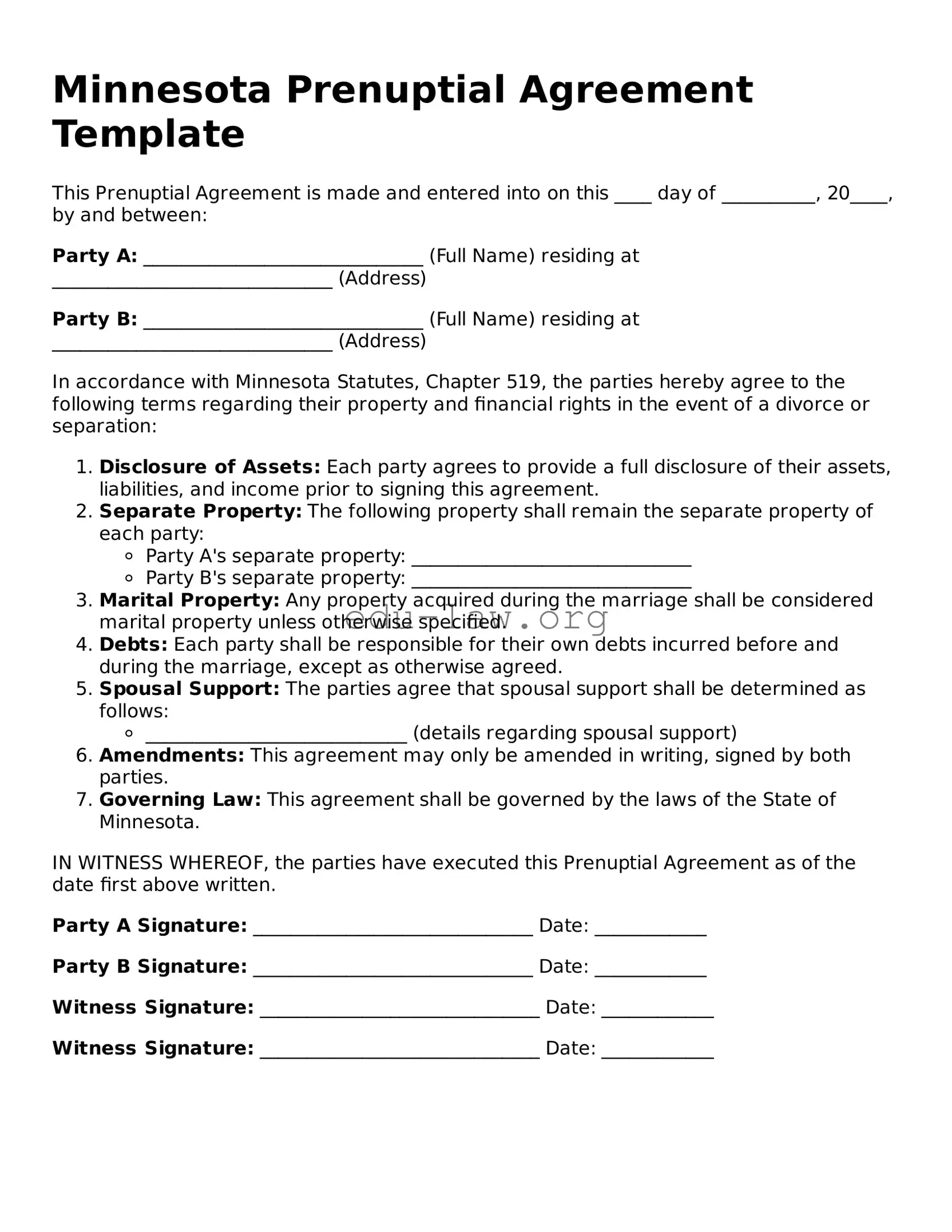
Minnesota Prenuptial Agreement Template
This Prenuptial Agreement is made and entered into on this ____ day of __________, 20____, by and between:
Party A: ______________________________ (Full Name) residing at ______________________________ (Address)
Party B: ______________________________ (Full Name) residing at ______________________________ (Address)
In accordance with Minnesota Statutes, Chapter 519, the parties hereby agree to the following terms regarding their property and financial rights in the event of a divorce or separation:
IN WITNESS WHEREOF, the parties have executed this Prenuptial Agreement as of the date first above written.
Party A Signature: ______________________________ Date: ____________
Party B Signature: ______________________________ Date: ____________
Witness Signature: ______________________________ Date: ____________
Witness Signature: ______________________________ Date: ____________
| Fact Name | Description |
|---|---|
| Governing Law | The Minnesota Prenuptial Agreement is governed by Minnesota Statutes, Chapter 519. |
| Definition | A prenuptial agreement is a contract between two individuals before marriage that outlines the division of assets and responsibilities in the event of divorce or separation. |
| Enforceability | For a prenuptial agreement to be enforceable in Minnesota, it must be in writing and signed by both parties. |
| Full Disclosure | Both parties must provide a fair and reasonable disclosure of their financial situations prior to signing the agreement. |
| Voluntary Agreement | The agreement must be entered into voluntarily, without any coercion or undue influence from either party. |
| Modification and Revocation | A prenuptial agreement can be modified or revoked at any time, provided that both parties agree to the changes in writing. |
Filling out the Minnesota Prenuptial Agreement form is an important step for couples who wish to outline their financial arrangements before marriage. This process involves providing specific information about both individuals and their assets, ensuring clarity and mutual understanding.
What is a Minnesota Prenuptial Agreement?
A Minnesota Prenuptial Agreement is a legal document created by two individuals before they marry. This agreement outlines the division of assets and responsibilities in the event of divorce or separation. It can address various issues, including property rights, spousal support, and debt obligations. Having this agreement in place can provide clarity and protection for both parties, helping to avoid disputes in the future.
What should be included in a Minnesota Prenuptial Agreement?
While each agreement can be tailored to the couple's specific needs, common elements include the identification of separate and marital property, provisions for spousal support, and guidelines for the division of assets upon divorce. Couples may also include terms related to financial responsibilities during the marriage. It is crucial to ensure that all assets and liabilities are disclosed accurately to avoid potential disputes later.
How do I create a valid Prenuptial Agreement in Minnesota?
To create a valid Prenuptial Agreement in Minnesota, both parties must voluntarily agree to the terms. It is advisable for each party to consult with their own attorney to ensure that their interests are protected. The agreement should be in writing and signed by both parties. Additionally, it is recommended to execute the agreement well in advance of the wedding date to avoid any claims of coercion or duress.
Can a Prenuptial Agreement be changed after marriage?
Yes, a Prenuptial Agreement can be modified after marriage. Both parties must agree to the changes, and it is essential to document any amendments in writing. Just like the original agreement, any modifications should be signed by both parties. If the changes are significant, it may be beneficial to consult legal counsel to ensure that the new terms are enforceable and meet legal requirements.
Incomplete Information: Failing to provide all necessary personal details can lead to delays or issues later on. Ensure both parties include full names, addresses, and other required information.
Not Disclosing Assets: Hiding or omitting assets can invalidate the agreement. Both parties should fully disclose their financial situation, including debts and properties.
Using Ambiguous Language: Vague terms can cause confusion. Be specific about the rights and responsibilities of each party to avoid misunderstandings.
Ignoring State Laws: Each state has its own rules regarding prenuptial agreements. Familiarize yourself with Minnesota laws to ensure compliance.
Not Consulting an Attorney: Relying solely on templates without legal advice can lead to mistakes. Consulting a lawyer ensures the agreement is enforceable and meets legal standards.
Failing to Update the Agreement: Life changes, such as the birth of children or changes in income, may require updates to the agreement. Review and revise the document regularly.
Not Signing in Front of Witnesses: Some states require witnesses for prenuptial agreements to be valid. Make sure to follow the signing requirements to avoid complications.
Rushing the Process: Taking time to discuss and negotiate terms is crucial. Rushing can lead to overlooked details and potential disputes in the future.
A Minnesota Prenuptial Agreement is an important document that outlines the financial and property rights of each spouse in the event of a divorce or separation. Along with this agreement, several other forms and documents may be necessary to ensure a comprehensive approach to marital planning. Below is a list of related documents often used in conjunction with a prenuptial agreement.
Using these documents alongside a Minnesota Prenuptial Agreement can help clarify expectations and protect both parties' interests. It is advisable to consult with a legal professional to ensure all documents are properly prepared and executed.
A cohabitation agreement is similar to a prenuptial agreement in that both documents outline the rights and responsibilities of individuals in a relationship. While a prenuptial agreement is designed for couples planning to marry, a cohabitation agreement is intended for couples who choose to live together without formalizing their relationship through marriage. Both agreements can address property division, financial responsibilities, and other personal matters, providing clarity and protection for both parties involved. This can help prevent misunderstandings and disputes should the relationship end.
A postnuptial agreement shares similarities with a prenuptial agreement, as it also establishes the financial and property rights of spouses. The key difference lies in the timing; a postnuptial agreement is created after the couple has already married. Like a prenuptial agreement, it can cover issues such as asset distribution, debt responsibilities, and spousal support. This document can be particularly useful for couples who experience significant changes in their financial situation or wish to clarify their financial arrangements after marriage.
A separation agreement can be compared to a prenuptial agreement because both documents serve to clarify the terms of a relationship, though they are used at different stages. A separation agreement is created when a couple decides to live apart, often as a precursor to divorce. It outlines the division of assets, child custody arrangements, and support obligations. Like a prenuptial agreement, it aims to protect the interests of both parties and can help streamline the divorce process by addressing key issues in advance.
An estate plan, while primarily focused on the distribution of assets after death, shares some similarities with a prenuptial agreement in terms of financial planning. Both documents allow individuals to express their wishes regarding asset management and distribution. A prenuptial agreement can help determine what happens to marital property in the event of divorce, while an estate plan outlines how assets should be handled after one's passing. Both documents are essential tools for ensuring that personal wishes are respected and can help avoid potential conflicts among loved ones.
When filling out the Minnesota Prenuptial Agreement form, it's important to approach the process with care. Here are some guidelines to help ensure that you complete the form correctly.
Following these do's and don'ts can help create a fair and enforceable prenuptial agreement that protects both parties' interests.
There are several misconceptions about the Minnesota Prenuptial Agreement form that can lead to confusion. Understanding these can help couples make informed decisions. Here’s a list of common misunderstandings:
Being aware of these misconceptions can help couples approach the topic of prenuptial agreements with clarity and confidence.
When considering a prenuptial agreement in Minnesota, it’s important to understand the key elements that will guide you through the process. Here are some essential takeaways: