In Minnesota, the Power of Attorney form serves as a vital legal document that empowers individuals to designate someone they trust to act on their behalf in various matters, ranging from financial decisions to healthcare choices. This form is particularly important for those who may be facing health issues, planning for the future, or simply seeking peace of mind knowing that their affairs can be managed by a trusted person if they become unable to do so themselves. The document can be tailored to fit specific needs, allowing the principal—the person granting authority—to specify the scope of powers granted to the agent, whether it be for a limited time or for a broader range of responsibilities. It is essential to understand that this form not only facilitates decision-making in times of need but also ensures that the chosen agent acts in the best interest of the principal. Additionally, the Minnesota Power of Attorney form includes important provisions regarding the agent's responsibilities, which can help prevent misuse of authority. Understanding these aspects is crucial for anyone considering this important legal tool, as it lays the foundation for effective and responsible management of personal affairs.
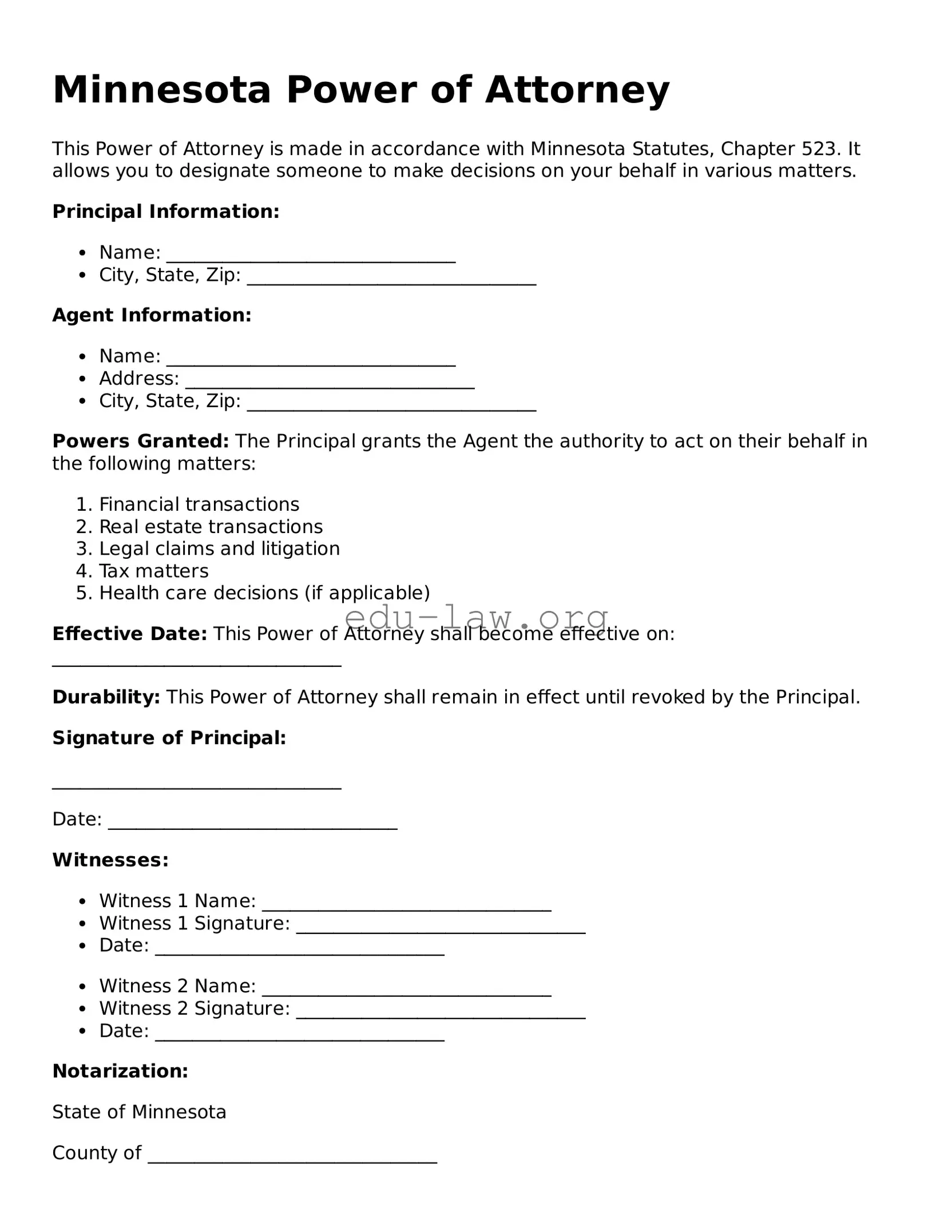
Minnesota Power of Attorney
This Power of Attorney is made in accordance with Minnesota Statutes, Chapter 523. It allows you to designate someone to make decisions on your behalf in various matters.
Principal Information:
Agent Information:
Powers Granted: The Principal grants the Agent the authority to act on their behalf in the following matters:
Effective Date: This Power of Attorney shall become effective on: _______________________________
Durability: This Power of Attorney shall remain in effect until revoked by the Principal.
Signature of Principal:
_______________________________
Date: _______________________________
Witnesses:
Notarization:
State of Minnesota
County of _______________________________
Subscribed and sworn before me this ____ day of ____________, 20__.
_______________________________
Notary Public
My commission expires: _______________________________
| Fact Name | Details |
|---|---|
| Definition | A Power of Attorney (POA) allows one person to make decisions on behalf of another. |
| Governing Law | The Minnesota Statutes, Chapter 523, govern the Power of Attorney in Minnesota. |
| Types of POA | There are several types, including durable, non-durable, and springing Power of Attorney. |
| Durable POA | A durable POA remains effective even if the principal becomes incapacitated. |
| Springing POA | A springing POA only becomes effective under specific conditions, such as incapacitation. |
| Agent's Authority | The agent can be granted broad or limited powers, depending on the principal's wishes. |
| Signing Requirements | The form must be signed by the principal and can require notarization or witnesses. |
| Revocation | The principal can revoke the Power of Attorney at any time, as long as they are competent. |
Filling out the Minnesota Power of Attorney form is an important step in designating someone to act on your behalf in financial or legal matters. Once completed, this document will need to be signed and possibly notarized, depending on your specific circumstances. Below are the steps to help guide you through the process of filling out the form.
What is a Power of Attorney in Minnesota?
A Power of Attorney (POA) in Minnesota is a legal document that allows one person, known as the principal, to grant another person, called the agent or attorney-in-fact, the authority to make decisions on their behalf. This can include financial decisions, medical decisions, or other personal matters. The principal can specify the scope of the agent’s authority, which can be broad or limited depending on the individual's needs and preferences.
Who can be appointed as an agent under a Minnesota Power of Attorney?
In Minnesota, any competent adult can serve as an agent under a Power of Attorney. This means that the person must be at least 18 years old and capable of understanding the responsibilities involved. Many people choose trusted family members or close friends as their agents, but it is essential to select someone who is reliable and will act in the principal's best interest.
What types of Power of Attorney are available in Minnesota?
There are generally two main types of Power of Attorney in Minnesota: Durable and Non-Durable. A Durable Power of Attorney remains effective even if the principal becomes incapacitated. This is particularly useful for long-term planning. On the other hand, a Non-Durable Power of Attorney is effective only as long as the principal is competent. It automatically terminates if the principal becomes incapacitated.
Do I need to have my Power of Attorney document notarized or witnessed?
Yes, in Minnesota, a Power of Attorney must be either notarized or signed in the presence of two witnesses to be valid. Notarization provides an extra layer of security and authenticity. If you choose to have witnesses, they must be at least 18 years old and cannot be named as agents in the document. This helps to ensure that the principal's wishes are respected and upheld.
Can I revoke a Power of Attorney in Minnesota?
Yes, a principal can revoke a Power of Attorney at any time as long as they are competent. To revoke the document, the principal should create a written revocation notice and provide copies to the agent and any institutions or individuals who may have relied on the original Power of Attorney. It’s important to clearly communicate the revocation to avoid any confusion or misuse of authority.
What happens if my agent is unable or unwilling to act?
If your appointed agent is unable or unwilling to fulfill their duties, the Power of Attorney may allow for an alternate agent to step in, if one has been designated. If no alternate agent is named, or if the original agent cannot serve, it may be necessary to seek legal intervention to appoint a new agent or guardian, depending on the circumstances. Planning ahead by designating alternates can help avoid complications in such situations.
Not specifying the powers granted. It's important to clearly outline what powers the agent will have. If the powers are vague or too broad, it can lead to confusion and disputes.
Failing to date the document. A date is crucial for establishing when the Power of Attorney becomes effective. Without a date, it may be questioned in the future.
Not signing in front of a notary. In Minnesota, a Power of Attorney must be notarized to be valid. Without this step, the document may not hold up in legal situations.
Choosing the wrong agent. Selecting someone who is not trustworthy or lacks the ability to make sound decisions can lead to problems. It's essential to choose someone who understands your wishes and can act in your best interest.
Overlooking the need for witnesses. Depending on the situation, having witnesses may be required. Always check the latest requirements to ensure compliance.
Not reviewing the form regularly. Life circumstances change, and so do needs. Regularly reviewing and updating the Power of Attorney ensures it reflects current wishes and conditions.
When considering a Minnesota Power of Attorney, it's essential to understand that this document often works in conjunction with several other forms and legal documents. Each serves a unique purpose, ensuring that individuals can effectively manage their legal and financial affairs. Below is a list of commonly used documents alongside the Power of Attorney form.
Understanding these documents and how they interact with the Minnesota Power of Attorney can greatly enhance an individual's ability to manage their affairs effectively. Each document plays a vital role in ensuring that one's wishes are respected and that appropriate decisions can be made in times of need.
The Minnesota Power of Attorney (POA) form shares similarities with the Durable Power of Attorney. Both documents allow an individual, known as the principal, to appoint someone else, called the agent, to make decisions on their behalf. The key difference lies in durability; a Durable Power of Attorney remains effective even if the principal becomes incapacitated, whereas a standard POA may become invalid under such circumstances. This feature makes the Durable Power of Attorney a popular choice for long-term planning.
Another document that resembles the Minnesota Power of Attorney is the Healthcare Power of Attorney. This specific type of POA is focused solely on medical decisions. Like the general POA, it allows the principal to designate someone to make health-related choices when they are unable to do so themselves. This ensures that the agent can act in the principal's best interests, adhering to their wishes regarding medical treatment and end-of-life care.
The Living Will is also comparable to the Minnesota Power of Attorney, particularly the Healthcare Power of Attorney. While a Living Will outlines the principal's wishes regarding medical treatment in specific scenarios, it does not appoint an agent. Instead, it serves as a guide for healthcare providers and loved ones. Both documents work together to ensure that an individual’s healthcare preferences are respected, but they serve different functions in the decision-making process.
The Revocable Trust shares some similarities with the Minnesota Power of Attorney in terms of asset management. A Revocable Trust allows the principal to transfer assets into the trust while retaining control during their lifetime. Like a POA, it can help manage finances and property if the individual becomes incapacitated. However, a Revocable Trust does not require a designated agent; instead, it has a trustee who manages the trust according to the principal's instructions.
The Advance Directive is another document that aligns with the Minnesota Power of Attorney, particularly in the context of healthcare decisions. An Advance Directive combines elements of a Living Will and a Healthcare Power of Attorney. It allows individuals to express their medical preferences while also appointing an agent to make decisions on their behalf. This comprehensive approach ensures that healthcare providers and family members understand the individual’s wishes in critical situations.
A Guardianship is similar to a Power of Attorney in that both can involve decision-making for another person. However, a Guardianship is typically established through a court process and is often used when an individual is unable to make decisions due to incapacity. While a POA is a voluntary arrangement, a Guardianship is a legal intervention that grants authority to a guardian, who must act in the best interests of the ward.
The Conservatorship also bears resemblance to the Minnesota Power of Attorney, particularly regarding financial matters. A Conservatorship is a court-appointed arrangement where an individual, the conservator, is given the authority to manage the financial affairs of someone who is unable to do so. Unlike a POA, which can be created without court involvement, a Conservatorship requires judicial oversight, ensuring that the conservator acts in the best interests of the individual.
Finally, the Authorization for Release of Information is another document that shares characteristics with the Minnesota Power of Attorney. This form allows an individual to permit someone else to access personal information, such as medical records or financial details. While a POA grants broader decision-making powers, the Authorization for Release of Information is more limited in scope, focusing on information sharing rather than decision-making authority.
When filling out the Minnesota Power of Attorney form, it is essential to approach the task with care. Here are five things to consider doing and avoiding to ensure the document is completed correctly.
Understanding the Minnesota Power of Attorney form is crucial for anyone considering this legal document. However, several misconceptions can lead to confusion. Here are nine common misconceptions about the Minnesota Power of Attorney form, along with clarifications.
Clarifying these misconceptions can help individuals make informed decisions regarding the use of a Power of Attorney in Minnesota.
Filling out and using the Minnesota Power of Attorney form is a significant step in ensuring your financial and legal affairs are managed according to your wishes. Here are key takeaways to keep in mind:
By keeping these points in mind, you can create a Power of Attorney that serves your interests effectively and provides peace of mind.