In Minnesota, the Power of Attorney for a Child form serves as a vital tool for parents and guardians who need to delegate authority for the care of their children. This form allows a designated individual, often a relative or trusted friend, to make decisions on behalf of the child in various situations, such as during a temporary absence of the parents. Key aspects of the form include the ability to grant authority for medical decisions, educational matters, and general welfare, ensuring that the child's needs are met without delay. It is essential to specify the duration of the power granted, as well as any limitations or specific instructions that the parent wishes to include. By completing this form, parents can have peace of mind, knowing that their child will be cared for by someone they trust, even in their absence. Understanding the implications and responsibilities associated with this legal document is crucial for both the parent and the appointed individual, making it a significant consideration for families in various circumstances.
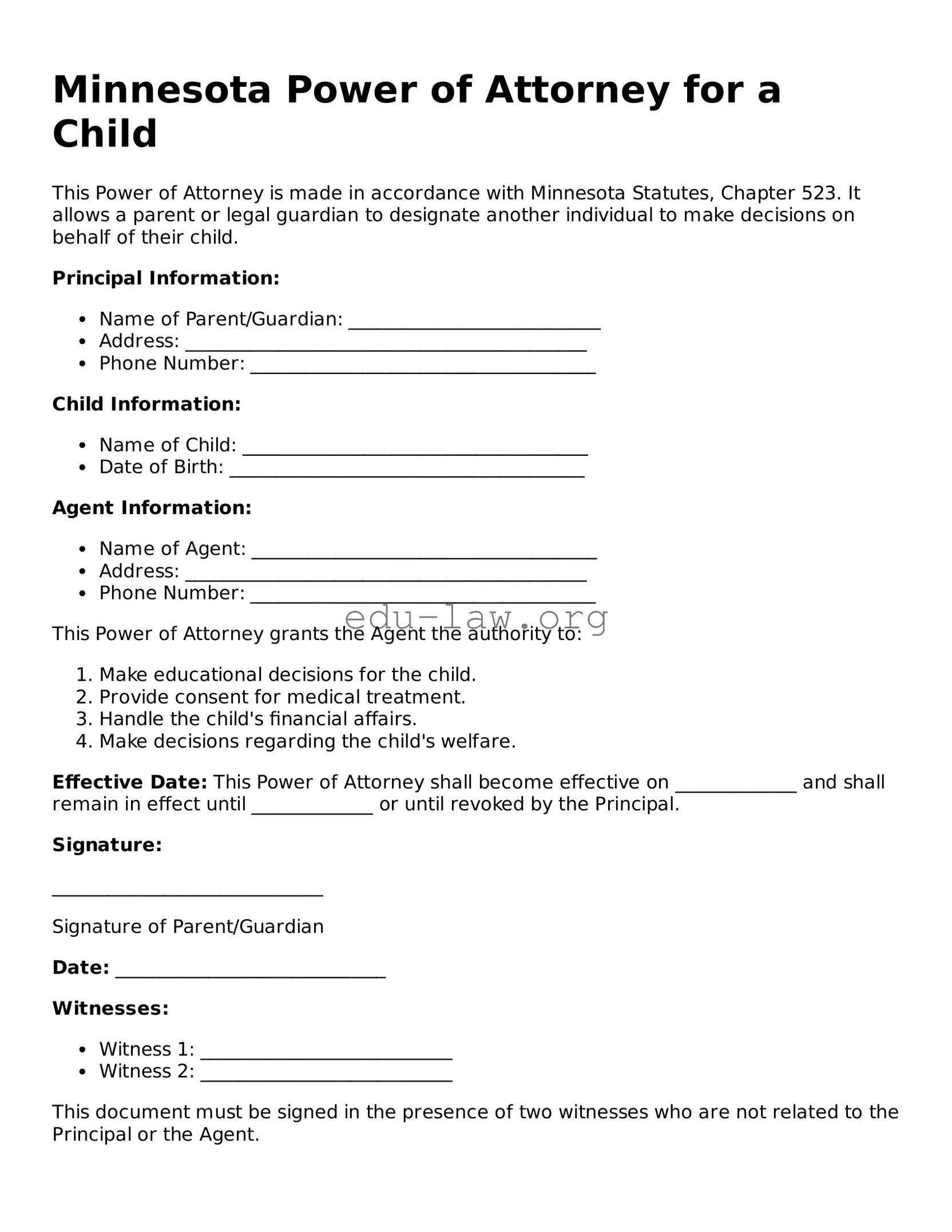
Minnesota Power of Attorney for a Child
This Power of Attorney is made in accordance with Minnesota Statutes, Chapter 523. It allows a parent or legal guardian to designate another individual to make decisions on behalf of their child.
Principal Information:
Child Information:
Agent Information:
This Power of Attorney grants the Agent the authority to:
Effective Date: This Power of Attorney shall become effective on _____________ and shall remain in effect until _____________ or until revoked by the Principal.
Signature:
_____________________________
Signature of Parent/Guardian
Date: _____________________________
Witnesses:
This document must be signed in the presence of two witnesses who are not related to the Principal or the Agent.
| Fact Name | Details |
|---|---|
| Purpose | The Minnesota Power of Attorney for a Child form allows a parent or legal guardian to designate another adult to make decisions on behalf of their child. |
| Governing Law | This form is governed by Minnesota Statutes, Chapter 523.24. |
| Duration | The power of attorney can be set for a specific period or remain in effect until revoked by the parent or guardian. |
| Eligibility | Any adult can be appointed as an attorney-in-fact, provided they are trustworthy and responsible. |
| Revocation | A parent or guardian can revoke the power of attorney at any time by providing written notice. |
| Notarization | The form must be signed in the presence of a notary public to be legally binding. |
| Limitations | The attorney-in-fact cannot make decisions regarding the child's education or health care unless specifically authorized. |
| Use Cases | This form is commonly used for temporary situations, such as travel or emergencies when a parent is unavailable. |
Filling out the Minnesota Power of Attorney for a Child form is an important step in ensuring that someone you trust can make decisions for your child when you are unable to do so. Once you have completed the form, you will need to have it signed and possibly notarized, depending on your specific situation.
What is a Minnesota Power of Attorney for a Child form?
The Minnesota Power of Attorney for a Child form is a legal document that allows a parent or legal guardian to designate another adult to make decisions on behalf of their child. This can include decisions related to education, healthcare, and general welfare. It is particularly useful in situations where the parent or guardian may be temporarily unavailable, such as during travel or extended absences.
Who can serve as an agent under this form?
Any adult can be appointed as an agent in the Power of Attorney for a Child form. This may include relatives, family friends, or trusted individuals. It is essential to choose someone who is responsible and capable of making decisions in the best interest of the child.
How long is the Power of Attorney for a Child valid?
The validity of the Power of Attorney for a Child can vary depending on the specific terms outlined in the document. Generally, it remains in effect until the parent or guardian revokes it or until the child reaches the age of majority, which is 18 years old in Minnesota. It is advisable to specify a duration if a temporary arrangement is intended.
Do I need to have the Power of Attorney for a Child form notarized?
Yes, the Power of Attorney for a Child form must be signed in the presence of a notary public to be legally valid in Minnesota. This step helps to ensure that the document is authentic and that the parent or guardian is granting authority willingly.
Can I revoke the Power of Attorney for a Child once it is established?
Absolutely. A parent or legal guardian has the right to revoke the Power of Attorney for a Child at any time. This can be done by providing written notice to the agent and any relevant parties. It is recommended to formally document the revocation to prevent any confusion.
What if the child has special needs?
If the child has special needs, it is crucial to consider these factors when selecting an agent and making decisions. The agent should be someone familiar with the child's specific requirements and capable of advocating for their best interests. Additional provisions can also be included in the Power of Attorney to address any unique circumstances.
Where can I obtain the Power of Attorney for a Child form?
The Power of Attorney for a Child form can typically be obtained from various sources, including legal offices, online legal resources, or state government websites. It is important to ensure that the form is the most current version and complies with Minnesota laws.
Not providing complete information about the child. It’s essential to include the child's full name, date of birth, and any other identifying details. Missing this information can lead to confusion or delays.
Failing to specify the powers granted. Clearly outline what decisions the agent can make on behalf of the child. Vague language can create misunderstandings and limit the effectiveness of the document.
Not signing the document in the appropriate places. All required signatures must be present. If the form isn’t signed correctly, it may not be valid.
Overlooking the need for witnesses or notarization. Depending on the specific requirements in Minnesota, you may need to have the document signed in front of a notary or witnesses to ensure its legality.
Choosing an unsuitable agent. The person you designate should be trustworthy and capable of making decisions in the best interest of the child. Think carefully about this choice.
Not updating the form when circumstances change. If there are changes in the family situation or the agent’s ability to serve, it’s crucial to revise the document accordingly.
Ignoring state-specific requirements. Each state has its own rules regarding power of attorney forms. Familiarize yourself with Minnesota's specific guidelines to avoid issues.
When preparing a Power of Attorney for a Child in Minnesota, several other forms and documents may also be necessary. These documents can help clarify authority, provide necessary information, and ensure that all legal requirements are met. Below is a list of common forms that are often used alongside the Power of Attorney for a Child.
Using these documents in conjunction with the Power of Attorney for a Child can provide clarity and ensure that all necessary permissions and authorities are in place. Always consider consulting with a legal professional to ensure compliance with Minnesota laws and regulations.
The Minnesota Power of Attorney for a Child form shares similarities with a General Power of Attorney. Both documents allow an individual to designate another person to make decisions on their behalf. In the case of a General Power of Attorney, the appointed person can handle a wide range of financial and legal matters. However, the Power of Attorney for a Child is specifically focused on the care and custody of a minor, granting authority to make decisions related to the child’s welfare, education, and healthcare. This targeted scope makes it distinct yet comparable to the broader General Power of Attorney.
Another document that resembles the Power of Attorney for a Child is the Medical Power of Attorney. This form enables an individual to appoint someone to make healthcare decisions on their behalf if they become unable to do so. Like the Power of Attorney for a Child, the Medical Power of Attorney emphasizes the importance of having a trusted individual in charge of critical decisions. However, it is primarily concerned with medical matters rather than the overall care and custody of a child.
The Custody Agreement is also similar in that it outlines the responsibilities and rights of caregivers regarding a child. This legal document is typically established during divorce or separation proceedings. While the Custody Agreement focuses on parental rights and visitation schedules, the Power of Attorney for a Child allows a parent to temporarily delegate their authority to another trusted adult. Both documents aim to protect the child's best interests but do so through different mechanisms.
A Guardianship Agreement can be compared to the Power of Attorney for a Child in terms of providing care and decision-making authority for a minor. In a Guardianship Agreement, a court appoints a guardian to take care of a child, often in situations where the biological parents are unable to do so. While the Power of Attorney for a Child can be established without court intervention and is usually temporary, a Guardianship Agreement is more formal and may require ongoing legal oversight.
Lastly, the Authorization for Release of Medical Information is another document that bears resemblance to the Power of Attorney for a Child. This form allows a parent or guardian to grant permission for healthcare providers to share a child’s medical records with designated individuals. While the Power of Attorney for a Child provides broader decision-making authority, the Authorization for Release of Medical Information focuses specifically on health-related information. Both documents are essential for ensuring that caregivers have the necessary access to information and authority to act in the child’s best interests.
When filling out the Minnesota Power of Attorney for a Child form, it's essential to be meticulous and informed. Here’s a list of ten important do's and don'ts to guide you through the process:
By following these guidelines, you can navigate the process more smoothly and ensure that the power of attorney is set up correctly for your child's needs.
Understanding the Minnesota Power of Attorney for a Child form is crucial for parents and guardians who wish to delegate authority over their children. However, several misconceptions can cloud the understanding of this important legal document. Below are five common misconceptions:
By dispelling these misconceptions, parents can better understand how to utilize the Power of Attorney for a Child form effectively, ensuring their children’s needs are met even in their absence.
Filling out and utilizing the Minnesota Power of Attorney for a Child form is an important step for parents and guardians. Here are some key takeaways to keep in mind:
By following these guidelines, you can ensure that the Minnesota Power of Attorney for a Child form serves its intended purpose effectively and compassionately.