When starting a business in Minnesota, one of the key documents you’ll encounter is the Operating Agreement. This form plays a crucial role in outlining the structure and management of your limited liability company (LLC). It details the rights and responsibilities of members, ensuring everyone is on the same page from the get-go. With this agreement, you can specify how profits and losses will be distributed, establish rules for decision-making, and even outline procedures for adding new members or handling disputes. While the state doesn’t require an Operating Agreement, having one can protect your interests and help avoid misunderstandings down the line. It serves as a roadmap for your business operations, providing clarity and stability as your company grows. Understanding the major aspects of this form is essential for any entrepreneur looking to establish a solid foundation for their LLC in Minnesota.
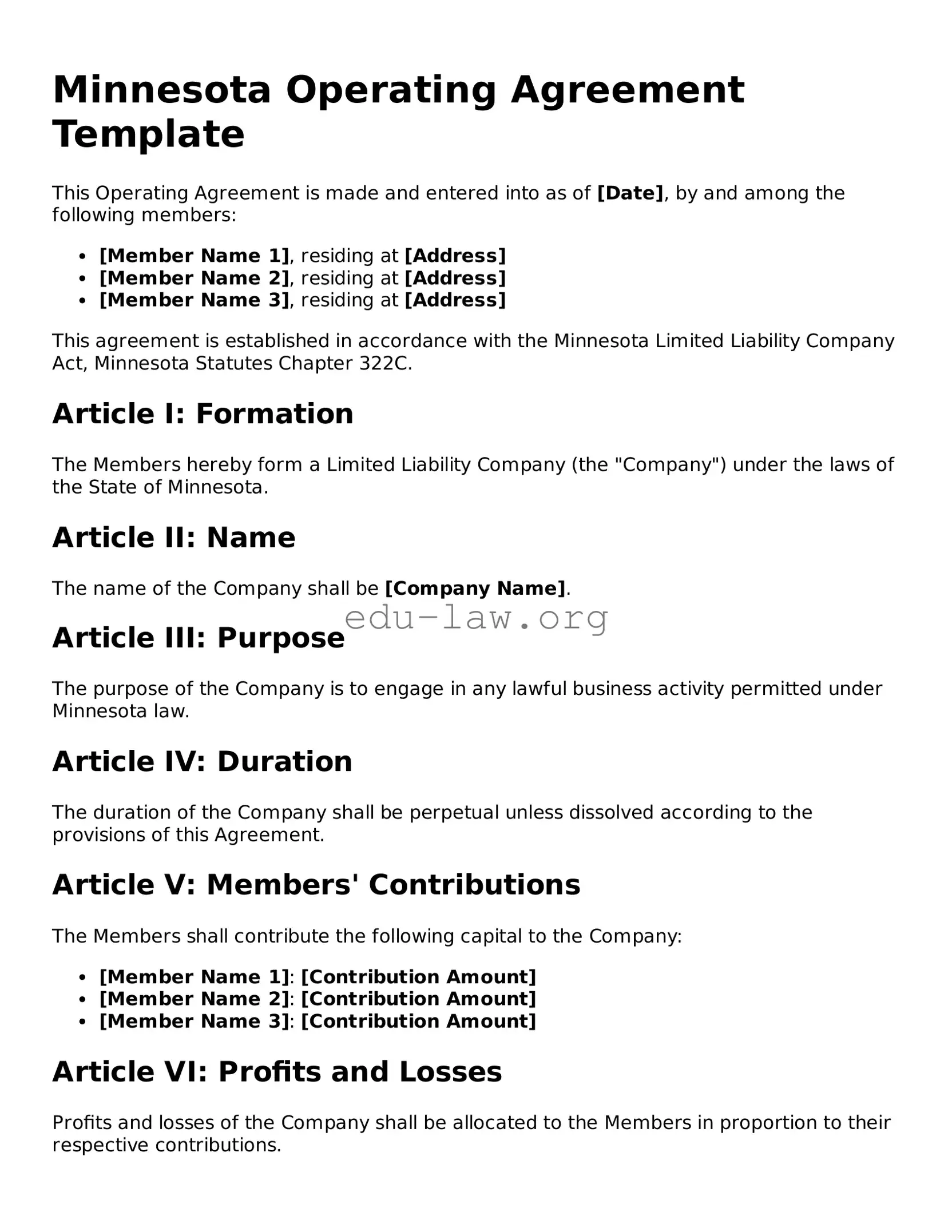
Minnesota Operating Agreement Template
This Operating Agreement is made and entered into as of [Date], by and among the following members:
This agreement is established in accordance with the Minnesota Limited Liability Company Act, Minnesota Statutes Chapter 322C.
Article I: Formation
The Members hereby form a Limited Liability Company (the "Company") under the laws of the State of Minnesota.
Article II: Name
The name of the Company shall be [Company Name].
Article III: Purpose
The purpose of the Company is to engage in any lawful business activity permitted under Minnesota law.
Article IV: Duration
The duration of the Company shall be perpetual unless dissolved according to the provisions of this Agreement.
Article V: Members' Contributions
The Members shall contribute the following capital to the Company:
Article VI: Profits and Losses
Profits and losses of the Company shall be allocated to the Members in proportion to their respective contributions.
Article VII: Management
The management of the Company shall be vested in the Members. Decisions shall be made by a majority vote unless otherwise specified in this Agreement.
Article VIII: Indemnification
The Company shall indemnify the Members against any losses, expenses, or liabilities incurred in connection with the Company, except in cases of gross negligence or willful misconduct.
Article IX: Amendments
This Agreement may be amended only by a written agreement signed by all Members.
Article X: Governing Law
This Agreement shall be governed by and construed in accordance with the laws of the State of Minnesota.
IN WITNESS WHEREOF, the Members have executed this Operating Agreement as of the date first above written.
_________________________
[Member Name 1]
_________________________
[Member Name 2]
_________________________
[Member Name 3]
| Fact Name | Description |
|---|---|
| Purpose | The Minnesota Operating Agreement outlines the management structure and operational procedures of a limited liability company (LLC). |
| Governing Law | This agreement is governed by the laws of the State of Minnesota, specifically under Chapter 322C of the Minnesota Statutes. |
| Membership Details | It includes information about members, their ownership percentages, and their rights and responsibilities. |
| Management Structure | The agreement can specify whether the LLC will be managed by its members or by appointed managers. |
| Amendment Procedures | It outlines how the operating agreement can be amended, ensuring that changes are documented properly. |
| Dispute Resolution | The document may include procedures for resolving disputes among members, promoting harmony within the LLC. |
| Importance of Customization | While templates exist, it is crucial for members to customize the agreement to reflect their unique business needs and relationships. |
Completing the Minnesota Operating Agreement form is an important step for your business. Once you have filled it out, you will be better prepared to outline the management structure and operational procedures of your company. Follow these steps carefully to ensure accuracy and compliance.
Once you have completed these steps, review the form for any errors or omissions. It’s essential that everything is accurate before submitting it to the appropriate authorities. This will help ensure that your business operates smoothly and in accordance with Minnesota laws.
What is a Minnesota Operating Agreement?
A Minnesota Operating Agreement is a legal document that outlines the management structure and operating procedures of a limited liability company (LLC) in Minnesota. It details the roles and responsibilities of the members, how profits and losses will be distributed, and the process for making decisions. This agreement is essential for establishing clear guidelines and preventing disputes among members.
Why do I need an Operating Agreement for my LLC?
An Operating Agreement is crucial for several reasons. First, it provides a clear framework for how your LLC will operate, which can help prevent misunderstandings and conflicts. Second, it is often required by banks and investors when opening a business account or securing financing. Lastly, having an Operating Agreement can protect your limited liability status by demonstrating that your LLC is a separate entity from its owners.
Can I create my own Operating Agreement?
Yes, you can create your own Operating Agreement. However, it is advisable to ensure that it complies with Minnesota laws and accurately reflects the intentions of all members. You may choose to use templates available online or seek assistance from a legal professional to ensure that your agreement meets all necessary requirements and adequately protects your interests.
What should be included in the Operating Agreement?
Your Operating Agreement should include several key elements. These include the name of the LLC, the purpose of the business, the names and addresses of the members, the management structure, the process for admitting new members, and procedures for handling disputes. Additionally, it should outline how profits and losses will be allocated and the procedures for dissolving the LLC if necessary.
How do I file the Operating Agreement in Minnesota?
Unlike some states, Minnesota does not require you to file your Operating Agreement with the state. Instead, you should keep it in a safe place with your other business records. It is important that all members have a copy and that they review it periodically to ensure it remains relevant and reflects any changes in the business or membership.
Failing to include all members' names and addresses. Each member's information is crucial for establishing ownership and responsibilities.
Not specifying the purpose of the business. Clearly defining the business's purpose helps avoid confusion and legal issues down the line.
Overlooking the voting rights of members. It’s important to outline how decisions will be made and what percentage of votes is required for various actions.
Neglecting to detail the distribution of profits and losses. This section should be clear to prevent disputes among members regarding financial matters.
Not including procedures for adding or removing members. Establishing clear guidelines can help manage changes in the business structure smoothly.
Ignoring the need for a dispute resolution process. Having a plan in place can save time and money if conflicts arise among members.
Using vague language. Clear and precise wording helps ensure that all members understand their rights and obligations.
Failing to review the agreement regularly. As the business evolves, the operating agreement should be updated to reflect new circumstances and agreements.
When forming a limited liability company (LLC) in Minnesota, the Operating Agreement is a crucial document. However, several other forms and documents are often used in conjunction with it to ensure proper organization and compliance with state laws. Here’s a brief overview of these essential documents.
Understanding these additional documents can help ensure that an LLC operates smoothly and remains compliant with legal requirements. Together with the Operating Agreement, they form a comprehensive framework for managing the business effectively.
The Minnesota Operating Agreement form shares similarities with the Limited Liability Company (LLC) Formation Documents. Both documents serve as foundational elements for establishing an LLC. The formation documents typically include the Articles of Organization, which officially register the LLC with the state. Like the Operating Agreement, these documents outline the structure and purpose of the LLC, ensuring compliance with state regulations.
Another document that parallels the Minnesota Operating Agreement is the Partnership Agreement. This agreement governs the relationship between partners in a business venture. Similar to the Operating Agreement, it details the roles, responsibilities, and profit-sharing arrangements among partners. Both documents aim to prevent disputes by clearly defining expectations and operational procedures.
The Corporate Bylaws are also comparable to the Minnesota Operating Agreement. While bylaws apply to corporations, they serve a similar function in outlining the governance of the entity. They detail the roles of directors and officers, meeting procedures, and voting rights. Like the Operating Agreement, Corporate Bylaws are essential for maintaining order and transparency within the organization.
The Shareholder Agreement is another document that bears resemblance to the Minnesota Operating Agreement. This agreement is used in corporations to outline the rights and obligations of shareholders. It addresses issues such as share transfers and decision-making processes. Both documents aim to protect the interests of stakeholders and provide a clear framework for operations.
The Joint Venture Agreement also shares characteristics with the Minnesota Operating Agreement. This document outlines the terms of collaboration between two or more parties for a specific project or business endeavor. Similar to the Operating Agreement, it defines the roles, responsibilities, and profit-sharing arrangements, ensuring all parties are aligned on their objectives and contributions.
The Non-Disclosure Agreement (NDA) can be seen as related to the Minnesota Operating Agreement in terms of protecting sensitive information. While the Operating Agreement focuses on internal governance, an NDA ensures that proprietary information shared between parties remains confidential. Both documents are crucial for maintaining trust and safeguarding interests within a business relationship.
Lastly, the Employment Agreement has similarities to the Minnesota Operating Agreement in that it outlines the terms of employment for individuals within a business. This document specifies job responsibilities, compensation, and termination conditions. Like the Operating Agreement, it aims to create clarity and prevent misunderstandings regarding roles and expectations within the organization.
When filling out the Minnesota Operating Agreement form, it’s important to approach the task thoughtfully. Here are some guidelines to help you navigate the process effectively.
By following these do's and don'ts, you can help ensure that your Minnesota Operating Agreement is complete and clear, setting a solid foundation for your business.
There are several misconceptions about the Minnesota Operating Agreement form. Understanding the truth behind these can help you navigate the process more effectively. Here are six common misconceptions:
By addressing these misconceptions, you can better understand the importance of the Minnesota Operating Agreement and how it can benefit your business.
Filling out and using the Minnesota Operating Agreement form is essential for any business operating as an LLC in Minnesota. Here are key takeaways to consider:
By following these takeaways, you can create a comprehensive Operating Agreement that protects your LLC and its members.