In Minnesota, the Notary Acknowledgement form plays a crucial role in the realm of legal documentation. This form serves as a formal declaration that a signer has willingly and knowingly executed a document, ensuring that their identity has been verified by a licensed notary public. It provides a layer of authenticity to various legal instruments, such as contracts, deeds, and affidavits. The form typically includes essential details, such as the name of the signer, the date of the acknowledgment, and the notary's signature and seal. By using this form, individuals can enhance the credibility of their documents, making them more reliable in legal proceedings. Understanding the importance and proper usage of the Notary Acknowledgement form is vital for anyone looking to navigate the complexities of legal transactions in Minnesota.
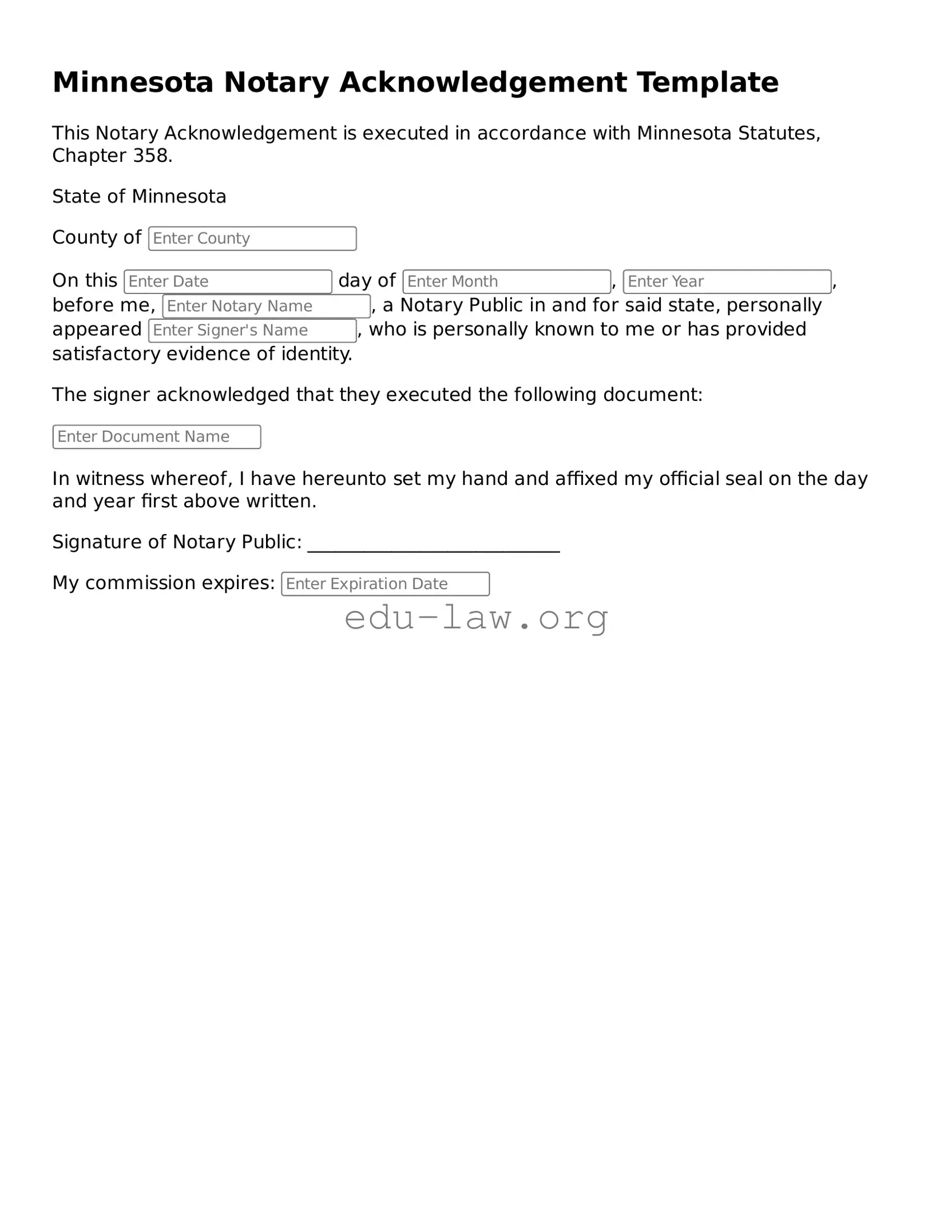
Minnesota Notary Acknowledgement Template
This Notary Acknowledgement is executed in accordance with Minnesota Statutes, Chapter 358.
State of Minnesota
County of
On this day of , , before me, , a Notary Public in and for said state, personally appeared , who is personally known to me or has provided satisfactory evidence of identity.
The signer acknowledged that they executed the following document:
In witness whereof, I have hereunto set my hand and affixed my official seal on the day and year first above written.
Signature of Notary Public: ___________________________
My commission expires:
| Fact Name | Description |
|---|---|
| Purpose | The Minnesota Notary Acknowledgment form is used to verify the identity of a signer and confirm that they willingly signed a document. |
| Governing Law | This form is governed by Minnesota Statutes, Chapter 358, which outlines notarial acts and procedures. |
| Signature Requirement | The signer must personally appear before the notary to acknowledge their signature on the document. |
| Notary's Role | The notary public is responsible for confirming the identity of the signer and witnessing the signing of the document. |
| Form Language | The acknowledgment can be written in English or another language, provided it meets the legal standards for notarization. |
| Fees | Notaries in Minnesota can charge a fee for their services, typically not exceeding $2 per signature. |
| Record Keeping | Notaries are required to keep a record of their notarial acts, including details about the signer and the document. |
| Expiration | Notarial acknowledgments do not expire, but the underlying document may have its own validity period. |
| Jurisdiction | The form must be executed within the state of Minnesota to be valid under Minnesota law. |
| Use Cases | This form is commonly used for real estate transactions, legal documents, and any situation requiring verification of a signature. |
After obtaining the Minnesota Notary Acknowledgement form, you will need to fill it out accurately to ensure that it serves its intended purpose. Follow the steps below to complete the form correctly.
Once you have completed these steps, the form is ready for submission or use as needed. Make sure to keep a copy for your records.
What is a Minnesota Notary Acknowledgement form?
The Minnesota Notary Acknowledgement form is a legal document that verifies the identity of a signer and confirms that they willingly signed a document. This form is typically used in various legal transactions, such as real estate deeds, contracts, and other important agreements. By completing this form, a notary public certifies that they have witnessed the signer’s signature, which helps prevent fraud and ensures the authenticity of the document.
Who can serve as a notary public in Minnesota?
In Minnesota, a notary public must be at least 18 years old, a resident or have a place of employment in the state, and be able to read and write in English. They must also pass a background check and complete an application process. Once approved, a notary public can perform notarial acts, including acknowledgments, oaths, and affirmations. It is important for notaries to adhere to ethical guidelines and maintain impartiality during their duties.
How do I complete a Notary Acknowledgement form?
To complete a Notary Acknowledgement form, the signer must first fill out the relevant document that requires notarization. Afterward, the signer must appear before the notary public and provide valid identification to confirm their identity. The notary will then complete the form by filling in the details, such as the date of the acknowledgment, the name of the signer, and the notary’s signature and seal. It is essential that the signer does not sign the document until they are in the presence of the notary.
Is a Notary Acknowledgement form required for all documents?
No, a Notary Acknowledgement form is not required for every document. However, it is often necessary for documents that are filed with government entities or that require legal enforceability. For example, real estate transactions typically require notarized documents to ensure their validity. It is advisable to check the specific requirements for the type of document you are working with, as different situations may have varying needs for notarization.
Incorrect Name Spelling: Always double-check the spelling of names. A small typo can lead to significant issues later.
Missing Signatures: Ensure that all required parties have signed the document. An overlooked signature can invalidate the acknowledgment.
Wrong Date: The date of the acknowledgment must match the date of signing. Be careful not to confuse the two.
Not Including the Notary's Seal: A notary's seal is essential. Without it, the acknowledgment may not be considered valid.
Failure to Identify the Signer: It's crucial to include how the signer was identified. This can be through personal knowledge or a valid ID.
Inaccurate Document Description: The form should clearly describe the document being acknowledged. Ambiguity can lead to confusion.
Not Using the Correct Form: Ensure you are using the latest version of the Minnesota Notary Acknowledgment form. Outdated forms can lead to complications.
Ignoring State-Specific Requirements: Each state may have unique requirements. Familiarize yourself with Minnesota's rules to avoid errors.
Neglecting to Keep Copies: Always keep a copy of the completed acknowledgment for your records. This can be helpful for future reference.
When preparing documents that require notarization in Minnesota, several forms and documents may accompany the Minnesota Notary Acknowledgment form. Each of these documents serves a specific purpose in legal transactions or agreements. Below is a list of commonly used forms that often work in conjunction with the Notary Acknowledgment form.
Each of these documents plays a vital role in various legal processes. Understanding their purpose can help ensure that all necessary paperwork is completed accurately and efficiently, promoting smoother transactions and interactions.
The Minnesota Notary Acknowledgment form shares similarities with the Affidavit. Both documents require a notary public to verify the identity of the signers. In an affidavit, a person makes a sworn statement under oath, which the notary then acknowledges. This process ensures that the information provided is truthful and can be relied upon in legal matters. The notary’s role is crucial in both cases, as they serve to authenticate the identity of the individuals involved.
Another document akin to the Minnesota Notary Acknowledgment is the Power of Attorney. This legal document allows one person to act on behalf of another in legal or financial matters. Like the acknowledgment form, a Power of Attorney must be signed in the presence of a notary to confirm the identities of the parties involved and to ensure that the document is executed voluntarily. The notary’s verification helps prevent fraud and ensures that the authority granted is legitimate.
The Deed also resembles the Minnesota Notary Acknowledgment form. A deed is a legal document that transfers ownership of property from one party to another. Notarization is often required to validate the deed, similar to how the acknowledgment form functions. The notary confirms that the signatures on the deed are genuine and that the signers understand the implications of the transaction, thereby safeguarding the interests of all parties involved.
Another comparable document is the Mortgage. When a borrower takes out a mortgage, they must sign several documents, including a promissory note and a mortgage deed. The notarization process is essential here as well, ensuring that the signatures are authentic and that the borrower fully comprehends the obligations they are undertaking. This protects lenders and borrowers alike by providing a clear record of the agreement.
The Last Will and Testament shares characteristics with the Minnesota Notary Acknowledgment form. While not all wills require notarization, having a will acknowledged by a notary can add an extra layer of validity. The notary’s role is to verify the identity of the testator and confirm that they are signing the will voluntarily. This can help reduce disputes among heirs and ensure that the wishes of the deceased are honored.
Similar to the acknowledgment form is the Certification of Trust. This document outlines the terms of a trust and identifies the trustee. A notary public is often involved in certifying the trust document, ensuring that the signatures are legitimate and that the trustee has the authority to act. This verification process helps maintain the integrity of the trust and protects the interests of the beneficiaries.
The Bill of Sale also exhibits similarities to the Minnesota Notary Acknowledgment form. This document is used to transfer ownership of personal property from one party to another. Notarization is often recommended to authenticate the transaction. The notary verifies the identities of both the buyer and seller, ensuring that the sale is legitimate and that both parties understand the terms of the agreement.
Another document that aligns with the Minnesota Notary Acknowledgment is the Release of Liability. This form is used to protect one party from legal claims made by another. Notarization of the release ensures that the individual signing it understands the implications of relinquishing their right to sue. The notary’s verification of the signer’s identity adds credibility to the document and helps prevent future disputes.
Lastly, the Certification of Identity is similar to the Minnesota Notary Acknowledgment form. This document is often used in various legal and financial transactions to verify a person's identity. A notary public certifies the identity of the individual signing the document, much like in the acknowledgment process. This certification helps ensure that the parties involved in a transaction are who they claim to be, thereby reducing the risk of fraud.
When filling out the Minnesota Notary Acknowledgment form, there are important steps to follow to ensure that the process goes smoothly. Here’s a guide on what to do and what to avoid.
By following these guidelines, you can help ensure that the Minnesota Notary Acknowledgment form is filled out correctly and legally binding. Always double-check your work to avoid any potential issues.
Notary acknowledgments play a crucial role in verifying the authenticity of signatures on documents. However, several misconceptions often arise regarding the Minnesota Notary Acknowledgment form. Here are six common misunderstandings:
Understanding these misconceptions can help individuals navigate the notarization process more effectively and ensure that their documents are properly executed.
Understanding the Minnesota Notary Acknowledgement form is essential for anyone involved in notarization. Here are some key takeaways to keep in mind:
By keeping these points in mind, you can navigate the Minnesota Notary Acknowledgement form with confidence and ensure that your notarization process is smooth and effective.