In the realm of business and professional relationships, protecting sensitive information is crucial. The Minnesota Non-disclosure Agreement (NDA) form serves as a vital tool for individuals and organizations looking to safeguard proprietary data. This legally binding document outlines the obligations of parties involved in sharing confidential information, ensuring that sensitive details remain secure. Key components of the form include definitions of what constitutes confidential information, the duration of the confidentiality obligation, and the consequences of breaching the agreement. By clearly delineating these aspects, the NDA fosters trust and encourages open communication between parties while minimizing the risk of information leaks. Whether you are a startup sharing trade secrets with potential investors or an employee privy to confidential company strategies, understanding the Minnesota NDA form is essential for maintaining confidentiality and protecting your interests.
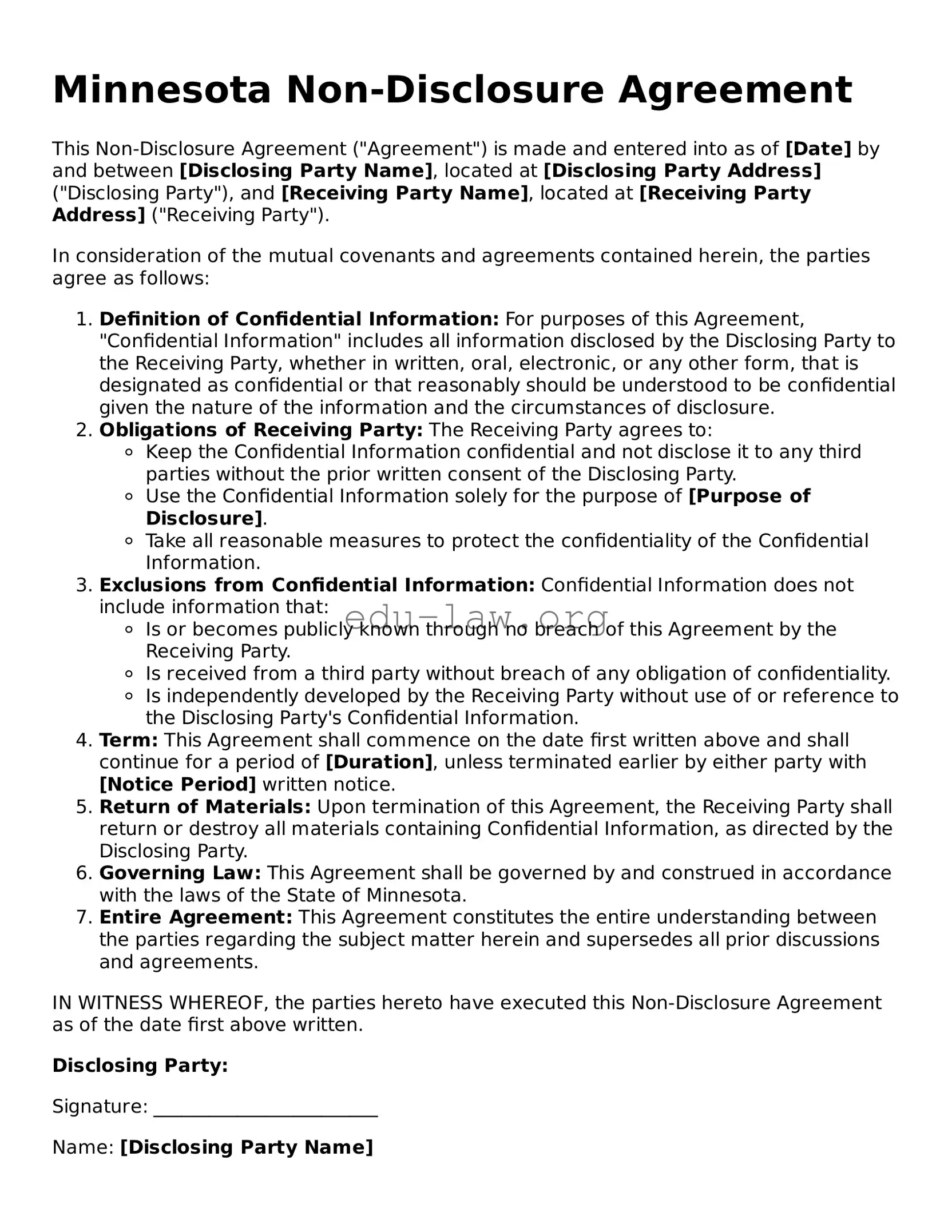
Minnesota Non-Disclosure Agreement
This Non-Disclosure Agreement ("Agreement") is made and entered into as of [Date] by and between [Disclosing Party Name], located at [Disclosing Party Address] ("Disclosing Party"), and [Receiving Party Name], located at [Receiving Party Address] ("Receiving Party").
In consideration of the mutual covenants and agreements contained herein, the parties agree as follows:
IN WITNESS WHEREOF, the parties hereto have executed this Non-Disclosure Agreement as of the date first above written.
Disclosing Party:
Signature: ________________________
Name: [Disclosing Party Name]
Title: [Disclosing Party Title]
Receiving Party:
Signature: ________________________
Name: [Receiving Party Name]
Title: [Receiving Party Title]
| Fact Name | Description |
|---|---|
| Purpose | The Minnesota Non-disclosure Agreement form is used to protect confidential information shared between parties. |
| Governing Law | This agreement is governed by the laws of the State of Minnesota. |
| Parties Involved | The agreement typically involves at least two parties: the disclosing party and the receiving party. |
| Duration of Confidentiality | The duration of confidentiality can vary and should be specified within the agreement. |
After obtaining the Minnesota Non-disclosure Agreement form, the next step involves carefully completing the document. Each section must be filled out accurately to ensure that the agreement is legally binding and clearly outlines the intentions of the parties involved.
What is a Minnesota Non-disclosure Agreement (NDA)?
A Minnesota Non-disclosure Agreement (NDA) is a legal contract designed to protect sensitive information shared between parties. This agreement ensures that confidential information, such as trade secrets, business plans, or proprietary data, remains private. By signing an NDA, the parties agree not to disclose this information to unauthorized individuals or entities. It is commonly used in business settings, especially during negotiations or collaborations where sensitive information is exchanged.
Who should use a Minnesota NDA?
Any individual or business that intends to share confidential information with another party should consider using a Minnesota NDA. This includes entrepreneurs sharing ideas with potential investors, businesses discussing partnerships, or employers revealing sensitive company information to employees or contractors. By utilizing an NDA, parties can safeguard their interests and maintain the confidentiality of crucial information.
What are the key components of a Minnesota NDA?
A typical Minnesota NDA includes several essential components. First, it defines what constitutes confidential information. Second, it outlines the obligations of the receiving party, specifying how they must handle and protect the information. Third, the agreement typically includes the duration of confidentiality, indicating how long the information must remain private. Lastly, it may specify the consequences of breaching the agreement, which can include legal action or financial penalties.
How can I enforce a Minnesota NDA?
Enforcing a Minnesota NDA involves taking legal action if a breach occurs. If a party discloses confidential information without permission, the injured party can seek remedies through the courts. This may include seeking damages for any losses incurred due to the breach. It is advisable to consult with a legal professional to understand the specific steps needed to enforce the NDA effectively and to ensure that the agreement is properly drafted to withstand legal scrutiny.
Failing to clearly define the confidential information. It's crucial to specify what information is considered confidential to avoid misunderstandings later.
Not including an expiration date. A Non-disclosure Agreement should state how long the confidentiality obligations last. Without this, the agreement may be open-ended.
Omitting the purpose of the disclosure. Clearly stating why the information is being shared helps both parties understand the context and limits of the agreement.
Using vague language. Being specific about terms and conditions reduces ambiguity. Avoid broad statements that could lead to confusion.
Neglecting to include exceptions to confidentiality. It's important to outline situations where disclosure is permissible, such as legal obligations or prior knowledge.
Forgetting to identify the parties involved. Clearly naming all parties ensures that everyone knows their rights and responsibilities under the agreement.
Not having the agreement signed by both parties. An unsigned agreement may not hold up in court. Ensure that all parties sign and date the document.
Ignoring state-specific requirements. Minnesota may have unique legal requirements for Non-disclosure Agreements. Familiarity with these can prevent future issues.
When entering into a Non-disclosure Agreement (NDA) in Minnesota, several other forms and documents may be relevant to ensure a comprehensive understanding and protection of confidential information. Below is a list of documents that are often used alongside an NDA.
Each of these documents plays a critical role in protecting sensitive information and ensuring that all parties understand their rights and responsibilities. When combined with an NDA, they help create a robust framework for confidentiality and trust in business relationships.
The Minnesota Non-disclosure Agreement (NDA) is similar to a Confidentiality Agreement, which serves the same fundamental purpose: to protect sensitive information from being disclosed to unauthorized parties. Both documents establish a legal framework that binds the parties to confidentiality, outlining what information is considered confidential and the obligations of each party regarding that information. While the terminology may differ slightly, the core intent remains the same—safeguarding proprietary information from competitors or the public.
Another document akin to the NDA is the Non-compete Agreement. This agreement restricts an individual from engaging in business activities that directly compete with their employer or another party for a specified duration and within a defined geographic area. While the NDA focuses on preventing the sharing of confidential information, the Non-compete Agreement aims to protect a business's market position and trade secrets by limiting the actions of former employees or partners after the termination of their relationship.
A third similar document is the Non-solicitation Agreement. This agreement prevents one party from soliciting the clients or employees of another party after the termination of a business relationship. Like the NDA, it seeks to protect business interests and relationships. However, while the NDA deals primarily with information confidentiality, the Non-solicitation Agreement emphasizes the protection of business relationships and the workforce.
The Mutual Non-disclosure Agreement is another closely related document. This type of NDA involves two parties exchanging confidential information, where both parties agree to protect each other's sensitive data. Unlike a unilateral NDA, where only one party discloses information, the mutual version ensures that both parties have equal obligations to maintain confidentiality. This is particularly useful in joint ventures or partnerships where both sides need to share proprietary information.
Lastly, the Proprietary Information Agreement (PIA) is similar to the NDA in that it also aims to protect confidential information. The PIA specifically focuses on proprietary information owned by a business, outlining how such information should be handled and the consequences of unauthorized disclosure. While both agreements serve to protect sensitive information, the PIA often includes more detailed definitions of what constitutes proprietary information and may also cover additional aspects like intellectual property rights.
When filling out the Minnesota Non-disclosure Agreement form, it’s important to approach the process with care. Here are some helpful tips on what you should and shouldn't do:
By following these guidelines, you can help ensure that your Non-disclosure Agreement is completed correctly and serves its intended purpose.
Misconceptions about the Minnesota Non-disclosure Agreement (NDA) can lead to misunderstandings about its purpose and effectiveness. Here are nine common misconceptions:
When dealing with sensitive information in Minnesota, a Non-disclosure Agreement (NDA) is a vital tool. Here are some key takeaways to keep in mind when filling out and using this form:
By keeping these points in mind, you can effectively use the Minnesota Non-disclosure Agreement to safeguard your sensitive information.