The Minnesota Non-compete Agreement form serves as a crucial legal instrument designed to protect the interests of businesses while balancing the rights of employees. This form typically outlines the terms under which an employee agrees not to engage in competitive activities that could harm the employer's business after the termination of their employment. Key aspects of the agreement include the duration of the non-compete clause, the geographical area it covers, and the specific activities that are restricted. Additionally, the form often addresses considerations such as the potential for financial compensation during the non-compete period and the conditions under which the agreement may be deemed enforceable. Understanding these elements is essential for both employers seeking to safeguard their proprietary information and employees who must navigate their career options post-employment. By clearly delineating the expectations and limitations placed on employees, the Minnesota Non-compete Agreement form aims to foster a fair and transparent working environment while mitigating the risks associated with competitive practices.
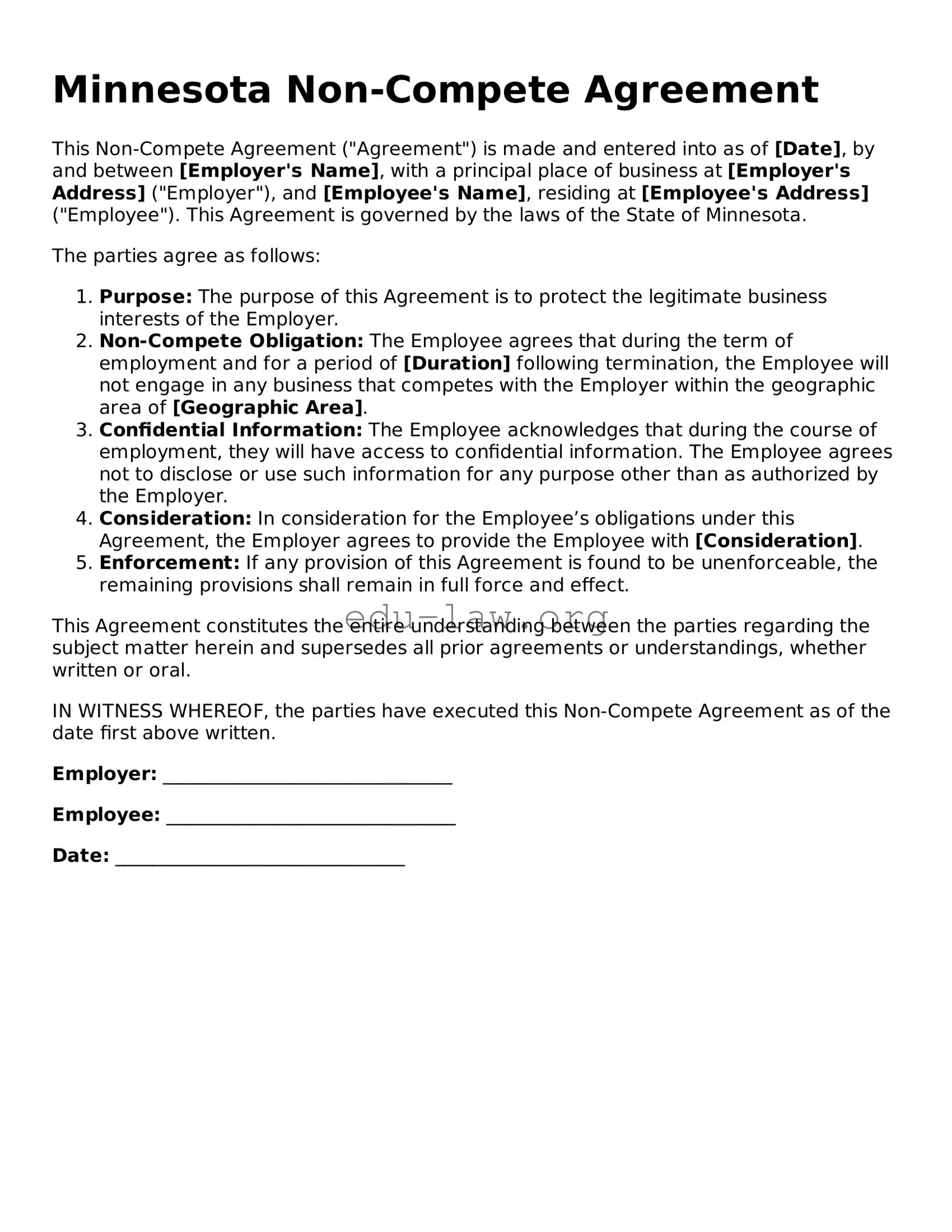
Minnesota Non-Compete Agreement
This Non-Compete Agreement ("Agreement") is made and entered into as of [Date], by and between [Employer's Name], with a principal place of business at [Employer's Address] ("Employer"), and [Employee's Name], residing at [Employee's Address] ("Employee"). This Agreement is governed by the laws of the State of Minnesota.
The parties agree as follows:
This Agreement constitutes the entire understanding between the parties regarding the subject matter herein and supersedes all prior agreements or understandings, whether written or oral.
IN WITNESS WHEREOF, the parties have executed this Non-Compete Agreement as of the date first above written.
Employer: _______________________________
Employee: _______________________________
Date: _______________________________
| Fact Name | Description |
|---|---|
| Definition | A non-compete agreement restricts an employee from working with competitors after leaving a job. |
| Governing Law | The Minnesota Non-compete Agreement is governed by Minnesota Statutes, Chapter 325D. |
| Enforceability | Non-compete agreements in Minnesota must be reasonable in scope and duration to be enforceable. |
| Duration | Typically, a duration of one to two years is considered reasonable, depending on the circumstances. |
| Geographic Scope | The agreement must specify a reasonable geographic area where the restrictions apply. |
| Consideration | For a non-compete to be valid, there must be consideration, such as a job offer or promotion. |
| Employee Rights | Employees have the right to negotiate the terms of a non-compete agreement before signing. |
| Exceptions | Non-compete agreements cannot restrict employees from working in their field if they are laid off. |
| Judicial Review | Courts in Minnesota may modify overly broad non-compete agreements to make them enforceable. |
| Legal Advice | It is advisable to seek legal counsel before signing a non-compete agreement to understand its implications. |
Completing the Minnesota Non-compete Agreement form is a straightforward process. After you fill it out, you will need to ensure that both parties involved sign the document. This will help to formalize the agreement and provide clarity regarding the terms outlined.
What is a Minnesota Non-compete Agreement?
A Minnesota Non-compete Agreement is a legal document that restricts an employee from working for a competitor or starting a competing business for a certain period after leaving their current employer. This agreement is designed to protect the employer’s business interests, including trade secrets and client relationships.
Are Non-compete Agreements enforceable in Minnesota?
Yes, non-compete agreements can be enforceable in Minnesota, but they must meet specific criteria. The agreement should be reasonable in scope, duration, and geographic area. Courts will assess whether the agreement protects legitimate business interests and does not impose an undue hardship on the employee.
What factors determine the enforceability of a Non-compete Agreement?
The enforceability of a non-compete agreement in Minnesota hinges on several factors. These include the length of time the restriction lasts, the geographic area covered, and whether the agreement is necessary to protect the employer’s legitimate business interests. Courts will also consider whether the agreement is overly broad or if it unfairly limits the employee's ability to find work.
How long can a Non-compete Agreement last in Minnesota?
While there is no specific time limit defined by law, most non-compete agreements in Minnesota typically last from six months to two years. The duration should be reasonable and should align with the nature of the business and the position held by the employee.
Can I negotiate the terms of a Non-compete Agreement?
Yes, negotiating the terms of a non-compete agreement is possible. Employees should feel empowered to discuss the duration, geographic scope, and any other terms they find concerning. Open communication can lead to a more balanced agreement that protects both the employer's interests and the employee's future opportunities.
What happens if I violate a Non-compete Agreement?
If you violate a non-compete agreement, your former employer may take legal action against you. This could include seeking an injunction to prevent you from working for a competitor or pursuing damages. The consequences can vary based on the terms of the agreement and the specifics of the situation.
Can I still work in my field if I have a Non-compete Agreement?
While a non-compete agreement may limit your options, it does not necessarily bar you from working in your field altogether. You may still pursue roles that do not directly compete with your former employer or explore opportunities in different geographic areas, depending on the agreement's terms.
What should I do if I am asked to sign a Non-compete Agreement?
Before signing a non-compete agreement, take the time to read it carefully. Consider seeking legal advice to understand your rights and obligations fully. Ensure you are comfortable with the terms and that they align with your career goals. It’s important to make an informed decision.
Is there a way to get out of a Non-compete Agreement?
Getting out of a non-compete agreement can be challenging, but it is not impossible. You may be able to negotiate a release with your former employer or challenge the agreement in court if it is deemed unreasonable. Consulting with a legal professional can provide guidance tailored to your situation.
Failing to clearly define the scope of the agreement. It is important to specify what activities are restricted.
Not including a time frame for the non-compete clause. A specific duration helps avoid ambiguity.
Overlooking the geographic area covered by the agreement. Clearly state the locations where the restrictions apply.
Using vague language can lead to misunderstandings. Be precise in wording to ensure clarity.
Neglecting to consider state laws regarding non-compete agreements. Laws can vary significantly, and compliance is essential.
Not discussing the agreement with a legal professional. Seeking advice can help avoid potential pitfalls.
Forgetting to include a severability clause. This protects the agreement if part of it is found unenforceable.
Failing to have all parties sign and date the document. Signatures are necessary for the agreement to be valid.
The Minnesota Non-compete Agreement is often accompanied by several other documents to ensure clarity and legal compliance. Each of these documents serves a specific purpose in the context of employment and contractual relationships. Below is a list of forms commonly used alongside the Non-compete Agreement.
These documents work together to create a comprehensive framework for employment relationships. By using them in conjunction with the Minnesota Non-compete Agreement, employers and employees can better understand their rights and responsibilities.
The Minnesota Non-compete Agreement is similar to a Non-disclosure Agreement (NDA). Both documents aim to protect sensitive information. While the Non-compete Agreement restricts an employee from working with competitors after leaving a job, the NDA focuses on preventing the sharing of confidential information. Companies often use both agreements to safeguard their business interests. Together, they create a comprehensive approach to protecting trade secrets and proprietary information.
Another related document is the Non-solicitation Agreement. This agreement prevents an employee from soliciting clients or employees from their former employer after leaving the company. Like the Non-compete Agreement, it seeks to protect the business's relationships and workforce. However, it does not restrict the employee from working in their field; instead, it focuses on maintaining the integrity of the company's connections.
The Confidentiality Agreement is also similar in purpose. This document requires parties to keep specific information private. While the Non-compete Agreement restricts future employment opportunities, the Confidentiality Agreement focuses solely on the handling of sensitive information during and after employment. Both documents emphasize the importance of trust and confidentiality in business relationships.
A Partnership Agreement shares some similarities as well. This document outlines the terms of a business partnership, including roles, responsibilities, and profit-sharing. While it does not specifically address competition, it can include clauses that restrict partners from competing against the business. Like the Non-compete Agreement, it aims to protect the interests of the business and its stakeholders.
The Employment Agreement is another document that often includes non-compete clauses. This agreement outlines the terms of employment, including job responsibilities, compensation, and any restrictions on future employment. The Non-compete Agreement can be a part of this broader document, ensuring that employees understand their obligations regarding competition after leaving the company.
Finally, the Release of Claims Agreement is relevant in this context. This document typically releases a company from any future claims an employee might have after leaving. While it primarily focuses on legal protections, it can also include non-compete provisions. Both documents are designed to protect the company’s interests while providing clarity to the departing employee about their obligations.
When filling out the Minnesota Non-compete Agreement form, it is essential to approach the task with care. Here are ten important considerations to keep in mind:
Non-compete agreements can be confusing, and several misconceptions often arise regarding their use in Minnesota. Understanding these misconceptions can help individuals and businesses navigate the complexities of these agreements more effectively.
Understanding these misconceptions can help individuals make informed decisions regarding non-compete agreements in Minnesota.
When filling out and using the Minnesota Non-compete Agreement form, keep these key takeaways in mind:
These points will help ensure that your use of the Minnesota Non-compete Agreement form is effective and compliant with the law.