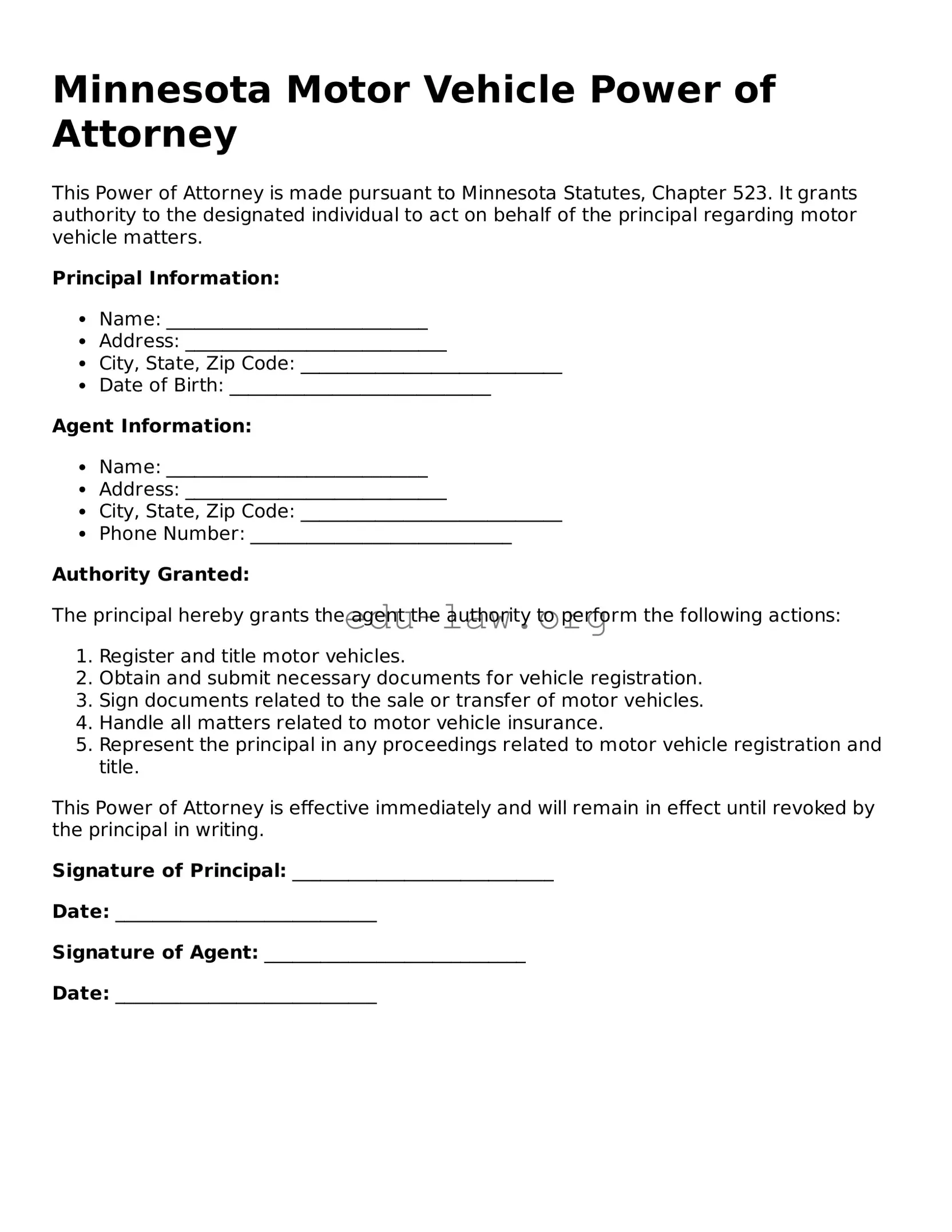
The Minnesota Motor Vehicle Power of Attorney form serves as a crucial legal document that allows an individual to designate another person to act on their behalf in matters related to motor vehicles. This form is particularly useful when the vehicle owner cannot be present to handle transactions, such as transferring ownership, registering a vehicle, or obtaining titles. By granting this authority, the vehicle owner can ensure that their interests are represented without needing to be physically present. The designated agent can carry out various tasks, including signing documents and making decisions related to the vehicle. It’s important for both the vehicle owner and the appointed agent to understand the responsibilities and limitations outlined in the form. Additionally, this document must be filled out accurately and may need to be notarized to ensure its validity. Understanding how to properly complete and utilize this form can simplify the process of managing vehicle-related matters, making it a valuable tool for anyone navigating the complexities of vehicle ownership in Minnesota.
Minnesota Motor Vehicle Power of Attorney
This Power of Attorney is made pursuant to Minnesota Statutes, Chapter 523. It grants authority to the designated individual to act on behalf of the principal regarding motor vehicle matters.
Principal Information:
Agent Information:
Authority Granted:
The principal hereby grants the agent the authority to perform the following actions:
This Power of Attorney is effective immediately and will remain in effect until revoked by the principal in writing.
Signature of Principal: ____________________________
Date: ____________________________
Signature of Agent: ____________________________
Date: ____________________________
| Fact Name | Description |
|---|---|
| Purpose | The Minnesota Motor Vehicle Power of Attorney form allows an individual to authorize another person to act on their behalf regarding motor vehicle transactions. |
| Governing Law | This form is governed by Minnesota Statutes, Chapter 523, which outlines the regulations for powers of attorney in the state. |
| Principal | The person granting authority is referred to as the "principal." They must be at least 18 years old and legally competent. |
| Agent | The individual receiving authority is called the "agent." This person must also be at least 18 years old. |
| Scope of Authority | The form can be used for various motor vehicle-related tasks, such as transferring title, registering a vehicle, or obtaining a duplicate title. |
| Duration | The power of attorney remains effective until revoked by the principal or until the principal's death. |
| Signature Requirement | The principal must sign the form, and it is recommended to have the signature notarized for added legal validity. |
| Revocation | The principal can revoke the power of attorney at any time by providing written notice to the agent and any relevant parties. |
Filling out the Minnesota Motor Vehicle Power of Attorney form is a straightforward process. This form allows one person to authorize another to handle specific motor vehicle transactions on their behalf. After completing the form, it will need to be submitted to the appropriate authorities for processing.
What is the Minnesota Motor Vehicle Power of Attorney form?
The Minnesota Motor Vehicle Power of Attorney form allows an individual to designate another person to act on their behalf regarding motor vehicle transactions. This can include signing documents, transferring titles, or handling registrations. It is particularly useful when the vehicle owner cannot be present for these actions.
Who can be appointed as an agent in this form?
Any adult can be appointed as an agent in the Minnesota Motor Vehicle Power of Attorney form. This can include family members, friends, or professionals such as attorneys or car dealers. The key requirement is that the appointed person must be trustworthy and capable of handling the responsibilities assigned to them.
What transactions can the agent perform?
The agent can perform various transactions related to motor vehicles. This includes signing title transfers, applying for or renewing vehicle registrations, and handling any necessary paperwork for the sale or purchase of a vehicle. The scope of authority can be tailored to meet the specific needs of the vehicle owner.
Do I need to have the form notarized?
Yes, the Minnesota Motor Vehicle Power of Attorney form must be notarized to be valid. This ensures that the identity of the person signing the document is verified and that they are acting voluntarily. Notarization adds an extra layer of security and legitimacy to the form.
How long is the Power of Attorney valid?
The validity of the Power of Attorney can vary based on the specific terms outlined in the document. Generally, it remains in effect until the vehicle owner revokes it, the agent completes the assigned tasks, or the vehicle owner passes away. It is advisable to specify an expiration date if the authority is intended to be temporary.
Can I revoke the Power of Attorney once it is signed?
Yes, you can revoke the Power of Attorney at any time as long as you are mentally competent. To do this, you should provide a written notice of revocation to the agent and any relevant parties, such as the Department of Motor Vehicles. This ensures that all parties are aware that the agent no longer has authority to act on your behalf.
Is there a fee associated with using this form?
There may be fees associated with processing motor vehicle transactions through the Department of Motor Vehicles. However, there is typically no fee specifically for completing the Power of Attorney form itself. It is always best to check with local authorities for any applicable fees related to vehicle transactions.
Where can I obtain the Minnesota Motor Vehicle Power of Attorney form?
The form can be obtained from the Minnesota Department of Public Safety website or through local DMV offices. It is important to use the most current version of the form to ensure compliance with state regulations.
Incomplete Information: One common mistake is failing to provide all necessary details. Ensure that the names, addresses, and contact information of both the principal and the agent are filled out completely.
Incorrect Signatures: It's crucial that the principal signs the form. Sometimes, people forget to sign or mistakenly think that the agent can sign on behalf of the principal, which is not acceptable.
Not Specifying the Vehicle: The form requires clear identification of the vehicle in question. Omitting the vehicle identification number (VIN) or other details can lead to confusion and invalidation of the document.
Failing to Date the Form: A date is essential. Without it, the validity of the Power of Attorney can be questioned. Always include the date when the form is completed and signed.
Ignoring Witness or Notary Requirements: Depending on the situation, the form may need to be witnessed or notarized. Failing to meet these requirements can render the document ineffective.
Not Understanding the Authority Granted: It's important to fully comprehend what powers are being granted to the agent. Some individuals may not realize the extent of the authority they are giving away, which can lead to misuse.
The Minnesota Motor Vehicle Power of Attorney form allows an individual to designate someone else to handle motor vehicle transactions on their behalf. This can include tasks like transferring ownership or registering a vehicle. Along with this form, there are several other documents that may be useful in similar contexts. Below is a list of other forms and documents often used in conjunction with the Minnesota Motor Vehicle Power of Attorney form.
These documents can help facilitate the various processes involved in vehicle ownership and transactions. Having the right forms on hand can make the experience smoother and ensure compliance with state regulations.
The Minnesota Motor Vehicle Power of Attorney form is similar to a General Power of Attorney. Both documents allow an individual to grant authority to another person to act on their behalf. While the General Power of Attorney can cover a wide range of financial and legal matters, the Motor Vehicle Power of Attorney is specifically focused on transactions related to motor vehicles. This targeted approach makes it easier for individuals to manage vehicle-related tasks without needing to handle broader legal responsibilities.
Another comparable document is the Durable Power of Attorney. This form remains effective even if the principal becomes incapacitated, ensuring that the designated agent can continue to make decisions regarding the principal's affairs. Like the Motor Vehicle Power of Attorney, it allows for specific powers to be granted, but the Durable Power of Attorney encompasses a wider array of decisions beyond just vehicle transactions.
The Limited Power of Attorney is also similar, as it allows the principal to specify particular powers granted to the agent. This document is useful when the principal only wants the agent to handle certain tasks, such as selling a vehicle or transferring ownership. The Motor Vehicle Power of Attorney serves a similar purpose but is tailored specifically for motor vehicle-related actions.
A Vehicle Title Transfer form shares similarities with the Motor Vehicle Power of Attorney in that both are used during the transfer of vehicle ownership. However, the Vehicle Title Transfer form is a formal document that records the change of ownership, while the Power of Attorney allows someone to act on behalf of the owner during this process. This distinction highlights the functional roles each document plays in vehicle transactions.
The Release of Liability form is another document that relates closely to the Motor Vehicle Power of Attorney. When a vehicle is sold, the seller may use a Release of Liability to protect themselves from future claims related to the vehicle. While the Power of Attorney enables someone to manage the sale, the Release of Liability ensures that the seller is no longer responsible for the vehicle once the transaction is complete.
The Bill of Sale is also relevant, as it documents the sale of a vehicle between parties. The Motor Vehicle Power of Attorney may be used to authorize someone to sign this document on behalf of the seller. While the Bill of Sale serves as proof of the transaction, the Power of Attorney provides the legal authority for the agent to execute the sale.
Lastly, the Affidavit of Vehicle Ownership can be compared to the Motor Vehicle Power of Attorney. This document is often used when the original title is lost or unavailable, allowing the owner to affirm their ownership of the vehicle. The Power of Attorney may be utilized to authorize someone to file this affidavit on behalf of the owner, ensuring that the necessary steps are taken to establish ownership without the original title.
When filling out the Minnesota Motor Vehicle Power of Attorney form, it is important to follow certain guidelines to ensure the process goes smoothly. Below are six things to keep in mind:
Many people have misunderstandings about the Minnesota Motor Vehicle Power of Attorney form. Clearing up these misconceptions can help individuals make informed decisions. Here are six common misconceptions:
This is not true. The form can also be used for other purposes, such as transferring titles, registering vehicles, and handling related paperwork.
While legal advice can be helpful, anyone can complete the form as long as they understand the information required and the authority they are granting.
Notarization is not always necessary. The form can be valid without a notary, but having it notarized may provide additional assurance.
The form does not have a set expiration date. It remains valid until the task is completed or revoked by the person who granted the authority.
This is incorrect. The form can be used for both personal and commercial vehicles, as long as the individual has the proper authority.
This is a misconception. The person who created the Power of Attorney can revoke or modify it at any time, as long as they are mentally competent.
Understanding these points can help you navigate the process more effectively. Always consider seeking professional guidance if you have specific questions or concerns.
Filling out and using the Minnesota Motor Vehicle Power of Attorney form can be straightforward if you keep a few key points in mind. Here are some important takeaways:
By keeping these points in mind, you can navigate the process of using the Minnesota Motor Vehicle Power of Attorney form with greater confidence and ease.