The Minnesota Medical Power of Attorney form is a crucial legal document that allows individuals to appoint someone they trust to make healthcare decisions on their behalf in case they become unable to do so. This form not only provides clarity about a person's medical preferences but also ensures that their wishes are respected during critical times. It covers essential aspects such as the designation of a healthcare agent, the scope of authority granted to that agent, and any specific instructions regarding medical treatment. By completing this form, individuals can communicate their values and preferences, whether they desire aggressive treatment or wish to prioritize comfort care. Additionally, the form allows for flexibility, enabling individuals to tailor their healthcare directives to fit their unique circumstances. Understanding the importance of this document can empower individuals to take control of their medical care and ensure their voices are heard, even when they cannot speak for themselves.
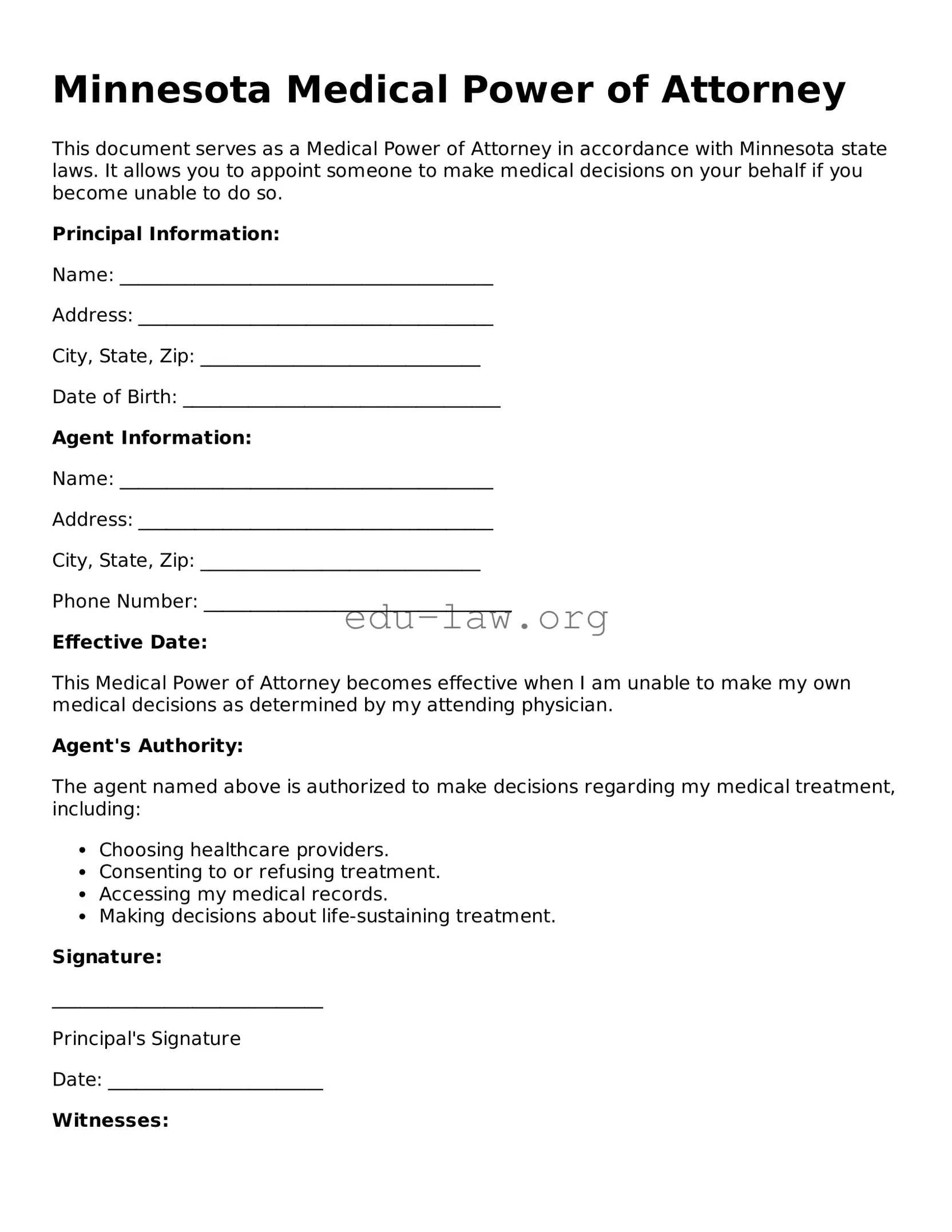
Minnesota Medical Power of Attorney
This document serves as a Medical Power of Attorney in accordance with Minnesota state laws. It allows you to appoint someone to make medical decisions on your behalf if you become unable to do so.
Principal Information:
Name: ________________________________________
Address: ______________________________________
City, State, Zip: ______________________________
Date of Birth: __________________________________
Agent Information:
Name: ________________________________________
Address: ______________________________________
City, State, Zip: ______________________________
Phone Number: _________________________________
Effective Date:
This Medical Power of Attorney becomes effective when I am unable to make my own medical decisions as determined by my attending physician.
Agent's Authority:
The agent named above is authorized to make decisions regarding my medical treatment, including:
Signature:
_____________________________
Principal's Signature
Date: _______________________
Witnesses:
This document must be signed in the presence of two witnesses who are not related to the principal or the agent.
Notarization:
This document may also be notarized to enhance its validity.
State of Minnesota
County of ______________________________
Subscribed and sworn before me this _____ day of ____________, 20__.
_____________________________
Notary Public
| Fact Name | Details |
|---|---|
| Purpose | The Minnesota Medical Power of Attorney form allows individuals to appoint a trusted person to make medical decisions on their behalf if they become unable to do so. |
| Governing Laws | This form is governed by Minnesota Statutes, Chapter 145C, which outlines the laws regarding health care directives and powers of attorney. |
| Signature Requirements | The form must be signed by the principal in the presence of two witnesses or a notary public to ensure its validity. |
| Revocation | Individuals can revoke the Medical Power of Attorney at any time, as long as they are competent to do so. This can be done through a written notice or by creating a new power of attorney. |
Filling out the Minnesota Medical Power of Attorney form is an important step in planning for your healthcare decisions. By completing this form, you will designate someone you trust to make medical decisions on your behalf if you are unable to do so. Below are the steps to guide you through the process of filling out the form.
What is a Minnesota Medical Power of Attorney?
A Minnesota Medical Power of Attorney is a legal document that allows an individual to designate someone else to make healthcare decisions on their behalf if they become unable to do so. This ensures that your medical preferences are respected even when you cannot communicate them yourself.
Who can be appointed as an agent in a Medical Power of Attorney?
In Minnesota, you can appoint any competent adult as your agent. This may include a family member, friend, or even a trusted advisor. It is important to choose someone who understands your values and wishes regarding medical treatment.
What types of decisions can my agent make?
Your agent can make a wide range of healthcare decisions, including choices about medical treatments, surgeries, and end-of-life care. They can also communicate with healthcare providers on your behalf and access your medical records to make informed decisions.
Do I need a lawyer to create a Medical Power of Attorney in Minnesota?
No, you do not need a lawyer to create a Medical Power of Attorney in Minnesota. However, consulting with a legal professional can help ensure that the document is completed correctly and reflects your wishes accurately.
How do I create a Medical Power of Attorney?
To create a Medical Power of Attorney, you must complete a form that outlines your wishes and the person you are appointing as your agent. After filling out the form, you must sign it in the presence of a notary public or two witnesses, who must also sign the document. This step is crucial for the document to be legally binding.
Can I revoke my Medical Power of Attorney?
Yes, you can revoke your Medical Power of Attorney at any time as long as you are still competent. To do this, you should notify your agent and any healthcare providers of your decision. It is also advisable to create a new document if you wish to appoint a different agent.
What if I do not have a Medical Power of Attorney?
If you do not have a Medical Power of Attorney and become incapacitated, medical decisions may be made by family members or guardians. This can lead to disagreements and may not reflect your personal wishes. Having a Medical Power of Attorney in place helps avoid this uncertainty.
Is a Medical Power of Attorney the same as a living will?
No, a Medical Power of Attorney is not the same as a living will. A living will specifically outlines your preferences for medical treatment in situations where you are terminally ill or in a persistent vegetative state. In contrast, a Medical Power of Attorney grants someone the authority to make healthcare decisions on your behalf, which may include situations not covered by a living will.
How often should I review my Medical Power of Attorney?
It is advisable to review your Medical Power of Attorney periodically, especially after significant life events such as marriage, divorce, or changes in health. Regular reviews ensure that your appointed agent and your wishes still align with your current circumstances.
Not Naming Alternate Agents: Many individuals fail to designate an alternate agent in case the primary agent is unavailable or unable to act. This can lead to confusion and delays in making medical decisions when they are most needed.
Inadequate Specificity in Instructions: Some people provide vague or unclear instructions regarding their medical preferences. It is crucial to be as specific as possible to ensure that the appointed agent understands and can carry out the individual’s wishes effectively.
Failure to Sign and Date: A common oversight is not signing and dating the form. Without a signature, the document may not be considered valid, which could result in the appointed agent being unable to make decisions when necessary.
Not Informing the Agent: It is vital to inform the chosen agent about their role and responsibilities. Failing to do so can lead to misunderstandings and may hinder their ability to act in accordance with the individual’s wishes.
When creating a Minnesota Medical Power of Attorney, it’s essential to consider other documents that can complement this important form. These documents help ensure that your healthcare wishes are respected and that your loved ones are prepared to make decisions on your behalf if necessary.
Incorporating these documents alongside your Minnesota Medical Power of Attorney can provide a comprehensive approach to your healthcare and financial decisions. By planning ahead, you can ensure that your wishes are respected and that your loved ones are prepared to act in your best interests.
The Minnesota Medical Power of Attorney form is similar to the Durable Power of Attorney for Health Care. Both documents allow individuals to appoint someone to make medical decisions on their behalf if they become unable to do so. While the Durable Power of Attorney can cover a broader range of financial and legal matters, the health care version focuses specifically on medical choices, ensuring that the appointed agent can act in accordance with the principal's wishes regarding health care treatment.
Another related document is the Living Will. This document outlines an individual's preferences for medical treatment in situations where they are terminally ill or incapacitated. Unlike the Medical Power of Attorney, which designates an agent to make decisions, the Living Will provides specific instructions about the types of medical interventions a person does or does not want, serving as a guide for both family members and healthcare providers.
The Advance Directive is also comparable. It combines elements of both the Medical Power of Attorney and the Living Will. An Advance Directive allows individuals to express their medical preferences and appoint a health care agent. This comprehensive approach ensures that both specific treatment wishes and decision-making authority are clearly communicated, providing a robust framework for future health care scenarios.
The Health Care Proxy form shares similarities with the Medical Power of Attorney. This document designates a person to make health care decisions on behalf of someone else. The key difference lies in the terminology and specific legal requirements, which can vary by state. The Health Care Proxy is commonly used in many states and serves the same fundamental purpose of ensuring that medical decisions align with the principal's values and desires.
A Do Not Resuscitate (DNR) order is another document that aligns with the Medical Power of Attorney. While the Medical Power of Attorney grants someone the authority to make decisions, a DNR specifically instructs medical personnel not to perform CPR if the individual’s heart stops or if they stop breathing. This document is particularly relevant in end-of-life situations and complements the broader decision-making authority granted in a Medical Power of Attorney.
The Physician Orders for Life-Sustaining Treatment (POLST) form is similar in that it translates a patient’s wishes regarding life-sustaining treatment into actionable medical orders. While the Medical Power of Attorney designates an agent for decision-making, the POLST form provides specific medical orders that guide healthcare providers in emergency situations, ensuring that the patient’s preferences are honored at critical moments.
The Mental Health Advance Directive is another important document that parallels the Medical Power of Attorney. This form allows individuals to specify their preferences regarding mental health treatment and appoint an agent to make decisions during a mental health crisis. Like the Medical Power of Attorney, it empowers individuals to take control of their health care, but it focuses specifically on mental health issues.
Lastly, the Consent to Treatment form is relevant as well. This document allows individuals to give permission for medical treatment or procedures. While the Medical Power of Attorney designates someone to make decisions when the individual cannot, the Consent to Treatment form is typically used when the individual is capable of making their own decisions but needs to formally authorize a specific treatment. Both documents are essential in ensuring that medical care aligns with the patient's wishes.
When filling out the Minnesota Medical Power of Attorney form, it is essential to approach the task with care. Here are some important guidelines to consider:
Understanding the Minnesota Medical Power of Attorney form is crucial for making informed healthcare decisions. However, several misconceptions can lead to confusion. Here are eight common misconceptions:
While legal advice can be helpful, individuals can complete the form themselves. It is designed for straightforward use.
Anyone, regardless of age, can face medical emergencies. Having this document ensures your preferences are known.
You can revoke or modify your Medical Power of Attorney at any time, as long as you are mentally competent.
You can choose anyone you trust, including friends or professionals, to act as your agent.
The document can take effect whenever you are unable to communicate your healthcare wishes, not just in terminal situations.
These documents serve different purposes. A living will outlines your wishes, while a Medical Power of Attorney designates someone to make decisions on your behalf.
Your agent must follow your wishes as outlined in the document. They cannot make decisions outside of your specified preferences.
In Minnesota, a Medical Power of Attorney does not need to be notarized. It only requires your signature and the signatures of two witnesses.
Being aware of these misconceptions can help ensure that individuals make well-informed decisions regarding their healthcare preferences.
When filling out and using the Minnesota Medical Power of Attorney form, it's important to understand a few key points. Here are some takeaways to keep in mind:
Understanding these points can help ensure that your medical wishes are respected when it matters most.