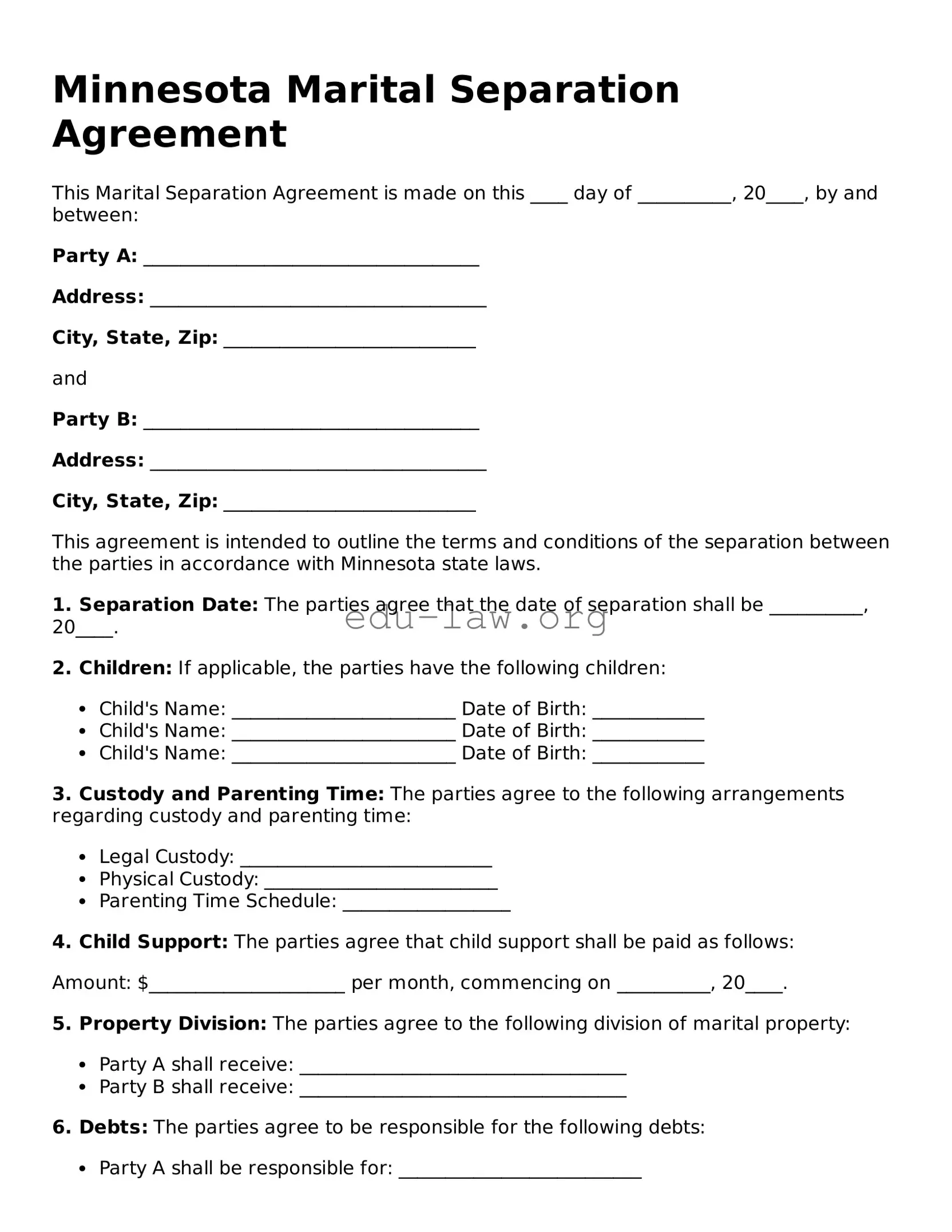
The Minnesota Marital Separation Agreement is an essential document for couples who wish to formalize their separation while addressing various important aspects of their relationship. This agreement outlines the rights and responsibilities of each spouse, ensuring clarity and reducing potential conflicts during the separation period. Key components typically included are the division of assets and debts, child custody arrangements, visitation schedules, and spousal support provisions. By detailing these elements, the agreement serves to protect the interests of both parties and any children involved. It is crucial for individuals to understand that this document is not a divorce decree but rather a step towards either reconciliation or eventual divorce. Properly executed, the Minnesota Marital Separation Agreement can provide a framework for a smoother transition during a challenging time.
Minnesota Marital Separation Agreement
This Marital Separation Agreement is made on this ____ day of __________, 20____, by and between:
Party A: ____________________________________
Address: ____________________________________
City, State, Zip: ___________________________
and
Party B: ____________________________________
Address: ____________________________________
City, State, Zip: ___________________________
This agreement is intended to outline the terms and conditions of the separation between the parties in accordance with Minnesota state laws.
1. Separation Date: The parties agree that the date of separation shall be __________, 20____.
2. Children: If applicable, the parties have the following children:
3. Custody and Parenting Time: The parties agree to the following arrangements regarding custody and parenting time:
4. Child Support: The parties agree that child support shall be paid as follows:
Amount: $_____________________ per month, commencing on __________, 20____.
5. Property Division: The parties agree to the following division of marital property:
6. Debts: The parties agree to be responsible for the following debts:
7. Spousal Support: The parties agree to the following terms regarding spousal support:
Amount: $_____________________ per month, commencing on __________, 20____.
8. Miscellaneous: Any additional terms or agreements should be specified here:
______________________________________________________________
______________________________________________________________
9. Governing Law: This agreement shall be governed by the laws of the State of Minnesota.
IN WITNESS WHEREOF, the parties have executed this Marital Separation Agreement as of the date first above written.
Party A Signature: ___________________________ Date: __________
Party B Signature: ___________________________ Date: __________
Witness Signature: ___________________________ Date: __________
| Fact Name | Description |
|---|---|
| Purpose | The Minnesota Marital Separation Agreement outlines the terms of separation between spouses. |
| Governing Law | This agreement is governed by Minnesota Statutes Chapter 518.09. |
| Voluntary Agreement | Both parties must voluntarily agree to the terms laid out in the document. |
| Property Division | The agreement addresses how property and debts will be divided between the spouses. |
| Child Custody | If applicable, the agreement can include arrangements for child custody and support. |
| Notarization | It is recommended to have the agreement notarized to ensure its validity. |
Filling out the Minnesota Marital Separation Agreement form is an important step in the process of legally separating from a spouse. This document outlines the terms of the separation and helps both parties understand their rights and responsibilities moving forward. Once completed, it will need to be signed and filed appropriately.
What is a Minnesota Marital Separation Agreement?
A Minnesota Marital Separation Agreement is a legal document that outlines the terms of a couple's separation. It helps both parties clarify their rights and responsibilities while they live apart. This agreement can cover various aspects, including property division, child custody, visitation rights, and spousal support. It serves as a roadmap for the couple during their separation, ensuring that both individuals understand their obligations and can avoid future conflicts.
How do I create a Marital Separation Agreement in Minnesota?
Creating a Marital Separation Agreement involves several steps. First, both parties should openly discuss their needs and expectations. It's essential to communicate honestly about finances, living arrangements, and any children involved. Once you have a mutual understanding, you can draft the agreement. While you can find templates online, it may be beneficial to consult with a legal professional to ensure that your agreement complies with Minnesota laws and covers all necessary aspects. After drafting, both parties should review the document, make any necessary adjustments, and sign it to make it official.
Is a Marital Separation Agreement legally binding?
Yes, a Marital Separation Agreement is legally binding in Minnesota, provided both parties voluntarily agree to its terms and sign the document. However, it's important to note that the agreement may be subject to review by a court, especially if it involves child custody or support issues. If either party fails to adhere to the terms of the agreement, the other party can seek legal recourse. Therefore, ensuring that the agreement is fair and reasonable is crucial for both parties.
Can a Marital Separation Agreement be modified?
Yes, a Marital Separation Agreement can be modified if both parties agree to the changes. Life circumstances can change, and what worked during the separation may not be suitable later on. To modify the agreement, both parties should discuss the desired changes and document them in writing. It's advisable to have the revised agreement reviewed and signed again to ensure that it remains legally binding. If the parties cannot agree on modifications, they may need to seek mediation or legal assistance to resolve the issues.
Incomplete Information: One common mistake is failing to provide all necessary details. Ensure that both parties' names, addresses, and other identifying information are filled out completely.
Not Specifying Assets and Debts: Another frequent error is not clearly listing all marital assets and debts. It is crucial to itemize these to avoid disputes later.
Ignoring Child Custody and Support: Parents often overlook the importance of detailing custody arrangements and child support obligations. Clearly outline these terms to protect both parties and the children involved.
Failing to Review the Agreement: Many individuals do not take the time to review the completed agreement. It is essential to read through the document carefully to ensure accuracy and clarity before signing.
A Minnesota Marital Separation Agreement is an important document for couples who wish to outline the terms of their separation. Several other forms and documents may accompany this agreement to ensure that all aspects of the separation are properly addressed. Below is a list of commonly used forms that can be helpful in this process.
Utilizing these documents in conjunction with the Minnesota Marital Separation Agreement can help ensure a smoother separation process. Each form plays a crucial role in addressing specific needs and concerns, making it easier for both parties to reach a fair resolution.
The Minnesota Marital Separation Agreement is similar to a Divorce Agreement, which outlines the terms of the divorce between spouses. Both documents address issues such as asset division, child custody, and support obligations. While a divorce agreement finalizes the end of a marriage, a marital separation agreement allows couples to live apart while still legally married, providing a framework for their separation without dissolving the marriage entirely.
Another related document is the Separation Agreement. This document serves a similar purpose to the marital separation agreement but can be used in various states. It details the terms under which the parties will live separately, covering issues like property division, spousal support, and child custody. The key difference is that a separation agreement may not be specific to Minnesota and can be used more broadly across different jurisdictions.
The Parenting Plan is another important document that often accompanies a marital separation agreement. It specifically addresses the parenting arrangements for minor children, including custody, visitation schedules, and decision-making authority. While the marital separation agreement may touch on these topics, the parenting plan provides a more detailed framework focused solely on the children’s welfare.
A Child Support Agreement is also similar in that it outlines the financial responsibilities of each parent regarding their children. This document specifies the amount of child support to be paid, the payment schedule, and any additional expenses that may be covered. While the marital separation agreement may include child support provisions, a separate child support agreement ensures clarity and compliance with state guidelines.
The Property Settlement Agreement is closely related as well. This document specifically addresses how marital property will be divided between the spouses. It details the distribution of assets and liabilities, ensuring that both parties understand their rights and responsibilities regarding property. The marital separation agreement may include property division terms, but a property settlement agreement focuses solely on this aspect.
In addition, a Spousal Support Agreement can be similar to a marital separation agreement. This document outlines the financial support one spouse will provide to the other during the separation. It details the amount, duration, and conditions under which spousal support will be paid. The marital separation agreement may address spousal support, but a separate agreement can provide more clarity and enforceability.
The Cohabitation Agreement also bears similarities, particularly for couples who choose to live together without marrying. This document outlines the rights and responsibilities of each partner regarding property, finances, and other aspects of their relationship. While it is not specific to separation, it shares the concept of defining terms between parties in a domestic arrangement.
A Non-Disclosure Agreement (NDA) can also be relevant in the context of marital separation. This document protects confidential information shared between spouses during their marriage. It ensures that sensitive information, such as financial details or personal matters, remains private. While not directly related to the separation itself, it can be an important consideration for couples navigating the complexities of their relationship.
Finally, a Legal Separation Agreement is similar but distinct from a marital separation agreement. This document formally recognizes the couple's separation under the law, which may have implications for health insurance, tax filing, and other legal matters. While both documents serve to outline the terms of separation, a legal separation agreement provides a more formalized status, often with court approval.
When filling out the Minnesota Marital Separation Agreement form, it is crucial to approach the process with care. Here are some important do's and don'ts to keep in mind:
When it comes to the Minnesota Marital Separation Agreement form, many misunderstandings can lead to confusion. Here’s a look at some common misconceptions and the truths behind them.
Understanding these misconceptions can help couples make informed decisions about their separation and ensure they create an agreement that meets their needs.
When filling out and using the Minnesota Marital Separation Agreement form, it's essential to understand the key components involved. Here are ten important takeaways to consider:
By keeping these takeaways in mind, individuals can navigate the process of creating a Minnesota Marital Separation Agreement more effectively.