Creating a Minnesota Living Will is an important step for anyone looking to express their wishes regarding medical treatment in the event they become unable to communicate. This document allows individuals to outline their preferences for life-sustaining measures, such as resuscitation or artificial nutrition, ensuring that their values and desires are respected. In Minnesota, the Living Will form is straightforward and user-friendly, making it accessible for all residents. It typically requires the individual’s signature and may need to be witnessed or notarized, depending on specific circumstances. By completing this form, individuals can provide clear guidance to their healthcare providers and loved ones during difficult times, helping to alleviate the burden of decision-making when it matters most. Understanding the key components of the Minnesota Living Will form is essential for anyone considering their healthcare options and wanting to ensure their voice is heard, even when they cannot speak for themselves.
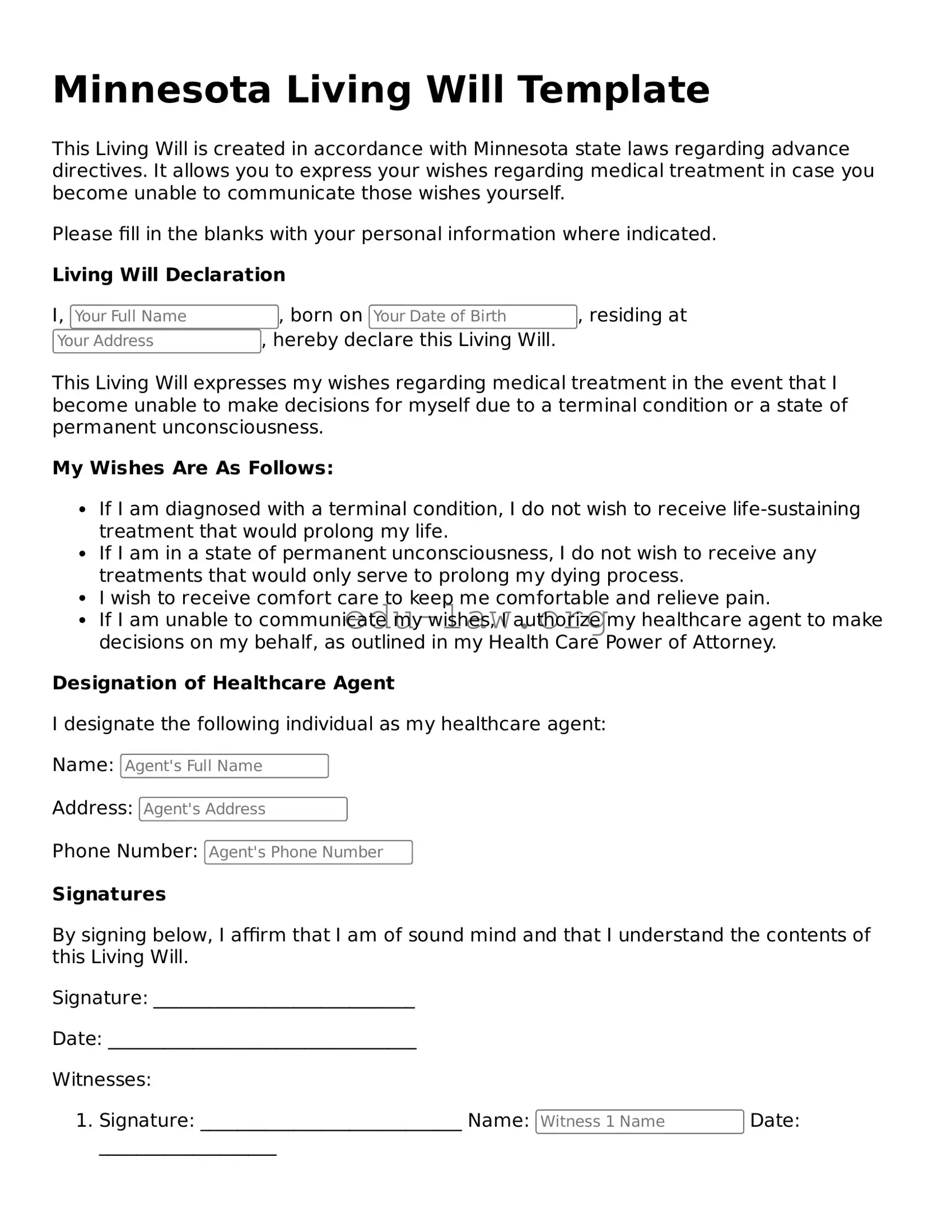
Minnesota Living Will Template
This Living Will is created in accordance with Minnesota state laws regarding advance directives. It allows you to express your wishes regarding medical treatment in case you become unable to communicate those wishes yourself.
Please fill in the blanks with your personal information where indicated.
Living Will Declaration
I, , born on , residing at , hereby declare this Living Will.
This Living Will expresses my wishes regarding medical treatment in the event that I become unable to make decisions for myself due to a terminal condition or a state of permanent unconsciousness.
My Wishes Are As Follows:
Designation of Healthcare Agent
I designate the following individual as my healthcare agent:
Name:
Address:
Phone Number:
Signatures
By signing below, I affirm that I am of sound mind and that I understand the contents of this Living Will.
Signature: ____________________________
Date: _________________________________
Witnesses:
This document should be kept in a safe place, and copies should be provided to your healthcare agent and family members.
| Fact Name | Details |
|---|---|
| Governing Law | The Minnesota Living Will is governed by Minnesota Statutes Chapter 145B. |
| Purpose | A Living Will allows individuals to express their wishes regarding medical treatment in case they become unable to communicate. |
| Eligibility | Any adult who is of sound mind can create a Living Will in Minnesota. |
| Signature Requirement | The document must be signed by the individual creating the Living Will. |
| Witness Requirement | Two witnesses must sign the Living Will, affirming that the individual is of sound mind and not under duress. |
| Revocation | A Living Will can be revoked at any time by the individual, regardless of mental state. |
| Health Care Directive | The Living Will is often part of a broader Health Care Directive, which may include appointing a health care agent. |
| Notification | It is advisable to inform family members and health care providers about the existence of the Living Will. |
| Legal Effect | Health care providers are required to follow the wishes outlined in a valid Living Will. |
Filling out the Minnesota Living Will form is an important step in making your healthcare wishes known. This document outlines your preferences for medical treatment in case you are unable to communicate your desires in the future. By completing this form, you ensure that your voice is heard even when you cannot speak for yourself.
What is a Minnesota Living Will form?
A Minnesota Living Will form is a legal document that allows individuals to outline their preferences regarding medical treatment in the event they become unable to communicate their wishes. This document specifically addresses end-of-life care and helps ensure that a person's desires about life-sustaining treatments are respected by healthcare providers and family members.
Who should consider creating a Living Will in Minnesota?
Anyone over the age of 18 who wants to have a say in their medical treatment should consider creating a Living Will. This is particularly important for individuals with serious medical conditions, those undergoing significant medical procedures, or anyone who wishes to ensure their end-of-life preferences are known and honored.
What information is typically included in a Minnesota Living Will?
A Minnesota Living Will generally includes specific instructions about the types of medical treatments a person wishes to receive or refuse. This can encompass decisions about resuscitation, mechanical ventilation, tube feeding, and pain management. It may also express preferences regarding organ donation and the appointment of a healthcare agent to make decisions on the individual's behalf.
How does a Living Will differ from a Power of Attorney for Healthcare?
While both documents are related to healthcare decisions, they serve different purposes. A Living Will focuses on specific medical treatment preferences, particularly at the end of life. In contrast, a Power of Attorney for Healthcare designates an individual to make healthcare decisions on your behalf if you are unable to do so. You can have both documents in place to ensure comprehensive coverage of your healthcare wishes.
Is a Living Will legally binding in Minnesota?
Yes, a Living Will is legally binding in Minnesota as long as it meets the state’s requirements. To be valid, the document must be signed by the individual and witnessed by two adults who are not related to the individual or beneficiaries of their estate. It is advisable to keep copies of the Living Will in accessible locations and share them with family members and healthcare providers.
Can a Living Will be changed or revoked?
Absolutely. A person can modify or revoke a Living Will at any time as long as they are competent to do so. To revoke a Living Will, you simply need to destroy the existing document and create a new one if you wish to outline different preferences. It is important to inform your healthcare providers and family members about any changes made to ensure that your latest wishes are known.
Where should I keep my Living Will?
It is advisable to keep your Living Will in a safe but accessible location. Consider storing it in a place where trusted family members can easily find it, such as a file cabinet or a safe. Additionally, providing copies to your healthcare provider, family members, and your appointed healthcare agent ensures that your wishes can be honored when needed.
Failing to understand the purpose of the Minnesota Living Will. Many individuals do not grasp that this document is designed to express their wishes regarding medical treatment in the event they become unable to communicate. Without this understanding, they may leave out crucial details.
Not specifying treatment preferences clearly. People often use vague language when stating their desires about life-sustaining treatments. For instance, saying "I want everything done" can lead to confusion. Clarity is key.
Overlooking the importance of witnesses. Minnesota law requires that the Living Will be signed in the presence of two witnesses. Failing to have the proper witnesses can render the document invalid.
Neglecting to update the document. Life circumstances change, and so do personal beliefs about medical treatment. Regularly reviewing and updating the Living Will ensures that it reflects current wishes.
Not discussing the Living Will with family or healthcare providers. Open conversations can prevent misunderstandings and ensure that loved ones and medical professionals are aware of one’s wishes.
Using outdated forms. Laws and regulations can change, so it’s essential to use the most current version of the Minnesota Living Will form. An outdated form might not comply with current legal standards.
Forgetting to sign and date the document. A Living Will must be signed and dated to be considered valid. Omitting this step can lead to complications when the document is needed.
Assuming that a Living Will is the only necessary document. While it is an important part of advance care planning, individuals should also consider creating a durable power of attorney for healthcare to ensure comprehensive coverage of their medical wishes.
When considering end-of-life decisions, individuals often create a Minnesota Living Will to express their healthcare preferences. However, this document is just one part of a larger toolkit for ensuring that your wishes are respected. Below is a list of other important forms and documents that can complement a Living Will.
Each of these documents plays a vital role in ensuring that your healthcare and personal preferences are honored. By preparing them alongside your Minnesota Living Will, you can create a comprehensive plan that reflects your values and provides clarity for your loved ones during challenging times.
The Minnesota Health Care Directive is closely related to the Living Will. This document allows individuals to outline their preferences for medical treatment in situations where they cannot communicate their wishes. Like a Living Will, it addresses end-of-life decisions but also includes the appointment of a health care agent to make decisions on behalf of the individual. This dual function makes it a comprehensive tool for health care planning.
The Durable Power of Attorney for Health Care is another important document. This form grants someone the authority to make medical decisions for you if you become incapacitated. While a Living Will focuses primarily on specific treatment preferences, the Durable Power of Attorney provides broader authority, allowing the appointed agent to make a wide range of health care choices based on your best interests.
The Advance Directive is similar to the Living Will in that it serves to express your health care preferences. It combines elements of both the Living Will and the Durable Power of Attorney, allowing you to specify your wishes regarding medical treatment and appoint someone to make decisions on your behalf. This combination can simplify the decision-making process for loved ones during difficult times.
The Do Not Resuscitate (DNR) order is a specific type of directive that can complement a Living Will. It explicitly states that you do not want to receive CPR or other life-saving measures in the event of cardiac arrest. While a Living Will may address broader treatment preferences, a DNR focuses solely on resuscitation efforts, providing clear guidance to medical personnel.
The Physician Orders for Life-Sustaining Treatment (POLST) form is another document that aligns with the Living Will. It translates your wishes regarding life-sustaining treatment into actionable medical orders. Unlike a Living Will, which is often more general, the POLST form is designed to be filled out by a physician and is intended to be honored by emergency responders and health care providers in urgent situations.
The Five Wishes document is a more comprehensive approach to end-of-life planning. It not only covers medical preferences similar to a Living Will but also addresses personal, emotional, and spiritual needs. This document allows individuals to express their desires about how they want to be treated and what matters most to them, making it a holistic alternative to traditional Living Wills.
The Medicaid Advance Directive is tailored for individuals who may rely on Medicaid for health care. This document outlines your preferences for care and can help ensure that your wishes are respected within the context of Medicaid regulations. It serves a similar purpose to a Living Will but is specifically designed to address the nuances of Medicaid coverage.
The Health Care Proxy is a document that designates someone to make health care decisions on your behalf. While it shares similarities with the Durable Power of Attorney, it is often used in conjunction with a Living Will. The Health Care Proxy allows you to appoint a trusted individual to interpret and implement your wishes when you cannot communicate them yourself.
Finally, the Mental Health Advance Directive is a specialized form that focuses on mental health treatment preferences. It allows individuals to specify their wishes regarding mental health care, including treatments and medications. This document complements a Living Will by addressing the unique needs of those with mental health conditions, ensuring that their preferences are respected in all circumstances.
When filling out the Minnesota Living Will form, it is essential to approach the process carefully. Below is a list of things to do and avoid to ensure your wishes are clearly communicated.
Things You Should Do:
Things You Shouldn't Do:
Many individuals have misunderstandings about the Minnesota Living Will form. Clarifying these misconceptions can help ensure that people make informed decisions regarding their healthcare preferences. Below are seven common misconceptions:
While both documents are related to healthcare decisions, a Living Will specifically outlines your wishes regarding end-of-life care. In contrast, a Durable Power of Attorney for Healthcare designates someone to make healthcare decisions on your behalf if you are unable to do so.
Anyone, regardless of age or health status, can benefit from having a Living Will. Accidents and sudden illnesses can happen to anyone, making it essential to express your wishes about medical treatment.
This is incorrect. You can modify or revoke your Living Will at any time as long as you are mentally competent. It is advisable to review your document periodically to ensure it still reflects your wishes.
While healthcare providers are generally expected to honor your Living Will, there may be circumstances where they cannot comply due to medical ethics or legal considerations. It is important to discuss your wishes with your healthcare team.
A Living Will cannot anticipate every possible medical situation. It is designed to address specific scenarios, primarily regarding life-sustaining treatments. For broader concerns, consider discussing your wishes with your healthcare agent.
This misconception arises from a misunderstanding of the purpose of a Living Will. It does not mean you will be denied care; rather, it ensures that you receive treatment aligned with your wishes, especially in critical situations.
While you can fill out a Living Will independently, consulting with a healthcare professional or legal expert is advisable. They can help clarify your options and ensure that your document is valid and comprehensive.
When considering a Minnesota Living Will, it is important to keep several key points in mind. This document can help ensure your healthcare wishes are respected in the event you cannot communicate them yourself.