In Minnesota, parents who choose to homeschool their children embark on a rewarding yet intricate journey that requires careful planning and adherence to state regulations. One of the first steps in this process is the completion of the Homeschool Letter of Intent form, a crucial document that signals your intention to provide home-based education. This form serves several important purposes: it notifies the local school district of your educational plans, outlines the educational approach you will take, and establishes your commitment to meet the state's homeschooling requirements. The form typically includes essential details such as the names and ages of the children being homeschooled, the educational curriculum you plan to use, and a declaration of your intent to comply with Minnesota's homeschooling laws. By submitting this letter, parents not only fulfill a legal obligation but also set the foundation for an enriching educational experience tailored to their children's unique needs. Understanding the nuances of this form can empower families to navigate the homeschooling landscape with confidence and clarity.
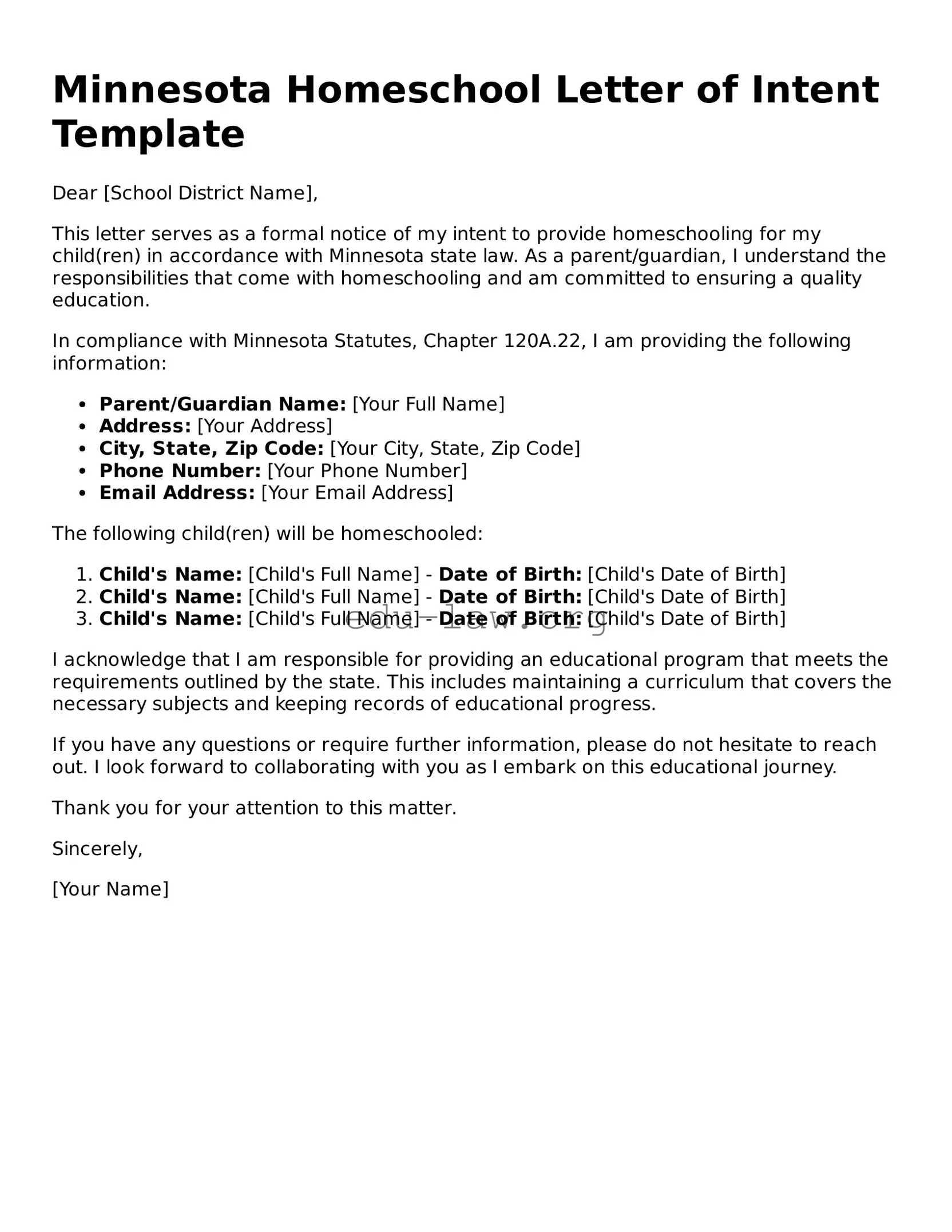
Minnesota Homeschool Letter of Intent Template
Dear [School District Name],
This letter serves as a formal notice of my intent to provide homeschooling for my child(ren) in accordance with Minnesota state law. As a parent/guardian, I understand the responsibilities that come with homeschooling and am committed to ensuring a quality education.
In compliance with Minnesota Statutes, Chapter 120A.22, I am providing the following information:
The following child(ren) will be homeschooled:
I acknowledge that I am responsible for providing an educational program that meets the requirements outlined by the state. This includes maintaining a curriculum that covers the necessary subjects and keeping records of educational progress.
If you have any questions or require further information, please do not hesitate to reach out. I look forward to collaborating with you as I embark on this educational journey.
Thank you for your attention to this matter.
Sincerely,
[Your Name]
| Fact Name | Description |
|---|---|
| Purpose | The Minnesota Homeschool Letter of Intent form is used to formally notify the state of Minnesota of a parent's intention to homeschool their child. |
| Governing Law | This form is governed by Minnesota Statutes, Section 120A.22, which outlines the requirements for homeschooling in the state. |
| Submission Timeline | Parents must submit the Letter of Intent at least 15 days before beginning their homeschool program for the school year. |
| Required Information | The form requires basic information, including the child's name, age, and the address of the homeschooling location. |
After completing the Minnesota Homeschool Letter of Intent form, you will submit it to your local school district. Make sure to keep a copy for your records. This form is an important step in establishing your homeschooling plan.
What is the Minnesota Homeschool Letter of Intent?
The Minnesota Homeschool Letter of Intent is a formal document that parents or guardians must submit to notify their school district of their intention to homeschool their child. This letter serves as the official declaration that the parent will be providing educational instruction at home, in compliance with Minnesota state laws regarding homeschooling.
When do I need to submit the Letter of Intent?
The Letter of Intent should be submitted to the school district before the start of the school year or within 15 days of beginning homeschooling if you decide to start mid-year. It is important to ensure that the letter is submitted on time to avoid any potential issues with your child's educational status.
What information is required in the Letter of Intent?
The Letter of Intent must include specific details such as the name and age of the child, the address of the homeschooling location, and a statement indicating the intent to provide homeschooling. Additionally, it may be beneficial to include the parent’s contact information and any other relevant details that could assist the school district in processing the request.
Is there a specific format for the Letter of Intent?
While there is no mandated format for the Letter of Intent, it is recommended to keep the letter clear and concise. A simple, straightforward approach is often best. Including all required information in a well-organized manner will help ensure that the school district can process your letter without unnecessary delays.
What happens after I submit the Letter of Intent?
Once the Letter of Intent is submitted, the school district will typically acknowledge receipt of the letter. Parents are encouraged to keep a copy of the submitted letter for their records. After the letter is processed, the family can begin homeschooling according to the state’s educational requirements, which may include submitting an annual assessment of the child’s progress.
Filling out the Minnesota Homeschool Letter of Intent form requires careful attention to detail. Below are common mistakes that individuals often make when completing this form:
Many people forget to provide all required personal details, such as the names and birthdates of the children being homeschooled. Omitting this information can lead to delays or rejection of the application.
Some applicants neglect to sign the form or fail to have both parents sign if applicable. This oversight can result in the form being considered invalid.
Individuals often miscalculate the submission deadline. It is essential to send the form within the specified timeframe to ensure compliance with state regulations.
Some applicants do not adhere to the required format for the letter. This can include issues such as improper spacing or not using the correct font size, which may lead to confusion during processing.
By avoiding these common mistakes, individuals can improve their chances of a smooth and successful submission of the Minnesota Homeschool Letter of Intent form.
When families decide to homeschool in Minnesota, they often need to prepare several documents to ensure compliance with state regulations. The Homeschool Letter of Intent is just one part of the process. Here are other important forms and documents that may be used in conjunction with the Letter of Intent.
These documents work together to create a comprehensive educational plan for homeschooling families in Minnesota. Staying organized and maintaining accurate records can help ensure a smooth homeschooling experience.
The Minnesota Homeschool Letter of Intent form is similar to the Notice of Intent to Homeschool form used in many states. This document serves as a formal declaration by parents or guardians that they intend to educate their children at home. Like the Minnesota form, it typically requires basic information about the student and the educational plan. Both forms aim to notify local education authorities of the parents’ choice to homeschool, ensuring compliance with state regulations.
Another comparable document is the Home Education Program Registration form. This form is often required in states that mandate registration for homeschooling families. It shares similarities with the Minnesota Homeschool Letter of Intent in that it collects information about the student, the curriculum being used, and the educational philosophy of the parents. Both documents serve to inform local school districts of a family's decision to educate their children outside of traditional public schools.
The Private School Affidavit is another document that bears resemblance to the Minnesota Homeschool Letter of Intent. In some states, parents who choose to homeschool must file this affidavit to establish their home as a private educational institution. Similar to the Letter of Intent, it requires details about the educational program and the students involved. The purpose of both documents is to maintain a record of educational choices made by families, ensuring transparency with educational authorities.
The Educational Plan form is also akin to the Minnesota Homeschool Letter of Intent. This document outlines the curriculum and educational strategies that parents intend to use for their children. Both forms require parents to articulate their educational objectives and methods, reinforcing their commitment to providing a structured learning environment. The Educational Plan form is often submitted alongside the Letter of Intent to provide a comprehensive view of the homeschooling approach.
The Curriculum Overview document serves a similar function as the Minnesota Homeschool Letter of Intent. This document provides a detailed description of the subjects and materials that will be used throughout the academic year. Like the Letter of Intent, it helps to ensure that parents are adhering to educational standards set by the state. Both documents aim to create a clear understanding of the educational framework that will be followed in a homeschooling setting.
The Annual Assessment form is another document that parallels the Minnesota Homeschool Letter of Intent. This form typically requires parents to report on the progress and performance of their homeschooled children at the end of the academic year. Both documents emphasize accountability in education, ensuring that families are meeting educational benchmarks and standards as outlined by state regulations.
Finally, the Withdrawal Notice from Public School form is similar to the Minnesota Homeschool Letter of Intent. This document is used by parents to officially withdraw their children from public school to begin homeschooling. Like the Letter of Intent, it serves as a formal notification to the school district, ensuring that all parties are aware of the change in the child’s educational status. Both forms are essential for maintaining clear communication between parents and educational authorities.
When filling out the Minnesota Homeschool Letter of Intent form, it is important to follow certain guidelines to ensure the process goes smoothly. Below is a list of things to do and avoid.
Things to Do:
Things Not to Do:
When it comes to homeschooling in Minnesota, the Letter of Intent form is a crucial document. However, several misconceptions often arise regarding its purpose and requirements. Here are seven common misunderstandings:
Many people think that you cannot homeschool in Minnesota unless you submit the Letter of Intent. In reality, while the form is necessary for notifying the state, homeschooling is legal as long as you meet the state's educational requirements.
Some believe that anyone can submit a Letter of Intent. However, only parents or legal guardians of the child can complete and file this document. This ensures that the person responsible for the child's education is officially recognized.
It's a common myth that the Letter of Intent must be filed strictly at the start of the academic year. In fact, you can submit the form at any time during the year if you decide to begin homeschooling.
While the Letter of Intent is essential, it is not the only requirement. Parents must also ensure they meet other educational standards set by the state, such as providing instruction and keeping records.
Many fear that once they submit the Letter of Intent, they will be constantly monitored by the state. This is not the case. While the state requires notification, it does not involve ongoing oversight of your homeschooling activities.
Some people think that the information on the Letter of Intent is set in stone. However, you can update or amend the form if there are changes to your homeschooling plans or your child's educational needs.
There is a misconception that only specific families, like those with religious beliefs or those dissatisfied with public schools, choose to homeschool. In reality, families from all walks of life and with various motivations opt for homeschooling.
Understanding these misconceptions can help clarify the process and empower families considering homeschooling in Minnesota. It's important to stay informed and know your rights and responsibilities as an educator.
Filling out and using the Minnesota Homeschool Letter of Intent form is an essential step for families choosing to homeschool. Here are ten key takeaways to consider:
By following these key points, families can navigate the process of homeschooling in Minnesota with greater ease and confidence.