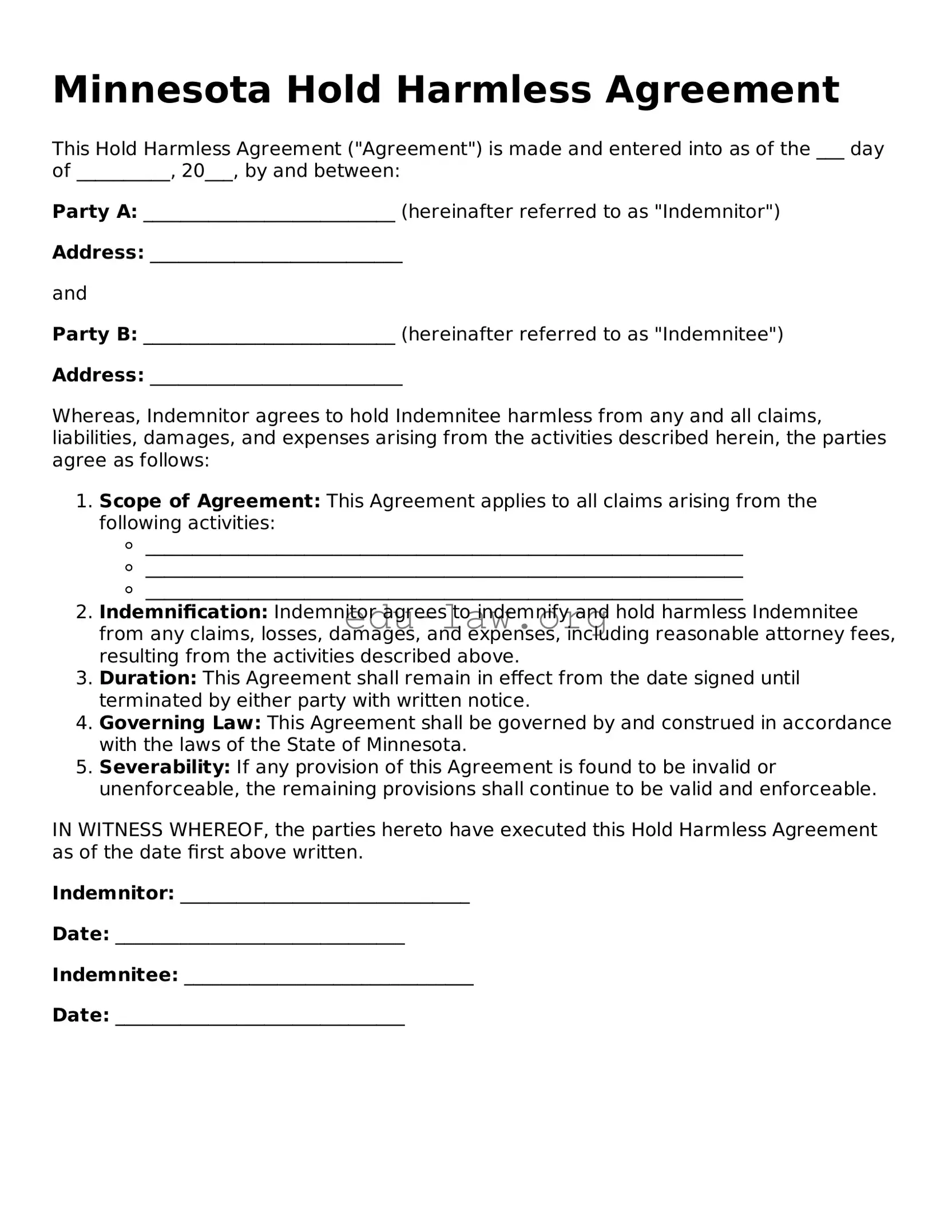
The Minnesota Hold Harmless Agreement form serves as a crucial legal document designed to protect one party from liability or claims that may arise during specific activities or events. This agreement typically outlines the responsibilities of each party involved, ensuring that one party agrees to assume the risks associated with certain actions, thereby shielding the other from potential legal repercussions. By signing this form, participants acknowledge their understanding of the inherent risks and agree not to hold the other party accountable for any injuries, damages, or losses that may occur. The agreement often includes details such as the scope of the activities covered, the duration of the agreement, and any specific terms that may apply. This form is commonly used in various contexts, including recreational activities, events, and business transactions, making it an essential tool for both individuals and organizations looking to mitigate risk and foster a clear understanding of liability. Understanding the implications of this agreement is vital for anyone involved in activities that carry potential risks, as it not only clarifies responsibilities but also promotes a culture of safety and accountability.
Minnesota Hold Harmless Agreement
This Hold Harmless Agreement ("Agreement") is made and entered into as of the ___ day of __________, 20___, by and between:
Party A: ___________________________ (hereinafter referred to as "Indemnitor")
Address: ___________________________
and
Party B: ___________________________ (hereinafter referred to as "Indemnitee")
Address: ___________________________
Whereas, Indemnitor agrees to hold Indemnitee harmless from any and all claims, liabilities, damages, and expenses arising from the activities described herein, the parties agree as follows:
IN WITNESS WHEREOF, the parties hereto have executed this Hold Harmless Agreement as of the date first above written.
Indemnitor: _______________________________
Date: _______________________________
Indemnitee: _______________________________
Date: _______________________________
| Fact Name | Description |
|---|---|
| Definition | A Hold Harmless Agreement is a legal document where one party agrees to not hold another party responsible for certain liabilities or damages. |
| Purpose | This agreement is often used to protect one party from legal claims or financial losses that may arise during an activity or event. |
| Common Usage | It is frequently used in contracts related to events, rentals, and services, especially where risks are involved. |
| Governing Law | In Minnesota, the agreement is governed by state contract laws, which outline the enforceability and requirements of such agreements. |
| Mutual vs. Unilateral | Hold Harmless Agreements can be mutual, where both parties agree to indemnify each other, or unilateral, where only one party assumes the risk. |
| Enforceability | The enforceability of the agreement depends on its clarity and whether it meets state legal standards. |
| Limitations | Some limitations may apply, especially if the agreement attempts to waive liability for gross negligence or willful misconduct. |
| Legal Advice | It is advisable to seek legal counsel when drafting or signing a Hold Harmless Agreement to ensure it meets all legal requirements. |
| Documentation | Proper documentation and signatures are essential for the agreement to be valid and enforceable in Minnesota. |
Completing the Minnesota Hold Harmless Agreement form is a straightforward process that requires careful attention to detail. After filling out the form, it will be ready for submission to the appropriate parties involved in the agreement.
What is a Minnesota Hold Harmless Agreement?
A Minnesota Hold Harmless Agreement is a legal document designed to protect one party from liability for any injuries or damages that may occur during a specific activity or event. By signing this agreement, one party agrees not to hold the other party responsible for certain risks associated with the activity. This type of agreement is commonly used in various contexts, including events, recreational activities, and construction projects.
Who typically uses a Hold Harmless Agreement in Minnesota?
Various individuals and organizations use Hold Harmless Agreements in Minnesota. These can include event organizers, property owners, contractors, and businesses. For instance, if a community center hosts a sports event, they may require participants to sign a Hold Harmless Agreement to mitigate potential liability. Similarly, contractors may ask subcontractors to sign such agreements to protect themselves from claims arising from the subcontractor's work.
What are the key components of a Hold Harmless Agreement?
A typical Hold Harmless Agreement will include several essential components. First, it identifies the parties involved, clearly stating who is releasing liability and who is being protected. Next, it outlines the specific activities covered by the agreement. Additionally, the document may include a description of the risks involved and a statement affirming that the signing party understands these risks. Finally, it often requires the signature of the party agreeing to the terms, along with the date of signing.
Is a Hold Harmless Agreement legally binding in Minnesota?
Yes, a Hold Harmless Agreement can be legally binding in Minnesota, provided it meets certain criteria. For the agreement to be enforceable, it must be clear and unambiguous. Both parties should fully understand the terms and voluntarily agree to them. Additionally, the agreement should not violate any public policy or statutory provisions. If these conditions are met, courts in Minnesota generally uphold the validity of Hold Harmless Agreements.
Are there any limitations to a Hold Harmless Agreement?
While Hold Harmless Agreements offer significant protection, they do have limitations. For example, they may not protect against gross negligence or willful misconduct. Courts may refuse to enforce agreements that attempt to waive liability for such actions. Furthermore, certain statutory protections for specific activities, like recreational activities involving minors, may limit the effectiveness of these agreements. It is essential to understand these limitations when drafting or signing a Hold Harmless Agreement.
Can a Hold Harmless Agreement be modified after it has been signed?
Yes, a Hold Harmless Agreement can be modified after it has been signed, but both parties must agree to the changes. Any modifications should be documented in writing and signed by both parties to ensure clarity and enforceability. Verbal agreements regarding modifications may not hold up in court, so it is advisable to keep all changes formal and documented.
Where can I find a template for a Minnesota Hold Harmless Agreement?
Templates for Minnesota Hold Harmless Agreements can be found through various sources. Online legal document services, local legal aid organizations, and some government websites may provide templates tailored to Minnesota laws. However, it is wise to consult with a legal professional to ensure that the template meets specific needs and complies with state regulations before use.
Failing to read the entire agreement thoroughly. Many individuals rush through the document without understanding the implications of the terms.
Not providing accurate personal information. Errors in names, addresses, or contact details can lead to complications later on.
Overlooking the specific event or activity covered by the agreement. It is essential to clearly identify what the agreement pertains to.
Neglecting to include necessary signatures. Both parties must sign the document for it to be valid.
Misunderstanding the scope of liability. Individuals often do not grasp the extent of the protection offered by the agreement.
Not consulting with a legal professional when in doubt. Seeking guidance can prevent costly mistakes.
Failing to keep a copy of the signed agreement. Retaining a record is crucial for future reference and to avoid disputes.
When engaging in various agreements, especially in Minnesota, a Hold Harmless Agreement is often accompanied by other essential documents. Each of these forms serves a specific purpose, providing clarity and protection for the parties involved. Below is a list of documents frequently used alongside the Hold Harmless Agreement, each contributing to a comprehensive understanding of the legal landscape.
Utilizing these documents in conjunction with a Hold Harmless Agreement can significantly enhance the protection of all parties involved. Each form plays a crucial role in defining responsibilities and minimizing potential disputes, ultimately fostering a safer and more transparent environment for all transactions.
The Indemnity Agreement is similar to the Minnesota Hold Harmless Agreement in that both documents aim to protect one party from legal liability. In an Indemnity Agreement, one party agrees to compensate another for any losses or damages that may arise from a specific action or event. This is often used in business transactions where one party wants to ensure they are not financially responsible for the actions of another party.
The Liability Waiver is another document that shares similarities with the Hold Harmless Agreement. A Liability Waiver releases one party from liability for any injuries or damages that may occur during an activity. Participants typically sign this document before engaging in activities like sports or recreational events, acknowledging the risks involved and agreeing not to hold the organizer responsible.
The Release of Liability form is closely related to both the Hold Harmless Agreement and the Liability Waiver. This document is used to relinquish any claims against another party for injuries or damages. It is often employed in situations where an individual voluntarily participates in an activity that carries inherent risks, ensuring they cannot later seek compensation from the organizer or facility.
The Service Agreement can also resemble the Hold Harmless Agreement in certain contexts. While primarily focused on the terms of service between two parties, it may include clauses that protect one party from liabilities arising from the services provided. This is especially common in contracts involving contractors or freelancers who may face risks while performing their duties.
The Rental Agreement often includes a Hold Harmless provision, making it similar to the Minnesota form. In this context, the landlord may require the tenant to agree to hold them harmless from any accidents or damages that occur on the rental property. This protects the landlord from potential legal claims stemming from incidents that happen during the tenant's occupancy.
The Construction Contract frequently incorporates Hold Harmless clauses to protect contractors and subcontractors from liability. In construction projects, these agreements ensure that one party will not be held responsible for damages or injuries caused by the actions of another party. This is crucial in an industry where accidents can occur frequently.
The Partnership Agreement may include Hold Harmless provisions to safeguard partners from liabilities incurred by the business. In this case, one partner may agree to indemnify the other for losses arising from specific activities or decisions made in the course of business operations. This helps clarify responsibilities and protect individual partners from financial risk.
The Employment Agreement can also contain Hold Harmless clauses, particularly in industries where employees may face risks. Employers may require employees to agree to hold them harmless from any claims related to workplace injuries or incidents. This is common in fields like construction, where the potential for accidents is higher.
The Event Contract often includes a Hold Harmless Agreement to protect event organizers from liability. When planning events, organizers may require vendors, participants, or attendees to sign a Hold Harmless Agreement. This ensures that if an injury or damage occurs during the event, the organizer will not be held responsible.
Finally, the Non-Disclosure Agreement (NDA) can sometimes feature Hold Harmless clauses. While NDAs primarily focus on protecting confidential information, they may also include provisions that protect one party from liability related to the misuse of that information. This ensures that both parties are aware of their responsibilities and the potential risks involved.
When filling out the Minnesota Hold Harmless Agreement form, it is crucial to approach the task with care. This document serves to protect one party from liability or claims arising from the actions of another. Below are some important dos and don'ts to consider.
Things You Should Do:
Things You Shouldn't Do:
The Minnesota Hold Harmless Agreement form is often misunderstood. Here are ten common misconceptions about this legal document, along with clarifications to enhance understanding.
Understanding these misconceptions can help individuals and businesses make informed decisions when utilizing Hold Harmless Agreements in Minnesota.
When considering the Minnesota Hold Harmless Agreement form, it is essential to understand its purpose and implications. Here are some key takeaways to keep in mind:
By keeping these points in mind, individuals can navigate the process of filling out and using the Minnesota Hold Harmless Agreement form with greater confidence.