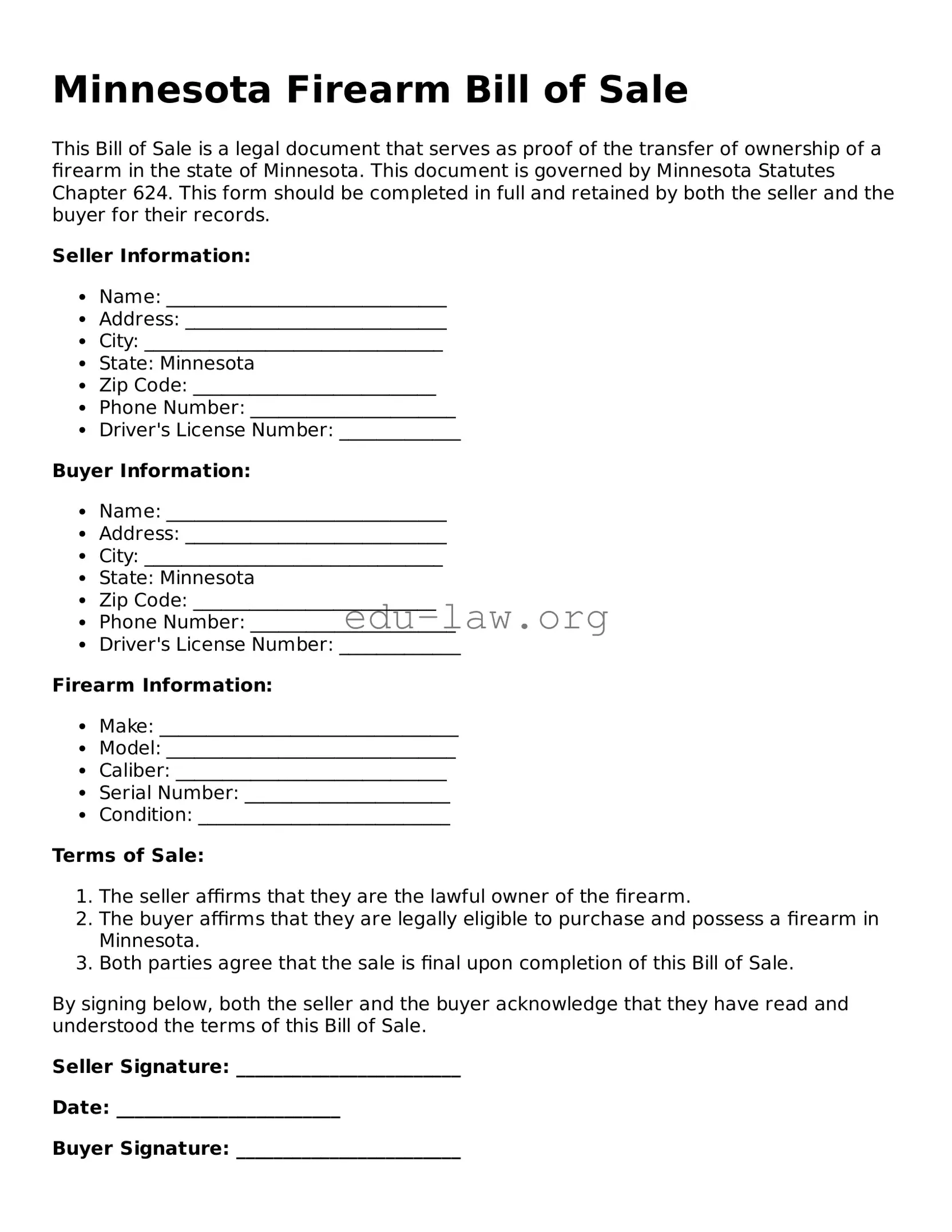
The Minnesota Firearm Bill of Sale form serves as a crucial document in the process of transferring ownership of firearms between individuals. This form not only provides a written record of the transaction but also helps ensure compliance with state laws governing firearm sales. When completing this form, both the seller and the buyer must provide essential information, including their names, addresses, and the details of the firearm being sold, such as its make, model, and serial number. Additionally, the form typically requires the date of the transaction and may include a statement confirming that both parties are legally eligible to engage in the sale. This document is particularly important in Minnesota, where regulations surrounding firearm ownership and sales are designed to promote responsible gun ownership and enhance public safety. By using the Firearm Bill of Sale form, individuals can protect themselves legally while facilitating a smooth transfer of ownership, thus ensuring that both parties have a clear understanding of the terms of the sale.
Minnesota Firearm Bill of Sale
This Bill of Sale is a legal document that serves as proof of the transfer of ownership of a firearm in the state of Minnesota. This document is governed by Minnesota Statutes Chapter 624. This form should be completed in full and retained by both the seller and the buyer for their records.
Seller Information:
Buyer Information:
Firearm Information:
Terms of Sale:
By signing below, both the seller and the buyer acknowledge that they have read and understood the terms of this Bill of Sale.
Seller Signature: ________________________
Date: ________________________
Buyer Signature: ________________________
Date: ________________________
This Bill of Sale is not a substitute for any required background checks or compliance with state and federal laws regarding firearm sales.
| Fact Name | Description |
|---|---|
| Purpose | The Minnesota Firearm Bill of Sale form serves as a legal document that records the sale or transfer of a firearm between two parties. |
| Governing Laws | This form is governed by Minnesota Statutes, Chapter 624, which outlines the laws surrounding firearms in the state. |
| Parties Involved | The form requires information from both the seller and the buyer, ensuring that both parties are identified in the transaction. |
| Identification Requirements | Both parties must provide valid identification to verify their identities and ensure compliance with state laws. |
| Firearm Details | Specific details about the firearm, including make, model, and serial number, must be included to accurately document the sale. |
| Signatures | Both the seller and the buyer must sign the form to validate the transaction and acknowledge their agreement. |
| Record Keeping | It is advisable for both parties to keep a copy of the completed form for their records, as it may be needed for future reference. |
| Notarization | While notarization is not always required, having the form notarized can add an extra layer of authenticity to the transaction. |
| Legal Protection | Using a Bill of Sale can provide legal protection for both the buyer and seller in case of disputes regarding the transaction. |
After obtaining the Minnesota Firearm Bill of Sale form, you will need to complete it accurately to ensure a smooth transaction. This form serves as a legal record of the sale and transfer of ownership of a firearm. Follow these steps to fill it out correctly.
What is a Minnesota Firearm Bill of Sale form?
The Minnesota Firearm Bill of Sale form is a legal document used to record the sale or transfer of a firearm between two parties. This form serves as proof of the transaction and includes essential details about the firearm, the seller, and the buyer. It helps ensure that both parties are aware of the terms of the sale and provides a record that can be referenced in the future if needed.
Is a Bill of Sale required for firearm transactions in Minnesota?
While Minnesota law does not mandate the use of a Bill of Sale for private firearm transactions, it is highly recommended. This document protects both the buyer and the seller by providing a clear record of the transaction. In the event of a dispute or legal issue, having a Bill of Sale can serve as vital evidence to support each party's claims.
What information should be included in the Bill of Sale?
A comprehensive Bill of Sale should include the following details: the names and addresses of both the buyer and seller, the date of the transaction, a description of the firearm (including make, model, caliber, and serial number), and the purchase price. Additionally, both parties should sign and date the document to confirm their agreement to the sale.
Can I create my own Bill of Sale, or do I need to use a specific form?
You can create your own Bill of Sale as long as it contains all the necessary information. However, using a standardized form can simplify the process and ensure that no important details are overlooked. Various online resources offer templates that can be easily customized to fit your needs.
Do I need to have the Bill of Sale notarized?
Notarization is not required for a Bill of Sale in Minnesota. However, having the document notarized can add an extra layer of authenticity and may be beneficial if any disputes arise in the future. It can also provide peace of mind for both parties involved in the transaction.
What should I do if I lose my Bill of Sale?
If you lose your Bill of Sale, it is advisable to recreate the document if possible. You can ask the other party for a copy or try to recall the details of the transaction to draft a new form. Keep in mind that having a record of the transaction is important for future reference, especially if you plan to sell or transfer the firearm again.
Are there any restrictions on who can buy a firearm in Minnesota?
Yes, there are specific restrictions in place regarding firearm purchases in Minnesota. Individuals who have been convicted of certain felonies, those with a history of domestic violence, and individuals who have been involuntarily committed for mental health reasons may be prohibited from purchasing firearms. It is essential for sellers to verify the eligibility of the buyer to ensure compliance with state laws.
What should I do if I suspect a firearm is stolen before completing the sale?
If you suspect that a firearm may be stolen, it is crucial to refrain from completing the sale. You should report your concerns to local law enforcement. They can assist in verifying the firearm's status and determining the appropriate course of action. Ensuring that the firearm is legally owned protects both you and the buyer from potential legal issues.
Incomplete Information: Many individuals fail to provide all necessary details. This can include missing the seller's or buyer's name, address, or contact information. Each section must be filled out completely to ensure the sale is valid.
Incorrect Identification: Some people do not include the correct identification number for the firearm. It's crucial to accurately list the make, model, and serial number. An error here can lead to legal complications.
Not Signing the Form: A common mistake is forgetting to sign the form. Both the seller and buyer must provide their signatures to finalize the transaction. Without signatures, the document is not legally binding.
Failure to Keep a Copy: After filling out the form, some individuals neglect to make a copy for their records. Keeping a copy is important for both parties in case any disputes arise in the future.
When completing a firearm transaction in Minnesota, several forms and documents may accompany the Firearm Bill of Sale form. Each of these documents serves a specific purpose and helps ensure that the sale is conducted legally and transparently. Below is a list of commonly used forms that may be relevant in such transactions.
Each of these documents plays a vital role in ensuring that the firearm transaction is completed smoothly and legally. By being aware of these forms, both buyers and sellers can better navigate the process and protect their rights throughout the transaction.
The Minnesota Firearm Bill of Sale form shares similarities with a general Bill of Sale document. Both serve as legal proof of a transaction between a buyer and a seller. In the case of a firearm, this document specifically outlines the details of the firearm being sold, such as its make, model, and serial number. A general Bill of Sale can pertain to various items, including vehicles or equipment, and includes the names and addresses of both parties, the date of the transaction, and the purchase price. This common structure helps protect both the buyer and seller by providing a written record of the exchange.
Another document similar to the Minnesota Firearm Bill of Sale is the Vehicle Bill of Sale. Like the firearm version, this document records the transfer of ownership from one party to another. It includes crucial information such as the vehicle identification number (VIN), make, model, and year of the vehicle, as well as the names and addresses of the buyer and seller. Both documents serve to confirm that the buyer has acquired ownership and that the seller has relinquished it, thus protecting both parties in the transaction.
The Lease Agreement is another document that bears resemblance to the Minnesota Firearm Bill of Sale. While a Lease Agreement pertains to renting property, it still involves a clear transfer of rights and responsibilities between two parties. Both documents require the identification of the parties involved and detail the terms of the agreement. In the case of a firearm sale, the terms include the specifics of the firearm, whereas a Lease Agreement outlines the rental period, payment terms, and property details. Both serve to formalize an arrangement and provide legal recourse if disputes arise.
A Purchase Agreement is also similar to the Minnesota Firearm Bill of Sale. This document outlines the terms and conditions of a sale, ensuring that both parties understand their rights and obligations. In the context of a firearm, the Purchase Agreement would specify the details of the firearm being sold, the price, and any conditions of the sale. This is akin to how a Purchase Agreement for real estate would detail the property being sold, the purchase price, and contingencies. Both documents are essential for clarifying the transaction and protecting the interests of both parties.
The Transfer of Ownership form is another document that parallels the Minnesota Firearm Bill of Sale. This form is used to officially document the change in ownership of an item, which can include firearms, vehicles, or other property. Similar to the Firearm Bill of Sale, it captures the essential details of the item being transferred, as well as the identities of the buyer and seller. This ensures that there is a clear record of who owns the item at any given time, which is crucial for legal purposes and for establishing accountability.
Lastly, the Warranty Deed can be compared to the Minnesota Firearm Bill of Sale in terms of its function in transferring ownership. A Warranty Deed is used in real estate transactions to guarantee that the seller has the legal right to sell the property and that the property is free of any liens or encumbrances. While the context is different, both documents serve to confirm the legitimacy of ownership transfer. They provide assurances to the buyer that they are receiving clear title to the item or property, whether it be a firearm or a piece of real estate.
When filling out the Minnesota Firearm Bill of Sale form, it’s important to follow certain guidelines to ensure the process goes smoothly. Here’s a list of things you should and shouldn’t do:
By following these tips, you can help ensure that your firearm sale is conducted legally and efficiently.
Understanding the Minnesota Firearm Bill of Sale form is essential for anyone involved in buying or selling firearms in the state. However, several misconceptions can lead to confusion. Here are seven common misunderstandings:
Addressing these misconceptions can help ensure that firearm transactions in Minnesota are conducted legally and responsibly.
When filling out and using the Minnesota Firearm Bill of Sale form, consider the following key takeaways:
By following these guidelines, you can ensure a smooth and legally compliant firearm transaction in Minnesota.