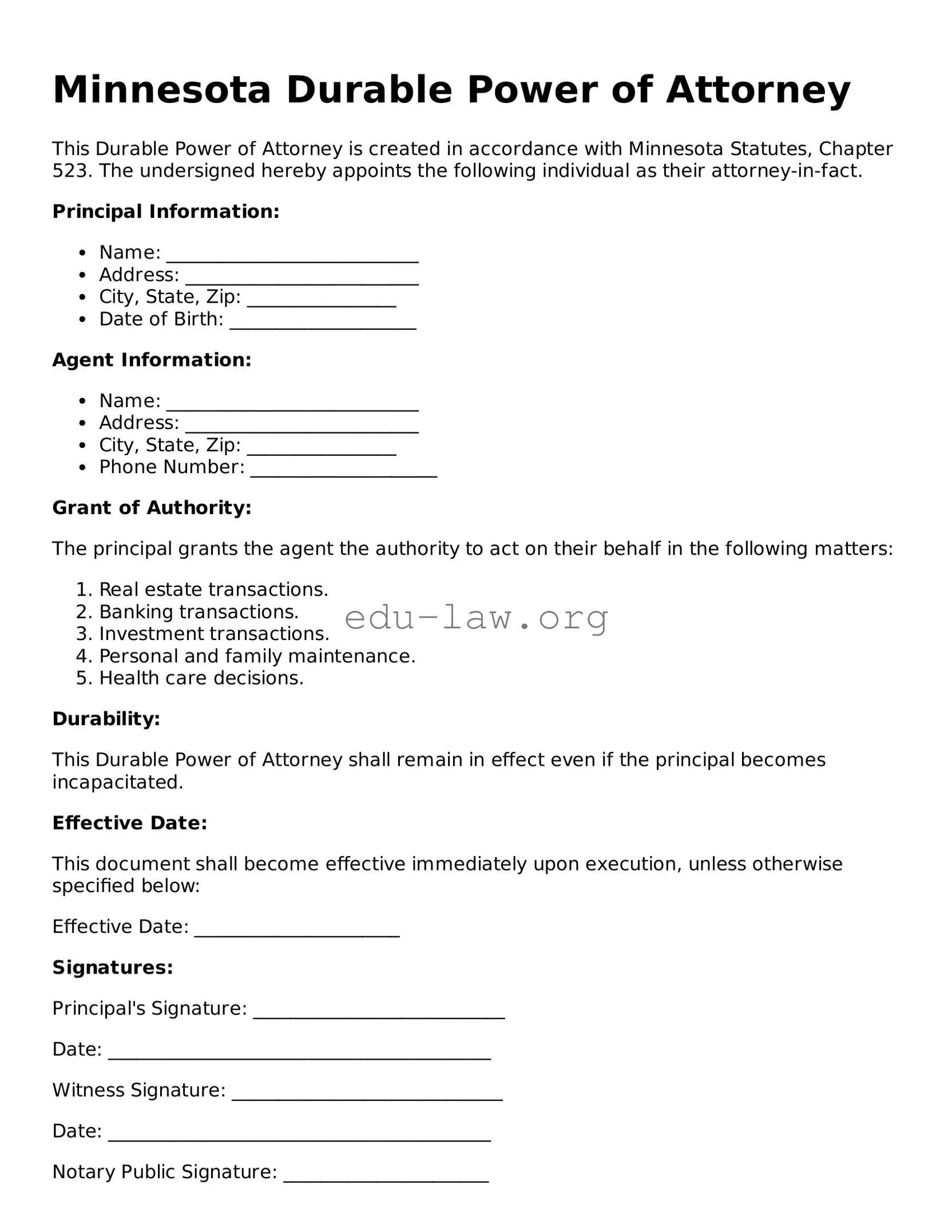
In the state of Minnesota, the Durable Power of Attorney form is a vital tool that empowers individuals to designate someone they trust to make important decisions on their behalf, especially in times of incapacity. This legal document allows you to appoint an agent who can handle financial matters, manage property, and make healthcare decisions when you are unable to do so yourself. The beauty of this form lies in its durability; unlike a standard power of attorney, it remains effective even if you become mentally incapacitated. This ensures that your wishes are honored and that your affairs continue to be managed without interruption. Additionally, the Minnesota Durable Power of Attorney includes specific guidelines on how the agent should act, ensuring they operate within the scope of your wishes. Understanding how to properly complete this form, the rights it grants, and the responsibilities it imposes can provide peace of mind, knowing that your affairs are in capable hands, regardless of what the future may hold.
Minnesota Durable Power of Attorney
This Durable Power of Attorney is created in accordance with Minnesota Statutes, Chapter 523. The undersigned hereby appoints the following individual as their attorney-in-fact.
Principal Information:
Agent Information:
Grant of Authority:
The principal grants the agent the authority to act on their behalf in the following matters:
Durability:
This Durable Power of Attorney shall remain in effect even if the principal becomes incapacitated.
Effective Date:
This document shall become effective immediately upon execution, unless otherwise specified below:
Effective Date: ______________________
Signatures:
Principal's Signature: ___________________________
Date: _________________________________________
Witness Signature: _____________________________
Date: _________________________________________
Notary Public Signature: ______________________
Date: _________________________________________
| Fact Name | Description |
|---|---|
| Definition | A Minnesota Durable Power of Attorney allows an individual to appoint someone else to manage their financial affairs, even if they become incapacitated. |
| Governing Law | The Minnesota Durable Power of Attorney is governed by Minnesota Statutes, Chapter 523.23. |
| Durability | This form remains effective even if the principal becomes incapacitated, distinguishing it from a regular power of attorney. |
| Principal's Authority | The principal can specify the scope of authority granted to the agent, which can be broad or limited. |
| Revocation | The principal can revoke the Durable Power of Attorney at any time, provided they are mentally competent to do so. |
| Agent's Responsibilities | The agent must act in the best interest of the principal and manage the principal's affairs responsibly and transparently. |
Filling out the Minnesota Durable Power of Attorney form is a straightforward process that allows you to designate someone to make decisions on your behalf when you are unable to do so. This document requires careful attention to detail to ensure that it meets legal standards and accurately reflects your wishes.
Once you have completed the form, keep a copy for your records and provide a copy to your agent. It’s also wise to inform family members about the existence of this document and where they can find it. This ensures that your wishes are known and respected when needed.
What is a Minnesota Durable Power of Attorney?
A Minnesota Durable Power of Attorney is a legal document that allows you to appoint someone, known as your agent or attorney-in-fact, to make decisions on your behalf if you become unable to do so. This document remains effective even if you become incapacitated, ensuring that your financial and legal matters can be handled without interruption. It's important to choose someone you trust, as they will have significant authority over your affairs.
How do I create a Durable Power of Attorney in Minnesota?
To create a Durable Power of Attorney in Minnesota, you need to complete a specific form that outlines your wishes. This form must be signed by you and notarized, or witnessed by two individuals who are not related to you and do not stand to benefit from your estate. After completing the form, it is advisable to share copies with your agent and any relevant financial institutions to ensure they are aware of your appointed representative.
Can I revoke or change my Durable Power of Attorney?
Yes, you can revoke or change your Durable Power of Attorney at any time, as long as you are mentally competent. To revoke the document, you should create a new revocation form and provide copies to your agent and any institutions that may have relied on the previous document. If you wish to change your agent or the terms of the authority granted, you will need to create a new Durable Power of Attorney form and follow the same signing and witnessing requirements.
What powers can I grant to my agent in a Durable Power of Attorney?
In a Durable Power of Attorney, you can grant your agent a wide range of powers, including managing your finances, paying bills, handling real estate transactions, and making investment decisions. However, you can also limit the powers granted by specifying certain actions your agent cannot take. It’s crucial to clearly outline your intentions in the document to avoid any misunderstandings in the future.
Not specifying the powers granted: Many individuals fail to clearly outline the specific powers they wish to grant to their agent. This can lead to confusion and potential disputes later on.
Inadequate agent selection: Choosing an agent who lacks the necessary skills or trustworthiness can undermine the purpose of the Durable Power of Attorney. It is essential to select someone who understands your wishes and can act in your best interest.
Failing to date the document: A common oversight is neglecting to date the form. Without a date, the validity of the document may be questioned, especially if there are multiple versions.
Not having witnesses or notarization: In Minnesota, the law requires either a witness or notarization for the Durable Power of Attorney to be valid. Skipping this step can render the document ineffective.
Leaving sections blank: Some people mistakenly leave sections of the form blank, assuming it will not affect the document's validity. Every section should be completed to avoid ambiguity.
Overlooking successor agents: Failing to name a successor agent can create complications if the primary agent is unable or unwilling to serve. It is wise to designate an alternative.
Not reviewing or updating the document: Life circumstances change, and so do relationships. Regularly reviewing and updating the Durable Power of Attorney is crucial to ensure it reflects current wishes and conditions.
A Minnesota Durable Power of Attorney is an important legal document that allows an individual to appoint someone else to make financial and legal decisions on their behalf. However, it is often used in conjunction with other documents that provide a more comprehensive approach to managing one’s affairs, especially in cases of incapacity. Below is a list of other forms and documents that are commonly associated with the Durable Power of Attorney.
Each of these documents serves a unique purpose and can work together to create a robust plan for managing one's affairs. It is essential to consider how these documents complement each other to ensure that your wishes are respected and your interests are protected.
The Minnesota Durable Power of Attorney (DPOA) form is similar to the General Power of Attorney (GPOA). Both documents allow an individual, known as the principal, to appoint another person, referred to as the agent, to make decisions on their behalf. However, the key difference lies in durability. The GPOA becomes ineffective if the principal becomes incapacitated, while the DPOA remains valid even if the principal is unable to make decisions due to illness or disability.
The Health Care Power of Attorney (HCPOA) is another document that shares similarities with the DPOA. Like the DPOA, the HCPOA allows an individual to designate someone to make decisions for them. However, the HCPOA specifically focuses on health care decisions, such as medical treatment options and end-of-life care. This document ensures that the agent can act in the best interest of the principal regarding medical matters when the principal cannot express their wishes.
The Living Will is another document that often complements the DPOA. While the DPOA allows someone to make decisions on behalf of the principal, the Living Will outlines the principal's wishes regarding medical treatment in situations where they cannot communicate their preferences. This document is particularly important for end-of-life decisions and ensures that the principal's desires are respected even if they cannot articulate them.
The Revocation of Power of Attorney is a document that serves to cancel a previously established power of attorney. It is similar to the DPOA in that it involves the authority granted to an agent, but it specifically terminates that authority. This document is essential for individuals who wish to change their agent or revoke the powers granted to an agent due to changes in circumstances or relationships.
The Guardianship document is akin to the DPOA in that both involve the appointment of an individual to make decisions for someone else. However, guardianship is typically established through a court process and is often used for individuals who are unable to care for themselves. In contrast, a DPOA is created by the principal voluntarily and does not require court intervention, making it a more flexible option for many individuals.
The Conservatorship document is similar to the DPOA in that it involves appointing someone to manage the affairs of another person. However, conservatorship is generally established for individuals who are unable to manage their own finances or personal affairs due to incapacity. Unlike the DPOA, which can be set up while the principal is still capable, conservatorship usually requires a court ruling to determine that the individual needs assistance.
The Medical Directive is another document that aligns with the DPOA. This document provides specific instructions regarding medical care and treatment preferences. While the DPOA allows an agent to make decisions on behalf of the principal, the Medical Directive serves as a guide for the agent, outlining the principal's wishes regarding various medical scenarios. This ensures that the agent has a clear understanding of the principal's desires when making health care decisions.
Lastly, the Special Power of Attorney is similar to the DPOA but is limited in scope. This document allows the principal to grant specific powers to the agent for particular tasks or transactions, such as selling a property or managing a business. Unlike the DPOA, which can be broad and cover various aspects of decision-making, the Special Power of Attorney is tailored to specific needs, providing a more targeted approach to delegation.
When filling out the Minnesota Durable Power of Attorney form, it's essential to approach the task with care and attention to detail. Here’s a guide to help you navigate the process effectively.
Things You Should Do:
Things You Shouldn't Do:
When it comes to the Minnesota Durable Power of Attorney (DPOA) form, there are several misconceptions that can lead to confusion. Understanding these misconceptions can help you make informed decisions about your legal documents. Here are five common misunderstandings:
This is not true. While many people associate DPOAs with aging, anyone can benefit from having one. Life is unpredictable, and having a DPOA in place ensures that someone you trust can make decisions on your behalf, regardless of your age.
Not exactly. The authority granted in a DPOA can be tailored to your specific needs. You can choose what powers to give your agent, such as managing finances or making healthcare decisions, and you can limit their authority as you see fit.
This is a common misunderstanding. A Durable Power of Attorney becomes effective as soon as you sign it, unless you specify otherwise. This means your agent can act on your behalf even when you are fully capable of making decisions.
In reality, you can revoke a DPOA at any time as long as you are mentally competent. To do so, simply create a written revocation and inform your agent and any institutions that may have a copy of the original document.
These two documents serve different purposes. A Durable Power of Attorney allows someone to make decisions on your behalf, while a living will specifically outlines your wishes regarding medical treatment in the event you cannot communicate them yourself.
Understanding these misconceptions can help you navigate the process of creating a Durable Power of Attorney in Minnesota. It's always wise to consult with a legal professional for personalized advice and guidance.
Understanding the Minnesota Durable Power of Attorney form is crucial for effective planning. Here are some key takeaways to keep in mind:
By taking these steps, you can ensure that your financial and legal matters are handled according to your preferences. Always consider consulting with a legal professional for personalized advice.