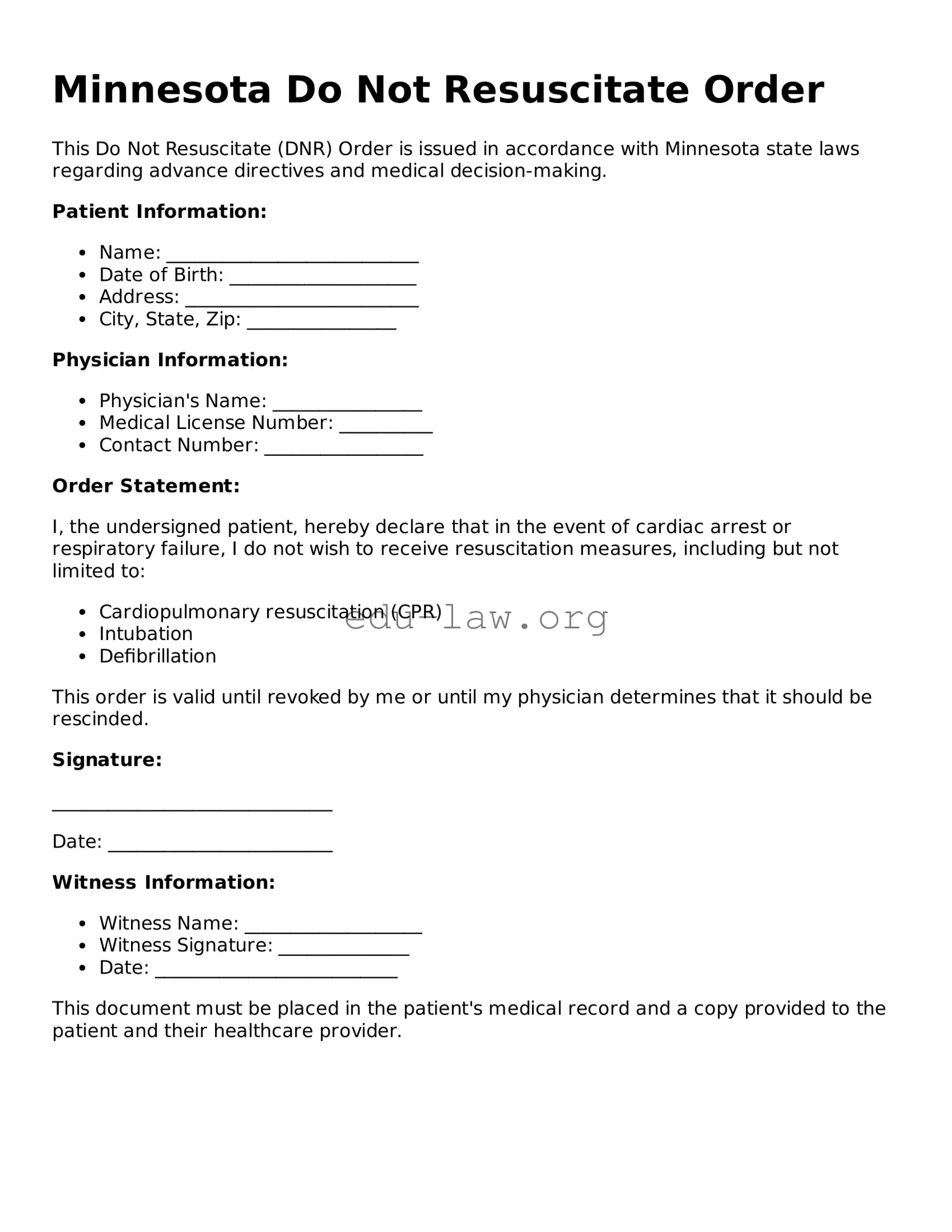
The Minnesota Do Not Resuscitate (DNR) Order form serves as a crucial document for individuals who wish to communicate their preferences regarding medical interventions in the event of a life-threatening situation. This form is designed to ensure that patients receive care aligned with their values and desires, particularly when it comes to resuscitation efforts. It typically includes essential information such as the patient's name, date of birth, and a clear declaration of their wish not to receive cardiopulmonary resuscitation (CPR) or other life-sustaining treatments. The form must be signed by the patient or their legal representative, along with a physician's signature, to validate the order. Additionally, the DNR Order is intended to be easily accessible, allowing healthcare providers to quickly understand the patient's wishes in critical moments. Understanding the implications of this document is vital, as it empowers individuals to make informed decisions about their healthcare and ensures that their preferences are respected during emergencies.
Minnesota Do Not Resuscitate Order
This Do Not Resuscitate (DNR) Order is issued in accordance with Minnesota state laws regarding advance directives and medical decision-making.
Patient Information:
Physician Information:
Order Statement:
I, the undersigned patient, hereby declare that in the event of cardiac arrest or respiratory failure, I do not wish to receive resuscitation measures, including but not limited to:
This order is valid until revoked by me or until my physician determines that it should be rescinded.
Signature:
______________________________
Date: ________________________
Witness Information:
This document must be placed in the patient's medical record and a copy provided to the patient and their healthcare provider.
| Fact Name | Details |
|---|---|
| Governing Law | The Minnesota Do Not Resuscitate Order is governed by Minnesota Statutes, Section 144A.40 to 144A.44. |
| Eligibility | Any adult patient, or a legal representative, can request a Do Not Resuscitate Order if they wish to forgo resuscitation in the event of a cardiac arrest. |
| Form Requirements | The form must be signed by a physician and the patient or their legal representative to be valid. |
| Revocation | A Do Not Resuscitate Order can be revoked at any time by the patient or their legal representative, either verbally or in writing. |
Filling out the Minnesota Do Not Resuscitate Order form is an important step in making your healthcare wishes known. This document allows you to communicate your preferences regarding resuscitation efforts in the event of a medical emergency. Taking the time to complete this form ensures that your choices are respected and followed by medical personnel.
What is a Minnesota Do Not Resuscitate Order (DNR) form?
A Minnesota Do Not Resuscitate Order (DNR) form is a legal document that allows a person to refuse resuscitation efforts in the event of a medical emergency. This form indicates that if the individual stops breathing or their heart stops beating, emergency medical personnel should not perform cardiopulmonary resuscitation (CPR) or other life-saving measures. It is important for individuals to discuss their wishes with their healthcare providers before completing the form.
Who can complete a DNR form in Minnesota?
In Minnesota, any adult who is capable of making their own healthcare decisions can complete a DNR form. This includes individuals who are at least 18 years old and understand the implications of the order. Additionally, a parent or legal guardian can complete the form for a minor. It is advisable to consult with healthcare professionals when considering a DNR order to ensure that it aligns with the individual’s health goals and values.
How do I obtain and complete a DNR form in Minnesota?
A DNR form can be obtained from various sources, including healthcare facilities, hospitals, and online resources provided by the Minnesota Department of Health. Once you have the form, it should be completed by the individual or their healthcare provider. The form requires the signature of the individual and, in some cases, a witness or healthcare provider’s signature. After completion, it is important to keep the form in a location that is easily accessible to emergency medical personnel.
What should I do if my wishes change regarding my DNR order?
If an individual’s wishes change regarding their DNR order, they can revoke or modify the order at any time. To do this, the individual should destroy the existing DNR form and inform their healthcare provider of the change. It is also recommended to complete a new DNR form if the individual decides to continue with a DNR order under different terms. Keeping healthcare providers and family members informed about any changes is crucial for ensuring that the individual’s current wishes are respected.
Incomplete Information: One of the most common mistakes is failing to provide all necessary personal details. This includes the patient’s full name, date of birth, and contact information. Omitting any of this information can lead to confusion and potential delays in honoring the order.
Incorrect Signatures: The form requires signatures from both the patient and their physician. Sometimes, individuals forget to obtain the physician’s signature, or the physician may not sign it correctly. This can render the document invalid.
Not Discussing with Family: Failing to communicate the decision with family members can lead to misunderstandings and emotional distress. It is important that loved ones are aware of the patient’s wishes to avoid conflicts during critical moments.
Using Outdated Forms: Some individuals may use an older version of the Do Not Resuscitate Order form. Always ensure that the most current version is being utilized to avoid any legal issues.
Not Reviewing State Laws: Each state has specific regulations regarding Do Not Resuscitate Orders. Ignoring Minnesota’s specific requirements can lead to complications in enforcement. Familiarity with local laws is crucial.
Failing to Make Copies: After filling out the form, it is essential to make copies. Not having enough copies can lead to situations where medical personnel are unaware of the patient’s wishes.
Not Updating the Form: Life circumstances change, and so do medical preferences. Failing to update the Do Not Resuscitate Order when necessary can result in outdated directives being followed.
Overlooking Witness Requirements: Some forms may require witnesses to the signing process. Neglecting to fulfill this requirement can invalidate the order, so it is important to check the specifics.
Assuming Verbal Orders are Sufficient: Relying solely on verbal communication of wishes can lead to misunderstandings. A written order is essential to ensure that the patient’s desires are clearly documented and legally recognized.
In Minnesota, the Do Not Resuscitate (DNR) Order form is a crucial document for individuals who wish to communicate their preferences regarding resuscitation in medical emergencies. Alongside this form, several other documents are often utilized to ensure that a person's healthcare wishes are clearly articulated and respected. Below is a list of these documents.
These documents work in tandem with the Minnesota Do Not Resuscitate Order form to provide a comprehensive approach to end-of-life care and medical decision-making. Together, they help ensure that individuals' healthcare preferences are respected and followed by medical professionals.
The Minnesota Do Not Resuscitate (DNR) Order form is closely related to the Advance Directive, which is a legal document allowing individuals to outline their healthcare preferences in advance. An Advance Directive includes instructions for medical treatment if a person becomes unable to communicate their wishes. This empowers individuals to make their choices known, just like a DNR order, ensuring that their healthcare aligns with their values and desires even when they can’t speak for themselves.
Another document similar to the DNR Order is the Living Will. A Living Will specifically addresses end-of-life care and treatment preferences, detailing what types of medical interventions a person does or does not want in situations where they are terminally ill or in a persistent vegetative state. Like the DNR, it aims to provide clarity for healthcare providers and loved ones, ensuring that a person's wishes are respected during critical moments.
The Medical Power of Attorney (POA) is also comparable to the DNR Order. This document allows someone to appoint a trusted person to make medical decisions on their behalf if they become incapacitated. While the DNR focuses on resuscitation efforts, the Medical POA covers a broader range of healthcare decisions, ensuring that someone who knows the individual’s values can advocate for their wishes when they cannot do so themselves.
Similar to the DNR Order is the Physician Orders for Life-Sustaining Treatment (POLST) form. This document translates a patient’s preferences regarding life-sustaining treatments into actionable medical orders. While a DNR specifically addresses resuscitation, the POLST form encompasses a wider array of medical interventions, providing clear guidance to healthcare professionals about a patient’s treatment preferences in various situations.
The Comfort Care Order is another document that shares similarities with the DNR Order. This order focuses on ensuring that a patient receives comfort measures rather than aggressive treatments. While the DNR prevents resuscitation efforts, the Comfort Care Order emphasizes palliative care, allowing individuals to prioritize their comfort and quality of life during serious illness.
Additionally, the Do Not Intubate (DNI) Order serves as a related document. A DNI specifically instructs healthcare providers not to use intubation to assist with breathing in case of respiratory failure. While the DNR addresses cardiac arrest, the DNI focuses on respiratory issues, providing another layer of specificity in a patient’s wishes regarding life-sustaining treatments.
Lastly, the End-of-Life Care Plan can be compared to the DNR Order. This comprehensive document outlines a patient’s preferences for care during their final days. It encompasses various aspects of care, including pain management, emotional support, and spiritual considerations. Like the DNR, it aims to ensure that the patient’s values and desires are honored during a critical phase of life.
When filling out the Minnesota Do Not Resuscitate Order form, it is important to follow specific guidelines to ensure the document is completed correctly. Below is a list of things to do and not to do during this process.
Things to Do:
Things Not to Do:
Understanding the Minnesota Do Not Resuscitate (DNR) Order can be challenging, and several misconceptions often arise. Here are seven common misunderstandings about the DNR form:
Many people think that DNR orders are uniform across states. However, each state has its own specific forms and regulations regarding DNR orders. The Minnesota DNR form has particular requirements that must be met.
Some believe that having a DNR order means a person will not receive any medical care. In reality, a DNR only indicates that a person does not wish to receive CPR in the event of cardiac arrest. Other treatments and interventions can still be provided.
This is a common misconception. Anyone can request a DNR order, regardless of their health status. It is a personal choice that reflects an individual’s wishes about resuscitation efforts.
People often think that once a DNR order is established, it cannot be altered. In fact, individuals can change or revoke their DNR orders at any time, as long as they are competent to do so.
Some worry that medical professionals may ignore a DNR order. However, healthcare providers are legally obligated to respect and follow the DNR wishes outlined in the form.
Many believe that a DNR form requires legal representation to be valid. This is not the case; a DNR order only needs to be signed by a physician and the patient or their legal representative.
Some think DNR orders apply only within hospital settings. However, they can be used in various healthcare environments, including at home or in long-term care facilities, as long as the proper documentation is in place.
By understanding these misconceptions, individuals can make informed decisions about their healthcare preferences and communicate their wishes effectively.
When considering the Minnesota Do Not Resuscitate Order form, it's crucial to understand its purpose and implications. Here are some key takeaways to keep in mind:
Taking these steps can help ensure that your preferences are respected when it matters most. Act promptly to complete the form and communicate your wishes clearly.