Divorce can be a challenging and emotional process, and having the right tools can make a significant difference in navigating this difficult time. In Minnesota, a Divorce Settlement Agreement form plays a crucial role in outlining the terms of a divorce. This legal document addresses key aspects such as the division of assets and debts, child custody arrangements, visitation rights, and spousal support. It serves as a roadmap for both parties, ensuring that their rights and responsibilities are clearly defined and agreed upon. By carefully detailing these elements, the agreement helps to minimize conflicts and provides a sense of closure. Understanding the importance of this form is essential for anyone going through a divorce in Minnesota, as it lays the groundwork for a more amicable separation and future cooperation, especially when children are involved.
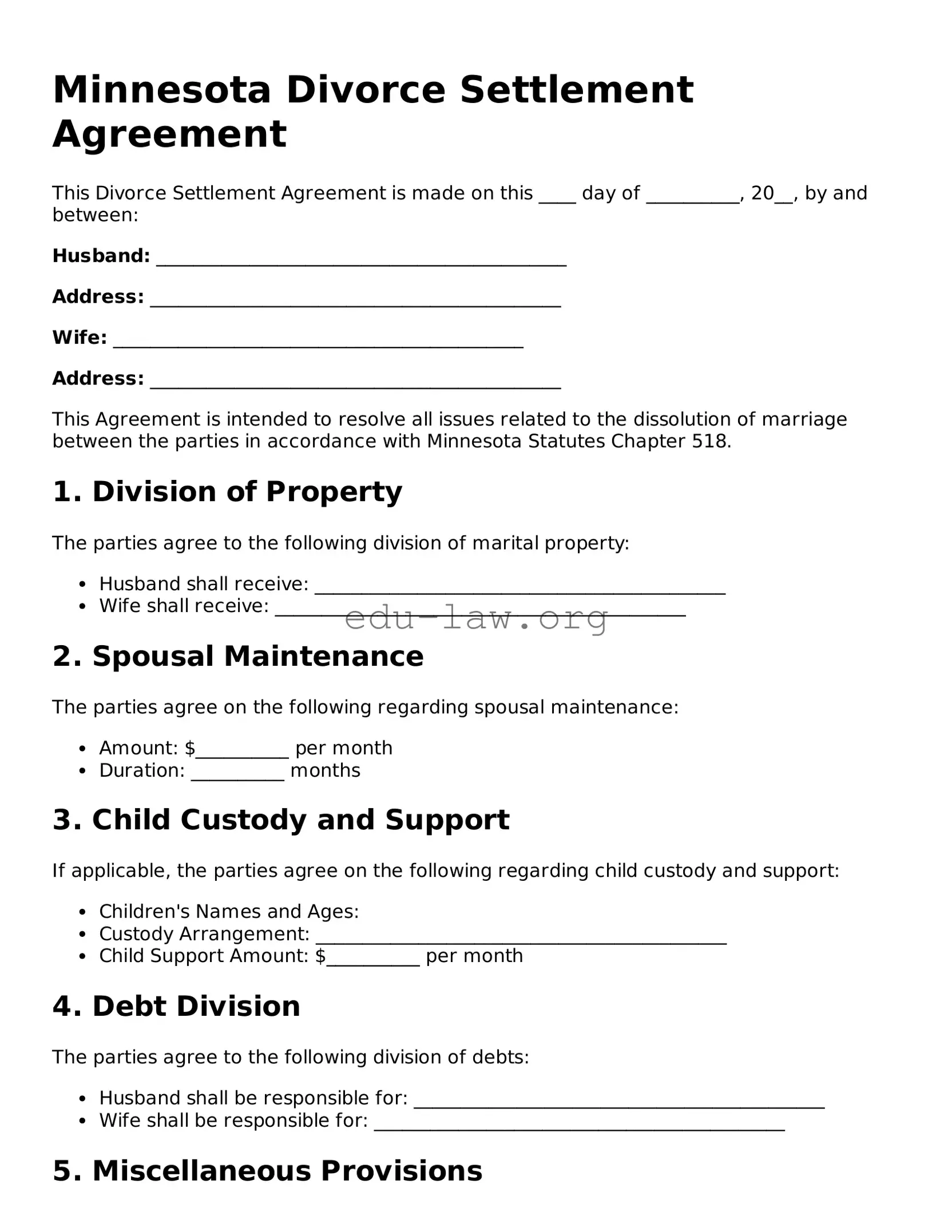
Minnesota Divorce Settlement Agreement
This Divorce Settlement Agreement is made on this ____ day of __________, 20__, by and between:
Husband: ____________________________________________
Address: ____________________________________________
Wife: ____________________________________________
Address: ____________________________________________
This Agreement is intended to resolve all issues related to the dissolution of marriage between the parties in accordance with Minnesota Statutes Chapter 518.
1. Division of Property
The parties agree to the following division of marital property:
2. Spousal Maintenance
The parties agree on the following regarding spousal maintenance:
3. Child Custody and Support
If applicable, the parties agree on the following regarding child custody and support:
4. Debt Division
The parties agree to the following division of debts:
5. Miscellaneous Provisions
The parties agree to the following additional terms:
6. Governing Law
This Agreement shall be governed by the laws of the State of Minnesota.
7. Signatures
By signing below, both parties agree to the terms outlined in this Divorce Settlement Agreement.
Husband's Signature: ___________________________ Date: __________
Wife's Signature: ___________________________ Date: __________
Witnessed by:
Witness Signature: ___________________________ Date: __________
| Fact Name | Description |
|---|---|
| Purpose | The Minnesota Divorce Settlement Agreement form outlines the terms agreed upon by both parties regarding the division of assets, debts, and other relevant matters during a divorce. |
| Governing Law | This form is governed by the Minnesota Statutes, specifically Chapter 518, which addresses marriage dissolution and related issues. |
| Mutual Agreement | Both parties must mutually agree to the terms laid out in the settlement agreement for it to be valid and enforceable in court. |
| Filing Requirement | The completed form must be filed with the court as part of the divorce proceedings to finalize the agreement. |
| Modification | Any changes to the terms of the settlement agreement after it has been signed require a new agreement and court approval. |
| Legal Representation | While not mandatory, it is highly recommended that both parties seek legal counsel to ensure their rights and interests are adequately represented. |
Once you have gathered the necessary information and documents, you can begin filling out the Minnesota Divorce Settlement Agreement form. This form is crucial for outlining the terms of your divorce, including the division of assets, debts, and any arrangements regarding children. Completing it accurately ensures that both parties have a clear understanding of their rights and responsibilities moving forward.
After completing the form, review it carefully to ensure all information is accurate and complete. Once satisfied, you can submit the form to the appropriate court for processing.
What is a Minnesota Divorce Settlement Agreement?
A Minnesota Divorce Settlement Agreement is a legal document that outlines the terms and conditions agreed upon by both spouses during a divorce. This agreement typically covers various aspects, including division of property, child custody, child support, and spousal maintenance. It serves as a formal record of the couple's decisions and can help streamline the divorce process by minimizing disputes in court.
How do I complete the Minnesota Divorce Settlement Agreement form?
To complete the Minnesota Divorce Settlement Agreement form, start by gathering all relevant information regarding assets, debts, and any children involved. Clearly outline the terms you and your spouse have agreed upon, ensuring that both parties' needs and rights are considered. It’s important to be thorough and precise, as any ambiguity could lead to misunderstandings later. Once completed, both spouses should review the document together and sign it in the presence of a notary public to ensure its validity.
Do I need an attorney to create a Divorce Settlement Agreement?
While it is not legally required to have an attorney to create a Divorce Settlement Agreement, seeking legal advice can be beneficial. An attorney can help ensure that your rights are protected and that the agreement complies with Minnesota law. If both parties are amicable and can communicate effectively, they may choose to draft the agreement themselves. However, consulting with a professional can provide peace of mind and clarity on complex issues.
What happens if my spouse and I cannot agree on the terms of the Divorce Settlement Agreement?
If you and your spouse cannot reach an agreement on the terms of the Divorce Settlement Agreement, mediation may be a viable option. A mediator can facilitate discussions and help both parties find common ground. If mediation fails, you may need to go to court, where a judge will make decisions regarding the contested issues. This process can be time-consuming and may result in outcomes that neither party prefers, making it beneficial to try to resolve disagreements outside of court whenever possible.
Failing to provide complete information. Incomplete details can lead to delays and complications.
Not understanding the terms. Ensure that all terms are clearly understood before agreeing to them.
Ignoring financial disclosures. Omitting assets or debts can result in future disputes.
Overlooking child support calculations. Accurate calculations are crucial for fair support agreements.
Neglecting to address spousal support. Clearly outline any agreements regarding alimony or maintenance.
Failing to specify property division. Be explicit about how property will be divided to avoid confusion.
Not including a parenting plan. If children are involved, a detailed parenting plan is essential.
Using vague language. Clear and specific language helps prevent misunderstandings.
Not consulting legal advice. Professional guidance can help navigate complex issues.
Forgetting to review the agreement. Take time to review the entire document before submission.
The Minnesota Divorce Settlement Agreement form is a crucial document in the divorce process, outlining the terms agreed upon by both parties. However, several other forms and documents are often used in conjunction with this agreement to ensure a comprehensive resolution of all relevant issues. Below is a list of some of these important documents.
These documents work together with the Minnesota Divorce Settlement Agreement to ensure that all aspects of the divorce are addressed. Properly completing and filing these forms can facilitate a smoother divorce process and help protect the interests of all parties involved.
The Minnesota Divorce Settlement Agreement is similar to a Marital Settlement Agreement, which is often used in divorce cases to outline the terms agreed upon by both spouses. This document typically covers property division, spousal support, and child custody arrangements. Like the Divorce Settlement Agreement, it serves as a legally binding contract that reflects the mutual decisions made during the divorce process. Both documents aim to provide clarity and prevent future disputes by detailing the responsibilities and rights of each party.
Another related document is the Child Custody Agreement. This specific agreement focuses solely on the arrangements regarding children involved in a divorce. It outlines custody arrangements, visitation schedules, and decision-making responsibilities. While the Divorce Settlement Agreement may include these elements, the Child Custody Agreement specifically hones in on the welfare of the children, ensuring their best interests are prioritized. Both documents require careful consideration and negotiation to ensure that all parties are satisfied with the outcomes.
A Property Settlement Agreement is also similar, as it addresses the division of marital assets and debts. This document details how property will be split between spouses, including real estate, bank accounts, and personal belongings. Like the Divorce Settlement Agreement, it aims to resolve financial matters amicably and legally. It can be a standalone document or incorporated into the broader divorce settlement, depending on the complexity of the financial situation.
The Parenting Plan is another important document akin to the Divorce Settlement Agreement. This plan outlines how parents will raise their children after the divorce, including schedules for parenting time and responsibilities for education and healthcare. While the Divorce Settlement Agreement may touch on these topics, the Parenting Plan provides a more comprehensive approach to co-parenting. It is designed to facilitate cooperation and communication between parents, ensuring that children have a stable and supportive environment.
A Separation Agreement can also be compared to the Divorce Settlement Agreement. This document is used when spouses decide to live apart but are not yet divorced. It addresses similar issues, such as property division and support obligations, laying the groundwork for a future divorce. Like the Divorce Settlement Agreement, it is legally binding and helps clarify expectations during the separation period, reducing potential conflicts.
Lastly, a Postnuptial Agreement shares similarities with the Divorce Settlement Agreement in that it outlines the division of assets and responsibilities, but it is created after marriage rather than during divorce. This document can be used to clarify financial arrangements and expectations while the couple is still together. In a way, it serves as a proactive measure to prevent disputes that could arise later, much like the Divorce Settlement Agreement aims to do once a divorce is underway.
When filling out the Minnesota Divorce Settlement Agreement form, it’s essential to approach the process thoughtfully. Here are some important dos and don’ts to keep in mind:
By following these guidelines, you can navigate the Minnesota Divorce Settlement Agreement form with greater confidence and clarity.
When navigating the complexities of divorce, misunderstandings about the Minnesota Divorce Settlement Agreement form can lead to confusion. Here are eight common misconceptions that individuals may have:
Understanding these misconceptions can help individuals approach the divorce process with greater clarity and confidence.
When filling out and using the Minnesota Divorce Settlement Agreement form, several key points should be considered to ensure a smooth process. Here are nine important takeaways: